Free resource · Primary 5
Primary 5 Maths Worksheets with Answers: Free PDF
This is a free sample set of Primary 5 Maths worksheets: 7 topics, 70 questions, with answers. There is one sheet of 10 questions for each of seven P5 topics: numbers to 10 million and order of operations, fractions, decimals and conversion of units, percentage, rate, area of triangle, and volume of cube and cuboid. Worked examples show the order of operations, multiplying fractions, finding a percentage of an amount and a rate question. The pack is a sample of the TSS Primary 5 Maths Assessment Book, which has 10 chapters.

- 8 pages
- A4 portrait
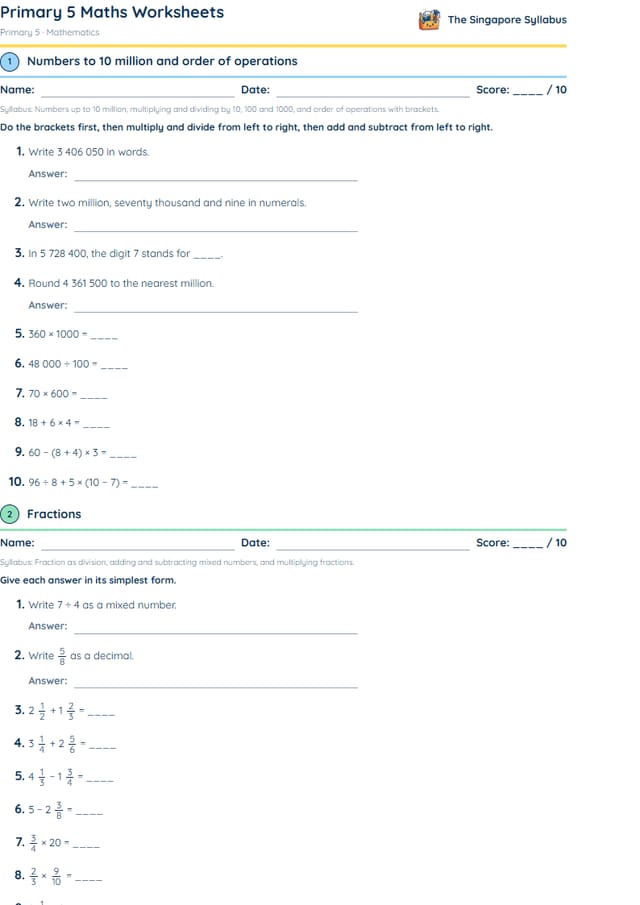
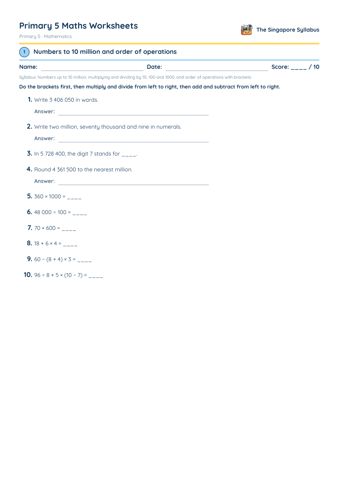
Numbers to 10 million and order of operations
Syllabus: Numbers up to 10 million, multiplying and dividing by 10, 100 and 1000, and order of operations with brackets.
Do the brackets first, then multiply and divide from left to right, then add and subtract from left to right.
Worked example
40 − (6 + 2) × 3 = ____
- Brackets first: 6 + 2 = 8.
- Multiply next: 8 × 3 = 24.
- Subtract last: 40 − 24 = 16.
Answer: 16
Write 3 406 050 in words.
Write two million, seventy thousand and nine in numerals.
In 5 728 400, the digit 7 stands for ____.
Round 4 361 500 to the nearest million.
360 × 1000 = ____
48 000 ÷ 100 = ____
70 × 600 = ____
18 + 6 × 4 = ____
60 − (8 + 4) × 3 = ____
96 ÷ 8 + 5 × (10 − 7) = ____
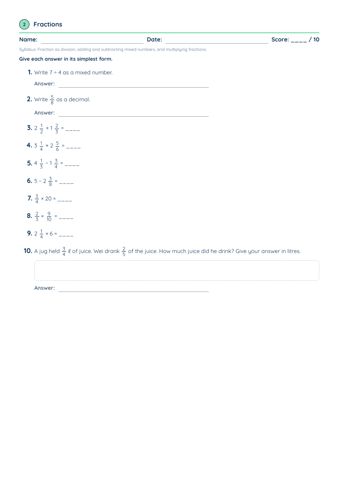
Fractions
Syllabus: Fraction as division, adding and subtracting mixed numbers, and multiplying fractions.
Give each answer in its simplest form.
Worked example
23 × 34 = ____
- Multiply the numerators: 2 × 3 = 6.
- Multiply the denominators: 3 × 4 = 12.
- Simplify: 612 = 12, dividing the top and bottom by 6.
Answer: 12
Write 7 ÷ 4 as a mixed number.
Write 58 as a decimal.
2 12 + 1 23 = ____
3 14 + 2 56 = ____
4 13 − 1 34 = ____
5 − 2 38 = ____
34 × 20 = ____
23 × 910 = ____
2 14 × 6 = ____
A jug held 34 ℓ of juice. Wei drank 25 of the juice. How much juice did he drink? Give your answer in litres.
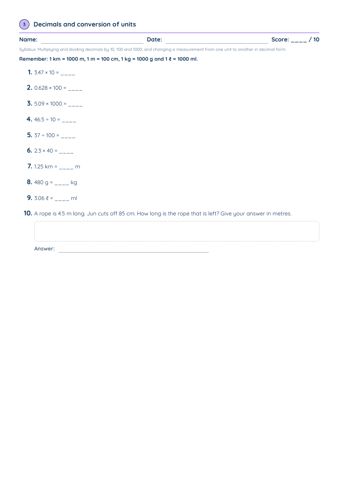
Decimals and conversion of units
Syllabus: Multiplying and dividing decimals by 10, 100 and 1000, and changing a measurement from one unit to another in decimal form.
Remember: 1 km = 1000 m, 1 m = 100 cm, 1 kg = 1000 g and 1 ℓ = 1000 ml.
3.47 × 10 = ____
0.628 × 100 = ____
5.09 × 1000 = ____
46.5 ÷ 10 = ____
37 ÷ 100 = ____
2.3 × 40 = ____
1.25 km = ____ m
480 g = ____ kg
3.06 ℓ = ____ ml
A rope is 4.5 m long. Jun cuts off 85 cm. How long is the rope that is left? Give your answer in metres.
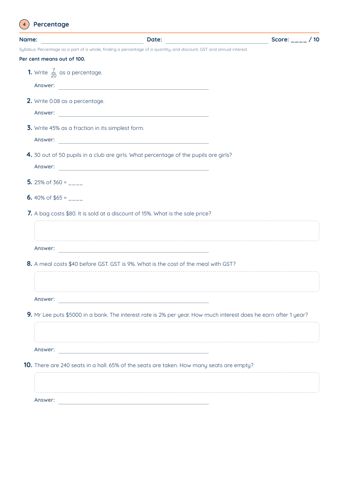
Percentage
Syllabus: Percentage as a part of a whole, finding a percentage of a quantity, and discount, GST and annual interest.
Per cent means out of 100.
Worked example
Find 15% of $80.
- 10% of $80 is $80 ÷ 10 = $8.
- 5% is half of 10%, so 5% of $80 is $4.
- 15% = 10% + 5%, so add: $8 + $4 = $12.
- Check another way: 15100 × 80 = 12.
Answer: $12
Write 720 as a percentage.
Write 0.08 as a percentage.
Write 45% as a fraction in its simplest form.
30 out of 50 pupils in a club are girls. What percentage of the pupils are girls?
25% of 360 = ____
40% of $65 = ____
A bag costs $80. It is sold at a discount of 15%. What is the sale price?
A meal costs $40 before GST. GST is 9%. What is the cost of the meal with GST?
Mr Lee puts $5000 in a bank. The interest rate is 2% per year. How much interest does he earn after 1 year?
There are 240 seats in a hall. 65% of the seats are taken. How many seats are empty?
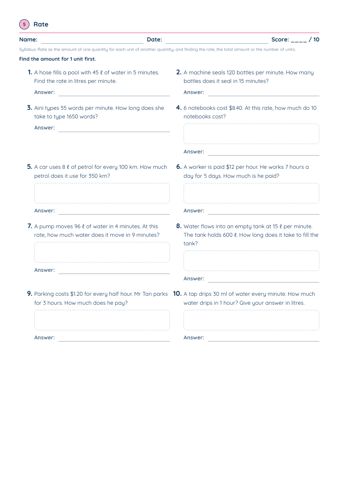
Rate
Syllabus: Rate as the amount of one quantity for each unit of another quantity, and finding the rate, the total amount or the number of units.
Find the amount for 1 unit first.
Worked example
A tap fills 3 pails in 12 minutes. At this rate, how long does it take to fill 7 pails?
- Find the time for 1 pail: 12 ÷ 3 = 4 minutes.
- Multiply for 7 pails: 7 × 4 = 28 minutes.
Answer: 28 minutes
A hose fills a pool with 45 ℓ of water in 5 minutes. Find the rate in litres per minute.
A machine seals 120 bottles per minute. How many bottles does it seal in 15 minutes?
Aini types 55 words per minute. How long does she take to type 1650 words?
6 notebooks cost $8.40. At this rate, how much do 10 notebooks cost?
A car uses 8 ℓ of petrol for every 100 km. How much petrol does it use for 350 km?
A worker is paid $12 per hour. He works 7 hours a day for 5 days. How much is he paid?
A pump moves 96 ℓ of water in 4 minutes. At this rate, how much water does it move in 9 minutes?
Water flows into an empty tank at 15 ℓ per minute. The tank holds 600 ℓ. How long does it take to fill the tank?
Parking costs $1.20 for every half hour. Mr Tan parks for 3 hours. How much does he pay?
A tap drips 30 ml of water every minute. How much water drips in 1 hour? Give your answer in litres.
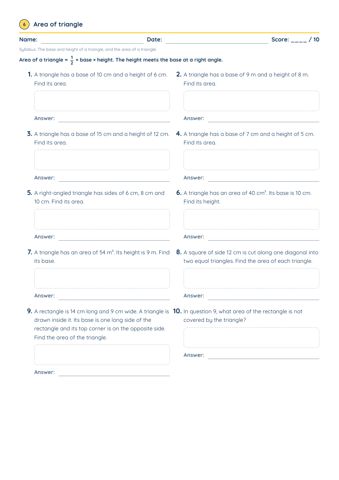
Area of triangle
Syllabus: The base and height of a triangle, and the area of a triangle.
Area of a triangle = 12 × base × height. The height meets the base at a right angle.
A triangle has a base of 10 cm and a height of 6 cm. Find its area.
A triangle has a base of 9 m and a height of 8 m. Find its area.
A triangle has a base of 15 cm and a height of 12 cm. Find its area.
A triangle has a base of 7 cm and a height of 5 cm. Find its area.
A right-angled triangle has sides of 6 cm, 8 cm and 10 cm. Find its area.
A triangle has an area of 40 cm². Its base is 10 cm. Find its height.
A triangle has an area of 54 m². Its height is 9 m. Find its base.
A square of side 12 cm is cut along one diagonal into two equal triangles. Find the area of each triangle.
A rectangle is 14 cm long and 9 cm wide. A triangle is drawn inside it. Its base is one long side of the rectangle and its top corner is on the opposite side. Find the area of the triangle.
In question 9, what area of the rectangle is not covered by the triangle?
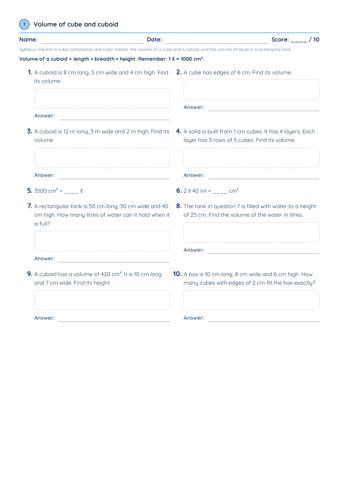
Volume of cube and cuboid
Syllabus: Volume in cubic centimetres and cubic metres, the volume of a cube and a cuboid, and the volume of liquid in a rectangular tank.
Volume of a cuboid = length × breadth × height. Remember: 1 ℓ = 1000 cm³.
A cuboid is 8 cm long, 5 cm wide and 4 cm high. Find its volume.
A cube has edges of 6 cm. Find its volume.
A cuboid is 12 m long, 3 m wide and 2 m high. Find its volume.
A solid is built from 1 cm cubes. It has 4 layers. Each layer has 3 rows of 5 cubes. Find its volume.
3500 cm³ = ____ ℓ
2 ℓ 40 ml = ____ cm³
A rectangular tank is 50 cm long, 30 cm wide and 40 cm high. How many litres of water can it hold when it is full?
The tank in question 7 is filled with water to a height of 25 cm. Find the volume of the water in litres.
A cuboid has a volume of 420 cm³. It is 10 cm long and 7 cm wide. Find its height.
A box is 10 cm long, 8 cm wide and 6 cm high. How many cubes with edges of 2 cm fill the box exactly?
For parents
How to use this pack
- Pick the topic the school is teaching now. Each topic is one worksheet of 10 questions with its answers.
- Read the worked example together where there is one, then let your child try the questions alone.
- Ask your child to show the working for every word problem, not just the answer.
- Mark the worksheet with the answer key. Ask your child to explain each wrong answer, then redo it a few days later.
How Primary 5 Maths is assessed in school
- A school sets no more than one weighted assessment per subject in each school term.
- There is no mid-year exam. MOE removed mid-year exams at every primary level by 2023.
- Report books do not show class or level position, and marks are shown as whole numbers.
- Ask the Maths teacher for the dates and topics of each assessment, then use the matching worksheet in the week before.
If your child finds Primary 5 Maths hard
- Primary 5 is a step up. Fractions, percentage and rate all appear in longer word problems.
- Signs to watch: adding fractions without a common denominator, moving the decimal point the wrong way, or mixing up the units in a rate.
- For every rate and percentage question, ask your child to say what 1 unit or 1% stands for before working it out.
When your child wants more practice
- This pack is a free sample. It has one worksheet for 7 of the 10 chapters in the TSS Primary 5 Maths Assessment Book.
- The book is a printable PDF of 309 pages. It has notes with worked examples for every chapter, 272 questions, answers that show the working, and the End-of-Year Practice Examination.
- Read real questions from the book on its sample questions page before you decide.
Primary 5 Maths book: sample questions · Primary 5 Maths Assessment Book
Sources: MOE, Learn for Life press release (28 September 2018), MOE, forum reply on removing mid-year exams (8 February 2023), MOE, learning support programmes.
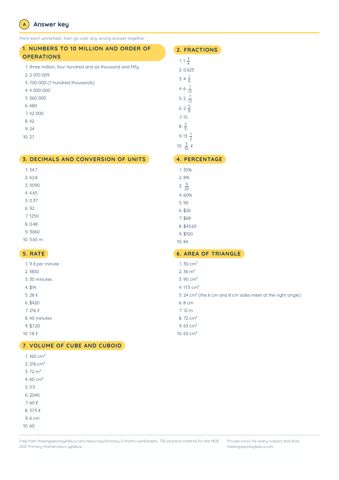
Answer key
Mark each worksheet, then go over any wrong answer together.
1. Numbers to 10 million and order of operations
- three million, four hundred and six thousand and fifty
- 2 070 009
- 700 000 (7 hundred thousands)
- 4 000 000
- 360 000
- 480
- 42 000
- 42
- 24
- 27
2. Fractions
- 1 34
- 0.625
- 4 16
- 6 112
- 2 712
- 2 58
- 15
- 35
- 13 12
- 310 ℓ
3. Decimals and conversion of units
- 34.7
- 62.8
- 5090
- 4.65
- 0.37
- 92
- 1250
- 0.48
- 3060
- 3.65 m
4. Percentage
- 35%
- 8%
- 920
- 60%
- 90
- $26
- $68
- $43.60
- $100
- 84
5. Rate
- 9 ℓ per minute
- 1800
- 30 minutes
- $14
- 28 ℓ
- $420
- 216 ℓ
- 40 minutes
- $7.20
- 1.8 ℓ
6. Area of triangle
- 30 cm²
- 36 m²
- 90 cm²
- 17.5 cm²
- 24 cm² (the 6 cm and 8 cm sides meet at the right angle)
- 8 cm
- 12 m
- 72 cm²
- 63 cm²
- 63 cm²
7. Volume of cube and cuboid
- 160 cm³
- 216 cm³
- 72 m³
- 60 cm³
- 3.5
- 2040
- 60 ℓ
- 37.5 ℓ
- 6 cm
- 60
Next steps
Questions students ask
What is in the Primary 5 Maths worksheets?
Seven worksheets of 10 questions each: numbers to 10 million and order of operations, fractions, decimals and conversion of units, percentage, rate, area of triangle, and volume of cube and cuboid. A full answer key comes at the end.
Do the Primary 5 Maths worksheets come with answers?
Yes. The answer key lists every answer, one list per worksheet. It is on this page and on the last page of the PDF.
Are these worksheets from MOE or a school?
No. They are The Singapore Syllabus's own practice questions, written for the Primary 5 topics in the MOE 2021 Primary Mathematics syllabus. They are not school papers and MOE did not issue them.
How is this free pack different from the TSS Primary 5 Maths book?
The pack is a sample: one sheet of 10 questions for 7 topics. The TSS Primary 5 Maths Assessment Book is a printable PDF of 309 pages with 10 chapters, notes with worked examples, 272 questions, answers that show the working and a practice examination. The questions in this pack are not taken from the book.
What is the order of operations in Primary 5 Maths?
Work out what is inside the brackets first. Then multiply and divide from left to right. Then add and subtract from left to right. So 60 − (8 + 4) × 3 is 60 − 12 × 3, which is 60 − 36 = 24.
How do you find the area of a triangle?
Area of a triangle = 1/2 × base × height. The height is the distance from the base to the opposite corner, measured at a right angle to the base. A triangle with a base of 10 cm and a height of 6 cm has an area of 30 cm².
How should my child use these worksheets?
Do one topic at a time, after the school has taught it. Mark with the answer key, ask your child to explain each wrong answer, and redo it a few days later. The PDF is free, with no sign-up.
Keep revising
- All free worksheetsEvery free worksheet pack, P1 to P6
- Primary 5 Maths tuitionThe P5 topics and a home tutor
- Primary 5 Maths book: sample questionsReal questions from the TSS book, with worked answers
- PSLE Math FormulasPSLE (Primary 1 to 6) · free PDF
- PSLE English Composition PhrasesPSLE (Primary 5 and 6) · free PDF
- PSLE Chinese Composition Phrases (好词好句)PSLE (Primary 5 and 6) · free PDF
- PSLE Score calculatorAdd up the four AL grades
- All free resourcesPSLE, O-Level and A-Level
More for this stage: PSLE Science Keywords, Primary English Oral Practice (P3 to PSLE), Primary English Listening Comprehension Practice (P3 to PSLE), Primary English Composition Topics (P3 to PSLE), Primary 1 Maths Worksheets, Primary 2 Maths Worksheets, Primary 3 Maths Worksheets, Primary 4 Maths Worksheets, Primary 6 Maths Worksheets, Primary 1 English Worksheets, Primary 2 English Worksheets, Primary 3 English Worksheets, Primary 1 Spelling and Vocabulary List, Primary 2 Spelling and Vocabulary List, Primary 3 Spelling and Vocabulary List, Primary 4 Spelling and Vocabulary List, Primary 5 Spelling and Vocabulary List, PSLE Vocabulary List (Primary 6).
Source
- MOE, 2021 Primary Mathematics Syllabus P1 to P6 (updated October 2025)
- MOE, Primary school subjects and syllabuses
The worksheets are our own practice material, written for the MOE 2021 Primary Mathematics syllabus. They are not issued by MOE. If a topic here differs from the MOE document, the MOE document is right. Tell us and we will fix it.