Free resource · Primary 5
Primary 5 Vocabulary List and Spelling Words: Free PDF
MOE does not publish a national Primary 5 spelling list, as each school sets its own. This free list gives 200 words for P5 in 20 themed lists of 10 across the four school terms, each with a simple meaning and an example sentence. It adds idioms and phrasal verbs, words with close meanings, 20 vocabulary MCQ and cloze questions with answers, 10 challenge words and a five-day routine to use at home.
About this list
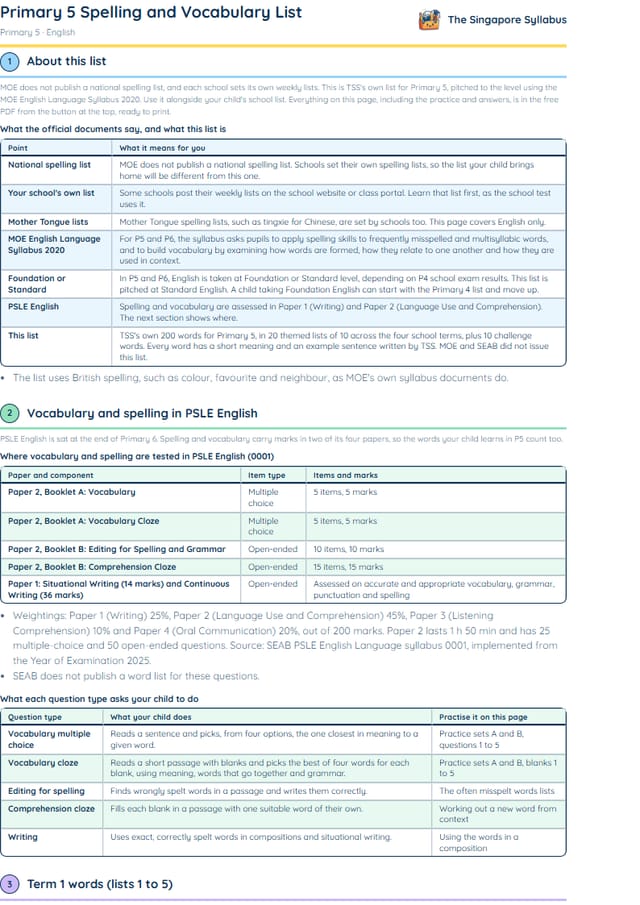
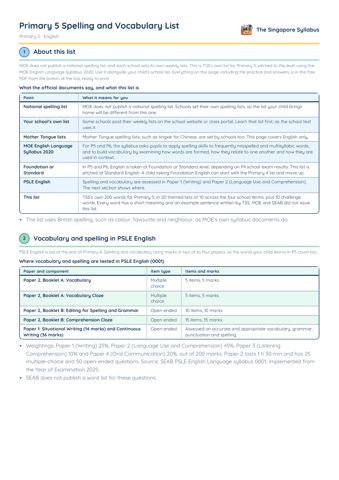
MOE does not publish a national spelling list, and each school sets its own weekly lists. This is TSS's own list for Primary 5, pitched to the level using the MOE English Language Syllabus 2020. Use it alongside your child's school list. Everything on this page, including the practice and answers, is in the free PDF from the button at the top, ready to print.
| Point | What it means for you |
|---|---|
| National spelling list | MOE does not publish a national spelling list. Schools set their own spelling lists, so the list your child brings home will be different from this one. |
| Your school's own list | Some schools post their weekly lists on the school website or class portal. Learn that list first, as the school test uses it. |
| Mother Tongue lists | Mother Tongue spelling lists, such as tingxie for Chinese, are set by schools too. This page covers English only. |
| MOE English Language Syllabus 2020 | For P5 and P6, the syllabus asks pupils to apply spelling skills to frequently misspelled and multisyllabic words, and to build vocabulary by examining how words are formed, how they relate to one another and how they are used in context. |
| Foundation or Standard | In P5 and P6, English is taken at Foundation or Standard level, depending on P4 school exam results. This list is pitched at Standard English. A child taking Foundation English can start with the Primary 4 list and move up. |
| PSLE English | Spelling and vocabulary are assessed in Paper 1 (Writing) and Paper 2 (Language Use and Comprehension). The next section shows where. |
| This list | TSS's own 200 words for Primary 5, in 20 themed lists of 10 across the four school terms, plus 10 challenge words. Every word has a short meaning and an example sentence written by TSS. MOE and SEAB did not issue this list. |
- The list uses British spelling, such as colour, favourite and neighbour, as MOE's own syllabus documents do.
Vocabulary and spelling in PSLE English
PSLE English is sat at the end of Primary 6. Spelling and vocabulary carry marks in two of its four papers, so the words your child learns in P5 count too.
| Paper and component | Item type | Items and marks |
|---|---|---|
| Paper 2, Booklet A: Vocabulary | Multiple choice | 5 items, 5 marks |
| Paper 2, Booklet A: Vocabulary Cloze | Multiple choice | 5 items, 5 marks |
| Paper 2, Booklet B: Editing for Spelling and Grammar | Open-ended | 10 items, 10 marks |
| Paper 2, Booklet B: Comprehension Cloze | Open-ended | 15 items, 15 marks |
| Paper 1: Situational Writing (14 marks) and Continuous Writing (36 marks) | Open-ended | Assessed on accurate and appropriate vocabulary, grammar, punctuation and spelling |
- Weightings: Paper 1 (Writing) 25%, Paper 2 (Language Use and Comprehension) 45%, Paper 3 (Listening Comprehension) 10% and Paper 4 (Oral Communication) 20%, out of 200 marks. Paper 2 lasts 1 h 50 min and has 25 multiple-choice and 50 open-ended questions. Source: SEAB PSLE English Language syllabus 0001, implemented from the Year of Examination 2025.
- SEAB does not publish a word list for these questions.
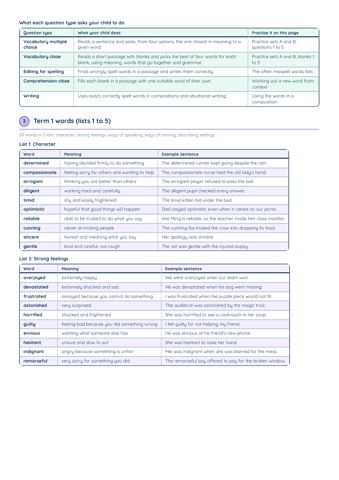
| Question type | What your child does | Practise it on this page |
|---|---|---|
| Vocabulary multiple choice | Reads a sentence and picks, from four options, the one closest in meaning to a given word. | Practice sets A and B, questions 1 to 5 |
| Vocabulary cloze | Reads a short passage with blanks and picks the best of four words for each blank, using meaning, words that go together and grammar. | Practice sets A and B, blanks 1 to 5 |
| Editing for spelling | Finds wrongly spelt words in a passage and writes them correctly. | The often misspelt words lists |
| Comprehension cloze | Fills each blank in a passage with one suitable word of their own. | Working out a new word from context |
| Writing | Uses exact, correctly spelt words in compositions and situational writing. | Using the words in a composition |
Term 1 words (lists 1 to 5)
50 words in 5 lists
50 words in 5 lists: character, strong feelings, ways of speaking, ways of moving, describing settings.
| Word | Meaning | Example sentence |
|---|---|---|
| determined | having decided firmly to do something | The determined runner kept going despite the rain. |
| compassionate | feeling sorry for others and wanting to help | The compassionate nurse held the old lady's hand. |
| arrogant | thinking you are better than others | The arrogant player refused to pass the ball. |
| diligent | working hard and carefully | The diligent pupil checked every answer. |
| timid | shy and easily frightened | The timid kitten hid under the bed. |
| optimistic | hopeful that good things will happen | Dad stayed optimistic even when it rained on our picnic. |
| reliable | able to be trusted to do what you say | Wei Ming is reliable, so the teacher made him class monitor. |
| cunning | clever at tricking people | The cunning fox tricked the crow into dropping its food. |
| sincere | honest and meaning what you say | Her apology was sincere. |
| gentle | kind and careful, not rough | The vet was gentle with the injured puppy. |
| Word | Meaning | Example sentence |
|---|---|---|
| overjoyed | extremely happy | We were overjoyed when our team won. |
| devastated | extremely shocked and sad | He was devastated when his dog went missing. |
| frustrated | annoyed because you cannot do something | I was frustrated when the puzzle piece would not fit. |
| astonished | very surprised | The audience was astonished by the magic trick. |
| horrified | shocked and frightened | She was horrified to see a cockroach in her soup. |
| guilty | feeling bad because you did something wrong | I felt guilty for not helping my friend. |
| envious | wanting what someone else has | He was envious of his friend's new phone. |
| hesitant | unsure and slow to act | She was hesitant to raise her hand. |
| indignant | angry because something is unfair | Mei was indignant when she was blamed for the mess. |
| remorseful | very sorry for something you did | The remorseful boy offered to pay for the broken window. |
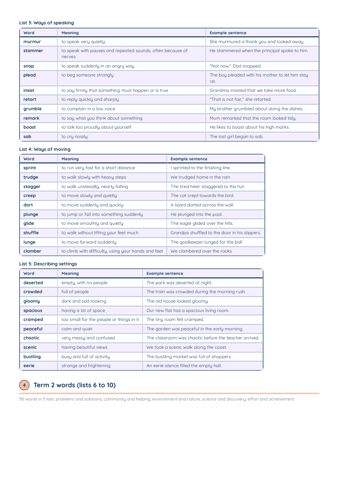
| Word | Meaning | Example sentence |
|---|---|---|
| murmur | to speak very quietly | She murmured a thank you and looked away. |
| stammer | to speak with pauses and repeated sounds, often because of nerves | He stammered when the principal spoke to him. |
| snap | to speak suddenly in an angry way | "Not now," Dad snapped. |
| plead | to beg someone strongly | The boy pleaded with his mother to let him stay up. |
| insist | to say firmly that something must happen or is true | Grandma insisted that we take more food. |
| retort | to reply quickly and sharply | "That is not fair," she retorted. |
| grumble | to complain in a low voice | My brother grumbled about doing the dishes. |
| remark | to say what you think about something | Mum remarked that the room looked tidy. |
| boast | to talk too proudly about yourself | He likes to boast about his high marks. |
| sob | to cry noisily | The lost girl began to sob. |
| Word | Meaning | Example sentence |
|---|---|---|
| sprint | to run very fast for a short distance | I sprinted to the finishing line. |
| trudge | to walk slowly with heavy steps | We trudged home in the rain. |
| stagger | to walk unsteadily, nearly falling | The tired hiker staggered to the hut. |
| creep | to move slowly and quietly | The cat crept towards the bird. |
| dart | to move suddenly and quickly | A lizard darted across the wall. |
| plunge | to jump or fall into something suddenly | He plunged into the pool. |
| glide | to move smoothly and quietly | The eagle glided over the hills. |
| shuffle | to walk without lifting your feet much | Grandpa shuffled to the door in his slippers. |
| lunge | to move forward suddenly | The goalkeeper lunged for the ball. |
| clamber | to climb with difficulty, using your hands and feet | We clambered over the rocks. |
| Word | Meaning | Example sentence |
|---|---|---|
| deserted | empty, with no people | The park was deserted at night. |
| crowded | full of people | The train was crowded during the morning rush. |
| gloomy | dark and sad-looking | The old house looked gloomy. |
| spacious | having a lot of space | Our new flat has a spacious living room. |
| cramped | too small for the people or things in it | The tiny room felt cramped. |
| peaceful | calm and quiet | The garden was peaceful in the early morning. |
| chaotic | very messy and confused | The classroom was chaotic before the teacher arrived. |
| scenic | having beautiful views | We took a scenic walk along the coast. |
| bustling | busy and full of activity | The bustling market was full of shoppers. |
| eerie | strange and frightening | An eerie silence filled the empty hall. |
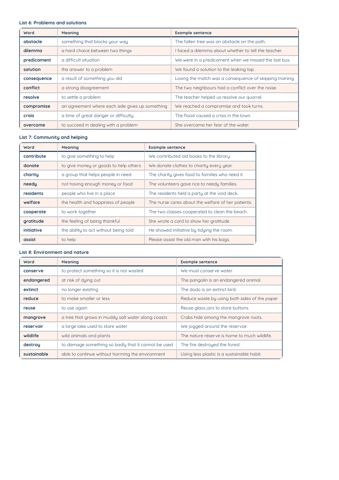
Term 2 words (lists 6 to 10)
50 words in 5 lists
50 words in 5 lists: problems and solutions, community and helping, environment and nature, science and discovery, effort and achievement.
| Word | Meaning | Example sentence |
|---|---|---|
| obstacle | something that blocks your way | The fallen tree was an obstacle on the path. |
| dilemma | a hard choice between two things | I faced a dilemma about whether to tell the teacher. |
| predicament | a difficult situation | We were in a predicament when we missed the last bus. |
| solution | the answer to a problem | We found a solution to the leaking tap. |
| consequence | a result of something you did | Losing the match was a consequence of skipping training. |
| conflict | a strong disagreement | The two neighbours had a conflict over the noise. |
| resolve | to settle a problem | The teacher helped us resolve our quarrel. |
| compromise | an agreement where each side gives up something | We reached a compromise and took turns. |
| crisis | a time of great danger or difficulty | The flood caused a crisis in the town. |
| overcome | to succeed in dealing with a problem | She overcame her fear of the water. |
| Word | Meaning | Example sentence |
|---|---|---|
| contribute | to give something to help | We contributed old books to the library. |
| donate | to give money or goods to help others | We donate clothes to charity every year. |
| charity | a group that helps people in need | The charity gives food to families who need it. |
| needy | not having enough money or food | The volunteers gave rice to needy families. |
| residents | people who live in a place | The residents held a party at the void deck. |
| welfare | the health and happiness of people | The nurse cares about the welfare of her patients. |
| cooperate | to work together | The two classes cooperated to clean the beach. |
| gratitude | the feeling of being thankful | She wrote a card to show her gratitude. |
| initiative | the ability to act without being told | He showed initiative by tidying the room. |
| assist | to help | Please assist the old man with his bags. |
| Word | Meaning | Example sentence |
|---|---|---|
| conserve | to protect something so it is not wasted | We must conserve water. |
| endangered | at risk of dying out | The pangolin is an endangered animal. |
| extinct | no longer existing | The dodo is an extinct bird. |
| reduce | to make smaller or less | Reduce waste by using both sides of the paper. |
| reuse | to use again | Reuse glass jars to store buttons. |
| mangrove | a tree that grows in muddy salt water along coasts | Crabs hide among the mangrove roots. |
| reservoir | a large lake used to store water | We jogged around the reservoir. |
| wildlife | wild animals and plants | The nature reserve is home to much wildlife. |
| destroy | to damage something so badly that it cannot be used | The fire destroyed the forest. |
| sustainable | able to continue without harming the environment | Using less plastic is a sustainable habit. |
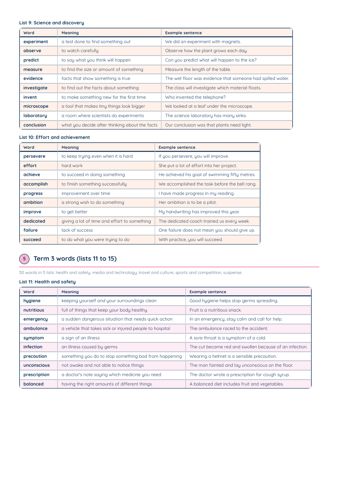
| Word | Meaning | Example sentence |
|---|---|---|
| experiment | a test done to find something out | We did an experiment with magnets. |
| observe | to watch carefully | Observe how the plant grows each day. |
| predict | to say what you think will happen | Can you predict what will happen to the ice? |
| measure | to find the size or amount of something | Measure the length of the table. |
| evidence | facts that show something is true | The wet floor was evidence that someone had spilled water. |
| investigate | to find out the facts about something | The class will investigate which material floats. |
| invent | to make something new for the first time | Who invented the telephone? |
| microscope | a tool that makes tiny things look bigger | We looked at a leaf under the microscope. |
| laboratory | a room where scientists do experiments | The science laboratory has many sinks. |
| conclusion | what you decide after thinking about the facts | Our conclusion was that plants need light. |
| Word | Meaning | Example sentence |
|---|---|---|
| persevere | to keep trying even when it is hard | If you persevere, you will improve. |
| effort | hard work | She put a lot of effort into her project. |
| achieve | to succeed in doing something | He achieved his goal of swimming fifty metres. |
| accomplish | to finish something successfully | We accomplished the task before the bell rang. |
| progress | improvement over time | I have made progress in my reading. |
| ambition | a strong wish to do something | Her ambition is to be a pilot. |
| improve | to get better | My handwriting has improved this year. |
| dedicated | giving a lot of time and effort to something | The dedicated coach trained us every week. |
| failure | lack of success | One failure does not mean you should give up. |
| succeed | to do what you were trying to do | With practice, you will succeed. |
Term 3 words (lists 11 to 15)
50 words in 5 lists
50 words in 5 lists: health and safety, media and technology, travel and culture, sports and competition, suspense.
| Word | Meaning | Example sentence |
|---|---|---|
| hygiene | keeping yourself and your surroundings clean | Good hygiene helps stop germs spreading. |
| nutritious | full of things that keep your body healthy | Fruit is a nutritious snack. |
| emergency | a sudden dangerous situation that needs quick action | In an emergency, stay calm and call for help. |
| ambulance | a vehicle that takes sick or injured people to hospital | The ambulance raced to the accident. |
| symptom | a sign of an illness | A sore throat is a symptom of a cold. |
| infection | an illness caused by germs | The cut became red and swollen because of an infection. |
| precaution | something you do to stop something bad from happening | Wearing a helmet is a sensible precaution. |
| unconscious | not awake and not able to notice things | The man fainted and lay unconscious on the floor. |
| prescription | a doctor's note saying which medicine you need | The doctor wrote a prescription for cough syrup. |
| balanced | having the right amounts of different things | A balanced diet includes fruit and vegetables. |
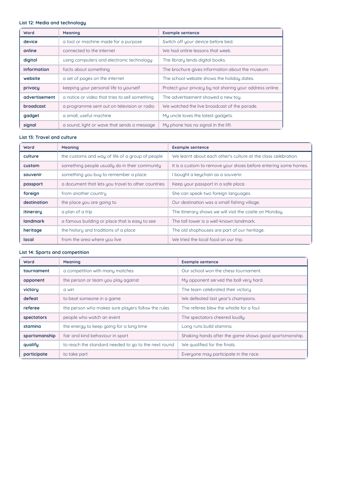
| Word | Meaning | Example sentence |
|---|---|---|
| device | a tool or machine made for a purpose | Switch off your device before bed. |
| online | connected to the internet | We had online lessons that week. |
| digital | using computers and electronic technology | The library lends digital books. |
| information | facts about something | The brochure gives information about the museum. |
| website | a set of pages on the internet | The school website shows the holiday dates. |
| privacy | keeping your personal life to yourself | Protect your privacy by not sharing your address online. |
| advertisement | a notice or video that tries to sell something | The advertisement showed a new toy. |
| broadcast | a programme sent out on television or radio | We watched the live broadcast of the parade. |
| gadget | a small, useful machine | My uncle loves the latest gadgets. |
| signal | a sound, light or wave that sends a message | My phone has no signal in the lift. |
| Word | Meaning | Example sentence |
|---|---|---|
| culture | the customs and way of life of a group of people | We learnt about each other's culture at the class celebration. |
| custom | something people usually do in their community | It is a custom to remove your shoes before entering some homes. |
| souvenir | something you buy to remember a place | I bought a keychain as a souvenir. |
| passport | a document that lets you travel to other countries | Keep your passport in a safe place. |
| foreign | from another country | She can speak two foreign languages. |
| destination | the place you are going to | Our destination was a small fishing village. |
| itinerary | a plan of a trip | The itinerary shows we will visit the castle on Monday. |
| landmark | a famous building or place that is easy to see | The tall tower is a well-known landmark. |
| heritage | the history and traditions of a place | The old shophouses are part of our heritage. |
| local | from the area where you live | We tried the local food on our trip. |
| Word | Meaning | Example sentence |
|---|---|---|
| tournament | a competition with many matches | Our school won the chess tournament. |
| opponent | the person or team you play against | My opponent served the ball very hard. |
| victory | a win | The team celebrated their victory. |
| defeat | to beat someone in a game | We defeated last year's champions. |
| referee | the person who makes sure players follow the rules | The referee blew the whistle for a foul. |
| spectators | people who watch an event | The spectators cheered loudly. |
| stamina | the energy to keep going for a long time | Long runs build stamina. |
| sportsmanship | fair and kind behaviour in sport | Shaking hands after the game shows good sportsmanship. |
| qualify | to reach the standard needed to go to the next round | We qualified for the finals. |
| participate | to take part | Everyone may participate in the race. |
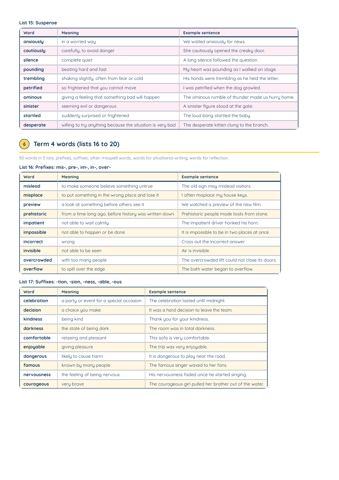
| Word | Meaning | Example sentence |
|---|---|---|
| anxiously | in a worried way | We waited anxiously for news. |
| cautiously | carefully, to avoid danger | She cautiously opened the creaky door. |
| silence | complete quiet | A long silence followed the question. |
| pounding | beating hard and fast | My heart was pounding as I walked on stage. |
| trembling | shaking slightly, often from fear or cold | His hands were trembling as he held the letter. |
| petrified | so frightened that you cannot move | I was petrified when the dog growled. |
| ominous | giving a feeling that something bad will happen | The ominous rumble of thunder made us hurry home. |
| sinister | seeming evil or dangerous | A sinister figure stood at the gate. |
| startled | suddenly surprised or frightened | The loud bang startled the baby. |
| desperate | willing to try anything because the situation is very bad | The desperate kitten clung to the branch. |
Term 4 words (lists 16 to 20)
50 words in 5 lists
50 words in 5 lists: prefixes, suffixes, often misspelt words, words for situational writing, words for reflection.
| Word | Meaning | Example sentence |
|---|---|---|
| mislead | to make someone believe something untrue | The old sign may mislead visitors. |
| misplace | to put something in the wrong place and lose it | I often misplace my house keys. |
| preview | a look at something before others see it | We watched a preview of the new film. |
| prehistoric | from a time long ago, before history was written down | Prehistoric people made tools from stone. |
| impatient | not able to wait calmly | The impatient driver honked his horn. |
| impossible | not able to happen or be done | It is impossible to be in two places at once. |
| incorrect | wrong | Cross out the incorrect answer. |
| invisible | not able to be seen | Air is invisible. |
| overcrowded | with too many people | The overcrowded lift could not close its doors. |
| overflow | to spill over the edge | The bath water began to overflow. |
| Word | Meaning | Example sentence |
|---|---|---|
| celebration | a party or event for a special occasion | The celebration lasted until midnight. |
| decision | a choice you make | It was a hard decision to leave the team. |
| kindness | being kind | Thank you for your kindness. |
| darkness | the state of being dark | The room was in total darkness. |
| comfortable | relaxing and pleasant | This sofa is very comfortable. |
| enjoyable | giving pleasure | The trip was very enjoyable. |
| dangerous | likely to cause harm | It is dangerous to play near the road. |
| famous | known by many people | The famous singer waved to her fans. |
| nervousness | the feeling of being nervous | His nervousness faded once he started singing. |
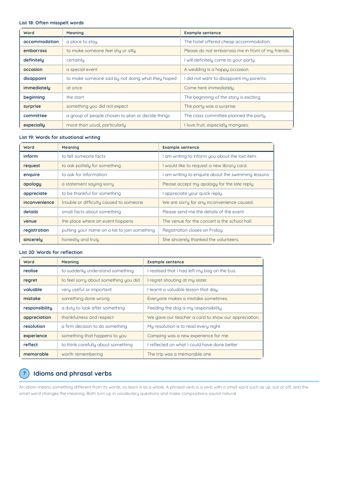
| courageous | very brave | The courageous girl pulled her brother out of the water. |
| Word | Meaning | Example sentence |
|---|---|---|
| accommodation | a place to stay | The hotel offered cheap accommodation. |
| embarrass | to make someone feel shy or silly | Please do not embarrass me in front of my friends. |
| definitely | certainly | I will definitely come to your party. |
| occasion | a special event | A wedding is a happy occasion. |
| disappoint | to make someone sad by not doing what they hoped | I did not want to disappoint my parents. |
| immediately | at once | Come here immediately. |
| beginning | the start | The beginning of the story is exciting. |
| surprise | something you did not expect | The party was a surprise. |
| committee | a group of people chosen to plan or decide things | The class committee planned the party. |
| especially | more than usual, particularly | I love fruit, especially mangoes. |
| Word | Meaning | Example sentence |
|---|---|---|
| inform | to tell someone facts | I am writing to inform you about the lost item. |
| request | to ask politely for something | I would like to request a new library card. |
| enquire | to ask for information | I am writing to enquire about the swimming lessons. |
| apology | a statement saying sorry | Please accept my apology for the late reply. |
| appreciate | to be thankful for something | I appreciate your quick reply. |
| inconvenience | trouble or difficulty caused to someone | We are sorry for any inconvenience caused. |
| details | small facts about something | Please send me the details of the event. |
| venue | the place where an event happens | The venue for the concert is the school hall. |
| registration | putting your name on a list to join something | Registration closes on Friday. |
| sincerely | honestly and truly | She sincerely thanked the volunteers. |
| Word | Meaning | Example sentence |
|---|---|---|
| realise | to suddenly understand something | I realised that I had left my bag on the bus. |
| regret | to feel sorry about something you did | I regret shouting at my sister. |
| valuable | very useful or important | I learnt a valuable lesson that day. |
| mistake | something done wrong | Everyone makes a mistake sometimes. |
| responsibility | a duty to look after something | Feeding the dog is my responsibility. |
| appreciation | thankfulness and respect | We gave our teacher a card to show our appreciation. |
| resolution | a firm decision to do something | My resolution is to read every night. |
| experience | something that happens to you | Camping was a new experience for me. |
| reflect | to think carefully about something | I reflected on what I could have done better. |
| memorable | worth remembering | The trip was a memorable one. |
Idioms and phrasal verbs
An idiom means something different from its words, so learn it as a whole. A phrasal verb is a verb with a small word such as up, out or off, and the small word changes the meaning. Both turn up in vocabulary questions and make compositions sound natural.
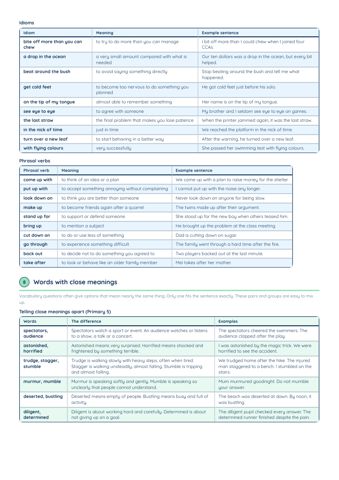
| Idiom | Meaning | Example sentence |
|---|---|---|
| bite off more than you can chew | to try to do more than you can manage | I bit off more than I could chew when I joined four CCAs. |
| a drop in the ocean | a very small amount compared with what is needed | Our ten dollars was a drop in the ocean, but every bit helped. |
| beat around the bush | to avoid saying something directly | Stop beating around the bush and tell me what happened. |
| get cold feet | to become too nervous to do something you planned | He got cold feet just before his solo. |
| on the tip of my tongue | almost able to remember something | Her name is on the tip of my tongue. |
| see eye to eye | to agree with someone | My brother and I seldom see eye to eye on games. |
| the last straw | the final problem that makes you lose patience | When the printer jammed again, it was the last straw. |
| in the nick of time | just in time | We reached the platform in the nick of time. |
| turn over a new leaf | to start behaving in a better way | After the warning, he turned over a new leaf. |
| with flying colours | very successfully | She passed her swimming test with flying colours. |
| Phrasal verb | Meaning | Example sentence |
|---|---|---|
| come up with | to think of an idea or a plan | We came up with a plan to raise money for the shelter. |
| put up with | to accept something annoying without complaining | I cannot put up with the noise any longer. |
| look down on | to think you are better than someone | Never look down on anyone for being slow. |
| make up | to become friends again after a quarrel | The twins made up after their argument. |
| stand up for | to support or defend someone | She stood up for the new boy when others teased him. |
| bring up | to mention a subject | He brought up the problem at the class meeting. |
| cut down on | to do or use less of something | Dad is cutting down on sugar. |
| go through | to experience something difficult | The family went through a hard time after the fire. |
| back out | to decide not to do something you agreed to | Two players backed out at the last minute. |
| take after | to look or behave like an older family member | Mei takes after her mother. |
Words with close meanings
Vocabulary questions often give options that mean nearly the same thing. Only one fits the sentence exactly. These pairs and groups are easy to mix up.
| Words | The difference | Examples |
|---|---|---|
| spectators, audience | Spectators watch a sport or event. An audience watches or listens to a show, a talk or a concert. | The spectators cheered the swimmers. The audience clapped after the play. |
| astonished, horrified | Astonished means very surprised. Horrified means shocked and frightened by something terrible. | I was astonished by the magic trick. We were horrified to see the accident. |
| trudge, stagger, stumble | Trudge is walking slowly with heavy steps, often when tired. Stagger is walking unsteadily, almost falling. Stumble is tripping and almost falling. | We trudged home after the hike. The injured man staggered to a bench. I stumbled on the stairs. |
| murmur, mumble | Murmur is speaking softly and gently. Mumble is speaking so unclearly that people cannot understand. | Mum murmured goodnight. Do not mumble your answer. |
| deserted, bustling | Deserted means empty of people. Bustling means busy and full of activity. | The beach was deserted at dawn. By noon, it was bustling. |
| diligent, determined | Diligent is about working hard and carefully. Determined is about not giving up on a goal. | The diligent pupil checked every answer. The determined runner finished despite the pain. |
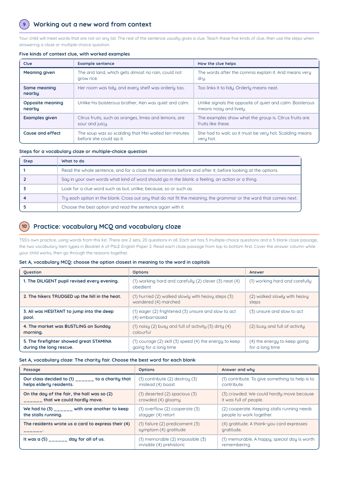
Working out a new word from context
Your child will meet words that are not on any list. The rest of the sentence usually gives a clue. Teach these five kinds of clue, then use the steps when answering a cloze or multiple-choice question.
| Clue | Example sentence | How the clue helps |
|---|---|---|
| Meaning given | The arid land, which gets almost no rain, could not grow rice. | The words after the comma explain it. Arid means very dry. |
| Same meaning nearby | Her room was tidy, and every shelf was orderly too. | Too links it to tidy. Orderly means neat. |
| Opposite meaning nearby | Unlike his boisterous brother, Ken was quiet and calm. | Unlike signals the opposite of quiet and calm. Boisterous means noisy and lively. |
| Examples given | Citrus fruits, such as oranges, limes and lemons, are sour and juicy. | The examples show what the group is. Citrus fruits are fruits like these. |
| Cause and effect | The soup was so scalding that Mei waited ten minutes before she could sip it. | She had to wait, so it must be very hot. Scalding means very hot. |
| Step | What to do |
|---|---|
| 1 | Read the whole sentence, and for a cloze the sentences before and after it, before looking at the options. |
| 2 | Say in your own words what kind of word should go in the blank: a feeling, an action or a thing. |
| 3 | Look for a clue word such as but, unlike, because, so or such as. |
| 4 | Try each option in the blank. Cross out any that do not fit the meaning, the grammar or the word that comes next. |
| 5 | Choose the best option and read the sentence again with it. |
Practice: vocabulary MCQ and vocabulary cloze
20 questions, answers under each set
TSS's own practice, using words from this list. There are 2 sets, 20 questions in all. Each set has 5 multiple-choice questions and a 5-blank cloze passage, the two vocabulary item types in Booklet A of PSLE English Paper 2. Read each cloze passage from top to bottom first. Cover the answer column while your child works, then go through the reasons together.
| Question | Options |
|---|---|
| 1. The DILIGENT pupil revised every evening. | (1) working hard and carefully (2) clever (3) neat (4) obedient |
| 2. The hikers TRUDGED up the hill in the heat. | (1) hurried (2) walked slowly with heavy steps (3) wandered (4) marched |
| 3. Ali was HESITANT to jump into the deep pool. | (1) eager (2) frightened (3) unsure and slow to act (4) embarrassed |
| 4. The market was BUSTLING on Sunday morning. | (1) noisy (2) busy and full of activity (3) dirty (4) colourful |
| 5. The firefighter showed great STAMINA during the long rescue. | (1) courage (2) skill (3) speed (4) the energy to keep going for a long time |
Show answersHide answers
| No. | Answer |
|---|---|
| 1 | (1) working hard and carefully |
| 2 | (2) walked slowly with heavy steps |
| 3 | (3) unsure and slow to act |
| 4 | (2) busy and full of activity |
| 5 | (4) the energy to keep going for a long time |
| Passage | Options |
|---|---|
| Our class decided to (1) ______ to a charity that helps elderly residents. | (1) contribute (2) destroy (3) mislead (4) boast |
| On the day of the fair, the hall was so (2) ______ that we could hardly move. | (1) deserted (2) spacious (3) crowded (4) gloomy |
| We had to (3) ______ with one another to keep the stalls running. | (1) overflow (2) cooperate (3) stagger (4) retort |
| The residents wrote us a card to express their (4) ______. | (1) failure (2) predicament (3) symptom (4) gratitude |
| It was a (5) ______ day for all of us. | (1) memorable (2) impossible (3) invisible (4) prehistoric |
Show answersHide answers
| No. | Answer and why |
|---|---|
| 1 | (1) contribute. To give something to help is to contribute. |
| 2 | (3) crowded. We could hardly move because it was full of people. |
| 3 | (2) cooperate. Keeping stalls running needs people to work together. |
| 4 | (4) gratitude. A thank-you card expresses gratitude. |
| 5 | (1) memorable. A happy, special day is worth remembering. |
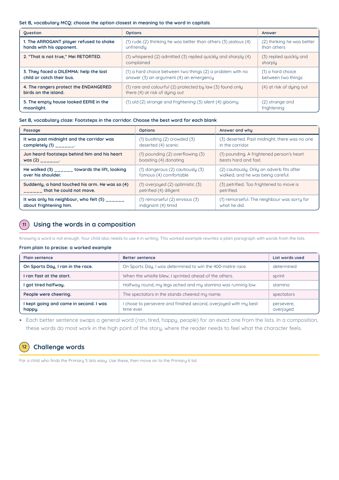
| Question | Options |
|---|---|
| 1. The ARROGANT player refused to shake hands with his opponent. | (1) rude (2) thinking he was better than others (3) jealous (4) unfriendly |
| 2. "That is not true," Mei RETORTED. | (1) whispered (2) admitted (3) replied quickly and sharply (4) complained |
| 3. They faced a DILEMMA: help the lost child or catch their bus. | (1) a hard choice between two things (2) a problem with no answer (3) an argument (4) an emergency |
| 4. The rangers protect the ENDANGERED birds on the island. | (1) rare and colourful (2) protected by law (3) found only there (4) at risk of dying out |
| 5. The empty house looked EERIE in the moonlight. | (1) old (2) strange and frightening (3) silent (4) gloomy |
Show answersHide answers
| No. | Answer |
|---|---|
| 1 | (2) thinking he was better than others |
| 2 | (3) replied quickly and sharply |
| 3 | (1) a hard choice between two things |
| 4 | (4) at risk of dying out |
| 5 | (2) strange and frightening |
| Passage | Options |
|---|---|
| It was past midnight and the corridor was completely (1) ______. | (1) bustling (2) crowded (3) deserted (4) scenic |
| Jun heard footsteps behind him and his heart was (2) ______. | (1) pounding (2) overflowing (3) boasting (4) donating |
| He walked (3) ______ towards the lift, looking over his shoulder. | (1) dangerous (2) cautiously (3) famous (4) comfortable |
| Suddenly, a hand touched his arm. He was so (4) ______ that he could not move. | (1) overjoyed (2) optimistic (3) petrified (4) diligent |
| It was only his neighbour, who felt (5) ______ about frightening him. | (1) remorseful (2) envious (3) indignant (4) timid |
Show answersHide answers
| No. | Answer and why |
|---|---|
| 1 | (3) deserted. Past midnight, there was no one in the corridor. |
| 2 | (1) pounding. A frightened person's heart beats hard and fast. |
| 3 | (2) cautiously. Only an adverb fits after walked, and he was being careful. |
| 4 | (3) petrified. Too frightened to move is petrified. |
| 5 | (1) remorseful. The neighbour was sorry for what he did. |
Using the words in a composition
Knowing a word is not enough. Your child also needs to use it in writing. This worked example rewrites a plain paragraph with words from the lists.
| Plain sentence | Better sentence | List words used |
|---|---|---|
| On Sports Day, I ran in the race. | On Sports Day, I was determined to win the 400-metre race. | determined |
| I ran fast at the start. | When the whistle blew, I sprinted ahead of the others. | sprint |
| I got tired halfway. | Halfway round, my legs ached and my stamina was running low. | stamina |
| People were cheering. | The spectators in the stands cheered my name. | spectators |
| I kept going and came in second. I was happy. | I chose to persevere and finished second, overjoyed with my best time ever. | persevere, overjoyed |
- Each better sentence swaps a general word (ran, tired, happy, people) for an exact one from the lists. In a composition, these words do most work in the high point of the story, where the reader needs to feel what the character feels.
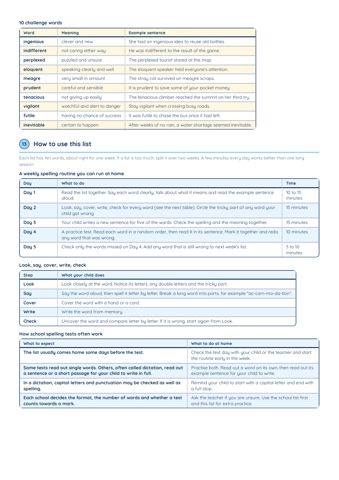
Challenge words
For a child who finds the Primary 5 lists easy. Use these, then move on to the Primary 6 list.
| Word | Meaning | Example sentence |
|---|---|---|
| ingenious | clever and new | She had an ingenious idea to reuse old bottles. |
| indifferent | not caring either way | He was indifferent to the result of the game. |
| perplexed | puzzled and unsure | The perplexed tourist stared at the map. |
| eloquent | speaking clearly and well | The eloquent speaker held everyone's attention. |
| meagre | very small in amount | The stray cat survived on meagre scraps. |
| prudent | careful and sensible | It is prudent to save some of your pocket money. |
| tenacious | not giving up easily | The tenacious climber reached the summit on her third try. |
| vigilant | watchful and alert to danger | Stay vigilant when crossing busy roads. |
| futile | having no chance of success | It was futile to chase the bus once it had left. |
| inevitable | certain to happen | After weeks of no rain, a water shortage seemed inevitable. |
How to use this list
Each list has ten words, about right for one week. If a list is too much, split it over two weeks. A few minutes every day works better than one long session.
| Day | What to do | Time |
|---|---|---|
| Day 1 | Read the list together. Say each word clearly, talk about what it means and read the example sentence aloud. | 10 to 15 minutes |
| Day 2 | Look, say, cover, write, check for every word (see the next table). Circle the tricky part of any word your child got wrong. | 15 minutes |
| Day 3 | Your child writes a new sentence for five of the words. Check the spelling and the meaning together. | 15 minutes |
| Day 4 | A practice test. Read each word in a random order, then read it in its sentence. Mark it together and redo any word that was wrong. | 10 minutes |
| Day 5 | Check only the words missed on Day 4. Add any word that is still wrong to next week's list. | 5 to 10 minutes |
| Step | What your child does |
|---|---|
| Look | Look closely at the word. Notice its letters, any double letters and the tricky part. |
| Say | Say the word aloud, then spell it letter by letter. Break a long word into parts, for example "ac-com-mo-da-tion". |
| Cover | Cover the word with a hand or a card. |
| Write | Write the word from memory. |
| Check | Uncover the word and compare letter by letter. If it is wrong, start again from Look. |
| What to expect | What to do at home |
|---|---|
| The list usually comes home some days before the test. | Check the test day with your child or the teacher and start the routine early in the week. |
| Some tests read out single words. Others, often called dictation, read out a sentence or a short passage for your child to write in full. | Practise both. Read out a word on its own, then read out its example sentence for your child to write. |
| In a dictation, capital letters and punctuation may be checked as well as spelling. | Remind your child to start with a capital letter and end with a full stop. |
| Each school decides the format, the number of words and whether a test counts towards a mark. | Ask the teacher if you are unsure. Use the school list first and this list for extra practice. |
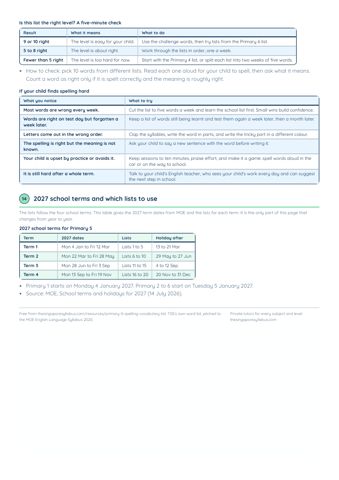
| Result | What it means | What to do |
|---|---|---|
| 9 or 10 right | The level is easy for your child. | Use the challenge words, then try lists from the Primary 6 list. |
| 5 to 8 right | The level is about right. | Work through the lists in order, one a week. |
| Fewer than 5 right | The level is too hard for now. | Start with the Primary 4 list, or split each list into two weeks of five words. |
- How to check: pick 10 words from different lists. Read each one aloud for your child to spell, then ask what it means. Count a word as right only if it is spelt correctly and the meaning is roughly right.
| What you notice | What to try |
|---|---|
| Most words are wrong every week. | Cut the list to five words a week and learn the school list first. Small wins build confidence. |
| Words are right on test day but forgotten a week later. | Keep a list of words still being learnt and test them again a week later, then a month later. |
| Letters come out in the wrong order. | Clap the syllables, write the word in parts, and write the tricky part in a different colour. |
| The spelling is right but the meaning is not known. | Ask your child to say a new sentence with the word before writing it. |
| Your child is upset by practice or avoids it. | Keep sessions to ten minutes, praise effort, and make it a game: spell words aloud in the car or on the way to school. |
| It is still hard after a whole term. | Talk to your child's English teacher, who sees your child's work every day and can suggest the next step in school. |
2027 school terms and which lists to use
The lists follow the four school terms. This table gives the 2027 term dates from MOE and the lists for each term. It is the only part of this page that changes from year to year.
| Term | 2027 dates | Lists | Holiday after |
|---|---|---|---|
| Term 1 | Mon 4 Jan to Fri 12 Mar | Lists 1 to 5 | 13 to 21 Mar |
| Term 2 | Mon 22 Mar to Fri 28 May | Lists 6 to 10 | 29 May to 27 Jun |
| Term 3 | Mon 28 Jun to Fri 3 Sep | Lists 11 to 15 | 4 to 12 Sep |
| Term 4 | Mon 13 Sep to Fri 19 Nov | Lists 16 to 20 | 20 Nov to 31 Dec |
- Primary 1 starts on Monday 4 January 2027. Primary 2 to 6 start on Tuesday 5 January 2027.
- Source: MOE, School terms and holidays for 2027 (14 July 2026).
Download the free PDFPDF · 13 pages · A4 portrait · free, no sign-up
Inside the PDF
13 A4 pages, ready to print. Tap a page to open the PDF there.
Questions students ask
Does MOE publish a Primary 5 spelling list?
No. MOE does not publish a national spelling or vocabulary list for any primary level. Each school sets its own lists, so use this one alongside the list your child brings home.
How many spelling words should my child learn each week?
Each list here has 10 words, which suits one week. If your child finds that too many, split a list over two weeks and keep the daily practice short.
How is spelling tested in PSLE English?
Paper 2 has an Editing for Spelling and Grammar section with 10 items worth 10 marks. Paper 1 (Writing) is also assessed on accurate and appropriate vocabulary, grammar, punctuation and spelling.
Is this list for Foundation English too?
It is pitched at Standard English. In P5 and P6, English is taken at Foundation or Standard level depending on P4 school exam results. A pupil taking Foundation English may find the Primary 4 list a better place to start.
Are there practice questions with answers?
Yes. There are 20 vocabulary questions, multiple choice and cloze, in the two vocabulary item types of PSLE English Paper 2. Every answer has a short reason, so your child can see why the other options do not fit.
Does this list use British or American spelling?
British spelling, such as colour, favourite and neighbour. MOE's own English syllabus documents use British spelling too, for example behaviour, organise and programme.
What if my child's school list has different words?
Learn the school list first, since the school test uses it. Then use this list for extra words, and use the meanings and example sentences to help your child use each word, not only spell it.
What if my child finds spelling hard?
Cut the list to five words a week, learn the school list first and keep a list of words still being learnt to test again a week later. If it is still hard after a term, talk to your child's English teacher.
What comes after this list?
The Primary 6 list, which is also our PSLE vocabulary list, picks up where this one ends, with no word repeated. If your child spells 9 or 10 of a random 10 words correctly, use the challenge words and then move on to it.
Keep revising
- PSLE English study guidePSLE English exam format and tips
- Primary 5 English tuitionWhat P5 English covers and how a tutor helps
- PSLE Math FormulasPSLE (Primary 1 to 6) · free PDF
- PSLE English Composition PhrasesPSLE (Primary 5 and 6) · free PDF
- PSLE Chinese Composition Phrases (好词好句)PSLE (Primary 5 and 6) · free PDF
- PSLE Science KeywordsPSLE (Primary 3 to 6) · free PDF
- Primary English Oral Practice (P3 to PSLE)Primary 3 to 6 and PSLE · free PDF
- Primary English Listening Comprehension Practice (P3 to PSLE)Primary 3 to 6 and PSLE · free PDF
- Primary English Composition Topics (P3 to PSLE)Primary 3 to 6 and PSLE · free PDF
- Primary 1 Maths WorksheetsPrimary 1 · free PDF
- Primary 2 Maths WorksheetsPrimary 2 · free PDF
- Primary 3 Maths WorksheetsPrimary 3 · free PDF
- Primary 1 English WorksheetsPrimary 1 · free PDF
- Primary 2 English WorksheetsPrimary 2 · free PDF
- Primary 3 English WorksheetsPrimary 3 · free PDF
- Primary 1 Spelling and Vocabulary ListPrimary 1 · free PDF
- Primary 2 Spelling and Vocabulary ListPrimary 2 · free PDF
- Primary 3 Spelling and Vocabulary ListPrimary 3 · free PDF
- Primary 4 Spelling and Vocabulary ListPrimary 4 · free PDF
- PSLE Vocabulary List (Primary 6)Primary 6 (PSLE) · free PDF
- PSLE Score calculatorAdd up the four AL grades
- All free resourcesPSLE, O-Level and A-Level
Source
- SEAB, PSLE English Language syllabus 0001 (implemented from 2025), Examination Format
- SEAB, PSLE formats examined in 2026
- MOE, English Language Syllabus 2020, Primary Foundation English and Secondary G1
- MOE, Primary school subjects and syllabuses
- MOE, School terms and holidays for 2027 (14 July 2026)
The words, meanings, example sentences and practice items are our own. MOE does not publish a national spelling list. The syllabus, exam and term details come from the MOE, SEAB and school pages above, and if they differ, those pages are right. Tell us and we will fix it.