Free resource · Primary 3 to 6 and PSLE

Composition Topics for Primary 3 to PSLE: Free PDF

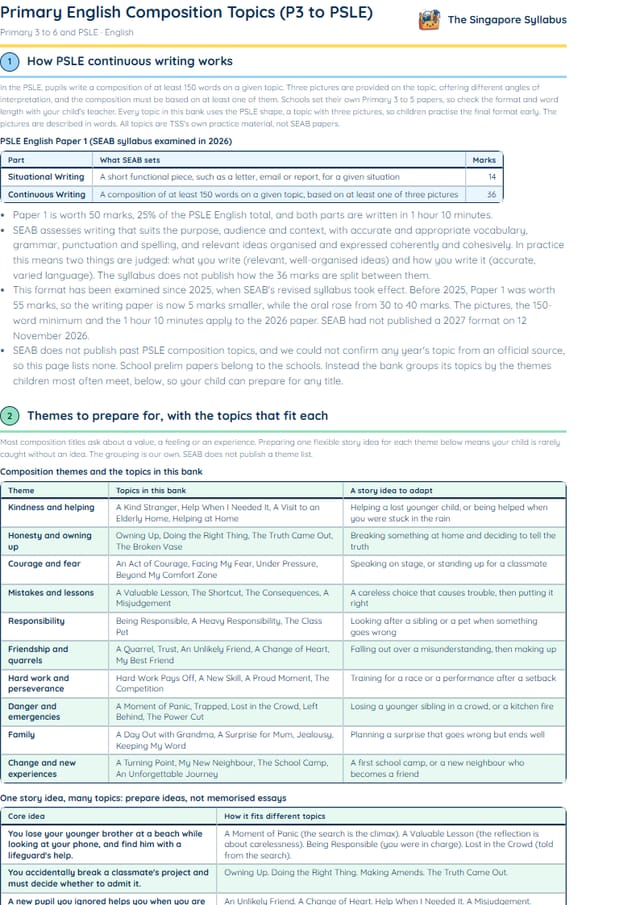
In the PSLE, pupils write a composition of at least 150 words on a given topic, based on at least one of three pictures, for 36 marks. This free bank, also a printable PDF, has 63 original topics for Primary 3 to 6 and PSLE, grouped by the themes children meet most, with a full model composition, how to read a topic, a five-part plan and the mistakes that lose marks.

PDF · 8 pages · A4 portrait · free, no sign-up

First page of the Primary English Composition Topics (P3 to PSLE) PDF

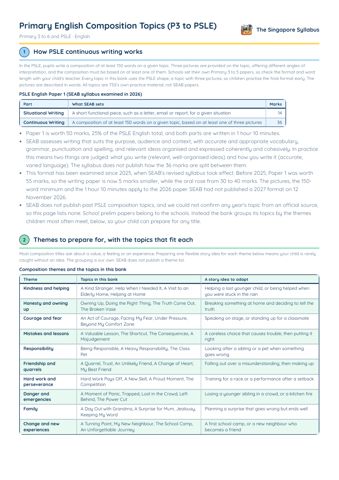
How PSLE continuous writing works

In the PSLE, pupils write a composition of at least 150 words on a given topic. Three pictures are provided on the topic, offering different angles of interpretation, and the composition must be based on at least one of them. Schools set their own Primary 3 to 5 papers, so check the format and word length with your child's teacher. Every topic in this bank uses the PSLE shape, a topic with three pictures, so children practise the final format early. The pictures are described in words. All topics are TSS's own practice material, not SEAB papers.

PSLE English Paper 1 (SEAB syllabus examined in 2026)
PartWhat SEAB setsMarks
Situational WritingA short functional piece, such as a letter, email or report, for a given situation14
Continuous WritingA composition of at least 150 words on a given topic, based on at least one of three pictures36
  • Paper 1 is worth 50 marks, 25% of the PSLE English total, and both parts are written in 1 hour 10 minutes.
  • SEAB assesses writing that suits the purpose, audience and context, with accurate and appropriate vocabulary, grammar, punctuation and spelling, and relevant ideas organised and expressed coherently and cohesively. In practice this means two things are judged: what you write (relevant, well-organised ideas) and how you write it (accurate, varied language). The syllabus does not publish how the 36 marks are split between them.
  • This format has been examined since 2025, when SEAB's revised syllabus took effect. Before 2025, Paper 1 was worth 55 marks, so the writing paper is now 5 marks smaller, while the oral rose from 30 to 40 marks. The pictures, the 150-word minimum and the 1 hour 10 minutes apply to the 2026 paper. SEAB had not published a 2027 format on 12 November 2026.
  • SEAB does not publish past PSLE composition topics, and we could not confirm any year's topic from an official source, so this page lists none. School prelim papers belong to the schools. Instead the bank groups its topics by the themes children most often meet, below, so your child can prepare for any title.

Back to all sections

Themes to prepare for, with the topics that fit each

Most composition titles ask about a value, a feeling or an experience. Preparing one flexible story idea for each theme below means your child is rarely caught without an idea. The grouping is our own. SEAB does not publish a theme list.

Composition themes and the topics in this bank
ThemeTopics in this bankA story idea to adapt
Kindness and helpingA Kind Stranger, Help When I Needed It, A Visit to an Elderly Home, Helping at HomeHelping a lost younger child, or being helped when you were stuck in the rain
Honesty and owning upOwning Up, Doing the Right Thing, The Truth Came Out, The Broken VaseBreaking something at home and deciding to tell the truth
Courage and fearAn Act of Courage, Facing My Fear, Under Pressure, Beyond My Comfort ZoneSpeaking on stage, or standing up for a classmate
Mistakes and lessonsA Valuable Lesson, The Shortcut, The Consequences, A MisjudgementA careless choice that causes trouble, then putting it right
ResponsibilityBeing Responsible, A Heavy Responsibility, The Class PetLooking after a sibling or a pet when something goes wrong
Friendship and quarrelsA Quarrel, Trust, An Unlikely Friend, A Change of Heart, My Best FriendFalling out over a misunderstanding, then making up
Hard work and perseveranceHard Work Pays Off, A New Skill, A Proud Moment, The CompetitionTraining for a race or a performance after a setback
Danger and emergenciesA Moment of Panic, Trapped, Lost in the Crowd, Left Behind, The Power CutLosing a younger sibling in a crowd, or a kitchen fire
FamilyA Day Out with Grandma, A Surprise for Mum, Jealousy, Keeping My WordPlanning a surprise that goes wrong but ends well
Change and new experiencesA Turning Point, My New Neighbour, The School Camp, An Unforgettable JourneyA first school camp, or a new neighbour who becomes a friend
One story idea, many topics: prepare ideas, not memorised essays
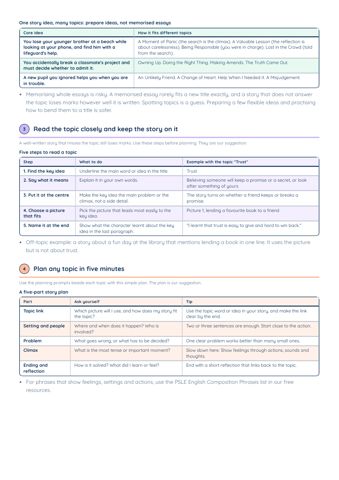
Core ideaHow it fits different topics
You lose your younger brother at a beach while looking at your phone, and find him with a lifeguard's help.A Moment of Panic (the search is the climax). A Valuable Lesson (the reflection is about carelessness). Being Responsible (you were in charge). Lost in the Crowd (told from the search).
You accidentally break a classmate's project and must decide whether to admit it.Owning Up. Doing the Right Thing. Making Amends. The Truth Came Out.
A new pupil you ignored helps you when you are in trouble.An Unlikely Friend. A Change of Heart. Help When I Needed It. A Misjudgement.
  • Memorising whole essays is risky. A memorised essay rarely fits a new title exactly, and a story that does not answer the topic loses marks however well it is written. Spotting topics is a guess. Preparing a few flexible ideas and practising how to bend them to a title is safer.

Back to all sections

Read the topic closely and keep the story on it

A well-written story that misses the topic still loses marks. Use these steps before planning. They are our suggestion.

Five steps to read a topic
StepWhat to doExample with the topic "Trust"
1. Find the key ideaUnderline the main word or idea in the title.Trust
2. Say what it meansExplain it in your own words.Believing someone will keep a promise or a secret, or look after something of yours
3. Put it at the centreMake the key idea the main problem or the climax, not a side detail.The story turns on whether a friend keeps or breaks a promise.
4. Choose a picture that fitsPick the picture that leads most easily to the key idea.Picture 1, lending a favourite book to a friend
5. Name it at the endShow what the character learnt about the key idea in the last paragraph."I learnt that trust is easy to give and hard to win back."
  • Off-topic example: a story about a fun day at the library that mentions lending a book in one line. It uses the picture but is not about trust.

Back to all sections

Plan any topic in five minutes

Use the planning prompts beside each topic with this simple plan. The plan is our suggestion.

A five-part story plan
PartAsk yourselfTip
Topic linkWhich picture will I use, and how does my story fit the topic?Use the topic word or idea in your story, and make the link clear by the end.
Setting and peopleWhere and when does it happen? Who is involved?Two or three sentences are enough. Start close to the action.
ProblemWhat goes wrong, or what has to be decided?One clear problem works better than many small ones.
ClimaxWhat is the most tense or important moment?Slow down here. Show feelings through actions, sounds and thoughts.
Ending and reflectionHow is it solved? What did I learn or feel?End with a short reflection that links back to the topic.
  • For phrases that show feelings, settings and actions, use the PSLE English Composition Phrases list in our free resources.
How long to write at each level (our guide)
LevelPractice lengthFocus
Primary 3About 100 to 150 wordsA clear beginning, middle and end, with correct past tense
Primary 4About 150 words or moreOne clear problem and how the character felt
Primary 5About 150 to 250 wordsA strong climax and a reflection that links to the topic
Primary 6 and PSLEAt least 150 words, as SEAB requiresA well-paced story that uses at least one picture and answers the topic
  • SEAB sets the 150-word minimum for the PSLE only. The P3 to P5 lengths are our practice guide. Follow your school's instructions if they differ.

Back to all sections

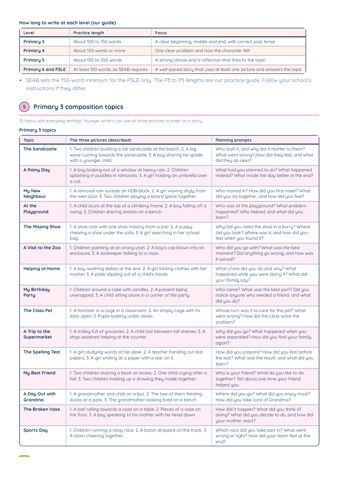
Primary 3 composition topics

15 topics with everyday settings. Younger writers can use all three pictures in order as a story.

Primary 3 topics
TopicThe three pictures (described)Planning prompts
The Sandcastle1. Two children building a tall sandcastle at the beach. 2. A big wave rushing towards the sandcastle. 3. A boy sharing his spade with a younger child.Who built it, and why did it matter to them? What went wrong? How did they feel, and what did they do next?
A Rainy Day1. A boy looking out of a window at heavy rain. 2. Children splashing in puddles in raincoats. 3. A girl holding an umbrella over a cat.What had you planned to do? What happened instead? What made the day better in the end?
My New Neighbour1. A removal van outside an HDB block. 2. A girl waving shyly from the next door. 3. Two children playing a board game together.Who moved in? How did you first meet? What did you do together, and how did you feel?
At the Playground1. A child stuck at the top of a climbing frame. 2. A boy falling off a swing. 3. Children sharing snacks on a bench.Who was at the playground? What problem happened? Who helped, and what did you learn?
The Missing Shoe1. A shoe rack with one shoe missing from a pair. 2. A puppy chewing a shoe under the sofa. 3. A girl searching in her school bag.Why did you need the shoe in a hurry? Where did you look? Where was it, and how did you feel when you found it?
A Visit to the Zoo1. Children pointing at an orang utan. 2. A boy's cap blown into an enclosure. 3. A zookeeper talking to a class.Who did you go with? What was the best moment? Did anything go wrong, and how was it solved?
Helping at Home1. A boy washing dishes at the sink. 2. A girl folding clothes with her mother. 3. A plate slipping out of a child's hands.What chore did you do and why? What happened while you were doing it? What did your family say?
My Birthday Party1. Children around a cake with candles. 2. A present being unwrapped. 3. A child sitting alone in a corner of the party.Who came? What was the best part? Did you notice anyone who needed a friend, and what did you do?
The Class Pet1. A hamster in a cage in a classroom. 2. An empty cage with its door open. 3. Pupils looking under desks.Whose turn was it to care for the pet? What went wrong? How did the class solve the problem?
A Trip to the Supermarket1. A trolley full of groceries. 2. A child lost between tall shelves. 3. A shop assistant helping at the counter.Why did you go? What happened when you were separated? How did you find your family again?
The Spelling Test1. A girl studying words at her desk. 2. A teacher handing out test papers. 3. A girl smiling at a paper with a star on it.How did you prepare? How did you feel before the test? What was the result, and what did you learn?
My Best Friend1. Two children sharing a book at recess. 2. One child crying after a fall. 3. Two children holding up a drawing they made together.Who is your friend? What do you like to do together? Tell about one time your friend helped you.
A Day Out with Grandma1. A grandmother and child on a bus. 2. The two of them feeding ducks at a park. 3. The grandmother looking tired on a bench.Where did you go? What did you enjoy most? How did you take care of Grandma?
The Broken Vase1. A ball rolling towards a vase on a table. 2. Pieces of a vase on the floor. 3. A boy speaking to his mother with his head down.How did it happen? What did you think of doing? What did you decide to do, and how did your mother react?
Sports Day1. Children running a relay race. 2. A baton dropped on the track. 3. A team cheering together.Which race did you take part in? What went wrong or right? How did your team feel at the end?

Back to all sections

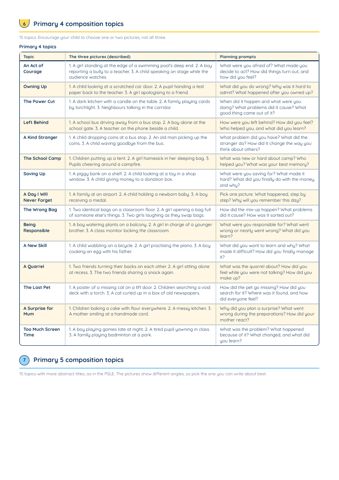
Primary 4 composition topics

15 topics. Encourage your child to choose one or two pictures, not all three.

Primary 4 topics
TopicThe three pictures (described)Planning prompts
An Act of Courage1. A girl standing at the edge of a swimming pool's deep end. 2. A boy reporting a bully to a teacher. 3. A child speaking on stage while the audience watches.What were you afraid of? What made you decide to act? How did things turn out, and how did you feel?
Owning Up1. A child looking at a scratched car door. 2. A pupil handing a test paper back to the teacher. 3. A girl apologising to a friend.What did you do wrong? Why was it hard to admit? What happened after you owned up?
The Power Cut1. A dark kitchen with a candle on the table. 2. A family playing cards by torchlight. 3. Neighbours talking in the corridor.When did it happen and what were you doing? What problems did it cause? What good thing came out of it?
Left Behind1. A school bus driving away from a bus stop. 2. A boy alone at the school gate. 3. A teacher on the phone beside a child.How were you left behind? How did you feel? Who helped you, and what did you learn?
A Kind Stranger1. A child dropping coins at a bus stop. 2. An old man picking up the coins. 3. A child waving goodbye from the bus.What problem did you have? What did the stranger do? How did it change the way you think about others?
The School Camp1. Children putting up a tent. 2. A girl homesick in her sleeping bag. 3. Pupils cheering around a campfire.What was new or hard about camp? Who helped you? What was your best memory?
Saving Up1. A piggy bank on a shelf. 2. A child looking at a toy in a shop window. 3. A child giving money to a donation box.What were you saving for? What made it hard? What did you finally do with the money, and why?
A Day I Will Never Forget1. A family at an airport. 2. A child holding a newborn baby. 3. A boy receiving a medal.Pick one picture. What happened, step by step? Why will you remember this day?
The Wrong Bag1. Two identical bags on a classroom floor. 2. A girl opening a bag full of someone else's things. 3. Two girls laughing as they swap bags.How did the mix-up happen? What problems did it cause? How was it sorted out?
Being Responsible1. A boy watering plants on a balcony. 2. A girl in charge of a younger brother. 3. A class monitor locking the classroom.What were you responsible for? What went wrong or nearly went wrong? What did you learn?
A New Skill1. A child wobbling on a bicycle. 2. A girl practising the piano. 3. A boy cooking an egg with his father.What did you want to learn and why? What made it difficult? How did you finally manage it?
A Quarrel1. Two friends turning their backs on each other. 2. A girl sitting alone at recess. 3. The two friends sharing a snack again.What was the quarrel about? How did you feel while you were not talking? How did you make up?
The Lost Pet1. A poster of a missing cat on a lift door. 2. Children searching a void deck with a torch. 3. A cat curled up in a box of old newspapers.How did the pet go missing? How did you search for it? Where was it found, and how did everyone feel?
A Surprise for Mum1. Children baking a cake with flour everywhere. 2. A messy kitchen. 3. A mother smiling at a handmade card.Why did you plan a surprise? What went wrong during the preparations? How did your mother react?
Too Much Screen Time1. A boy playing games late at night. 2. A tired pupil yawning in class. 3. A family playing badminton at a park.What was the problem? What happened because of it? What changed, and what did you learn?

Back to all sections

Primary 5 composition topics

15 topics with more abstract titles, as in the PSLE. The pictures show different angles, so pick the one you can write about best.

Primary 5 topics
TopicThe three pictures (described)Planning prompts
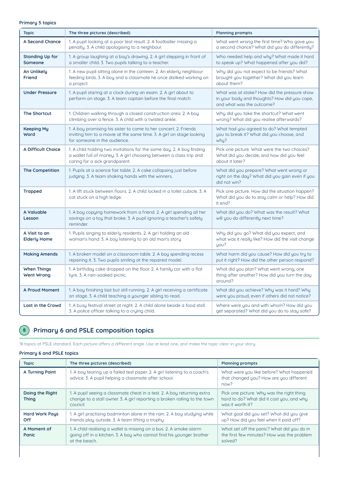
A Second Chance1. A pupil looking at a poor test result. 2. A footballer missing a penalty. 3. A child apologising to a neighbour.What went wrong the first time? Who gave you a second chance? What did you do differently?
Standing Up for Someone1. A group laughing at a boy's drawing. 2. A girl stepping in front of a smaller child. 3. Two pupils talking to a teacher.Who needed help and why? What made it hard to speak up? What happened after you did?
An Unlikely Friend1. A new pupil sitting alone in the canteen. 2. An elderly neighbour feeding birds. 3. A boy and a classmate he once disliked working on a project.Why did you not expect to be friends? What brought you together? What did you learn about them?
Under Pressure1. A pupil staring at a clock during an exam. 2. A girl about to perform on stage. 3. A team captain before the final match.What was at stake? How did the pressure show in your body and thoughts? How did you cope, and what was the outcome?
The Shortcut1. Children walking through a closed construction area. 2. A boy climbing over a fence. 3. A child with a twisted ankle.Why did you take the shortcut? What went wrong? What did you realise afterwards?
Keeping My Word1. A boy promising his sister to come to her concert. 2. Friends inviting him to a movie at the same time. 3. A girl on stage looking for someone in the audience.What had you agreed to do? What tempted you to break it? What did you choose, and why?
A Difficult Choice1. A child holding two invitations for the same day. 2. A boy finding a wallet full of money. 3. A girl choosing between a class trip and caring for a sick grandparent.Pick one picture. What were the two choices? What did you decide, and how did you feel about it later?
The Competition1. Pupils at a science fair table. 2. A cake collapsing just before judging. 3. A team shaking hands with the winners.What did you prepare? What went wrong or right on the day? What did you gain even if you did not win?
Trapped1. A lift stuck between floors. 2. A child locked in a toilet cubicle. 3. A cat stuck on a high ledge.Pick one picture. How did the situation happen? What did you do to stay calm or help? How did it end?
A Valuable Lesson1. A boy copying homework from a friend. 2. A girl spending all her savings on a toy that broke. 3. A pupil ignoring a teacher's safety reminder.What did you do? What was the result? What will you do differently next time?
A Visit to an Elderly Home1. Pupils singing to elderly residents. 2. A girl holding an old woman's hand. 3. A boy listening to an old man's story.Why did you go? What did you expect, and what was it really like? How did the visit change you?
Making Amends1. A broken model on a classroom table. 2. A boy spending recess repairing it. 3. Two pupils smiling at the repaired model.What harm did you cause? How did you try to put it right? How did the other person respond?
When Things Went Wrong1. A birthday cake dropped on the floor. 2. A family car with a flat tyre. 3. A rain-soaked picnic.What did you plan? What went wrong, one thing after another? How did you turn the day around?
A Proud Moment1. A boy finishing last but still running. 2. A girl receiving a certificate on stage. 3. A child teaching a younger sibling to read.What did you achieve? Why was it hard? Why were you proud, even if others did not notice?
Lost in the Crowd1. A busy festival street at night. 2. A child alone beside a food stall. 3. A police officer talking to a crying child.Where were you and with whom? How did you get separated? What did you do to stay safe?

Back to all sections

Primary 6 and PSLE composition topics

18 topics at PSLE standard. Each picture offers a different angle. Use at least one, and make the topic clear in your story.

Primary 6 and PSLE topics
TopicThe three pictures (described)Planning prompts
A Turning Point1. A boy tearing up a failed test paper. 2. A girl listening to a coach's advice. 3. A pupil helping a classmate after school.What were you like before? What happened that changed you? How are you different now?
Doing the Right Thing1. A pupil seeing a classmate cheat in a test. 2. A boy returning extra change to a stall owner. 3. A girl reporting a broken railing to the town council.Pick one picture. Why was the right thing hard to do? What did it cost you, and why was it worth it?
Hard Work Pays Off1. A girl practising badminton alone in the rain. 2. A boy studying while friends play outside. 3. A team lifting a trophy.What goal did you set? What did you give up? How did you feel when it paid off?
A Moment of Panic1. A child realising a wallet is missing on a bus. 2. A smoke alarm going off in a kitchen. 3. A boy who cannot find his younger brother at the beach.What set off the panic? What did you do in the first few minutes? How was the problem solved?
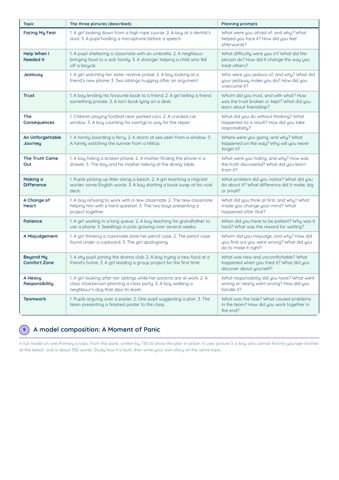
Facing My Fear1. A girl looking down from a high rope course. 2. A boy at a dentist's door. 3. A pupil holding a microphone before a speech.What were you afraid of, and why? What helped you face it? How did you feel afterwards?
Help When I Needed It1. A pupil sheltering a classmate with an umbrella. 2. A neighbour bringing food to a sick family. 3. A stranger helping a child who fell off a bicycle.What difficulty were you in? What did the person do? How did it change the way you treat others?
Jealousy1. A girl watching her sister receive praise. 2. A boy looking at a friend's new phone. 3. Two siblings hugging after an argument.Who were you jealous of, and why? What did your jealousy make you do? How did you overcome it?
Trust1. A boy lending his favourite book to a friend. 2. A girl telling a friend something private. 3. A torn book lying on a desk.Whom did you trust, and with what? How was the trust broken or kept? What did you learn about friendship?
The Consequences1. Children playing football near parked cars. 2. A cracked car window. 3. A boy counting his savings to pay for the repair.What did you do without thinking? What happened as a result? How did you take responsibility?
An Unforgettable Journey1. A family boarding a ferry. 2. A storm at sea seen from a window. 3. A family watching the sunrise from a hilltop.Where were you going, and why? What happened on the way? Why will you never forget it?
The Truth Came Out1. A boy hiding a broken phone. 2. A mother finding the phone in a drawer. 3. The boy and his mother talking at the dining table.What were you hiding, and why? How was the truth discovered? What did you learn from it?
Making a Difference1. Pupils picking up litter along a beach. 2. A girl teaching a migrant worker some English words. 3. A boy starting a book swap at his void deck.What problem did you notice? What did you do about it? What difference did it make, big or small?
A Change of Heart1. A boy refusing to work with a new classmate. 2. The new classmate helping him with a hard question. 3. The two boys presenting a project together.What did you think at first, and why? What made you change your mind? What happened after that?
Patience1. A girl waiting in a long queue. 2. A boy teaching his grandfather to use a phone. 3. Seedlings in pots growing over several weeks.When did you have to be patient? Why was it hard? What was the reward for waiting?
A Misjudgement1. A girl thinking a classmate stole her pencil case. 2. The pencil case found under a cupboard. 3. The girl apologising.Whom did you misjudge, and why? How did you find out you were wrong? What did you do to make it right?
Beyond My Comfort Zone1. A shy pupil joining the drama club. 2. A boy trying a new food at a friend's home. 3. A girl leading a group project for the first time.What was new and uncomfortable? What happened when you tried it? What did you discover about yourself?
A Heavy Responsibility1. A girl looking after her siblings while her parents are at work. 2. A class chairperson planning a class party. 3. A boy walking a neighbour's dog that slips its leash.What responsibility did you have? What went wrong or nearly went wrong? How did you handle it?
Teamwork1. Pupils arguing over a poster. 2. One pupil suggesting a plan. 3. The team presenting a finished poster to the class.What was the task? What caused problems in the team? How did you work together in the end?

Back to all sections

A model composition: A Moment of Panic

A full model on one Primary 6 topic from this bank, written by TSS to show the plan in action. It uses picture 3, a boy who cannot find his younger brother at the beach, and is about 350 words. Study how it is built, then write your own story on the same topic.

Model composition, paragraph by paragraph
PartParagraph
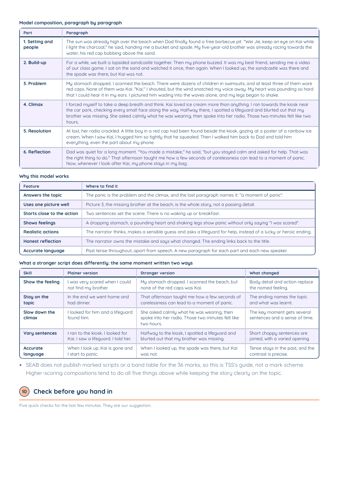
1. Setting and peopleThe sun was already high over the beach when Dad finally found a free barbecue pit. "Wei Jie, keep an eye on Kai while I light the charcoal," he said, handing me a bucket and spade. My five-year-old brother was already racing towards the water, his red cap bobbing above the sand.
2. Build-upFor a while, we built a lopsided sandcastle together. Then my phone buzzed. It was my best friend, sending me a video of our class game. I sat on the sand and watched it once, then again. When I looked up, the sandcastle was there and the spade was there, but Kai was not.
3. ProblemMy stomach dropped. I scanned the beach. There were dozens of children in swimsuits, and at least three of them wore red caps. None of them was Kai. "Kai," I shouted, but the wind snatched my voice away. My heart was pounding so hard that I could hear it in my ears. I pictured him wading into the waves alone, and my legs began to shake.
4. ClimaxI forced myself to take a deep breath and think. Kai loved ice cream more than anything. I ran towards the kiosk near the car park, checking every small face along the way. Halfway there, I spotted a lifeguard and blurted out that my brother was missing. She asked calmly what he was wearing, then spoke into her radio. Those two minutes felt like two hours.
5. ResolutionAt last, her radio crackled. A little boy in a red cap had been found beside the kiosk, gazing at a poster of a rainbow ice cream. When I saw Kai, I hugged him so tightly that he squealed. Then I walked him back to Dad and told him everything, even the part about my phone.
6. ReflectionDad was quiet for a long moment. "You made a mistake," he said, "but you stayed calm and asked for help. That was the right thing to do." That afternoon taught me how a few seconds of carelessness can lead to a moment of panic. Now, whenever I look after Kai, my phone stays in my bag.
Why this model works
FeatureWhere to find it
Answers the topicThe panic is the problem and the climax, and the last paragraph names it: "a moment of panic".
Uses one picture wellPicture 3, the missing brother at the beach, is the whole story, not a passing detail.
Starts close to the actionTwo sentences set the scene. There is no waking up or breakfast.
Shows feelingsA dropping stomach, a pounding heart and shaking legs show panic without only saying "I was scared".
Realistic actionsThe narrator thinks, makes a sensible guess and asks a lifeguard for help, instead of a lucky or heroic ending.
Honest reflectionThe narrator owns the mistake and says what changed. The ending links back to the title.
Accurate languagePast tense throughout, apart from speech. A new paragraph for each part and each new speaker.
What a stronger script does differently: the same moment written two ways
SkillPlainer versionStronger versionWhat changed
Show the feelingI was very scared when I could not find my brother.My stomach dropped. I scanned the beach, but none of the red caps was Kai.Body detail and action replace the named feeling.
Stay on the topicIn the end we went home and had dinner.That afternoon taught me how a few seconds of carelessness can lead to a moment of panic.The ending names the topic and what was learnt.
Slow down the climaxI looked for him and a lifeguard found him.She asked calmly what he was wearing, then spoke into her radio. Those two minutes felt like two hours.The key moment gets several sentences and a sense of time.
Vary sentencesI ran to the kiosk. I looked for Kai. I saw a lifeguard. I told her.Halfway to the kiosk, I spotted a lifeguard and blurted out that my brother was missing.Short choppy sentences are joined, with a varied opening.
Accurate languageWhen I look up, Kai is gone and I start to panic.When I looked up, the spade was there, but Kai was not.Tense stays in the past, and the contrast is precise.
  • SEAB does not publish marked scripts or a band table for the 36 marks, so this is TSS's guide, not a mark scheme. Higher-scoring compositions tend to do all five things above while keeping the story clearly on the topic.

Back to all sections

Check before you hand in

Five quick checks for the last few minutes. They are our suggestion.

Final checks
CheckWhat to look for
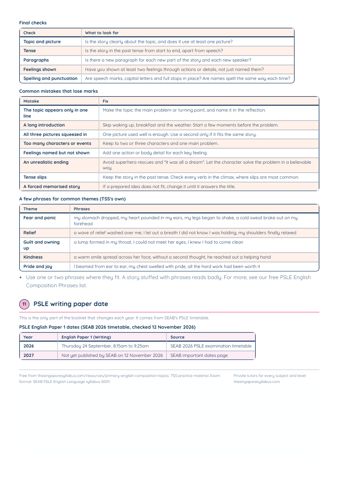
Topic and pictureIs the story clearly about the topic, and does it use at least one picture?
TenseIs the story in the past tense from start to end, apart from speech?
ParagraphsIs there a new paragraph for each new part of the story and each new speaker?
Feelings shownHave you shown at least two feelings through actions or details, not just named them?
Spelling and punctuationAre speech marks, capital letters and full stops in place? Are names spelt the same way each time?
Common mistakes that lose marks
MistakeFix
The topic appears only in one lineMake the topic the main problem or turning point, and name it in the reflection.
A long introductionSkip waking up, breakfast and the weather. Start a few moments before the problem.
All three pictures squeezed inOne picture used well is enough. Use a second only if it fits the same story.
Too many characters or eventsKeep to two or three characters and one main problem.
Feelings named but not shownAdd one action or body detail for each key feeling.
An unrealistic endingAvoid superhero rescues and "it was all a dream". Let the character solve the problem in a believable way.
Tense slipsKeep the story in the past tense. Check every verb in the climax, where slips are most common.
A forced memorised storyIf a prepared idea does not fit, change it until it answers the title.
A few phrases for common themes (TSS's own)
ThemePhrases
Fear and panicmy stomach dropped, my heart pounded in my ears, my legs began to shake, a cold sweat broke out on my forehead
Reliefa wave of relief washed over me, I let out a breath I did not know I was holding, my shoulders finally relaxed
Guilt and owning upa lump formed in my throat, I could not meet her eyes, I knew I had to come clean
Kindnessa warm smile spread across her face, without a second thought, he reached out a helping hand
Pride and joyI beamed from ear to ear, my chest swelled with pride, all the hard work had been worth it
  • Use one or two phrases where they fit. A story stuffed with phrases reads badly. For more, see our free PSLE English Composition Phrases list.

Back to all sections

PSLE writing paper date

This is the only part of the booklet that changes each year. It comes from SEAB's PSLE timetable.

PSLE English Paper 1 dates (SEAB 2026 timetable, checked 12 November 2026)
YearEnglish Paper 1 (Writing)Source
2026Thursday 24 September, 8.15am to 9.25amSEAB 2026 PSLE examination timetable
2027Not yet published by SEAB on 12 November 2026SEAB important dates page

Back to all sections

Download the free PDFPDF · 8 pages · A4 portrait · free, no sign-up

Inside the PDF

8 A4 pages, ready to print. Tap a page to open the PDF there.

  1. Primary English Composition Topics (P3 to PSLE) PDF, page 1 of 8: How PSLE continuous writing works, Themes to prepare for, with the topics that fit eachPage 1
  2. Primary English Composition Topics (P3 to PSLE) PDF, page 2 of 8: Read the topic closely and keep the story on it, Plan any topic in five minutesPage 2
  3. Primary English Composition Topics (P3 to PSLE) PDF, page 3 of 8: Primary 3 composition topicsPage 3
  4. Primary English Composition Topics (P3 to PSLE) PDF, page 4 of 8: Primary 4 composition topics, Primary 5 composition topicsPage 4
  5. Primary English Composition Topics (P3 to PSLE) PDF, page 5 of 8: Primary 6 and PSLE composition topicsPage 5
  6. Primary English Composition Topics (P3 to PSLE) PDF, page 6 of 8: A model composition: A Moment of PanicPage 6
  7. Primary English Composition Topics (P3 to PSLE) PDF, page 7 of 8: Check before you hand inPage 7
  8. Primary English Composition Topics (P3 to PSLE) PDF, page 8 of 8: PSLE writing paper datePage 8

Questions students ask

How many words must a PSLE composition be?

At least 150 words of continuous prose, according to the SEAB syllabus examined in 2026. There is no upper limit in the syllabus, but a clear, well-paced story matters more than length.

Must I use all three pictures in the PSLE composition?

No. SEAB provides three pictures on the topic, offering different angles of interpretation, and the composition must be based on at least one of them.

How many marks is the PSLE composition worth?

Continuous Writing is worth 36 marks. Together with Situational Writing (14 marks), Paper 1 is worth 50 marks, 25% of the total, and both parts are written in 1 hour 10 minutes.

What composition format do Primary 3 and Primary 4 use?

SEAB sets the format for the PSLE only. Schools set their own Primary 3 to 5 papers, so ask your child's teacher about the format and word length. This bank uses the PSLE shape at every level.

How should my child use these topics at home?

Pick one topic, choose a picture and plan for about 5 minutes with the planning prompts and the five-part plan. Then write, and leave a few minutes for the final checks. One composition a week, marked and rewritten, helps more than many unchecked ones.

Are these past PSLE composition topics?

No. Every topic and picture description here is TSS's own practice material. SEAB does not post past PSLE topics in its syllabus, and school prelim papers belong to the schools, so this bank groups its own topics by the themes children most often meet.

Did the PSLE composition format change in 2025?

Yes. Since 2025, Paper 1 is worth 50 marks instead of 55, with 36 for Continuous Writing and 14 for Situational Writing. The composition is at least 150 words, based on at least one of three pictures, in 1 hour 10 minutes for both parts. This applies to the 2026 paper, and SEAB had not published a 2027 format on 12 November 2026.

Where can I find good phrases to use?

Our free PSLE English Composition Phrases list sorts over 150 phrases by theme, from feelings and settings to openings and endings, each with an example sentence.

Should my child memorise model compositions?

No. A memorised essay rarely fits a new title, and a story that misses the topic loses marks. Prepare a few flexible story ideas, one per theme, and practise bending them to different titles.

Is there a model composition to study?

Yes. The booklet has a full model on the Primary 6 topic A Moment of Panic, about 350 words, with notes on why each part works.

Keep revising

Source

The topics, picture descriptions and planning prompts are our own practice material. The exam format details come from the SEAB syllabus, and if they differ, the SEAB document is right. Tell us and we will fix it.