Free resource · PSLE (Primary 3 to 6)
PSLE Science Keywords for Open-Ended Answers: Free PDF
SEAB assesses how well pupils communicate explanations and reasoning, so precise scientific words in full sentences that link cause and effect help. Key ones include heat gain and heat loss, water vapour condensing on a cooler surface, photosynthesis needing light, water and carbon dioxide, and friction opposing motion. For experiment questions, a good habit is to name the changed variable, two or more variables kept the same, and refer to the data.
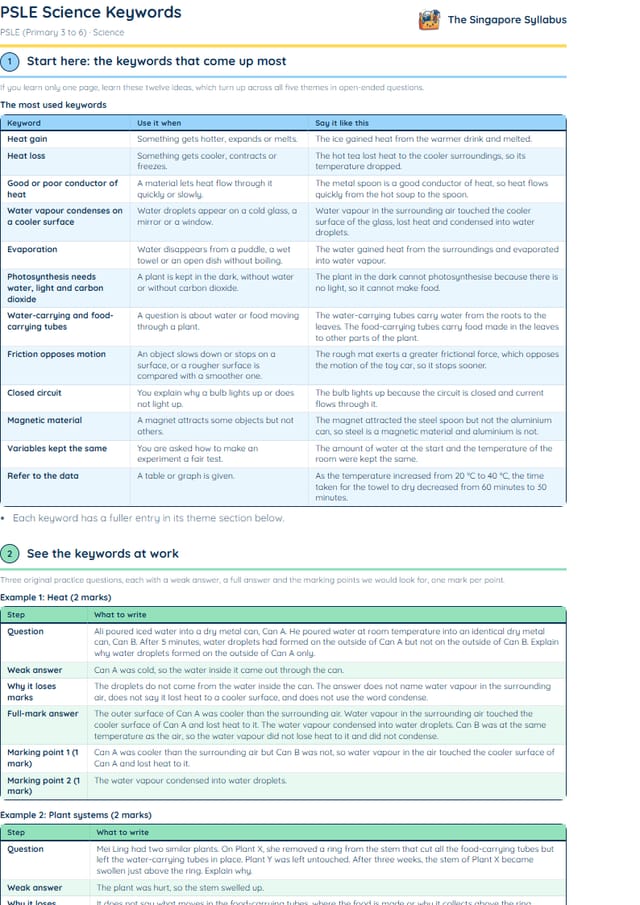
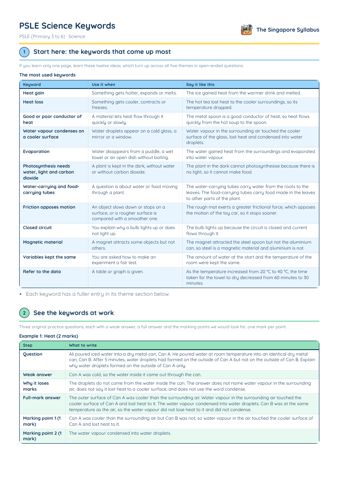
Start here: the keywords that come up most
If you learn only one page, learn these twelve ideas, which turn up across all five themes in open-ended questions.
| Keyword | Use it when | Say it like this |
|---|---|---|
| Heat gain | Something gets hotter, expands or melts. | The ice gained heat from the warmer drink and melted. |
| Heat loss | Something gets cooler, contracts or freezes. | The hot tea lost heat to the cooler surroundings, so its temperature dropped. |
| Good or poor conductor of heat | A material lets heat flow through it quickly or slowly. | The metal spoon is a good conductor of heat, so heat flows quickly from the hot soup to the spoon. |
| Water vapour condenses on a cooler surface | Water droplets appear on a cold glass, a mirror or a window. | Water vapour in the surrounding air touched the cooler surface of the glass, lost heat and condensed into water droplets. |
| Evaporation | Water disappears from a puddle, a wet towel or an open dish without boiling. | The water gained heat from the surroundings and evaporated into water vapour. |
| Photosynthesis needs water, light and carbon dioxide | A plant is kept in the dark, without water or without carbon dioxide. | The plant in the dark cannot photosynthesise because there is no light, so it cannot make food. |
| Water-carrying and food-carrying tubes | A question is about water or food moving through a plant. | The water-carrying tubes carry water from the roots to the leaves. The food-carrying tubes carry food made in the leaves to other parts of the plant. |
| Friction opposes motion | An object slows down or stops on a surface, or a rougher surface is compared with a smoother one. | The rough mat exerts a greater frictional force, which opposes the motion of the toy car, so it stops sooner. |
| Closed circuit | You explain why a bulb lights up or does not light up. | The bulb lights up because the circuit is closed and current flows through it. |
| Magnetic material | A magnet attracts some objects but not others. | The magnet attracted the steel spoon but not the aluminium can, so steel is a magnetic material and aluminium is not. |
| Variables kept the same | You are asked how to make an experiment a fair test. | The amount of water at the start and the temperature of the room were kept the same. |
| Refer to the data | A table or graph is given. | As the temperature increased from 20 °C to 40 °C, the time taken for the towel to dry decreased from 60 minutes to 30 minutes. |
- Each keyword has a fuller entry in its theme section below.
See the keywords at work
Three original practice questions, each with a weak answer, a full answer and the marking points we would look for, one mark per point.
| Step | What to write |
|---|---|
| Question | Ali poured iced water into a dry metal can, Can A. He poured water at room temperature into an identical dry metal can, Can B. After 5 minutes, water droplets had formed on the outside of Can A but not on the outside of Can B. Explain why water droplets formed on the outside of Can A only. |
| Weak answer | Can A was cold, so the water inside it came out through the can. |
| Why it loses marks | The droplets do not come from the water inside the can. The answer does not name water vapour in the surrounding air, does not say it lost heat to a cooler surface, and does not use the word condense. |
| Full-mark answer | The outer surface of Can A was cooler than the surrounding air. Water vapour in the surrounding air touched the cooler surface of Can A and lost heat to it. The water vapour condensed into water droplets. Can B was at the same temperature as the air, so the water vapour did not lose heat to it and did not condense. |
| Marking point 1 (1 mark) | Can A was cooler than the surrounding air but Can B was not, so water vapour in the air touched the cooler surface of Can A and lost heat to it. |
| Marking point 2 (1 mark) | The water vapour condensed into water droplets. |
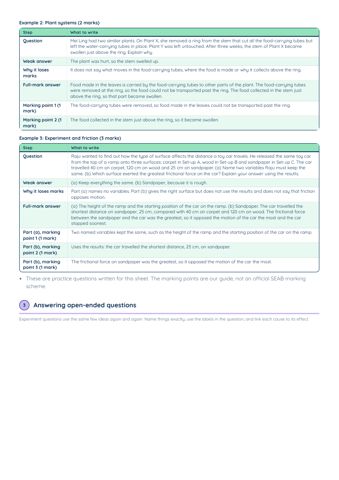
| Step | What to write |
|---|---|
| Question | Mei Ling had two similar plants. On Plant X, she removed a ring from the stem that cut all the food-carrying tubes but left the water-carrying tubes in place. Plant Y was left untouched. After three weeks, the stem of Plant X became swollen just above the ring. Explain why. |
| Weak answer | The plant was hurt, so the stem swelled up. |
| Why it loses marks | It does not say what moves in the food-carrying tubes, where the food is made or why it collects above the ring. |
| Full-mark answer | Food made in the leaves is carried by the food-carrying tubes to other parts of the plant. The food-carrying tubes were removed at the ring, so the food could not be transported past the ring. The food collected in the stem just above the ring, so that part became swollen. |
| Marking point 1 (1 mark) | The food-carrying tubes were removed, so food made in the leaves could not be transported past the ring. |
| Marking point 2 (1 mark) | The food collected in the stem just above the ring, so it became swollen. |
| Step | What to write |
|---|---|
| Question | Raju wanted to find out how the type of surface affects the distance a toy car travels. He released the same toy car from the top of a ramp onto three surfaces: carpet in Set-up A, wood in Set-up B and sandpaper in Set-up C. The car travelled 40 cm on carpet, 120 cm on wood and 25 cm on sandpaper. (a) Name two variables Raju must keep the same. (b) Which surface exerted the greatest frictional force on the car? Explain your answer using the results. |
| Weak answer | (a) Keep everything the same. (b) Sandpaper, because it is rough. |
| Why it loses marks | Part (a) names no variables. Part (b) gives the right surface but does not use the results and does not say that friction opposes motion. |
| Full-mark answer | (a) The height of the ramp and the starting position of the car on the ramp. (b) Sandpaper. The car travelled the shortest distance on sandpaper, 25 cm, compared with 40 cm on carpet and 120 cm on wood. The frictional force between the sandpaper and the car was the greatest, so it opposed the motion of the car the most and the car stopped soonest. |
| Part (a), marking point 1 (1 mark) | Two named variables kept the same, such as the height of the ramp and the starting position of the car on the ramp. |
| Part (b), marking point 2 (1 mark) | Uses the results: the car travelled the shortest distance, 25 cm, on sandpaper. |
| Part (b), marking point 3 (1 mark) | The frictional force on sandpaper was the greatest, so it opposed the motion of the car the most. |
- These are practice questions written for this sheet. The marking points are our guide, not an official SEAB marking scheme.
Answering open-ended questions
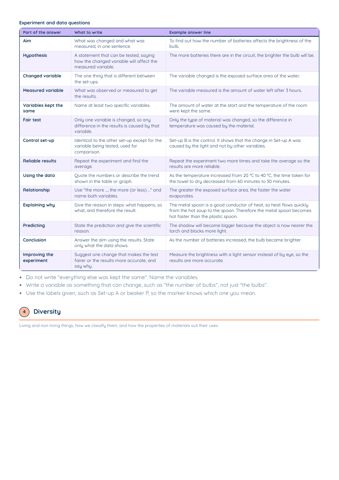
Experiment questions use the same few ideas again and again. Name things exactly, use the labels in the question, and link each cause to its effect.
| Part of the answer | What to write | Example answer line |
|---|---|---|
| Aim | What was changed and what was measured, in one sentence. | To find out how the number of batteries affects the brightness of the bulb. |
| Hypothesis | A statement that can be tested, saying how the changed variable will affect the measured variable. | The more batteries there are in the circuit, the brighter the bulb will be. |
| Changed variable | The one thing that is different between the set-ups. | The variable changed is the exposed surface area of the water. |
| Measured variable | What was observed or measured to get the results. | The variable measured is the amount of water left after 3 hours. |
| Variables kept the same | Name at least two specific variables. | The amount of water at the start and the temperature of the room were kept the same. |
| Fair test | Only one variable is changed, so any difference in the results is caused by that variable. | Only the type of material was changed, so the difference in temperature was caused by the material. |
| Control set-up | Identical to the other set-up except for the variable being tested, used for comparison. | Set-up B is the control. It shows that the change in Set-up A was caused by the light and not by other variables. |
| Reliable results | Repeat the experiment and find the average. | Repeat the experiment two more times and take the average so the results are more reliable. |
| Using the data | Quote the numbers or describe the trend shown in the table or graph. | As the temperature increased from 20 °C to 40 °C, the time taken for the towel to dry decreased from 60 minutes to 30 minutes. |
| Relationship | Use "the more ..., the more (or less) ..." and name both variables. | The greater the exposed surface area, the faster the water evaporates. |
| Explaining why | Give the reason in steps: what happens, so what, and therefore the result. | The metal spoon is a good conductor of heat, so heat flows quickly from the hot soup to the spoon. Therefore the metal spoon becomes hot faster than the plastic spoon. |
| Predicting | State the prediction and give the scientific reason. | The shadow will become bigger because the object is now nearer the torch and blocks more light. |
| Conclusion | Answer the aim using the results. State only what the data shows. | As the number of batteries increased, the bulb became brighter. |
| Improving the experiment | Suggest one change that makes the test fairer or the results more accurate, and say why. | Measure the brightness with a light sensor instead of by eye, so the results are more accurate. |
- Do not write "everything else was kept the same". Name the variables.
- Write a variable as something that can change, such as "the number of bulbs", not just "the bulbs".
- Use the labels given, such as Set-up A or beaker P, so the marker knows which one you mean.
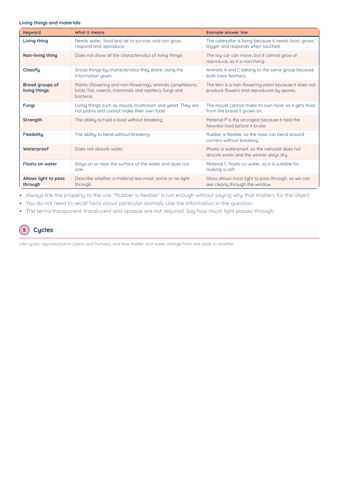
Diversity
Living and non-living things, how we classify them, and how the properties of materials suit their uses.
| Keyword | What it means | Example answer line |
|---|---|---|
| Living thing | Needs water, food and air to survive, and can grow, respond and reproduce. | The caterpillar is living because it needs food, grows bigger and responds when touched. |
| Non-living thing | Does not show all the characteristics of living things. | The toy car can move, but it cannot grow or reproduce, so it is non-living. |
| Classify | Group things by characteristics they share, using the information given. | Animals A and C belong to the same group because both have feathers. |
| Broad groups of living things | Plants (flowering and non-flowering), animals (amphibians, birds, fish, insects, mammals and reptiles), fungi and bacteria. | The fern is a non-flowering plant because it does not produce flowers and reproduces by spores. |
| Fungi | Living things such as mould, mushroom and yeast. They are not plants and cannot make their own food. | The mould cannot make its own food, so it gets food from the bread it grows on. |
| Strength | The ability to hold a load without breaking. | Material P is the strongest because it held the heaviest load before it broke. |
| Flexibility | The ability to bend without breaking. | Rubber is flexible, so the hose can bend around corners without breaking. |
| Waterproof | Does not absorb water. | Plastic is waterproof, so the raincoat does not absorb water and the wearer stays dry. |
| Floats on water | Stays on or near the surface of the water and does not sink. | Material C floats on water, so it is suitable for making a raft. |
| Allows light to pass through | Describe whether a material lets most, some or no light through. | Glass allows most light to pass through, so we can see clearly through the window. |
- Always link the property to the use. "Rubber is flexible" is not enough without saying why that matters for the object.
- You do not need to recall facts about particular animals. Use the information in the question.
- The terms transparent, translucent and opaque are not required. Say how much light passes through.
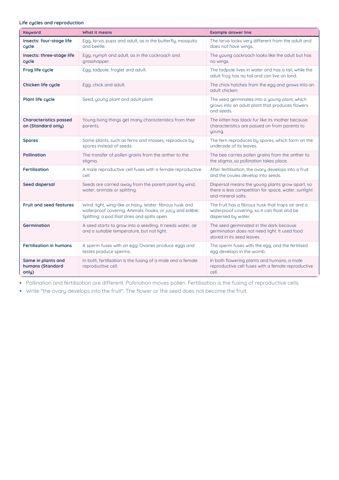
Cycles
Life cycles, reproduction in plants and humans, and how matter and water change from one state to another.
| Keyword | What it means | Example answer line |
|---|---|---|
| Insects: four-stage life cycle | Egg, larva, pupa and adult, as in the butterfly, mosquito and beetle. | The larva looks very different from the adult and does not have wings. |
| Insects: three-stage life cycle | Egg, nymph and adult, as in the cockroach and grasshopper. | The young cockroach looks like the adult but has no wings. |
| Frog life cycle | Egg, tadpole, froglet and adult. | The tadpole lives in water and has a tail, while the adult frog has no tail and can live on land. |
| Chicken life cycle | Egg, chick and adult. | The chick hatches from the egg and grows into an adult chicken. |
| Plant life cycle | Seed, young plant and adult plant. | The seed germinates into a young plant, which grows into an adult plant that produces flowers and seeds. |
| Characteristics passed on (Standard only) | Young living things get many characteristics from their parents. | The kitten has black fur like its mother because characteristics are passed on from parents to young. |
| Spores | Some plants, such as ferns and mosses, reproduce by spores instead of seeds. | The fern reproduces by spores, which form on the underside of its leaves. |
| Pollination | The transfer of pollen grains from the anther to the stigma. | The bee carries pollen grains from the anther to the stigma, so pollination takes place. |
| Fertilisation | A male reproductive cell fuses with a female reproductive cell. | After fertilisation, the ovary develops into a fruit and the ovules develop into seeds. |
| Seed dispersal | Seeds are carried away from the parent plant by wind, water, animals or splitting. | Dispersal means the young plants grow apart, so there is less competition for space, water, sunlight and mineral salts. |
| Fruit and seed features | Wind: light, wing-like or hairy. Water: fibrous husk and waterproof covering. Animals: hooks, or juicy and edible. Splitting: a pod that dries and splits open. | The fruit has a fibrous husk that traps air and a waterproof covering, so it can float and be dispersed by water. |
| Germination | A seed starts to grow into a seedling. It needs water, air and a suitable temperature, but not light. | The seed germinated in the dark because germination does not need light. It used food stored in its seed leaves. |
| Fertilisation in humans | A sperm fuses with an egg. Ovaries produce eggs and testes produce sperms. | The sperm fuses with the egg, and the fertilised egg develops in the womb. |
| Same in plants and humans (Standard only) | In both, fertilisation is the fusing of a male and a female reproductive cell. | In both flowering plants and humans, a male reproductive cell fuses with a female reproductive cell. |
- Pollination and fertilisation are different. Pollination moves pollen. Fertilisation is the fusing of reproductive cells.
- Write "the ovary develops into the fruit". The flower or the seed does not become the fruit.
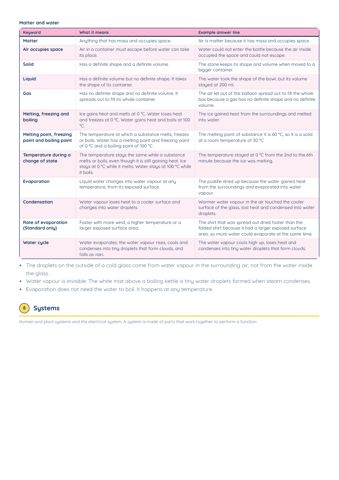
| Keyword | What it means | Example answer line |
|---|---|---|
| Matter | Anything that has mass and occupies space. | Air is matter because it has mass and occupies space. |
| Air occupies space | Air in a container must escape before water can take its place. | Water could not enter the bottle because the air inside occupied the space and could not escape. |
| Solid | Has a definite shape and a definite volume. | The stone keeps its shape and volume when moved to a bigger container. |
| Liquid | Has a definite volume but no definite shape. It takes the shape of its container. | The water took the shape of the bowl, but its volume stayed at 200 ml. |
| Gas | Has no definite shape and no definite volume. It spreads out to fill its whole container. | The air let out of the balloon spread out to fill the whole box because a gas has no definite shape and no definite volume. |
| Melting, freezing and boiling | Ice gains heat and melts at 0 °C. Water loses heat and freezes at 0 °C. Water gains heat and boils at 100 °C. | The ice gained heat from the surroundings and melted into water. |
| Melting point, freezing point and boiling point | The temperature at which a substance melts, freezes or boils. Water has a melting point and freezing point of 0 °C and a boiling point of 100 °C. | The melting point of substance X is 60 °C, so X is a solid at a room temperature of 30 °C. |
| Temperature during a change of state | The temperature stays the same while a substance melts or boils, even though it is still gaining heat. Ice stays at 0 °C while it melts. Water stays at 100 °C while it boils. | The temperature stayed at 0 °C from the 2nd to the 6th minute because the ice was melting. |
| Evaporation | Liquid water changes into water vapour at any temperature, from its exposed surface. | The puddle dried up because the water gained heat from the surroundings and evaporated into water vapour. |
| Condensation | Water vapour loses heat to a cooler surface and changes into water droplets. | Warmer water vapour in the air touched the cooler surface of the glass, lost heat and condensed into water droplets. |
| Rate of evaporation (Standard only) | Faster with more wind, a higher temperature or a larger exposed surface area. | The shirt that was spread out dried faster than the folded shirt because it had a larger exposed surface area, so more water could evaporate at the same time. |
| Water cycle | Water evaporates, the water vapour rises, cools and condenses into tiny droplets that form clouds, and falls as rain. | The water vapour cools high up, loses heat and condenses into tiny water droplets that form clouds. |
- The droplets on the outside of a cold glass come from water vapour in the surrounding air, not from the water inside the glass.
- Water vapour is invisible. The white mist above a boiling kettle is tiny water droplets formed when steam condenses.
- Evaporation does not need the water to boil. It happens at any temperature.
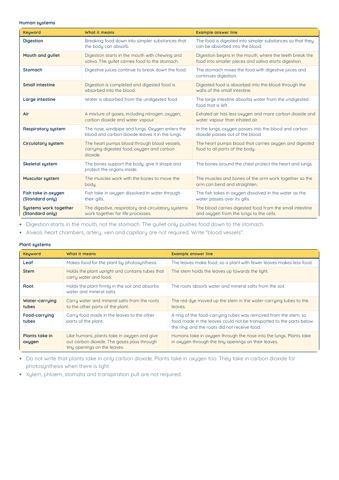
Systems
Human and plant systems and the electrical system. A system is made of parts that work together to perform a function.
| Keyword | What it means | Example answer line |
|---|---|---|
| Digestion | Breaking food down into simpler substances that the body can absorb. | The food is digested into simpler substances so that they can be absorbed into the blood. |
| Mouth and gullet | Digestion starts in the mouth with chewing and saliva. The gullet carries food to the stomach. | Digestion begins in the mouth, where the teeth break the food into smaller pieces and saliva starts digestion. |
| Stomach | Digestive juices continue to break down the food. | The stomach mixes the food with digestive juices and continues digestion. |
| Small intestine | Digestion is completed and digested food is absorbed into the blood. | Digested food is absorbed into the blood through the walls of the small intestine. |
| Large intestine | Water is absorbed from the undigested food. | The large intestine absorbs water from the undigested food that is left. |
| Air | A mixture of gases, including nitrogen, oxygen, carbon dioxide and water vapour. | Exhaled air has less oxygen and more carbon dioxide and water vapour than inhaled air. |
| Respiratory system | The nose, windpipe and lungs. Oxygen enters the blood and carbon dioxide leaves it in the lungs. | In the lungs, oxygen passes into the blood and carbon dioxide passes out of the blood. |
| Circulatory system | The heart pumps blood through blood vessels, carrying digested food, oxygen and carbon dioxide. | The heart pumps blood that carries oxygen and digested food to all parts of the body. |
| Skeletal system | The bones support the body, give it shape and protect the organs inside. | The bones around the chest protect the heart and lungs. |
| Muscular system | The muscles work with the bones to move the body. | The muscles and bones of the arm work together so the arm can bend and straighten. |
| Fish take in oxygen (Standard only) | Fish take in oxygen dissolved in water through their gills. | The fish takes in oxygen dissolved in the water as the water passes over its gills. |
| Systems work together (Standard only) | The digestive, respiratory and circulatory systems work together for life processes. | The blood carries digested food from the small intestine and oxygen from the lungs to the cells. |
- Digestion starts in the mouth, not the stomach. The gullet only pushes food down to the stomach.
- Alveoli, heart chambers, artery, vein and capillary are not required. Write "blood vessels".
| Keyword | What it means | Example answer line |
|---|---|---|
| Leaf | Makes food for the plant by photosynthesis. | The leaves make food, so a plant with fewer leaves makes less food. |
| Stem | Holds the plant upright and contains tubes that carry water and food. | The stem holds the leaves up towards the light. |
| Root | Holds the plant firmly in the soil and absorbs water and mineral salts. | The roots absorb water and mineral salts from the soil. |
| Water-carrying tubes | Carry water and mineral salts from the roots to the other parts of the plant. | The red dye moved up the stem in the water-carrying tubes to the leaves. |
| Food-carrying tubes | Carry food made in the leaves to the other parts of the plant. | A ring of the food-carrying tubes was removed from the stem, so food made in the leaves could not be transported to the parts below the ring, and the roots did not receive food. |
| Plants take in oxygen | Like humans, plants take in oxygen and give out carbon dioxide. The gases pass through tiny openings on the leaves. | Humans take in oxygen through the nose into the lungs. Plants take in oxygen through the tiny openings on their leaves. |
- Do not write that plants take in only carbon dioxide. Plants take in oxygen too. They take in carbon dioxide for photosynthesis when there is light.
- Xylem, phloem, stomata and transpiration pull are not required.
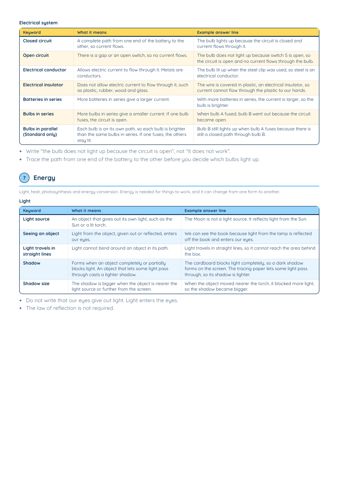
| Keyword | What it means | Example answer line |
|---|---|---|
| Closed circuit | A complete path from one end of the battery to the other, so current flows. | The bulb lights up because the circuit is closed and current flows through it. |
| Open circuit | There is a gap or an open switch, so no current flows. | The bulb does not light up because switch S is open, so the circuit is open and no current flows through the bulb. |
| Electrical conductor | Allows electric current to flow through it. Metals are conductors. | The bulb lit up when the steel clip was used, so steel is an electrical conductor. |
| Electrical insulator | Does not allow electric current to flow through it, such as plastic, rubber, wood and glass. | The wire is covered in plastic, an electrical insulator, so current cannot flow through the plastic to our hands. |
| Batteries in series | More batteries in series give a larger current. | With more batteries in series, the current is larger, so the bulb is brighter. |
| Bulbs in series | More bulbs in series give a smaller current. If one bulb fuses, the circuit is open. | When bulb A fused, bulb B went out because the circuit became open. |
| Bulbs in parallel (Standard only) | Each bulb is on its own path, so each bulb is brighter than the same bulbs in series. If one fuses, the others stay lit. | Bulb B still lights up when bulb A fuses because there is still a closed path through bulb B. |
- Write "the bulb does not light up because the circuit is open", not "it does not work".
- Trace the path from one end of the battery to the other before you decide which bulbs light up.
Energy
Light, heat, photosynthesis and energy conversion. Energy is needed for things to work, and it can change from one form to another.
| Keyword | What it means | Example answer line |
|---|---|---|
| Light source | An object that gives out its own light, such as the Sun or a lit torch. | The Moon is not a light source. It reflects light from the Sun. |
| Seeing an object | Light from the object, given out or reflected, enters our eyes. | We can see the book because light from the lamp is reflected off the book and enters our eyes. |
| Light travels in straight lines | Light cannot bend around an object in its path. | Light travels in straight lines, so it cannot reach the area behind the box. |
| Shadow | Forms when an object completely or partially blocks light. An object that lets some light pass through casts a lighter shadow. | The cardboard blocks light completely, so a dark shadow forms on the screen. The tracing paper lets some light pass through, so its shadow is lighter. |
| Shadow size | The shadow is bigger when the object is nearer the light source or further from the screen. | When the object moved nearer the torch, it blocked more light, so the shadow became bigger. |
- Do not write that our eyes give out light. Light enters the eyes.
- The law of reflection is not required.
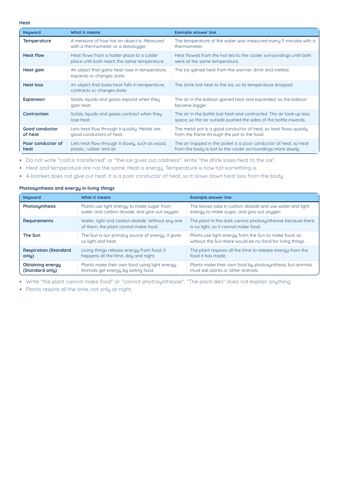
| Keyword | What it means | Example answer line |
|---|---|---|
| Temperature | A measure of how hot an object is. Measured with a thermometer or a datalogger. | The temperature of the water was measured every 5 minutes with a thermometer. |
| Heat flow | Heat flows from a hotter place to a colder place until both reach the same temperature. | Heat flowed from the hot tea to the cooler surroundings until both were at the same temperature. |
| Heat gain | An object that gains heat rises in temperature, expands or changes state. | The ice gained heat from the warmer drink and melted. |
| Heat loss | An object that loses heat falls in temperature, contracts or changes state. | The drink lost heat to the ice, so its temperature dropped. |
| Expansion | Solids, liquids and gases expand when they gain heat. | The air in the balloon gained heat and expanded, so the balloon became bigger. |
| Contraction | Solids, liquids and gases contract when they lose heat. | The air in the bottle lost heat and contracted. The air took up less space, so the air outside pushed the sides of the bottle inwards. |
| Good conductor of heat | Lets heat flow through it quickly. Metals are good conductors of heat. | The metal pot is a good conductor of heat, so heat flows quickly from the flame through the pot to the food. |
| Poor conductor of heat | Lets heat flow through it slowly, such as wood, plastic, rubber and air. | The air trapped in the jacket is a poor conductor of heat, so heat from the body is lost to the cooler surroundings more slowly. |
- Do not write "cold is transferred" or "the ice gives out coldness". Write "the drink loses heat to the ice".
- Heat and temperature are not the same. Heat is energy. Temperature is how hot something is.
- A blanket does not give out heat. It is a poor conductor of heat, so it slows down heat loss from the body.
| Keyword | What it means | Example answer line |
|---|---|---|
| Photosynthesis | Plants use light energy to make sugar from water and carbon dioxide, and give out oxygen. | The leaves take in carbon dioxide and use water and light energy to make sugar, and give out oxygen. |
| Requirements | Water, light and carbon dioxide. Without any one of them, the plant cannot make food. | The plant in the dark cannot photosynthesise because there is no light, so it cannot make food. |
| The Sun | The Sun is our primary source of energy. It gives us light and heat. | Plants use light energy from the Sun to make food, so without the Sun there would be no food for living things. |
| Respiration (Standard only) | Living things release energy from food. It happens all the time, day and night. | The plant respires all the time to release energy from the food it has made. |
| Obtaining energy (Standard only) | Plants make their own food using light energy. Animals get energy by eating food. | Plants make their own food by photosynthesis, but animals must eat plants or other animals. |
- Write "the plant cannot make food" or "cannot photosynthesise". "The plant dies" does not explain anything.
- Plants respire all the time, not only at night.
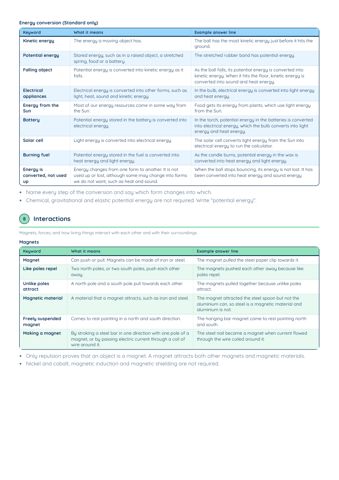
| Keyword | What it means | Example answer line |
|---|---|---|
| Kinetic energy | The energy a moving object has. | The ball has the most kinetic energy just before it hits the ground. |
| Potential energy | Stored energy, such as in a raised object, a stretched spring, food or a battery. | The stretched rubber band has potential energy. |
| Falling object | Potential energy is converted into kinetic energy as it falls. | As the ball falls, its potential energy is converted into kinetic energy. When it hits the floor, kinetic energy is converted into sound and heat energy. |
| Electrical appliances | Electrical energy is converted into other forms, such as light, heat, sound and kinetic energy. | In the bulb, electrical energy is converted into light energy and heat energy. |
| Energy from the Sun | Most of our energy resources come in some way from the Sun. | Food gets its energy from plants, which use light energy from the Sun. |
| Battery | Potential energy stored in the battery is converted into electrical energy. | In the torch, potential energy in the batteries is converted into electrical energy, which the bulb converts into light energy and heat energy. |
| Solar cell | Light energy is converted into electrical energy. | The solar cell converts light energy from the Sun into electrical energy to run the calculator. |
| Burning fuel | Potential energy stored in the fuel is converted into heat energy and light energy. | As the candle burns, potential energy in the wax is converted into heat energy and light energy. |
| Energy is converted, not used up | Energy changes from one form to another. It is not used up or lost, although some may change into forms we do not want, such as heat and sound. | When the ball stops bouncing, its energy is not lost. It has been converted into heat energy and sound energy. |
- Name every step of the conversion and say which form changes into which.
- Chemical, gravitational and elastic potential energy are not required. Write "potential energy".
Interactions
Magnets, forces, and how living things interact with each other and with their surroundings.
| Keyword | What it means | Example answer line |
|---|---|---|
| Magnet | Can push or pull. Magnets can be made of iron or steel. | The magnet pulled the steel paper clip towards it. |
| Like poles repel | Two north poles, or two south poles, push each other away. | The magnets pushed each other away because like poles repel. |
| Unlike poles attract | A north pole and a south pole pull towards each other. | The magnets pulled together because unlike poles attract. |
| Magnetic material | A material that a magnet attracts, such as iron and steel. | The magnet attracted the steel spoon but not the aluminium can, so steel is a magnetic material and aluminium is not. |
| Freely suspended magnet | Comes to rest pointing in a north and south direction. | The hanging bar magnet came to rest pointing north and south. |
| Making a magnet | By stroking a steel bar in one direction with one pole of a magnet, or by passing electric current through a coil of wire around it. | The steel nail became a magnet when current flowed through the wire coiled around it. |
- Only repulsion proves that an object is a magnet. A magnet attracts both other magnets and magnetic materials.
- Nickel and cobalt, magnetic induction and magnetic shielding are not required.
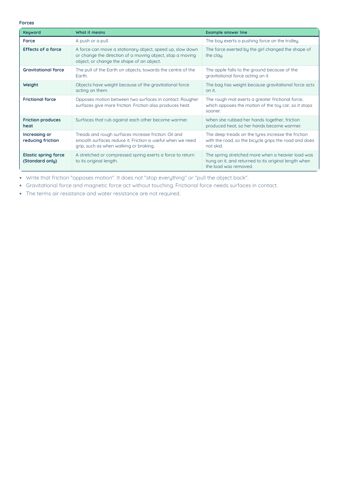
| Keyword | What it means | Example answer line |
|---|---|---|
| Force | A push or a pull. | The boy exerts a pushing force on the trolley. |
| Effects of a force | A force can move a stationary object, speed up, slow down or change the direction of a moving object, stop a moving object, or change the shape of an object. | The force exerted by the girl changed the shape of the clay. |
| Gravitational force | The pull of the Earth on objects, towards the centre of the Earth. | The apple falls to the ground because of the gravitational force acting on it. |
| Weight | Objects have weight because of the gravitational force acting on them. | The bag has weight because gravitational force acts on it. |
| Frictional force | Opposes motion between two surfaces in contact. Rougher surfaces give more friction. Friction also produces heat. | The rough mat exerts a greater frictional force, which opposes the motion of the toy car, so it stops sooner. |
| Friction produces heat | Surfaces that rub against each other become warmer. | When she rubbed her hands together, friction produced heat, so her hands became warmer. |
| Increasing or reducing friction | Treads and rough surfaces increase friction. Oil and smooth surfaces reduce it. Friction is useful when we need grip, such as when walking or braking. | The deep treads on the tyres increase the friction with the road, so the bicycle grips the road and does not skid. |
| Elastic spring force (Standard only) | A stretched or compressed spring exerts a force to return to its original length. | The spring stretched more when a heavier load was hung on it, and returned to its original length when the load was removed. |
- Write that friction "opposes motion". It does not "stop everything" or "pull the object back".
- Gravitational force and magnetic force act without touching. Frictional force needs surfaces in contact.
- The terms air resistance and water resistance are not required.
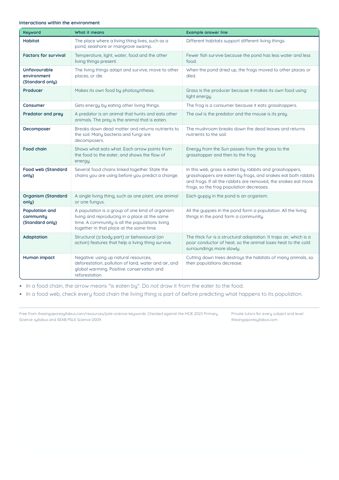
| Keyword | What it means | Example answer line |
|---|---|---|
| Habitat | The place where a living thing lives, such as a pond, seashore or mangrove swamp. | Different habitats support different living things. |
| Factors for survival | Temperature, light, water, food and the other living things present. | Fewer fish survive because the pond has less water and less food. |
| Unfavourable environment (Standard only) | The living things adapt and survive, move to other places, or die. | When the pond dried up, the frogs moved to other places or died. |
| Producer | Makes its own food by photosynthesis. | Grass is the producer because it makes its own food using light energy. |
| Consumer | Gets energy by eating other living things. | The frog is a consumer because it eats grasshoppers. |
| Predator and prey | A predator is an animal that hunts and eats other animals. The prey is the animal that is eaten. | The owl is the predator and the mouse is its prey. |
| Decomposer | Breaks down dead matter and returns nutrients to the soil. Many bacteria and fungi are decomposers. | The mushroom breaks down the dead leaves and returns nutrients to the soil. |
| Food chain | Shows what eats what. Each arrow points from the food to the eater, and shows the flow of energy. | Energy from the Sun passes from the grass to the grasshopper and then to the frog. |
| Food web (Standard only) | Several food chains linked together. State the chains you are using before you predict a change. | In this web, grass is eaten by rabbits and grasshoppers, grasshoppers are eaten by frogs, and snakes eat both rabbits and frogs. If all the rabbits are removed, the snakes eat more frogs, so the frog population decreases. |
| Organism (Standard only) | A single living thing, such as one plant, one animal or one fungus. | Each guppy in the pond is an organism. |
| Population and community (Standard only) | A population is a group of one kind of organism living and reproducing in a place at the same time. A community is all the populations living together in that place at the same time. | All the guppies in the pond form a population. All the living things in the pond form a community. |
| Adaptation | Structural (a body part) or behavioural (an action) features that help a living thing survive. | The thick fur is a structural adaptation. It traps air, which is a poor conductor of heat, so the animal loses heat to the cold surroundings more slowly. |
| Human impact | Negative: using up natural resources, deforestation, pollution of land, water and air, and global warming. Positive: conservation and reforestation. | Cutting down trees destroys the habitats of many animals, so their populations decrease. |
- In a food chain, the arrow means "is eaten by". Do not draw it from the eater to the food.
- In a food web, check every food chain the living thing is part of before predicting what happens to its population.
Inside the PDF
12 A4 pages, ready to print. Tap a page to open the PDF there.
Questions students ask
Do I need words like xylem, stomata and artery for PSLE Science?
No. The 2023 Primary Science syllabus says the terms xylem, phloem, stomata, artery, vein and capillary are not required. Write water-carrying tubes, food-carrying tubes, tiny openings on the leaves and blood vessels instead.
Is energy conversion tested in Foundation Science?
No. Energy Conversion has learning outcomes for Standard Science only. Elastic spring force, food webs, bulbs in parallel and the factors that affect evaporation are also Standard only. The keyword bank marks each of these.
What should I write when a question asks why an experiment is a fair test?
Say that only one variable was changed and name it. Then name at least two variables that were kept the same, such as the amount of water and the room temperature, so any difference in the results was caused by the changed variable.
Keep revising
- PSLE Science study guideTopic guides and the exam format
- PSLE Math FormulasPSLE (Primary 1 to 6) · free PDF
- PSLE English Composition PhrasesPSLE (Primary 5 and 6) · free PDF
- PSLE Chinese Composition Phrases (好词好句)PSLE (Primary 5 and 6) · free PDF
- PSLE Score calculatorAdd up the four AL grades
- All free resourcesPSLE, O-Level and A-Level
Source
- SEAB, PSLE Science (0009) for examination from 2026
- MOE, 2023 Primary Science Syllabus P3 to P6 (Standard and Foundation)
The keywords and answer lines are our own wording, checked against the 2023 MOE Primary Science syllabus. If anything here differs from the SEAB or MOE document, that document is right. Tell us and we will fix it.
Want a Science tutor?
Tell us the level and we send a shortlist of tutors on WhatsApp within 16 hours. You choose the tutor. About Science tuition