Free resource · PSLE (Primary 5 and 6)
PSLE English Composition Phrases: Free PDF
Good PSLE composition phrases show a feeling, a person or a place through actions and details instead of naming it. This list sorts over 150 phrases by theme, each with an original example sentence, from fear and relief to openings, endings and time connectors, with formal letter phrases for situational writing and sentence starters for the oral conversation.
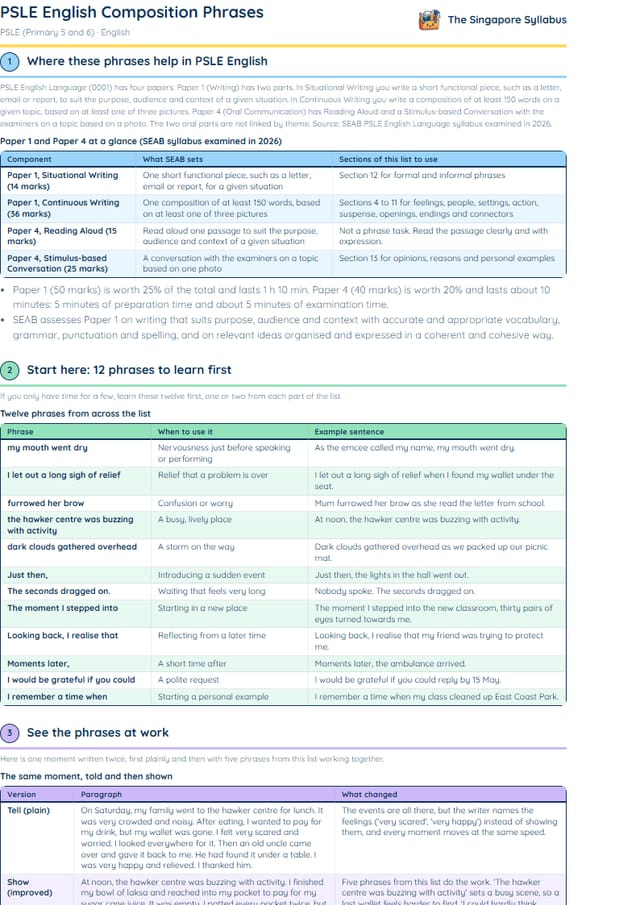
Where these phrases help in PSLE English
PSLE English Language (0001) has four papers. Paper 1 (Writing) has two parts. In Situational Writing you write a short functional piece, such as a letter, email or report, to suit the purpose, audience and context of a given situation. In Continuous Writing you write a composition of at least 150 words on a given topic, based on at least one of three pictures. Paper 4 (Oral Communication) has Reading Aloud and a Stimulus-based Conversation with the examiners on a topic based on a photo. The two oral parts are not linked by theme. Source: SEAB PSLE English Language syllabus examined in 2026.
| Component | What SEAB sets | Sections of this list to use |
|---|---|---|
| Paper 1, Situational Writing (14 marks) | One short functional piece, such as a letter, email or report, for a given situation | Section 12 for formal and informal phrases |
| Paper 1, Continuous Writing (36 marks) | One composition of at least 150 words, based on at least one of three pictures | Sections 4 to 11 for feelings, people, settings, action, suspense, openings, endings and connectors |
| Paper 4, Reading Aloud (15 marks) | Read aloud one passage to suit the purpose, audience and context of a given situation | Not a phrase task. Read the passage clearly and with expression. |
| Paper 4, Stimulus-based Conversation (25 marks) | A conversation with the examiners on a topic based on one photo | Section 13 for opinions, reasons and personal examples |
- Paper 1 (50 marks) is worth 25% of the total and lasts 1 h 10 min. Paper 4 (40 marks) is worth 20% and lasts about 10 minutes: 5 minutes of preparation time and about 5 minutes of examination time.
- SEAB assesses Paper 1 on writing that suits purpose, audience and context with accurate and appropriate vocabulary, grammar, punctuation and spelling, and on relevant ideas organised and expressed in a coherent and cohesive way.
Start here: 12 phrases to learn first
If you only have time for a few, learn these twelve first, one or two from each part of the list.
| Phrase | When to use it | Example sentence |
|---|---|---|
| my mouth went dry | Nervousness just before speaking or performing | As the emcee called my name, my mouth went dry. |
| I let out a long sigh of relief | Relief that a problem is over | I let out a long sigh of relief when I found my wallet under the seat. |
| furrowed her brow | Confusion or worry | Mum furrowed her brow as she read the letter from school. |
| the hawker centre was buzzing with activity | A busy, lively place | At noon, the hawker centre was buzzing with activity. |
| dark clouds gathered overhead | A storm on the way | Dark clouds gathered overhead as we packed up our picnic mat. |
| Just then, | Introducing a sudden event | Just then, the lights in the hall went out. |
| The seconds dragged on. | Waiting that feels very long | Nobody spoke. The seconds dragged on. |
| The moment I stepped into | Starting in a new place | The moment I stepped into the new classroom, thirty pairs of eyes turned towards me. |
| Looking back, I realise that | Reflecting from a later time | Looking back, I realise that my friend was trying to protect me. |
| Moments later, | A short time after | Moments later, the ambulance arrived. |
| I would be grateful if you could | A polite request | I would be grateful if you could reply by 15 May. |
| I remember a time when | Starting a personal example | I remember a time when my class cleaned up East Coast Park. |
See the phrases at work
Here is one moment written twice, first plainly and then with five phrases from this list working together.
| Version | Paragraph | What changed |
|---|---|---|
| Tell (plain) | On Saturday, my family went to the hawker centre for lunch. It was very crowded and noisy. After eating, I wanted to pay for my drink, but my wallet was gone. I felt very scared and worried. I looked everywhere for it. Then an old uncle came over and gave it back to me. He had found it under a table. I was very happy and relieved. I thanked him. | The events are all there, but the writer names the feelings ('very scared', 'very happy') instead of showing them, and every moment moves at the same speed. |
| Show (improved) | At noon, the hawker centre was buzzing with activity. I finished my bowl of laksa and reached into my pocket to pay for my sugar cane juice. It was empty. I patted every pocket twice, but I could hardly think straight. I checked under our table, then under the next one, while Mum asked the auntie at the drinks stall if anyone had handed in a blue wallet. The seconds dragged on. Just then, an elderly uncle in a faded cap shuffled over, holding something out to me. It was my wallet. I let out a long sigh of relief and thanked him twice before he waved me away with a smile. | Five phrases from this list do the work. 'The hawker centre was buzzing with activity' sets a busy scene, so a lost wallet feels harder to find. 'I could hardly think straight' shows the panic instead of 'I felt very scared and worried'. 'The seconds dragged on.' slows the story at the worst moment. 'Just then,' marks the turning point. 'I let out a long sigh of relief' replaces 'I was very happy and relieved'. Small details, such as the laksa and the faded cap, make it believable. |
Describing feelings
Show the feeling through the body, the face or an action, then let the reader work out the emotion. Pick the phrase that matches how strong the feeling really is.
| Phrase | When to use it | Example sentence |
|---|---|---|
| a chill ran down my spine | Sudden fear when something strange happens. Common, so use it once at most. | When the corridor lights flickered off, a chill ran down my spine. |
| I stopped walking and listened | A fresher way to show sudden fear | When the corridor lights flickered off, I stopped walking and listened for footsteps. |
| my mouth went dry | Nervousness just before speaking or performing | As the emcee called my name, my mouth went dry. |
| my palms were clammy | Nervous waiting | My palms were clammy as I queued outside the exam hall. |
| I froze on the spot | Shock so strong you cannot move | I froze on the spot when the stray dog bared its teeth at me. |
| butterflies in my stomach | Mild nervousness before an important or exciting event. Common, so use it once at most. | I had butterflies in my stomach before my first CCA performance. |
| I checked my costume for the third time | A fresher way to show nerves before an event | Before my first CCA performance, I checked my costume for the third time and still could not stand still. |
| my knees went weak | Fear that makes you unsteady | When I peered down from the top of the climbing wall, my knees went weak. |
| I held my breath | Tense waiting for news or a result | I held my breath as Mrs Tan read out the names of the winners. |
| my stomach tightened into a knot | Dread about something that is about to happen | My stomach tightened into a knot when I remembered the homework I had not done. |
| I could hardly think straight | Panic when things go wrong quickly | With the bus pulling away and my wallet gone, I could hardly think straight. |
| I bit my lip | Trying to stay calm or quiet while worried | I bit my lip and tried not to look at the cracked vase. |
| Phrase | When to use it | Example sentence |
|---|---|---|
| a broad grin spread across my face | Joy at good news | When I spotted my name on the list, a broad grin spread across my face. |
| I was walking on air | Happiness that lasts for a while afterwards. Common, so use it once at most. | For the rest of the day, I was walking on air. |
| I hummed the whole way home | A fresher way to show lasting happiness | I hummed the whole way home and even offered to wash the dishes. |
| I could not stop smiling | Quiet, lasting happiness | Even on the bus ride home, I could not stop smiling. |
| a wave of relief washed over me | Relief after fear or worry. Common, so use it once at most. | When the doctor said Grandma would be fine, a wave of relief washed over me. |
| my shoulders finally dropped | A fresher way to show relief | When the doctor said Grandma would be fine, my shoulders finally dropped and I noticed how tightly I had been gripping the chair. |
| I let out a long sigh of relief | Relief that a problem is over | I let out a long sigh of relief when I found my wallet under the seat. |
| a weight had been lifted off my shoulders | Relief after owning up or finishing a hard task. Common, so use it once at most. | After I told Dad the truth, I felt as if a weight had been lifted off my shoulders. |
| I slept properly for the first time that week | A fresher way to show relief after owning up | After I told Dad the truth, I slept properly for the first time that week. |
| I stood a little taller | Pride in yourself | As Coach placed the medal around my neck, I stood a little taller. |
| beamed with pride | Someone else's pride in you | Mum beamed with pride as I walked off the stage. |
| it was worth every drop of sweat | Pride after hard work pays off | Our team came in second, and all that training was worth every drop of sweat. |
| Phrase | When to use it | Example sentence |
|---|---|---|
| I clenched my fists | Anger that you hold back | I clenched my fists as the older boys laughed at my brother. |
| my face grew hot | Anger or embarrassment | My face grew hot when the whole class turned to stare at me. |
| I bit back an angry reply | Choosing not to say something rude | I bit back an angry reply and walked away. |
| my heart sank | Sudden disappointment. Common, so use it once at most. | My heart sank when I saw the red marks all over my test paper. |
| I stared at the red 12/40 until the numbers blurred | A fresher way to show disappointment | When Mrs Tan returned our test papers, I stared at the red 12/40 until the numbers blurred. |
| a lump formed in my throat | Sadness when you are trying not to cry | A lump formed in my throat as we waved goodbye to our form teacher. |
| tears welled up in my eyes | Sadness that is about to show | Tears welled up in my eyes when I saw my torn drawing on the floor. |
| I could not meet her eyes | Guilt or shame in front of someone | When Mei Ling asked who had taken her pencil case, I could not meet her eyes. |
| a pang of guilt | A short, sharp feeling of guilt | I felt a pang of guilt as Ahmad searched his bag for the notes I had borrowed. |
| my conscience would not let me rest | Guilt that lasts until you act | That night, my conscience would not let me rest, so I decided to own up. |
| my jaw dropped | Great surprise. Common, so use it once at most. | My jaw dropped when I saw the whole family waiting behind the door. |
| I stood there with my school bag still on | A fresher way to show great surprise | When I saw the whole family waiting in the living room, I stood there with my school bag still on, unable to say a word. |
| I stared in disbelief | Surprise at something hard to believe | I stared in disbelief at the hundred-dollar note on the pavement. |
| I was caught off guard | An unexpected question or event | I was caught off guard when the principal asked me to speak at assembly. |
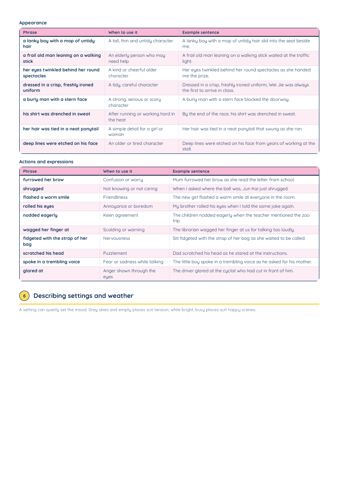
Describing people
Choose one or two details that matter to the story instead of describing a character from head to toe.
| Phrase | When to use it | Example sentence |
|---|---|---|
| a lanky boy with a mop of untidy hair | A tall, thin and untidy character | A lanky boy with a mop of untidy hair slid into the seat beside me. |
| a frail old man leaning on a walking stick | An elderly person who may need help | A frail old man leaning on a walking stick waited at the traffic light. |
| her eyes twinkled behind her round spectacles | A kind or cheerful older character | Her eyes twinkled behind her round spectacles as she handed me the prize. |
| dressed in a crisp, freshly ironed uniform | A tidy, careful character | Dressed in a crisp, freshly ironed uniform, Wei Jie was always the first to arrive in class. |
| a burly man with a stern face | A strong, serious or scary character | A burly man with a stern face blocked the doorway. |
| his shirt was drenched in sweat | After running or working hard in the heat | By the end of the race, his shirt was drenched in sweat. |
| her hair was tied in a neat ponytail | A simple detail for a girl or woman | Her hair was tied in a neat ponytail that swung as she ran. |
| deep lines were etched on his face | An older or tired character | Deep lines were etched on his face from years of working at the stall. |
| Phrase | When to use it | Example sentence |
|---|---|---|
| furrowed her brow | Confusion or worry | Mum furrowed her brow as she read the letter from school. |
| shrugged | Not knowing or not caring | When I asked where the ball was, Jun Kai just shrugged. |
| flashed a warm smile | Friendliness | The new girl flashed a warm smile at everyone in the room. |
| rolled his eyes | Annoyance or boredom | My brother rolled his eyes when I told the same joke again. |
| nodded eagerly | Keen agreement | The children nodded eagerly when the teacher mentioned the zoo trip. |
| wagged her finger at | Scolding or warning | The librarian wagged her finger at us for talking too loudly. |
| fidgeted with the strap of her bag | Nervousness | Siti fidgeted with the strap of her bag as she waited to be called. |
| scratched his head | Puzzlement | Dad scratched his head as he stared at the instructions. |
| spoke in a trembling voice | Fear or sadness while talking | The little boy spoke in a trembling voice as he asked for his mother. |
| glared at | Anger shown through the eyes | The driver glared at the cyclist who had cut in front of him. |
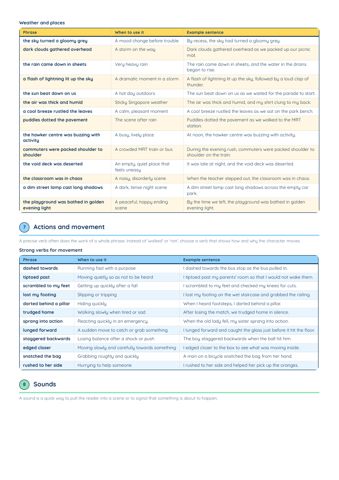
Describing settings and weather
A setting can quietly set the mood. Grey skies and empty places suit tension, while bright, busy places suit happy scenes.
| Phrase | When to use it | Example sentence |
|---|---|---|
| the sky turned a gloomy grey | A mood change before trouble | By recess, the sky had turned a gloomy grey. |
| dark clouds gathered overhead | A storm on the way | Dark clouds gathered overhead as we packed up our picnic mat. |
| the rain came down in sheets | Very heavy rain | The rain came down in sheets, and the water in the drains began to rise. |
| a flash of lightning lit up the sky | A dramatic moment in a storm | A flash of lightning lit up the sky, followed by a loud clap of thunder. |
| the sun beat down on us | A hot day outdoors | The sun beat down on us as we waited for the parade to start. |
| the air was thick and humid | Sticky Singapore weather | The air was thick and humid, and my shirt clung to my back. |
| a cool breeze rustled the leaves | A calm, pleasant moment | A cool breeze rustled the leaves as we sat on the park bench. |
| puddles dotted the pavement | The scene after rain | Puddles dotted the pavement as we walked to the MRT station. |
| the hawker centre was buzzing with activity | A busy, lively place | At noon, the hawker centre was buzzing with activity. |
| commuters were packed shoulder to shoulder | A crowded MRT train or bus | During the evening rush, commuters were packed shoulder to shoulder on the train. |
| the void deck was deserted | An empty, quiet place that feels uneasy | It was late at night, and the void deck was deserted. |
| the classroom was in chaos | A noisy, disorderly scene | When the teacher stepped out, the classroom was in chaos. |
| a dim street lamp cast long shadows | A dark, tense night scene | A dim street lamp cast long shadows across the empty car park. |
| the playground was bathed in golden evening light | A peaceful, happy ending scene | By the time we left, the playground was bathed in golden evening light. |
Actions and movement
A precise verb often does the work of a whole phrase. Instead of 'walked' or 'ran', choose a verb that shows how and why the character moves.
| Phrase | When to use it | Example sentence |
|---|---|---|
| dashed towards | Running fast with a purpose | I dashed towards the bus stop as the bus pulled in. |
| tiptoed past | Moving quietly so as not to be heard | I tiptoed past my parents' room so that I would not wake them. |
| scrambled to my feet | Getting up quickly after a fall | I scrambled to my feet and checked my knees for cuts. |
| lost my footing | Slipping or tripping | I lost my footing on the wet staircase and grabbed the railing. |
| darted behind a pillar | Hiding quickly | When I heard footsteps, I darted behind a pillar. |
| trudged home | Walking slowly when tired or sad | After losing the match, we trudged home in silence. |
| sprang into action | Reacting quickly in an emergency | When the old lady fell, my sister sprang into action. |
| lunged forward | A sudden move to catch or grab something | I lunged forward and caught the glass just before it hit the floor. |
| staggered backwards | Losing balance after a shock or push | The boy staggered backwards when the ball hit him. |
| edged closer | Moving slowly and carefully towards something | I edged closer to the box to see what was moving inside. |
| snatched the bag | Grabbing roughly and quickly | A man on a bicycle snatched the bag from her hand. |
| rushed to her side | Hurrying to help someone | I rushed to her side and helped her pick up the oranges. |
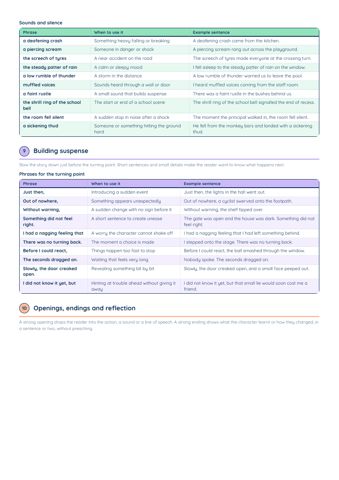
Sounds
A sound is a quick way to pull the reader into a scene or to signal that something is about to happen.
| Phrase | When to use it | Example sentence |
|---|---|---|
| a deafening crash | Something heavy falling or breaking | A deafening crash came from the kitchen. |
| a piercing scream | Someone in danger or shock | A piercing scream rang out across the playground. |
| the screech of tyres | A near accident on the road | The screech of tyres made everyone at the crossing turn. |
| the steady patter of rain | A calm or sleepy mood | I fell asleep to the steady patter of rain on the window. |
| a low rumble of thunder | A storm in the distance | A low rumble of thunder warned us to leave the pool. |
| muffled voices | Sounds heard through a wall or door | I heard muffled voices coming from the staff room. |
| a faint rustle | A small sound that builds suspense | There was a faint rustle in the bushes behind us. |
| the shrill ring of the school bell | The start or end of a school scene | The shrill ring of the school bell signalled the end of recess. |
| the room fell silent | A sudden stop in noise after a shock | The moment the principal walked in, the room fell silent. |
| a sickening thud | Someone or something hitting the ground hard | He fell from the monkey bars and landed with a sickening thud. |
Building suspense
Slow the story down just before the turning point. Short sentences and small details make the reader want to know what happens next.
| Phrase | When to use it | Example sentence |
|---|---|---|
| Just then, | Introducing a sudden event | Just then, the lights in the hall went out. |
| Out of nowhere, | Something appears unexpectedly | Out of nowhere, a cyclist swerved onto the footpath. |
| Without warning, | A sudden change with no sign before it | Without warning, the shelf tipped over. |
| Something did not feel right. | A short sentence to create unease | The gate was open and the house was dark. Something did not feel right. |
| I had a nagging feeling that | A worry the character cannot shake off | I had a nagging feeling that I had left something behind. |
| There was no turning back. | The moment a choice is made | I stepped onto the stage. There was no turning back. |
| Before I could react, | Things happen too fast to stop | Before I could react, the ball smashed through the window. |
| The seconds dragged on. | Waiting that feels very long | Nobody spoke. The seconds dragged on. |
| Slowly, the door creaked open. | Revealing something bit by bit | Slowly, the door creaked open, and a small face peeped out. |
| I did not know it yet, but | Hinting at trouble ahead without giving it away | I did not know it yet, but that small lie would soon cost me a friend. |
Openings, endings and reflection
A strong opening drops the reader into the action, a sound or a line of speech. A strong ending shows what the character learnt or how they changed, in a sentence or two, without preaching.
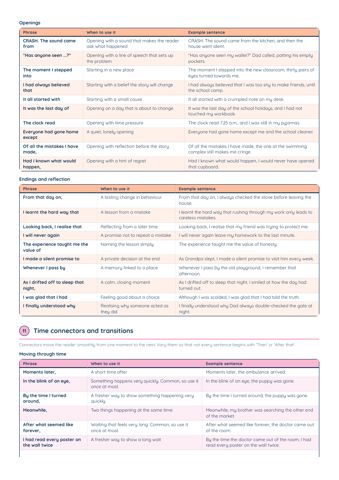
| Phrase | When to use it | Example sentence |
|---|---|---|
| CRASH. The sound came from | Opening with a sound that makes the reader ask what happened | CRASH. The sound came from the kitchen, and then the house went silent. |
| "Has anyone seen ...?" | Opening with a line of speech that sets up the problem | "Has anyone seen my wallet?" Dad called, patting his empty pockets. |
| The moment I stepped into | Starting in a new place | The moment I stepped into the new classroom, thirty pairs of eyes turned towards me. |
| I had always believed that | Starting with a belief the story will change | I had always believed that I was too shy to make friends, until the school camp. |
| It all started with | Starting with a small cause | It all started with a crumpled note on my desk. |
| It was the last day of | Opening on a day that is about to change | It was the last day of the school holidays, and I had not touched my workbook. |
| The clock read | Opening with time pressure | The clock read 7.25 a.m., and I was still in my pyjamas. |
| Everyone had gone home except | A quiet, lonely opening | Everyone had gone home except me and the school cleaner. |
| Of all the mistakes I have made, | Opening with reflection before the story | Of all the mistakes I have made, the one at the swimming complex still makes me cringe. |
| Had I known what would happen, | Opening with a hint of regret | Had I known what would happen, I would never have opened that cupboard. |
| Phrase | When to use it | Example sentence |
|---|---|---|
| From that day on, | A lasting change in behaviour | From that day on, I always checked the stove before leaving the house. |
| I learnt the hard way that | A lesson from a mistake | I learnt the hard way that rushing through my work only leads to careless mistakes. |
| Looking back, I realise that | Reflecting from a later time | Looking back, I realise that my friend was trying to protect me. |
| I will never again | A promise not to repeat a mistake | I will never again leave my homework to the last minute. |
| The experience taught me the value of | Naming the lesson simply | The experience taught me the value of honesty. |
| I made a silent promise to | A private decision at the end | As Grandpa slept, I made a silent promise to visit him every week. |
| Whenever I pass by | A memory linked to a place | Whenever I pass by the old playground, I remember that afternoon. |
| As I drifted off to sleep that night, | A calm, closing moment | As I drifted off to sleep that night, I smiled at how the day had turned out. |
| I was glad that I had | Feeling good about a choice | Although I was scolded, I was glad that I had told the truth. |
| I finally understood why | Realising why someone acted as they did | I finally understood why Dad always double-checked the gate at night. |
Time connectors and transitions
Connectors move the reader smoothly from one moment to the next. Vary them so that not every sentence begins with 'Then' or 'After that'.
| Phrase | When to use it | Example sentence |
|---|---|---|
| Moments later, | A short time after | Moments later, the ambulance arrived. |
| In the blink of an eye, | Something happens very quickly. Common, so use it once at most. | In the blink of an eye, the puppy was gone. |
| By the time I turned around, | A fresher way to show something happening very quickly | By the time I turned around, the puppy was gone. |
| Meanwhile, | Two things happening at the same time | Meanwhile, my brother was searching the other end of the market. |
| After what seemed like forever, | Waiting that feels very long. Common, so use it once at most. | After what seemed like forever, the doctor came out of the room. |
| I had read every poster on the wall twice | A fresher way to show a long wait | By the time the doctor came out of the room, I had read every poster on the wall twice. |
| By the time | One event finishes before another | By the time we reached the hall, the concert had started. |
| As soon as | One action follows straight after another | As soon as the bell rang, we raced to the canteen. |
| No sooner had ... than | A formal way to say one thing happened right after another | No sooner had I sat down than the teacher called my name. |
| Later that evening, | Moving to a new scene the same day | Later that evening, I told Mum everything. |
| The next morning, | Moving to the following day | The next morning, there was a note on my desk. |
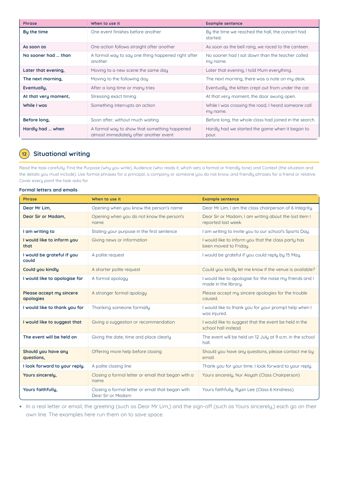
| Eventually, | After a long time or many tries | Eventually, the kitten crept out from under the car. |
| At that very moment, | Stressing exact timing | At that very moment, the door swung open. |
| While I was | Something interrupts an action | While I was crossing the road, I heard someone call my name. |
| Before long, | Soon after, without much waiting | Before long, the whole class had joined in the search. |
| Hardly had ... when | A formal way to show that something happened almost immediately after another event | Hardly had we started the game when it began to pour. |
Situational writing
Read the task carefully. Find the Purpose (why you write), Audience (who reads it, which sets a formal or friendly tone) and Context (the situation and the details you must include). Use formal phrases for a principal, a company or someone you do not know, and friendly phrases for a friend or relative. Cover every point the task asks for.
| Phrase | When to use it | Example sentence |
|---|---|---|
| Dear Mr Lim, | Opening when you know the person's name | Dear Mr Lim, I am the class chairperson of 6 Integrity. |
| Dear Sir or Madam, | Opening when you do not know the person's name | Dear Sir or Madam, I am writing about the lost item I reported last week. |
| I am writing to | Stating your purpose in the first sentence | I am writing to invite you to our school's Sports Day. |
| I would like to inform you that | Giving news or information | I would like to inform you that the class party has been moved to Friday. |
| I would be grateful if you could | A polite request | I would be grateful if you could reply by 15 May. |
| Could you kindly | A shorter polite request | Could you kindly let me know if the venue is available? |
| I would like to apologise for | A formal apology | I would like to apologise for the noise my friends and I made in the library. |
| Please accept my sincere apologies | A stronger formal apology | Please accept my sincere apologies for the trouble caused. |
| I would like to thank you for | Thanking someone formally | I would like to thank you for your prompt help when I was injured. |
| I would like to suggest that | Giving a suggestion or recommendation | I would like to suggest that the event be held in the school hall instead. |
| The event will be held on | Giving the date, time and place clearly | The event will be held on 12 July at 9 a.m. in the school hall. |
| Should you have any questions, | Offering more help before closing | Should you have any questions, please contact me by email. |
| I look forward to your reply. | A polite closing line | Thank you for your time. I look forward to your reply. |
| Yours sincerely, | Closing a formal letter or email that began with a name | Yours sincerely, Nur Aisyah (Class Chairperson) |
| Yours faithfully, | Closing a formal letter or email that began with Dear Sir or Madam | Yours faithfully, Ryan Lee (Class 6 Kindness) |
- In a real letter or email, the greeting (such as Dear Mr Lim,) and the sign-off (such as Yours sincerely,) each go on their own line. The examples here run them on to save space.
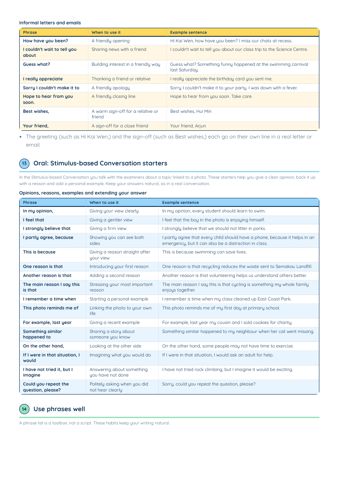
| Phrase | When to use it | Example sentence |
|---|---|---|
| How have you been? | A friendly opening | Hi Kai Wen, how have you been? I miss our chats at recess. |
| I couldn't wait to tell you about | Sharing news with a friend | I couldn't wait to tell you about our class trip to the Science Centre. |
| Guess what? | Building interest in a friendly way | Guess what? Something funny happened at the swimming carnival last Saturday. |
| I really appreciate | Thanking a friend or relative | I really appreciate the birthday card you sent me. |
| Sorry I couldn't make it to | A friendly apology | Sorry I couldn't make it to your party. I was down with a fever. |
| Hope to hear from you soon. | A friendly closing line | Hope to hear from you soon. Take care. |
| Best wishes, | A warm sign-off for a relative or friend | Best wishes, Hui Min |
| Your friend, | A sign-off for a close friend | Your friend, Arjun |
- The greeting (such as Hi Kai Wen,) and the sign-off (such as Best wishes,) each go on their own line in a real letter or email.
Oral: Stimulus-based Conversation starters
In the Stimulus-based Conversation you talk with the examiners about a topic linked to a photo. These starters help you give a clear opinion, back it up with a reason and add a personal example. Keep your answers natural, as in a real conversation.
| Phrase | When to use it | Example sentence |
|---|---|---|
| In my opinion, | Giving your view clearly | In my opinion, every student should learn to swim. |
| I feel that | Giving a gentler view | I feel that the boy in the photo is enjoying himself. |
| I strongly believe that | Giving a firm view | I strongly believe that we should not litter in parks. |
| I partly agree, because | Showing you can see both sides | I partly agree that every child should have a phone, because it helps in an emergency, but it can also be a distraction in class. |
| This is because | Giving a reason straight after your view | This is because swimming can save lives. |
| One reason is that | Introducing your first reason | One reason is that recycling reduces the waste sent to Semakau Landfill. |
| Another reason is that | Adding a second reason | Another reason is that volunteering helps us understand others better. |
| The main reason I say this is that | Stressing your most important reason | The main reason I say this is that cycling is something my whole family enjoys together. |
| I remember a time when | Starting a personal example | I remember a time when my class cleaned up East Coast Park. |
| This photo reminds me of | Linking the photo to your own life | This photo reminds me of my first day at primary school. |
| For example, last year | Giving a recent example | For example, last year my cousin and I sold cookies for charity. |
| Something similar happened to | Sharing a story about someone you know | Something similar happened to my neighbour when her cat went missing. |
| On the other hand, | Looking at the other side | On the other hand, some people may not have time to exercise. |
| If I were in that situation, I would | Imagining what you would do | If I were in that situation, I would ask an adult for help. |
| I have not tried it, but I imagine | Answering about something you have not done | I have not tried rock climbing, but I imagine it would be exciting. |
| Could you repeat the question, please? | Politely asking when you did not hear clearly | Sorry, could you repeat the question, please? |
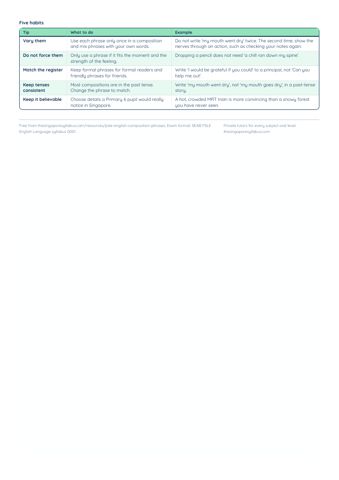
Use phrases well
A phrase list is a toolbox, not a script. These habits keep your writing natural.
| Tip | What to do | Example |
|---|---|---|
| Vary them | Use each phrase only once in a composition and mix phrases with your own words. | Do not write 'my mouth went dry' twice. The second time, show the nerves through an action, such as checking your notes again. |
| Do not force them | Only use a phrase if it fits the moment and the strength of the feeling. | Dropping a pencil does not need 'a chill ran down my spine'. |
| Match the register | Keep formal phrases for formal readers and friendly phrases for friends. | Write 'I would be grateful if you could' to a principal, not 'Can you help me out'. |
| Keep tenses consistent | Most compositions are in the past tense. Change the phrase to match. | Write 'my mouth went dry', not 'my mouth goes dry', in a past-tense story. |
| Keep it believable | Choose details a Primary 6 pupil would really notice in Singapore. | A hot, crowded MRT train is more convincing than a snowy forest you have never seen. |
Inside the PDF
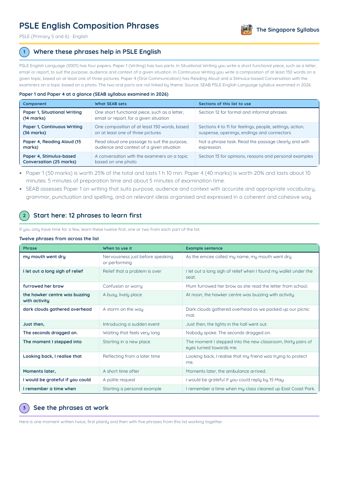
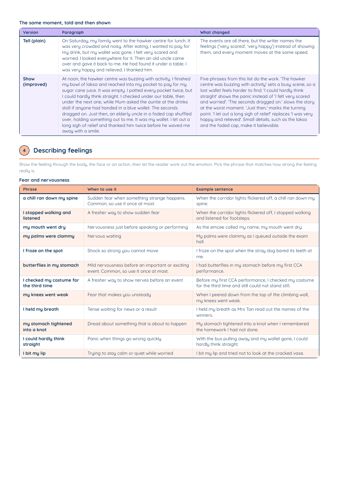
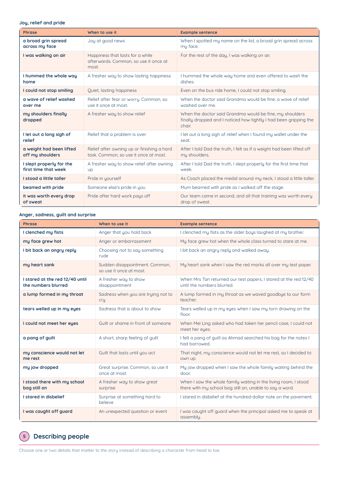
10 A4 pages, ready to print. Tap a page to open the PDF there.
Questions students ask
Will memorising phrases get me more marks for PSLE composition?
Only if they fit. SEAB assesses whether your writing suits the purpose, audience and context and uses accurate and appropriate vocabulary. Two or three phrases that match your story work better than a long list squeezed in.
How long must a PSLE English composition be?
The SEAB syllabus examined in 2026 asks for at least 150 words of continuous prose on a given topic. Three pictures are provided and the composition must be based on at least one of them.
Can I use these phrases in the PSLE English oral?
Yes. The last section gives sentence starters for the Stimulus-based Conversation, where you talk with the examiners on a topic based on a photo. Use them to give an opinion, a reason and a personal example in your own words.
Keep revising
- PSLE English study guidePSLE English exam format and tips
- PSLE Math FormulasPSLE (Primary 1 to 6) · free PDF
- PSLE Chinese Composition Phrases (好词好句)PSLE (Primary 5 and 6) · free PDF
- PSLE Science KeywordsPSLE (Primary 3 to 6) · free PDF
- PSLE Score calculatorAdd up the four AL grades
- All free resourcesPSLE, O-Level and A-Level
Source
- SEAB, PSLE English Language syllabus 0001 (examined in 2026), Examination Format
- SEAB, PSLE formats examined in 2026
The phrases and example sentences are our own. The exam format details come from the SEAB syllabus, and if they differ, the SEAB document is right. Tell us and we will fix it.
Want an English tutor?
Tell us the level and we send a shortlist of tutors on WhatsApp within 16 hours. You choose the tutor. About English tuition