Free resource · PSLE (Primary 1 to 6)
PSLE Math Formulas for PSLE 2027: Full List and Free PDF
There is no formula sheet in the PSLE Mathematics paper (0008), so pupils must recall every formula themselves. They need to know the formulas for perimeter, area and volume, the circumference and area of a circle, the angle facts for triangles and quadrilaterals, and the rules for fractions, percentage, ratio, rate and average. Calculators are allowed in Paper 2 only, not in Paper 1.
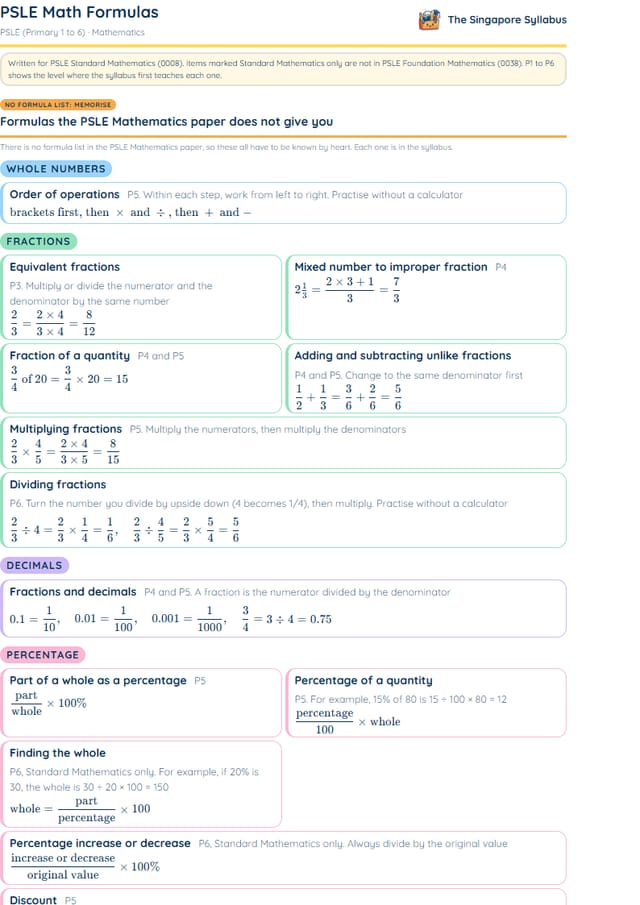
Written for PSLE Standard Mathematics (0008). Items marked Standard Mathematics only are not in PSLE Foundation Mathematics (0038). P1 to P6 shows the level where the syllabus first teaches each one.
No formula list: memorise
Formulas the PSLE Mathematics paper does not give you
There is no formula list in the PSLE Mathematics paper, so these all have to be known by heart. Each one is in the syllabus.
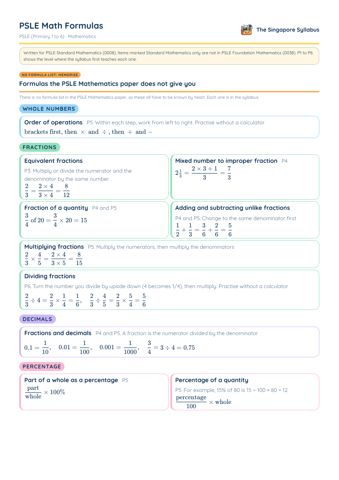
Whole numbers
- Order of operationsP5. Within each step, work from left to right. Practise without a calculator
Fractions
- Equivalent fractionsP3. Multiply or divide the numerator and the denominator by the same number
- Mixed number to improper fractionP4
- Fraction of a quantityP4 and P5
- Adding and subtracting unlike fractionsP4 and P5. Change to the same denominator first
- Multiplying fractionsP5. Multiply the numerators, then multiply the denominators
- Dividing fractionsP6. Turn the number you divide by upside down (4 becomes 1/4), then multiply. Practise without a calculator
Decimals
- Fractions and decimalsP4 and P5. A fraction is the numerator divided by the denominator
Percentage
- Part of a whole as a percentageP5
- Percentage of a quantityP5. For example, 15% of 80 is 15 ÷ 100 × 80 = 12
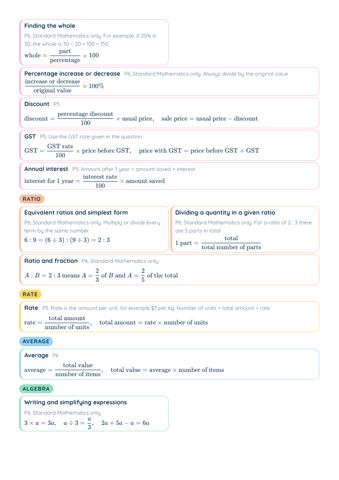
- Finding the wholeP6, Standard Mathematics only. For example, if 20% is 30, the whole is 30 ÷ 20 × 100 = 150
- Percentage increase or decreaseP6, Standard Mathematics only. Always divide by the original value
- DiscountP5
- GSTP5. Use the GST rate given in the question
- Annual interestP5. Amount after 1 year = amount saved + interest
Ratio
- Equivalent ratios and simplest formP6, Standard Mathematics only. Multiply or divide every term by the same number
- Dividing a quantity in a given ratioP6, Standard Mathematics only. For a ratio of 2 : 3 there are 5 parts in total
- Ratio and fractionP6, Standard Mathematics only
Rate
- RateP5. Rate is the amount per unit, for example $3 per kg. Number of units = total amount ÷ rate
Average
- AverageP6
Algebra
- Writing and simplifying expressionsP6, Standard Mathematics only
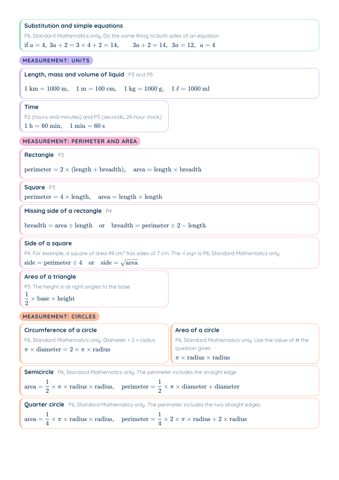
- Substitution and simple equationsP6, Standard Mathematics only. Do the same thing to both sides of an equation
Measurement: units
- Length, mass and volume of liquidP3 and P5
- TimeP2 (hours and minutes) and P3 (seconds, 24-hour clock)
Measurement: perimeter and area
- RectangleP3
- SquareP3
- Missing side of a rectangleP4
- Side of a squareP4. For example, a square of area 49 cm² has sides of 7 cm. The √ sign is P6, Standard Mathematics only
- Area of a triangleP5. The height is at right angles to the base
Measurement: circles
- Circumference of a circleP6, Standard Mathematics only. Diameter = 2 × radius
- Area of a circleP6, Standard Mathematics only. Use the value of π the question gives
- SemicircleP6, Standard Mathematics only. The perimeter includes the straight edge
- Quarter circleP6, Standard Mathematics only. The perimeter includes the two straight edges
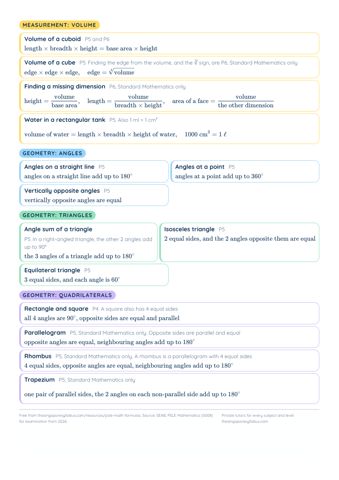
Measurement: volume
- Volume of a cuboidP5 and P6
- Volume of a cubeP5. Finding the edge from the volume, and the ∛ sign, are P6, Standard Mathematics only
- Finding a missing dimensionP6, Standard Mathematics only
- Water in a rectangular tankP5. Also 1 ml = 1 cm³
Geometry: angles
- Angles on a straight lineP5
- Angles at a pointP5
- Vertically opposite anglesP5
Geometry: triangles
- Angle sum of a triangleP5. In a right-angled triangle, the other 2 angles add up to 90°
- Isosceles triangleP5
- Equilateral triangleP5
Geometry: quadrilaterals
- Rectangle and squareP4. A square also has 4 equal sides
- ParallelogramP5, Standard Mathematics only. Opposite sides are parallel and equal
- RhombusP5, Standard Mathematics only. A rhombus is a parallelogram with 4 equal sides
- TrapeziumP5, Standard Mathematics only
Download the free PDFPDF · 4 pages · A4 portrait · free, no sign-up
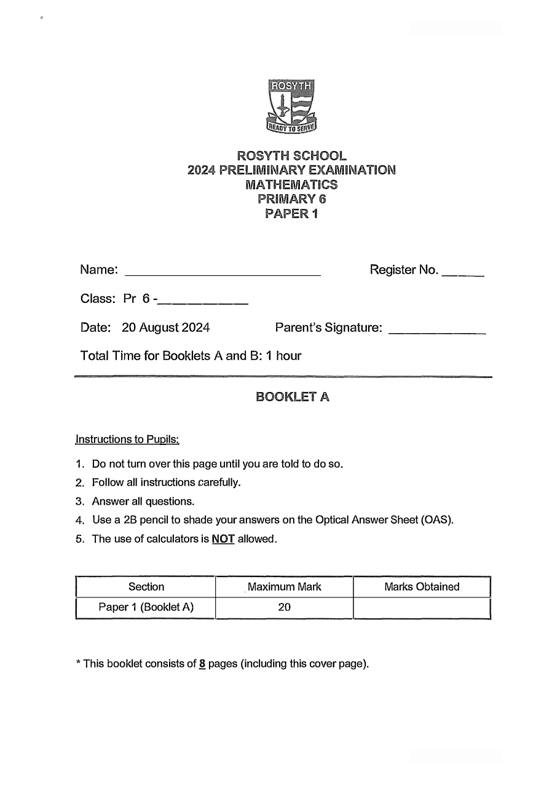
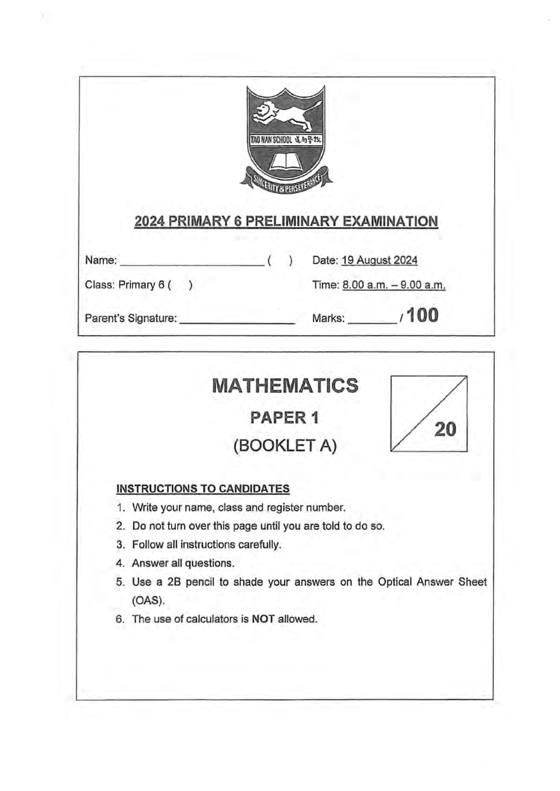
Real school papersNow practise with real PSLE Maths papers252 primary papers in Maths and Science and 119 secondary papers in E-Math, A-Math, Physics, Chemistry and Biology, set by Singapore schools. Most come with answers.See all 371 papers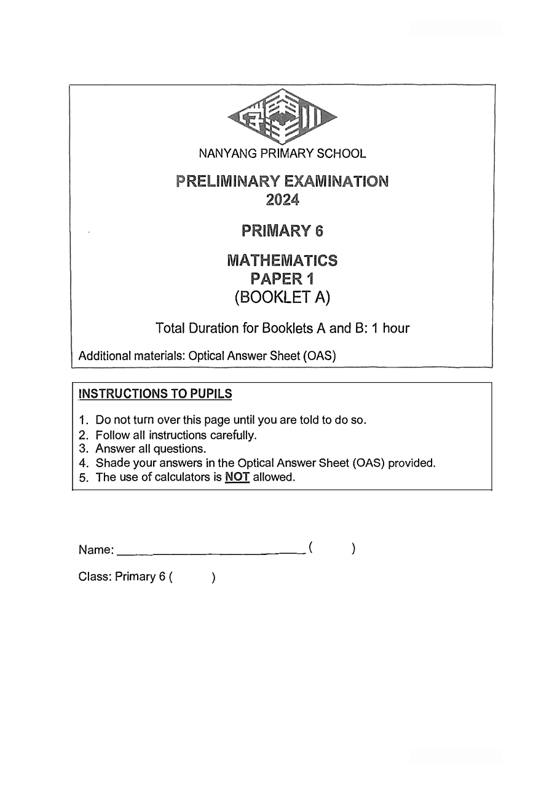
Questions students ask
What changed in PSLE Math from 2026?
From 2026 the PSLE Mathematics paper follows the 2021 syllabus. Speed is no longer tested, and neither is the area of a parallelogram or a trapezium. The format changed too. Paper 1 is now 50 marks in 1 hour 10 minutes, with no calculator, and Paper 2 is 50 marks in 1 hour 20 minutes, with a calculator. Before 2026 Paper 1 had 45 marks in 1 hour and Paper 2 had 55 marks in 1 hour 30 minutes.
Is a formula sheet given in PSLE Math?
No. The SEAB exam format for PSLE Mathematics (0008) does not include a list of formulae, and its first assessment objective asks pupils to "recall mathematical facts, concepts, rules and formulae". Every formula on this page has to be learnt by heart.
Can I use a calculator in PSLE Math?
Only in Paper 2. Paper 1 has two booklets and calculators are not allowed. Paper 2 has one booklet and calculators are allowed. The syllabus also lists some skills, such as the order of operations and dividing fractions, as done without a calculator, so practise these by hand.
Which value of π should I use in PSLE Math?
Neither the SEAB exam format nor the MOE syllabus fixes one value of π. Read each circle question carefully and use the value of π that the question tells you to use.
Is speed in the PSLE Math syllabus?
No. The 2021 Primary Mathematics syllabus, which applies to Primary 6 from 2026, does not list speed. It covers rate instead, as the amount of a quantity per unit of another quantity, from Primary 5. The area of a parallelogram or a trapezium is not listed either.
Is this sheet for Foundation Mathematics too?
Mostly. It is written for PSLE Standard Mathematics (0008). Items marked Standard Mathematics only, such as ratio, algebra, circles and the properties of a parallelogram, rhombus and trapezium, are not in PSLE Foundation Mathematics (0038). Everything else applies to both.
Keep revising
- PSLE Math study guideA guide for every syllabus topic
- Primary 6 Maths tuitionThe PSLE paper format and a 2027 year plan
- PSLE English Composition PhrasesPSLE (Primary 5 and 6) · free PDF
- PSLE Chinese Composition Phrases (好词好句)PSLE (Primary 5 and 6) · free PDF
- PSLE Science KeywordsPSLE (Primary 3 to 6) · free PDF
- PSLE Score calculatorAdd up the four AL grades
- All free resourcesPSLE, O-Level and A-Level
Source
- SEAB, PSLE Mathematics (0008) for examination from 2026
- MOE, 2021 Primary Mathematics Syllabus P1 to P6
The exam paper itself is what counts on the day. If anything here differs from the SEAB document, the SEAB document is right. Tell us and we will fix it.