Free resource · Primary 6 (PSLE)
PSLE Vocabulary List with Meanings (P6): Free PDF
SEAB does not publish a PSLE vocabulary list. Vocabulary is tested in PSLE English Paper 2 through 5 vocabulary multiple-choice questions, a 5-item vocabulary cloze and a 10-item editing section for spelling and grammar, and in the writing paper. This free list gives 200 Primary 6 words in 20 themed lists, each with a meaning and an example sentence, plus 60 practice questions in the PSLE format with answers, word partners, context clues and a term-by-term plan that finishes every list by the end of Term 3, before the PSLE written papers in late September.
About this list
MOE does not publish a national spelling list, and each school sets its own weekly lists. This is TSS's own list for Primary 6, pitched to the level using the MOE English Language Syllabus 2020. Use it alongside your child's school list. Everything on this page, including the practice and answers, is in the free PDF from the button at the top, ready to print.
| Point | What it means for you |
|---|---|
| National spelling list | MOE does not publish a national spelling list. Schools set their own spelling lists, so the list your child brings home will be different from this one. |
| Your school's own list | Some schools post their weekly lists on the school website or class portal. Learn that list first, as the school test uses it. |
| Mother Tongue lists | Mother Tongue spelling lists, such as tingxie for Chinese, are set by schools too. This page covers English only. |
| MOE English Language Syllabus 2020 | For P5 and P6, the syllabus asks pupils to apply spelling skills to frequently misspelled and multisyllabic words, and to build vocabulary by examining how words are formed, how they relate to one another and how they are used in context. |
| Foundation or Standard | In P5 and P6, English is taken at Foundation or Standard level, depending on P4 school exam results. This list is pitched at Standard English. A child taking Foundation English can start with the Primary 4 list and move up. |
| PSLE English | Spelling and vocabulary are assessed in Paper 1 (Writing) and Paper 2 (Language Use and Comprehension). The next section shows where. |
| This list | TSS's own 200 words for Primary 6, in 20 themed lists of 10 across Terms 1 to 3, so all of them are done before the PSLE written papers, plus 10 challenge words. Every word has a short meaning and an example sentence written by TSS. MOE and SEAB did not issue this list. |
- The list uses British spelling, such as colour, favourite and neighbour, as MOE's own syllabus documents do.
Vocabulary and spelling in PSLE English
Paper 2 has 5 vocabulary multiple-choice questions, a 5-item vocabulary cloze and a 10-item editing section for spelling and grammar. The practice section gives 6 full rounds of the two vocabulary item types, 60 questions with answers.
| Paper and component | Item type | Items and marks |
|---|---|---|
| Paper 2, Booklet A: Vocabulary | Multiple choice | 5 items, 5 marks |
| Paper 2, Booklet A: Vocabulary Cloze | Multiple choice | 5 items, 5 marks |
| Paper 2, Booklet B: Editing for Spelling and Grammar | Open-ended | 10 items, 10 marks |
| Paper 2, Booklet B: Comprehension Cloze | Open-ended | 15 items, 15 marks |
| Paper 1: Situational Writing (14 marks) and Continuous Writing (36 marks) | Open-ended | Assessed on accurate and appropriate vocabulary, grammar, punctuation and spelling |
- Weightings: Paper 1 (Writing) 25%, Paper 2 (Language Use and Comprehension) 45%, Paper 3 (Listening Comprehension) 10% and Paper 4 (Oral Communication) 20%, out of 200 marks. Paper 2 lasts 1 h 50 min and has 25 multiple-choice and 50 open-ended questions. Source: SEAB PSLE English Language syllabus 0001, implemented from the Year of Examination 2025.
- SEAB does not publish a word list for these questions.
| Question type | What your child does | Practise it on this page |
|---|---|---|
| Vocabulary multiple choice | Reads a sentence and picks, from four options, the one closest in meaning to a given word. | Practice sets A, B, C, D, E and F, questions 1 to 5 |
| Vocabulary cloze | Reads a short passage with blanks and picks the best of four words for each blank, using meaning, words that go together and grammar. | Practice sets A, B, C, D, E and F, blanks 1 to 5 |
| Editing for spelling | Finds wrongly spelt words in a passage and writes them correctly. | The often misspelt words lists |
| Comprehension cloze | Fills each blank in a passage with one suitable word of their own. | Working out a new word from context |
| Writing | Uses exact, correctly spelt words in compositions and situational writing. | Using the words in a composition |
Term 1 words (lists 1 to 7)
70 words in 7 lists
70 words in 7 lists: character traits, feelings, ways of speaking, ways of moving, ways of looking, words with close or opposite meanings, words that often go together.
| Word | Meaning | Example sentence |
|---|---|---|
| meticulous | very careful about every small detail | The meticulous pupil checked her work three times. |
| conscientious | careful to do your work well and properly | The conscientious prefect never missed a duty. |
| impulsive | doing things suddenly without thinking first | The impulsive boy shouted out the answer before the question ended. |
| resilient | able to recover quickly after something difficult | The resilient team bounced back after losing the first match. |
| modest | not talking much about your own abilities | Despite her prize, she was modest about her talent. |
| inquisitive | eager to learn and ask questions | The inquisitive child asked how the lift worked. |
| tactful | careful not to upset people | Be tactful when you point out a friend's mistake. |
| obstinate | refusing to change your mind | The obstinate goat would not move off the path. |
| benevolent | kind and wanting to do good | The benevolent shop owner gave free meals to the elderly. |
| irresponsible | not thinking about the results of your actions | It was irresponsible to leave the gate open. |
| Word | Meaning | Example sentence |
|---|---|---|
| apprehensive | worried that something bad may happen | She felt apprehensive before her first piano exam. |
| elated | extremely happy and excited | We were elated when we heard the good news. |
| dejected | sad and disappointed | The dejected players walked off the field. |
| exasperated | very annoyed by something you cannot change | The teacher was exasperated by the constant chatter. |
| mortified | extremely embarrassed | I was mortified when my phone rang during the concert. |
| bewildered | very confused | The tourist looked bewildered by the map. |
| contented | happy and satisfied | The baby looked contented after her feed. |
| resentful | angry because you were treated unfairly | He felt resentful when his brother got all the praise. |
| ecstatic | extremely happy | Mum was ecstatic when she won the lucky draw. |
| apologetic | showing that you are sorry | The waiter was apologetic about the late food. |
| Word | Meaning | Example sentence |
|---|---|---|
| bellow | to shout in a deep, loud voice | The coach bellowed instructions across the field. |
| mutter | to speak quietly, often to complain | He muttered something under his breath. |
| stutter | to repeat the first sounds of words when speaking | She stuttered as she gave her excuse. |
| interrupt | to stop someone while they are speaking | It is rude to interrupt your teacher. |
| declare | to say something firmly and clearly | The judge declared our class the winner. |
| protest | to say strongly that you disagree | The pupils protested against the new rule. |
| console | to comfort someone who is sad | I tried to console my friend after her loss. |
| reassure | to make someone feel less worried | The nurse reassured the frightened boy. |
| persuade | to make someone agree by giving good reasons | I persuaded Dad to let me join the camp. |
| scold | to speak angrily to someone who did something wrong | Mum scolded me for coming home late. |
| Word | Meaning | Example sentence |
|---|---|---|
| saunter | to walk in a slow, relaxed way | He sauntered into class as if he had all day. |
| hobble | to walk with difficulty because of pain | Grandma hobbled to the door with her walking stick. |
| lurch | to move suddenly and unsteadily | The bus lurched forward and I grabbed the pole. |
| scurry | to move quickly with short steps | The mice scurried into the corner. |
| bolt | to run away suddenly | The frightened deer bolted into the trees. |
| pace | to walk up and down because you are worried | Dad paced the corridor outside the operating theatre. |
| sprawl | to sit or lie with your arms and legs spread out | He sprawled on the sofa after the match. |
| tumble | to fall over and roll | The toddler tumbled down the grassy slope. |
| swagger | to walk in a proud, showy way | The bully swaggered across the playground. |
| lumber | to move in a slow, heavy way | The bear lumbered towards the river. |
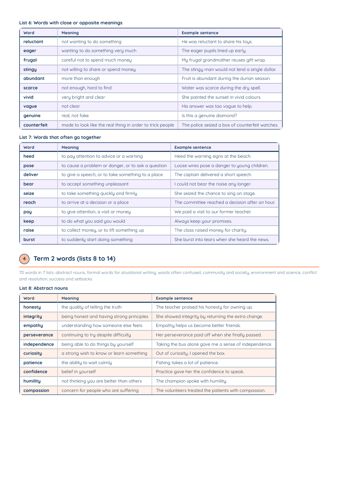
| Word | Meaning | Example sentence |
|---|---|---|
| glance | to look quickly | She glanced at the clock. |
| scrutinise | to look at something very closely to find any mistakes | The judge scrutinised every cake before choosing the winner. |
| glare | to look at someone angrily | The librarian glared at the noisy boys. |
| peer | to look closely because it is hard to see | I peered through the foggy window. |
| gaze | to look steadily for a long time, often with wonder | We gazed at the stars. |
| squint | to look with your eyes partly closed | I squinted in the bright sunlight. |
| scan | to look over something quickly to find something | She scanned the crowd for her mother. |
| gape | to stare with your mouth open in surprise | The children gaped at the giant cake. |
| inspect | to look at something closely to check it | The officer inspected our bags. |
| survey | to look over a whole place or scene | From the hilltop, we surveyed the whole reservoir. |
| Word | Meaning | Example sentence |
|---|---|---|
| reluctant | not wanting to do something | He was reluctant to share his toys. |
| eager | wanting to do something very much | The eager pupils lined up early. |
| frugal | careful not to spend much money | My frugal grandmother reuses gift wrap. |
| stingy | not willing to share or spend money | The stingy man would not lend a single dollar. |
| abundant | more than enough | Fruit is abundant during the durian season. |
| scarce | not enough, hard to find | Water was scarce during the dry spell. |
| vivid | very bright and clear | She painted the sunset in vivid colours. |
| vague | not clear | His answer was too vague to help. |
| genuine | real, not fake | Is this a genuine diamond? |
| counterfeit | made to look like the real thing in order to trick people | The police seized a box of counterfeit watches. |
| Word | Meaning | Example sentence |
|---|---|---|
| heed | to pay attention to advice or a warning | Heed the warning signs at the beach. |
| pose | to cause a problem or danger, or to ask a question | Loose wires pose a danger to young children. |
| deliver | to give a speech, or to take something to a place | The captain delivered a short speech. |
| bear | to accept something unpleasant | I could not bear the noise any longer. |
| seize | to take something quickly and firmly | She seized the chance to sing on stage. |
| reach | to arrive at a decision or a place | The committee reached a decision after an hour. |
| pay | to give attention, a visit or money | We paid a visit to our former teacher. |
| keep | to do what you said you would | Always keep your promises. |
| raise | to collect money, or to lift something up | The class raised money for charity. |
| burst | to suddenly start doing something | She burst into tears when she heard the news. |
Term 2 words (lists 8 to 14)
70 words in 7 lists
70 words in 7 lists: abstract nouns, formal words for situational writing, words often confused, community and society, environment and science, conflict and resolution, success and setbacks.
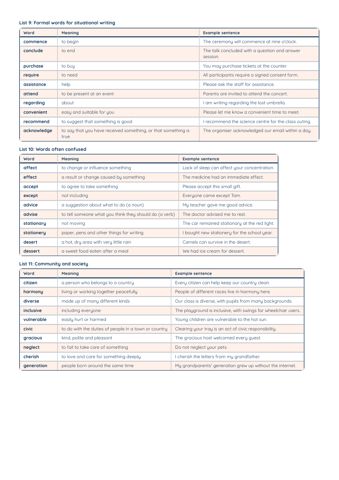
| Word | Meaning | Example sentence |
|---|---|---|
| honesty | the quality of telling the truth | The teacher praised his honesty for owning up. |
| integrity | being honest and having strong principles | She showed integrity by returning the extra change. |
| empathy | understanding how someone else feels | Empathy helps us become better friends. |
| perseverance | continuing to try despite difficulty | Her perseverance paid off when she finally passed. |
| independence | being able to do things by yourself | Taking the bus alone gave me a sense of independence. |
| curiosity | a strong wish to know or learn something | Out of curiosity, I opened the box. |
| patience | the ability to wait calmly | Fishing takes a lot of patience. |
| confidence | belief in yourself | Practice gave her the confidence to speak. |
| humility | not thinking you are better than others | The champion spoke with humility. |
| compassion | concern for people who are suffering | The volunteers treated the patients with compassion. |
| Word | Meaning | Example sentence |
|---|---|---|
| commence | to begin | The ceremony will commence at nine o'clock. |
| conclude | to end | The talk concluded with a question and answer session. |
| purchase | to buy | You may purchase tickets at the counter. |
| require | to need | All participants require a signed consent form. |
| assistance | help | Please ask the staff for assistance. |
| attend | to be present at an event | Parents are invited to attend the concert. |
| regarding | about | I am writing regarding the lost umbrella. |
| convenient | easy and suitable for you | Please let me know a convenient time to meet. |
| recommend | to suggest that something is good | I recommend the science centre for the class outing. |
| acknowledge | to say that you have received something, or that something is true | The organiser acknowledged our email within a day. |
| Word | Meaning | Example sentence |
|---|---|---|
| affect | to change or influence something | Lack of sleep can affect your concentration. |
| effect | a result or change caused by something | The medicine had an immediate effect. |
| accept | to agree to take something | Please accept this small gift. |
| except | not including | Everyone came except Tom. |
| advice | a suggestion about what to do (a noun) | My teacher gave me good advice. |
| advise | to tell someone what you think they should do (a verb) | The doctor advised me to rest. |
| stationary | not moving | The car remained stationary at the red light. |
| stationery | paper, pens and other things for writing | I bought new stationery for the school year. |
| desert | a hot, dry area with very little rain | Camels can survive in the desert. |
| dessert | a sweet food eaten after a meal | We had ice cream for dessert. |
| Word | Meaning | Example sentence |
|---|---|---|
| citizen | a person who belongs to a country | Every citizen can help keep our country clean. |
| harmony | living or working together peacefully | People of different races live in harmony here. |
| diverse | made up of many different kinds | Our class is diverse, with pupils from many backgrounds. |
| inclusive | including everyone | The playground is inclusive, with swings for wheelchair users. |
| vulnerable | easily hurt or harmed | Young children are vulnerable to the hot sun. |
| civic | to do with the duties of people in a town or country | Clearing your tray is an act of civic responsibility. |
| gracious | kind, polite and pleasant | The gracious host welcomed every guest. |
| neglect | to fail to take care of something | Do not neglect your pets. |
| cherish | to love and care for something deeply | I cherish the letters from my grandfather. |
| generation | people born around the same time | My grandparents' generation grew up without the internet. |
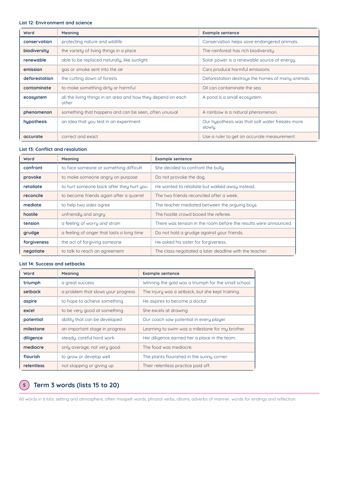
| Word | Meaning | Example sentence |
|---|---|---|
| conservation | protecting nature and wildlife | Conservation helps save endangered animals. |
| biodiversity | the variety of living things in a place | The rainforest has rich biodiversity. |
| renewable | able to be replaced naturally, like sunlight | Solar power is a renewable source of energy. |
| emission | gas or smoke sent into the air | Cars produce harmful emissions. |
| deforestation | the cutting down of forests | Deforestation destroys the homes of many animals. |
| contaminate | to make something dirty or harmful | Oil can contaminate the sea. |
| ecosystem | all the living things in an area and how they depend on each other | A pond is a small ecosystem. |
| phenomenon | something that happens and can be seen, often unusual | A rainbow is a natural phenomenon. |
| hypothesis | an idea that you test in an experiment | Our hypothesis was that salt water freezes more slowly. |
| accurate | correct and exact | Use a ruler to get an accurate measurement. |
| Word | Meaning | Example sentence |
|---|---|---|
| confront | to face someone or something difficult | She decided to confront the bully. |
| provoke | to make someone angry on purpose | Do not provoke the dog. |
| retaliate | to hurt someone back after they hurt you | He wanted to retaliate but walked away instead. |
| reconcile | to become friends again after a quarrel | The two friends reconciled after a week. |
| mediate | to help two sides agree | The teacher mediated between the arguing boys. |
| hostile | unfriendly and angry | The hostile crowd booed the referee. |
| tension | a feeling of worry and strain | There was tension in the room before the results were announced. |
| grudge | a feeling of anger that lasts a long time | Do not hold a grudge against your friends. |
| forgiveness | the act of forgiving someone | He asked his sister for forgiveness. |
| negotiate | to talk to reach an agreement | The class negotiated a later deadline with the teacher. |
| Word | Meaning | Example sentence |
|---|---|---|
| triumph | a great success | Winning the gold was a triumph for the small school. |
| setback | a problem that slows your progress | The injury was a setback, but she kept training. |
| aspire | to hope to achieve something | He aspires to become a doctor. |
| excel | to be very good at something | She excels at drawing. |
| potential | ability that can be developed | Our coach saw potential in every player. |
| milestone | an important stage in progress | Learning to swim was a milestone for my brother. |
| diligence | steady, careful hard work | Her diligence earned her a place in the team. |
| mediocre | only average, not very good | The food was mediocre. |
| flourish | to grow or develop well | The plants flourished in the sunny corner. |
| relentless | not stopping or giving up | Their relentless practice paid off. |
Term 3 words (lists 15 to 20)
60 words in 6 lists
60 words in 6 lists: setting and atmosphere, often misspelt words, phrasal verbs, idioms, adverbs of manner, words for endings and reflection.
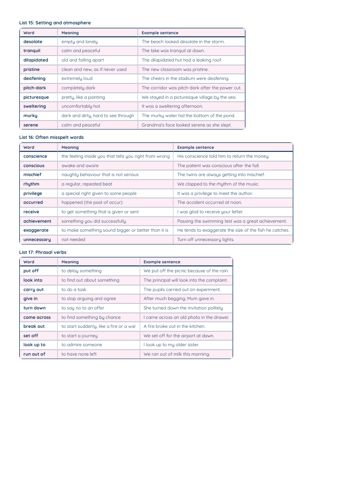
| Word | Meaning | Example sentence |
|---|---|---|
| desolate | empty and lonely | The beach looked desolate in the storm. |
| tranquil | calm and peaceful | The lake was tranquil at dawn. |
| dilapidated | old and falling apart | The dilapidated hut had a leaking roof. |
| pristine | clean and new, as if never used | The new classroom was pristine. |
| deafening | extremely loud | The cheers in the stadium were deafening. |
| pitch-dark | completely dark | The corridor was pitch-dark after the power cut. |
| picturesque | pretty, like a painting | We stayed in a picturesque village by the sea. |
| sweltering | uncomfortably hot | It was a sweltering afternoon. |
| murky | dark and dirty, hard to see through | The murky water hid the bottom of the pond. |
| serene | calm and peaceful | Grandma's face looked serene as she slept. |
| Word | Meaning | Example sentence |
|---|---|---|
| conscience | the feeling inside you that tells you right from wrong | His conscience told him to return the money. |
| conscious | awake and aware | The patient was conscious after the fall. |
| mischief | naughty behaviour that is not serious | The twins are always getting into mischief. |
| rhythm | a regular, repeated beat | We clapped to the rhythm of the music. |
| privilege | a special right given to some people | It was a privilege to meet the author. |
| occurred | happened (the past of occur) | The accident occurred at noon. |
| receive | to get something that is given or sent | I was glad to receive your letter. |
| achievement | something you did successfully | Passing the swimming test was a great achievement. |
| exaggerate | to make something sound bigger or better than it is | He tends to exaggerate the size of the fish he catches. |
| unnecessary | not needed | Turn off unnecessary lights. |
| Word | Meaning | Example sentence |
|---|---|---|
| put off | to delay something | We put off the picnic because of the rain. |
| look into | to find out about something | The principal will look into the complaint. |
| carry out | to do a task | The pupils carried out an experiment. |
| give in | to stop arguing and agree | After much begging, Mum gave in. |
| turn down | to say no to an offer | She turned down the invitation politely. |
| come across | to find something by chance | I came across an old photo in the drawer. |
| break out | to start suddenly, like a fire or a war | A fire broke out in the kitchen. |
| set off | to start a journey | We set off for the airport at dawn. |
| look up to | to admire someone | I look up to my older sister. |
| run out of | to have none left | We ran out of milk this morning. |
| Word | Meaning | Example sentence |
|---|---|---|
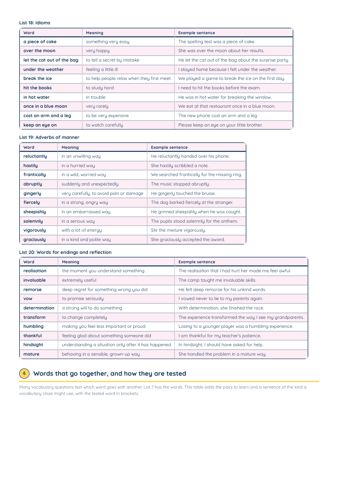
| a piece of cake | something very easy | The spelling test was a piece of cake. |
| over the moon | very happy | She was over the moon about her results. |
| let the cat out of the bag | to tell a secret by mistake | He let the cat out of the bag about the surprise party. |
| under the weather | feeling a little ill | I stayed home because I felt under the weather. |
| break the ice | to help people relax when they first meet | We played a game to break the ice on the first day. |
| hit the books | to study hard | I need to hit the books before the exam. |
| in hot water | in trouble | He was in hot water for breaking the window. |
| once in a blue moon | very rarely | We eat at that restaurant once in a blue moon. |
| cost an arm and a leg | to be very expensive | The new phone cost an arm and a leg. |
| keep an eye on | to watch carefully | Please keep an eye on your little brother. |
| Word | Meaning | Example sentence |
|---|---|---|
| reluctantly | in an unwilling way | He reluctantly handed over his phone. |
| hastily | in a hurried way | She hastily scribbled a note. |
| frantically | in a wild, worried way | We searched frantically for the missing ring. |
| abruptly | suddenly and unexpectedly | The music stopped abruptly. |
| gingerly | very carefully, to avoid pain or damage | He gingerly touched the bruise. |
| fiercely | in a strong, angry way | The dog barked fiercely at the stranger. |
| sheepishly | in an embarrassed way | He grinned sheepishly when he was caught. |
| solemnly | in a serious way | The pupils stood solemnly for the anthem. |
| vigorously | with a lot of energy | Stir the mixture vigorously. |
| graciously | in a kind and polite way | She graciously accepted the award. |
| Word | Meaning | Example sentence |
|---|---|---|
| realisation | the moment you understand something | The realisation that I had hurt her made me feel awful. |
| invaluable | extremely useful | The camp taught me invaluable skills. |
| remorse | deep regret for something wrong you did | He felt deep remorse for his unkind words. |
| vow | to promise seriously | I vowed never to lie to my parents again. |
| determination | a strong will to do something | With determination, she finished the race. |
| transform | to change completely | The experience transformed the way I see my grandparents. |
| humbling | making you feel less important or proud | Losing to a younger player was a humbling experience. |
| thankful | feeling glad about something someone did | I am thankful for my teacher's patience. |
| hindsight | understanding a situation only after it has happened | In hindsight, I should have asked for help. |
| mature | behaving in a sensible, grown-up way | She handled the problem in a mature way. |
Words that go together, and how they are tested
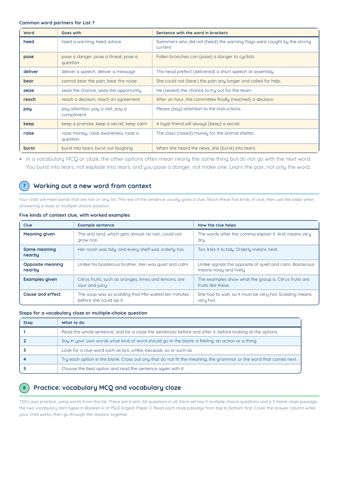
Many vocabulary questions test which word goes with another. List 7 has the words. This table adds the pairs to learn and a sentence of the kind a vocabulary cloze might use, with the tested word in brackets.
| Word | Goes with | Sentence with the word in brackets |
|---|---|---|
| heed | heed a warning, heed advice | Swimmers who did not (heed) the warning flags were caught by the strong current. |
| pose | pose a danger, pose a threat, pose a question | Fallen branches can (pose) a danger to cyclists. |
| deliver | deliver a speech, deliver a message | The head prefect (delivered) a short speech at assembly. |
| bear | cannot bear the pain, bear the noise | She could not (bear) the pain any longer and called for help. |
| seize | seize the chance, seize the opportunity | He (seized) the chance to try out for the team. |
| reach | reach a decision, reach an agreement | After an hour, the committee finally (reached) a decision. |
| pay | pay attention, pay a visit, pay a compliment | Please (pay) attention to the instructions. |
| keep | keep a promise, keep a secret, keep calm | A loyal friend will always (keep) a secret. |
| raise | raise money, raise awareness, raise a question | The class (raised) money for the animal shelter. |
| burst | burst into tears, burst out laughing | When she heard the news, she (burst) into tears. |
- In a vocabulary MCQ or cloze, the other options often mean nearly the same thing but do not go with the next word. You burst into tears, not explode into tears, and you pose a danger, not make one. Learn the pair, not only the word.
Working out a new word from context
Your child will meet words that are not on any list. The rest of the sentence usually gives a clue. Teach these five kinds of clue, then use the steps when answering a cloze or multiple-choice question.
| Clue | Example sentence | How the clue helps |
|---|---|---|
| Meaning given | The arid land, which gets almost no rain, could not grow rice. | The words after the comma explain it. Arid means very dry. |
| Same meaning nearby | Her room was tidy, and every shelf was orderly too. | Too links it to tidy. Orderly means neat. |
| Opposite meaning nearby | Unlike his boisterous brother, Ken was quiet and calm. | Unlike signals the opposite of quiet and calm. Boisterous means noisy and lively. |
| Examples given | Citrus fruits, such as oranges, limes and lemons, are sour and juicy. | The examples show what the group is. Citrus fruits are fruits like these. |
| Cause and effect | The soup was so scalding that Mei waited ten minutes before she could sip it. | She had to wait, so it must be very hot. Scalding means very hot. |
| Step | What to do |
|---|---|
| 1 | Read the whole sentence, and for a cloze the sentences before and after it, before looking at the options. |
| 2 | Say in your own words what kind of word should go in the blank: a feeling, an action or a thing. |
| 3 | Look for a clue word such as but, unlike, because, so or such as. |
| 4 | Try each option in the blank. Cross out any that do not fit the meaning, the grammar or the word that comes next. |
| 5 | Choose the best option and read the sentence again with it. |
Practice: vocabulary MCQ and vocabulary cloze
60 questions, answers under each set
TSS's own practice, using words from this list. There are 6 sets, 60 questions in all. Each set has 5 multiple-choice questions and a 5-blank cloze passage, the two vocabulary item types in Booklet A of PSLE English Paper 2. Read each cloze passage from top to bottom first. Cover the answer column while your child works, then go through the reasons together.
| Question | Options |
|---|---|
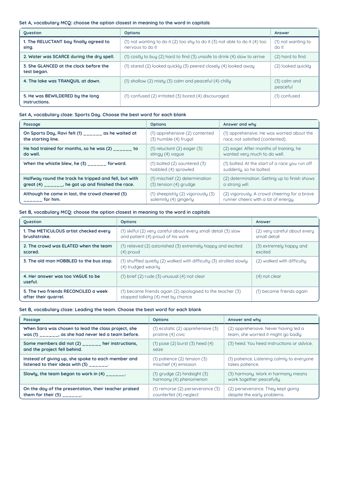
| 1. The RELUCTANT boy finally agreed to sing. | (1) not wanting to do it (2) too shy to do it (3) not able to do it (4) too nervous to do it |
| 2. Water was SCARCE during the dry spell. | (1) costly to buy (2) hard to find (3) unsafe to drink (4) slow to arrive |
| 3. She GLANCED at the clock before the test began. | (1) stared (2) looked quickly (3) peered closely (4) looked away |
| 4. The lake was TRANQUIL at dawn. | (1) shallow (2) misty (3) calm and peaceful (4) chilly |
| 5. He was BEWILDERED by the long instructions. | (1) confused (2) irritated (3) bored (4) discouraged |
Show answersHide answers
| No. | Answer |
|---|---|
| 1 | (1) not wanting to do it |
| 2 | (2) hard to find |
| 3 | (2) looked quickly |
| 4 | (3) calm and peaceful |
| 5 | (1) confused |
| Passage | Options |
|---|---|
| On Sports Day, Ravi felt (1) ______ as he waited at the starting line. | (1) apprehensive (2) contented (3) humble (4) frugal |
| He had trained for months, so he was (2) ______ to do well. | (1) reluctant (2) eager (3) stingy (4) vague |
| When the whistle blew, he (3) ______ forward. | (1) bolted (2) sauntered (3) hobbled (4) sprawled |
| Halfway round the track he tripped and fell, but with great (4) ______, he got up and finished the race. | (1) mischief (2) determination (3) tension (4) grudge |
| Although he came in last, the crowd cheered (5) ______ for him. | (1) sheepishly (2) vigorously (3) solemnly (4) gingerly |
Show answersHide answers
| No. | Answer and why |
|---|---|
| 1 | (1) apprehensive. He was worried about the race, not satisfied (contented). |
| 2 | (2) eager. After months of training, he wanted very much to do well. |
| 3 | (1) bolted. At the start of a race you run off suddenly, so he bolted. |
| 4 | (2) determination. Getting up to finish shows a strong will. |
| 5 | (2) vigorously. A crowd cheering for a brave runner cheers with a lot of energy. |
| Question | Options |
|---|---|
| 1. The METICULOUS artist checked every brushstroke. | (1) skilful (2) very careful about every small detail (3) slow and patient (4) proud of his work |
| 2. The crowd was ELATED when the team scored. | (1) relieved (2) astonished (3) extremely happy and excited (4) proud |
| 3. The old man HOBBLED to the bus stop. | (1) shuffled quietly (2) walked with difficulty (3) strolled slowly (4) trudged wearily |
| 4. Her answer was too VAGUE to be useful. | (1) brief (2) rude (3) unusual (4) not clear |
| 5. The two friends RECONCILED a week after their quarrel. | (1) became friends again (2) apologised to the teacher (3) stopped talking (4) met by chance |
Show answersHide answers
| No. | Answer |
|---|---|
| 1 | (2) very careful about every small detail |
| 2 | (3) extremely happy and excited |
| 3 | (2) walked with difficulty |
| 4 | (4) not clear |
| 5 | (1) became friends again |
| Passage | Options |
|---|---|
| When Sara was chosen to lead the class project, she was (1) ______, as she had never led a team before. | (1) ecstatic (2) apprehensive (3) pristine (4) civic |
| Some members did not (2) ______ her instructions, and the project fell behind. | (1) pose (2) burst (3) heed (4) seize |
| Instead of giving up, she spoke to each member and listened to their ideas with (3) ______. | (1) patience (2) tension (3) mischief (4) emission |
| Slowly, the team began to work in (4) ______. | (1) grudge (2) hindsight (3) harmony (4) phenomenon |
| On the day of the presentation, their teacher praised them for their (5) ______. | (1) remorse (2) perseverance (3) counterfeit (4) neglect |
Show answersHide answers
| No. | Answer and why |
|---|---|
| 1 | (2) apprehensive. Never having led a team, she worried it might go badly. |
| 2 | (3) heed. You heed instructions or advice. |
| 3 | (1) patience. Listening calmly to everyone takes patience. |
| 4 | (3) harmony. Work in harmony means work together peacefully. |
| 5 | (2) perseverance. They kept going despite the early problems. |
| Question | Options |
|---|---|
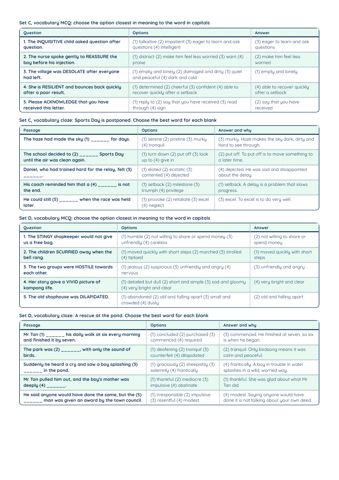
| 1. The INQUISITIVE child asked question after question. | (1) talkative (2) impatient (3) eager to learn and ask questions (4) intelligent |
| 2. The nurse spoke gently to REASSURE the boy before his injection. | (1) distract (2) make him feel less worried (3) warn (4) praise |
| 3. The village was DESOLATE after everyone had left. | (1) empty and lonely (2) damaged and dirty (3) quiet and peaceful (4) dark and cold |
| 4. She is RESILIENT and bounces back quickly after a poor result. | (1) determined (2) cheerful (3) confident (4) able to recover quickly after a setback |
| 5. Please ACKNOWLEDGE that you have received this letter. | (1) reply to (2) say that you have received (3) read through (4) sign |
Show answersHide answers
| No. | Answer |
|---|---|
| 1 | (3) eager to learn and ask questions |
| 2 | (2) make him feel less worried |
| 3 | (1) empty and lonely |
| 4 | (4) able to recover quickly after a setback |
| 5 | (2) say that you have received |
| Passage | Options |
|---|---|
| The haze had made the sky (1) ______ for days. | (1) serene (2) pristine (3) murky (4) tranquil |
| The school decided to (2) ______ Sports Day until the air was clean again. | (1) turn down (2) put off (3) look up to (4) give in |
| Daniel, who had trained hard for the relay, felt (3) ______. | (1) elated (2) ecstatic (3) contented (4) dejected |
| His coach reminded him that a (4) ______ is not the end. | (1) setback (2) milestone (3) triumph (4) privilege |
| He could still (5) ______ when the race was held later. | (1) provoke (2) retaliate (3) excel (4) neglect |
Show answersHide answers
| No. | Answer and why |
|---|---|
| 1 | (3) murky. Haze makes the sky dark, dirty and hard to see through. |
| 2 | (2) put off. To put off is to move something to a later time. |
| 3 | (4) dejected. He was sad and disappointed about the delay. |
| 4 | (1) setback. A delay is a problem that slows progress. |
| 5 | (3) excel. To excel is to do very well. |
| Question | Options |
|---|---|
| 1. The STINGY shopkeeper would not give us a free bag. | (1) humble (2) not willing to share or spend money (3) unfriendly (4) careless |
| 2. The children SCURRIED away when the bell rang. | (1) moved quickly with short steps (2) marched (3) strolled (4) tiptoed |
| 3. The two groups were HOSTILE towards each other. | (1) jealous (2) suspicious (3) unfriendly and angry (4) nervous |
| 4. Her story gave a VIVID picture of kampong life. | (1) detailed but dull (2) short and simple (3) sad and gloomy (4) very bright and clear |
| 5. The old shophouse was DILAPIDATED. | (1) abandoned (2) old and falling apart (3) small and crowded (4) dusty |
Show answersHide answers
| No. | Answer |
|---|---|
| 1 | (2) not willing to share or spend money |
| 2 | (1) moved quickly with short steps |
| 3 | (3) unfriendly and angry |
| 4 | (4) very bright and clear |
| 5 | (2) old and falling apart |
| Passage | Options |
|---|---|
| Mr Tan (1) ______ his daily walk at six every morning and finished it by seven. | (1) concluded (2) purchased (3) commenced (4) required |
| The park was (2) ______, with only the sound of birds. | (1) deafening (2) tranquil (3) counterfeit (4) dilapidated |
| Suddenly he heard a cry and saw a boy splashing (3) ______ in the pond. | (1) graciously (2) sheepishly (3) solemnly (4) frantically |
| Mr Tan pulled him out, and the boy's mother was deeply (4) ______. | (1) thankful (2) mediocre (3) impulsive (4) obstinate |
| He said anyone would have done the same, but the (5) ______ man was given an award by the town council. | (1) irresponsible (2) impulsive (3) resentful (4) modest |
Show answersHide answers
| No. | Answer and why |
|---|---|
| 1 | (3) commenced. He finished at seven, so six is when he began. |
| 2 | (2) tranquil. Only birdsong means it was calm and peaceful. |
| 3 | (4) frantically. A boy in trouble in water splashes in a wild, worried way. |
| 4 | (1) thankful. She was glad about what Mr Tan did. |
| 5 | (4) modest. Saying anyone would have done it is not talking about your own deed. |
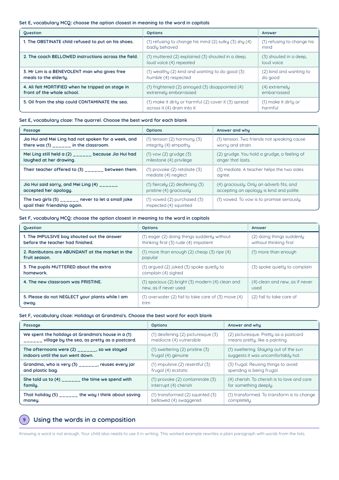
| Question | Options |
|---|---|
| 1. The OBSTINATE child refused to put on his shoes. | (1) refusing to change his mind (2) sulky (3) shy (4) badly behaved |
| 2. The coach BELLOWED instructions across the field. | (1) muttered (2) explained (3) shouted in a deep, loud voice (4) repeated |
| 3. Mr Lim is a BENEVOLENT man who gives free meals to the elderly. | (1) wealthy (2) kind and wanting to do good (3) humble (4) respected |
| 4. Ali felt MORTIFIED when he tripped on stage in front of the whole school. | (1) frightened (2) annoyed (3) disappointed (4) extremely embarrassed |
| 5. Oil from the ship could CONTAMINATE the sea. | (1) make it dirty or harmful (2) cover it (3) spread across it (4) drain into it |
Show answersHide answers
| No. | Answer |
|---|---|
| 1 | (1) refusing to change his mind |
| 2 | (3) shouted in a deep, loud voice |
| 3 | (2) kind and wanting to do good |
| 4 | (4) extremely embarrassed |
| 5 | (1) make it dirty or harmful |
| Passage | Options |
|---|---|
| Jia Hui and Mei Ling had not spoken for a week, and there was (1) ______ in the classroom. | (1) tension (2) harmony (3) integrity (4) empathy |
| Mei Ling still held a (2) ______ because Jia Hui had laughed at her drawing. | (1) vow (2) grudge (3) milestone (4) privilege |
| Their teacher offered to (3) ______ between them. | (1) provoke (2) retaliate (3) mediate (4) neglect |
| Jia Hui said sorry, and Mei Ling (4) ______ accepted her apology. | (1) fiercely (2) deafening (3) pristine (4) graciously |
| The two girls (5) ______ never to let a small joke spoil their friendship again. | (1) vowed (2) purchased (3) inspected (4) squinted |
Show answersHide answers
| No. | Answer and why |
|---|---|
| 1 | (1) tension. Two friends not speaking cause worry and strain. |
| 2 | (2) grudge. You hold a grudge, a feeling of anger that lasts. |
| 3 | (3) mediate. A teacher helps the two sides agree. |
| 4 | (4) graciously. Only an adverb fits, and accepting an apology is kind and polite. |
| 5 | (1) vowed. To vow is to promise seriously. |
| Question | Options |
|---|---|
| 1. The IMPULSIVE boy shouted out the answer before the teacher had finished. | (1) eager (2) doing things suddenly without thinking first (3) rude (4) impatient |
| 2. Rambutans are ABUNDANT at the market in the fruit season. | (1) more than enough (2) cheap (3) ripe (4) popular |
| 3. The pupils MUTTERED about the extra homework. | (1) argued (2) joked (3) spoke quietly to complain (4) sighed |
| 4. The new classroom was PRISTINE. | (1) spacious (2) bright (3) modern (4) clean and new, as if never used |
| 5. Please do not NEGLECT your plants while I am away. | (1) overwater (2) fail to take care of (3) move (4) trim |
Show answersHide answers
| No. | Answer |
|---|---|
| 1 | (2) doing things suddenly without thinking first |
| 2 | (1) more than enough |
| 3 | (3) spoke quietly to complain |
| 4 | (4) clean and new, as if never used |
| 5 | (2) fail to take care of |
| Passage | Options |
|---|---|
| We spent the holidays at Grandma's house in a (1) ______ village by the sea, as pretty as a postcard. | (1) deafening (2) picturesque (3) mediocre (4) vulnerable |
| The afternoons were (2) ______, so we stayed indoors until the sun went down. | (1) sweltering (2) pristine (3) frugal (4) genuine |
| Grandma, who is very (3) ______, reuses every jar and plastic bag. | (1) impulsive (2) resentful (3) frugal (4) ecstatic |
| She told us to (4) ______ the time we spend with family. | (1) provoke (2) contaminate (3) interrupt (4) cherish |
| That holiday (5) ______ the way I think about saving money. | (1) transformed (2) squinted (3) bellowed (4) swaggered |
Show answersHide answers
| No. | Answer and why |
|---|---|
| 1 | (2) picturesque. Pretty as a postcard means pretty, like a painting. |
| 2 | (1) sweltering. Staying out of the sun suggests it was uncomfortably hot. |
| 3 | (3) frugal. Reusing things to avoid spending is being frugal. |
| 4 | (4) cherish. To cherish is to love and care for something deeply. |
| 5 | (1) transformed. To transform is to change completely. |
Using the words in a composition
Knowing a word is not enough. Your child also needs to use it in writing. This worked example rewrites a plain paragraph with words from the lists.
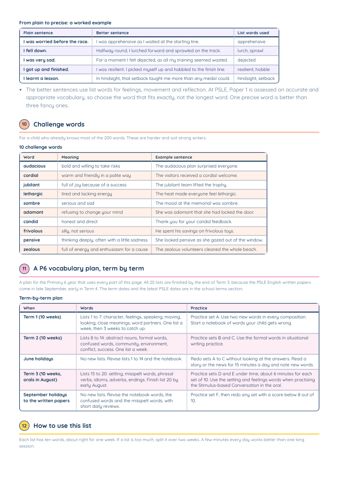
| Plain sentence | Better sentence | List words used |
|---|---|---|
| I was worried before the race. | I was apprehensive as I waited at the starting line. | apprehensive |
| I fell down. | Halfway round, I lurched forward and sprawled on the track. | lurch, sprawl |
| I was very sad. | For a moment I felt dejected, as all my training seemed wasted. | dejected |
| I got up and finished. | I was resilient. I picked myself up and hobbled to the finish line. | resilient, hobble |
| I learnt a lesson. | In hindsight, that setback taught me more than any medal could. | hindsight, setback |
- The better sentences use list words for feelings, movement and reflection. At PSLE, Paper 1 is assessed on accurate and appropriate vocabulary, so choose the word that fits exactly, not the longest word. One precise word is better than three fancy ones.
Challenge words
For a child who already knows most of the 200 words. These are harder and suit strong writers.
| Word | Meaning | Example sentence |
|---|---|---|
| audacious | bold and willing to take risks | The audacious plan surprised everyone. |
| cordial | warm and friendly in a polite way | The visitors received a cordial welcome. |
| jubilant | full of joy because of a success | The jubilant team lifted the trophy. |
| lethargic | tired and lacking energy | The heat made everyone feel lethargic. |
| sombre | serious and sad | The mood at the memorial was sombre. |
| adamant | refusing to change your mind | She was adamant that she had locked the door. |
| candid | honest and direct | Thank you for your candid feedback. |
| frivolous | silly, not serious | He spent his savings on frivolous toys. |
| pensive | thinking deeply, often with a little sadness | She looked pensive as she gazed out of the window. |
| zealous | full of energy and enthusiasm for a cause | The zealous volunteers cleaned the whole beach. |
A P6 vocabulary plan, term by term
A plan for the Primary 6 year that uses every part of this page. All 20 lists are finished by the end of Term 3, because the PSLE English written papers come in late September, early in Term 4. The term dates and the latest PSLE dates are in the school terms section.
| When | Words | Practice |
|---|---|---|
| Term 1 (10 weeks) | Lists 1 to 7: character, feelings, speaking, moving, looking, close meanings, word partners. One list a week, then 3 weeks to catch up. | Practice set A. Use two new words in every composition. Start a notebook of words your child gets wrong. |
| Term 2 (10 weeks) | Lists 8 to 14: abstract nouns, formal words, confused words, community, environment, conflict, success. One list a week. | Practice sets B and C. Use the formal words in situational writing practice. |
| June holidays | No new lists. Revise lists 1 to 14 and the notebook. | Redo sets A to C without looking at the answers. Read a story or the news for 15 minutes a day and note new words. |
| Term 3 (10 weeks, orals in August) | Lists 15 to 20: setting, misspelt words, phrasal verbs, idioms, adverbs, endings. Finish list 20 by early August. | Practice sets D and E under time, about 6 minutes for each set of 10. Use the setting and feelings words when practising the Stimulus-based Conversation in the oral. |
| September holidays to the written papers | No new lists. Revise the notebook words, the confused words and the misspelt words, with short daily reviews. | Practice set F, then redo any set with a score below 8 out of 10. |
How to use this list
Each list has ten words, about right for one week. If a list is too much, split it over two weeks. A few minutes every day works better than one long session.
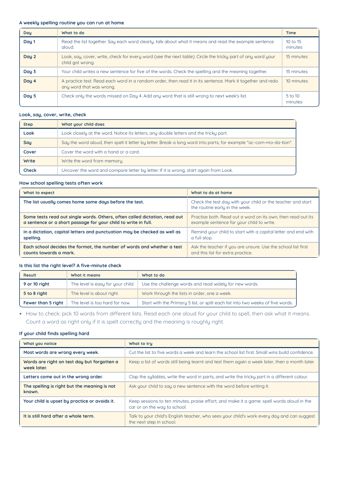
| Day | What to do | Time |
|---|---|---|
| Day 1 | Read the list together. Say each word clearly, talk about what it means and read the example sentence aloud. | 10 to 15 minutes |
| Day 2 | Look, say, cover, write, check for every word (see the next table). Circle the tricky part of any word your child got wrong. | 15 minutes |
| Day 3 | Your child writes a new sentence for five of the words. Check the spelling and the meaning together. | 15 minutes |
| Day 4 | A practice test. Read each word in a random order, then read it in its sentence. Mark it together and redo any word that was wrong. | 10 minutes |
| Day 5 | Check only the words missed on Day 4. Add any word that is still wrong to next week's list. | 5 to 10 minutes |
| Step | What your child does |
|---|---|
| Look | Look closely at the word. Notice its letters, any double letters and the tricky part. |
| Say | Say the word aloud, then spell it letter by letter. Break a long word into parts, for example "ac-com-mo-da-tion". |
| Cover | Cover the word with a hand or a card. |
| Write | Write the word from memory. |
| Check | Uncover the word and compare letter by letter. If it is wrong, start again from Look. |
| What to expect | What to do at home |
|---|---|
| The list usually comes home some days before the test. | Check the test day with your child or the teacher and start the routine early in the week. |
| Some tests read out single words. Others, often called dictation, read out a sentence or a short passage for your child to write in full. | Practise both. Read out a word on its own, then read out its example sentence for your child to write. |
| In a dictation, capital letters and punctuation may be checked as well as spelling. | Remind your child to start with a capital letter and end with a full stop. |
| Each school decides the format, the number of words and whether a test counts towards a mark. | Ask the teacher if you are unsure. Use the school list first and this list for extra practice. |
| Result | What it means | What to do |
|---|---|---|
| 9 or 10 right | The level is easy for your child. | Use the challenge words and read widely for new words. |
| 5 to 8 right | The level is about right. | Work through the lists in order, one a week. |
| Fewer than 5 right | The level is too hard for now. | Start with the Primary 5 list, or split each list into two weeks of five words. |
- How to check: pick 10 words from different lists. Read each one aloud for your child to spell, then ask what it means. Count a word as right only if it is spelt correctly and the meaning is roughly right.
| What you notice | What to try |
|---|---|
| Most words are wrong every week. | Cut the list to five words a week and learn the school list first. Small wins build confidence. |
| Words are right on test day but forgotten a week later. | Keep a list of words still being learnt and test them again a week later, then a month later. |
| Letters come out in the wrong order. | Clap the syllables, write the word in parts, and write the tricky part in a different colour. |
| The spelling is right but the meaning is not known. | Ask your child to say a new sentence with the word before writing it. |
| Your child is upset by practice or avoids it. | Keep sessions to ten minutes, praise effort, and make it a game: spell words aloud in the car or on the way to school. |
| It is still hard after a whole term. | Talk to your child's English teacher, who sees your child's work every day and can suggest the next step in school. |
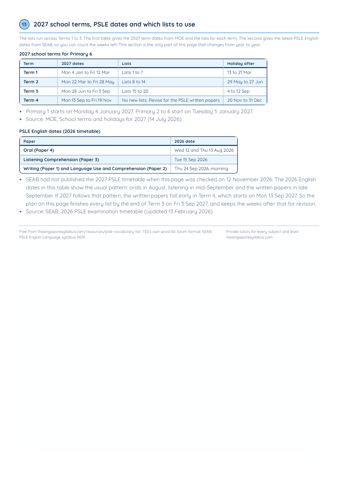
2027 school terms, PSLE dates and which lists to use
The lists run across Terms 1 to 3. The first table gives the 2027 term dates from MOE and the lists for each term. The second gives the latest PSLE English dates from SEAB, so you can count the weeks left. This section is the only part of this page that changes from year to year.
| Term | 2027 dates | Lists | Holiday after |
|---|---|---|---|
| Term 1 | Mon 4 Jan to Fri 12 Mar | Lists 1 to 7 | 13 to 21 Mar |
| Term 2 | Mon 22 Mar to Fri 28 May | Lists 8 to 14 | 29 May to 27 Jun |
| Term 3 | Mon 28 Jun to Fri 3 Sep | Lists 15 to 20 | 4 to 12 Sep |
| Term 4 | Mon 13 Sep to Fri 19 Nov | No new lists. Revise for the PSLE written papers | 20 Nov to 31 Dec |
- Primary 1 starts on Monday 4 January 2027. Primary 2 to 6 start on Tuesday 5 January 2027.
- Source: MOE, School terms and holidays for 2027 (14 July 2026).
| Paper | 2026 date |
|---|---|
| Oral (Paper 4) | Wed 12 and Thu 13 Aug 2026 |
| Listening Comprehension (Paper 3) | Tue 15 Sep 2026 |
| Writing (Paper 1) and Language Use and Comprehension (Paper 2) | Thu 24 Sep 2026, morning |
- SEAB had not published the 2027 PSLE timetable when this page was checked on 12 November 2026. The 2026 English dates in this table show the usual pattern: orals in August, listening in mid-September and the written papers in late September. If 2027 follows that pattern, the written papers fall early in Term 4, which starts on Mon 13 Sep 2027. So the plan on this page finishes every list by the end of Term 3 on Fri 3 Sep 2027, and keeps the weeks after that for revision.
- Source: SEAB, 2026 PSLE examination timetable (updated 13 February 2026).
Download the free PDFPDF · 15 pages · A4 portrait · free, no sign-up
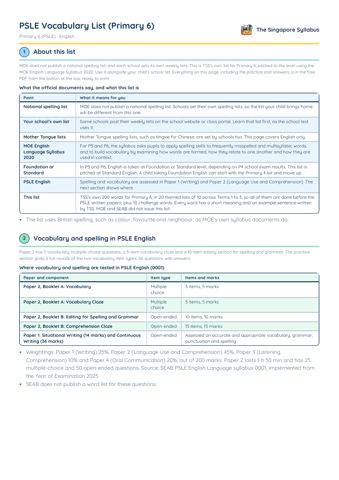
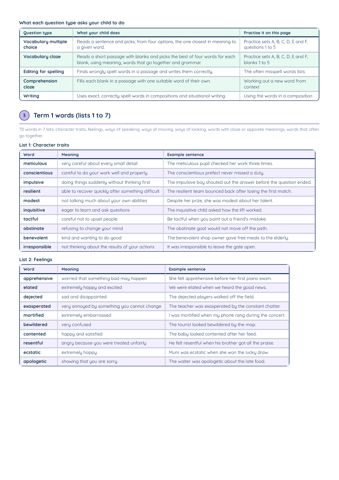
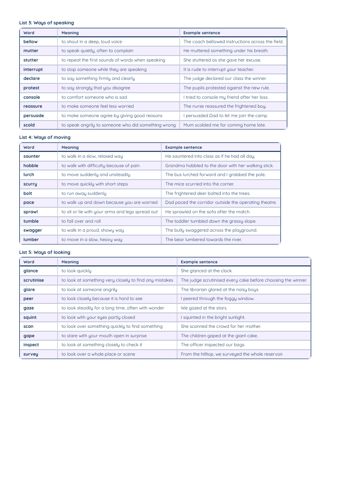
Inside the PDF
15 A4 pages, ready to print. Tap a page to open the PDF there.
Questions students ask
Is there an official PSLE vocabulary list?
No. SEAB publishes the PSLE English exam format, but no word list. Any suitable word can appear, so this list focuses on words that are useful in writing and in the vocabulary questions.
How many vocabulary questions are in PSLE English?
Paper 2 Booklet A has 5 vocabulary multiple-choice questions and 5 vocabulary cloze items, worth 10 marks together. Booklet B adds 10 editing items for spelling and grammar and a 15-item comprehension cloze.
When are the PSLE English papers?
SEAB sets the dates each year. In the 2026 timetable, the English oral was on Wed 12 and Thu 13 Aug, listening comprehension on Tue 15 Sep and Papers 1 and 2 on Thu 24 Sep. Plan to finish all the lists by the end of Term 3.
What is a vocabulary cloze in PSLE English?
It is a passage with blanks, and for each blank your child chooses the best word from the options given. In PSLE English (0001) it has 5 multiple-choice items worth 5 marks, in Booklet A of Paper 2. This page has 6 practice passages with answers and reasons.
How many spelling words should my child learn each week?
Each list here has 10 words, which suits one week. If your child finds that too many, split a list over two weeks and keep the daily practice short.
How is spelling tested in PSLE English?
Paper 2 has an Editing for Spelling and Grammar section with 10 items worth 10 marks. Paper 1 (Writing) is also assessed on accurate and appropriate vocabulary, grammar, punctuation and spelling.
Is this list for Foundation English too?
It is pitched at Standard English. In P5 and P6, English is taken at Foundation or Standard level depending on P4 school exam results. A pupil taking Foundation English may find the Primary 4 list a better place to start.
How should my child revise vocabulary across Primary 6?
Finish all 20 lists by the end of Term 3, about one a week, with one or two practice sets each term. The PSLE English written papers come in late September, early in Term 4, so the weeks from the September holidays are for revising only the words still being learnt. The plan section sets it out term by term.
Does this list use British or American spelling?
British spelling, such as colour, favourite and neighbour. MOE's own English syllabus documents use British spelling too, for example behaviour, organise and programme.
What if my child's school list has different words?
Learn the school list first, since the school test uses it. Then use this list for extra words, and use the meanings and example sentences to help your child use each word, not only spell it.
Keep revising
- PSLE English study guidePSLE English exam format and tips
- Primary 6 English tuitionThe PSLE English format and a year plan
- PSLE Math FormulasPSLE (Primary 1 to 6) · free PDF
- PSLE English Composition PhrasesPSLE (Primary 5 and 6) · free PDF
- PSLE Chinese Composition Phrases (好词好句)PSLE (Primary 5 and 6) · free PDF
- PSLE Science KeywordsPSLE (Primary 3 to 6) · free PDF
- Primary English Oral Practice (P3 to PSLE)Primary 3 to 6 and PSLE · free PDF
- Primary English Listening Comprehension Practice (P3 to PSLE)Primary 3 to 6 and PSLE · free PDF
- Primary English Composition Topics (P3 to PSLE)Primary 3 to 6 and PSLE · free PDF
- Primary 1 Maths WorksheetsPrimary 1 · free PDF
- Primary 2 Maths WorksheetsPrimary 2 · free PDF
- Primary 3 Maths WorksheetsPrimary 3 · free PDF
- Primary 1 English WorksheetsPrimary 1 · free PDF
- Primary 2 English WorksheetsPrimary 2 · free PDF
- Primary 3 English WorksheetsPrimary 3 · free PDF
- Primary 1 Spelling and Vocabulary ListPrimary 1 · free PDF
- Primary 2 Spelling and Vocabulary ListPrimary 2 · free PDF
- Primary 3 Spelling and Vocabulary ListPrimary 3 · free PDF
- Primary 4 Spelling and Vocabulary ListPrimary 4 · free PDF
- Primary 5 Spelling and Vocabulary ListPrimary 5 · free PDF
- PSLE Score calculatorAdd up the four AL grades
- All free resourcesPSLE, O-Level and A-Level
Source
- SEAB, PSLE English Language syllabus 0001 (implemented from 2025), Examination Format
- SEAB, PSLE formats examined in 2026
- MOE, English Language Syllabus 2020, Primary Foundation English and Secondary G1
- MOE, Primary school subjects and syllabuses
- MOE, School terms and holidays for 2027 (14 July 2026)
The words, meanings, example sentences and practice items are our own. MOE does not publish a national spelling list. The syllabus, exam and term details come from the MOE, SEAB and school pages above, and if they differ, those pages are right. Tell us and we will fix it.