Free resource · Primary 3
Primary 3 Vocabulary List and Spelling Words: Free PDF
MOE does not publish a national Primary 3 spelling list, as each school sets its own. This free list gives 160 words for P3 in 16 themed lists of 10 across the four school terms, each with a simple meaning and an example sentence. It adds phrasal verbs, words with close meanings, 20 vocabulary MCQ and cloze questions with answers, 10 challenge words and a five-day routine to use at home.
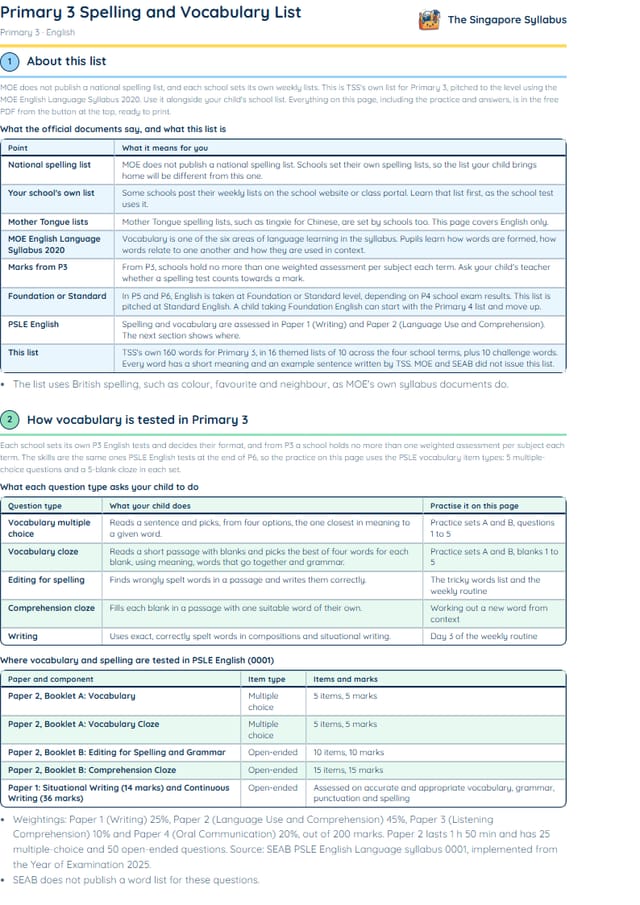
About this list
MOE does not publish a national spelling list, and each school sets its own weekly lists. This is TSS's own list for Primary 3, pitched to the level using the MOE English Language Syllabus 2020. Use it alongside your child's school list. Everything on this page, including the practice and answers, is in the free PDF from the button at the top, ready to print.
| Point | What it means for you |
|---|---|
| National spelling list | MOE does not publish a national spelling list. Schools set their own spelling lists, so the list your child brings home will be different from this one. |
| Your school's own list | Some schools post their weekly lists on the school website or class portal. Learn that list first, as the school test uses it. |
| Mother Tongue lists | Mother Tongue spelling lists, such as tingxie for Chinese, are set by schools too. This page covers English only. |
| MOE English Language Syllabus 2020 | Vocabulary is one of the six areas of language learning in the syllabus. Pupils learn how words are formed, how words relate to one another and how they are used in context. |
| Marks from P3 | From P3, schools hold no more than one weighted assessment per subject each term. Ask your child's teacher whether a spelling test counts towards a mark. |
| Foundation or Standard | In P5 and P6, English is taken at Foundation or Standard level, depending on P4 school exam results. This list is pitched at Standard English. A child taking Foundation English can start with the Primary 4 list and move up. |
| PSLE English | Spelling and vocabulary are assessed in Paper 1 (Writing) and Paper 2 (Language Use and Comprehension). The next section shows where. |
| This list | TSS's own 160 words for Primary 3, in 16 themed lists of 10 across the four school terms, plus 10 challenge words. Every word has a short meaning and an example sentence written by TSS. MOE and SEAB did not issue this list. |
- The list uses British spelling, such as colour, favourite and neighbour, as MOE's own syllabus documents do.
How vocabulary is tested in Primary 3
Each school sets its own P3 English tests and decides their format, and from P3 a school holds no more than one weighted assessment per subject each term. The skills are the same ones PSLE English tests at the end of P6, so the practice on this page uses the PSLE vocabulary item types: 5 multiple-choice questions and a 5-blank cloze in each set.
| Question type | What your child does | Practise it on this page |
|---|---|---|
| Vocabulary multiple choice | Reads a sentence and picks, from four options, the one closest in meaning to a given word. | Practice sets A and B, questions 1 to 5 |
| Vocabulary cloze | Reads a short passage with blanks and picks the best of four words for each blank, using meaning, words that go together and grammar. | Practice sets A and B, blanks 1 to 5 |
| Editing for spelling | Finds wrongly spelt words in a passage and writes them correctly. | The tricky words list and the weekly routine |
| Comprehension cloze | Fills each blank in a passage with one suitable word of their own. | Working out a new word from context |
| Writing | Uses exact, correctly spelt words in compositions and situational writing. | Day 3 of the weekly routine |
| Paper and component | Item type | Items and marks |
|---|---|---|
| Paper 2, Booklet A: Vocabulary | Multiple choice | 5 items, 5 marks |
| Paper 2, Booklet A: Vocabulary Cloze | Multiple choice | 5 items, 5 marks |
| Paper 2, Booklet B: Editing for Spelling and Grammar | Open-ended | 10 items, 10 marks |
| Paper 2, Booklet B: Comprehension Cloze | Open-ended | 15 items, 15 marks |
| Paper 1: Situational Writing (14 marks) and Continuous Writing (36 marks) | Open-ended | Assessed on accurate and appropriate vocabulary, grammar, punctuation and spelling |
- Weightings: Paper 1 (Writing) 25%, Paper 2 (Language Use and Comprehension) 45%, Paper 3 (Listening Comprehension) 10% and Paper 4 (Oral Communication) 20%, out of 200 marks. Paper 2 lasts 1 h 50 min and has 25 multiple-choice and 50 open-ended questions. Source: SEAB PSLE English Language syllabus 0001, implemented from the Year of Examination 2025.
- SEAB does not publish a word list for these questions.
Term 1 words (lists 1 to 4)
40 words in 4 lists
40 words in 4 lists: school life, family and home, action words, describing people.
| Word | Meaning | Example sentence |
|---|---|---|
| assembly | a meeting of the whole school in the hall | The principal spoke to us during assembly. |
| canteen | the place in school where you buy food | I bought fried noodles at the canteen. |
| recess | a short break between lessons | We play catching during recess. |
| timetable | a list that shows when each lesson happens | Check the timetable to see which books to bring. |
| principal | the head of a school | The principal shook hands with the winners. |
| uniform | special clothes that everyone in a group wears | I iron my school uniform on Sunday night. |
| notebook | a book with blank pages for writing notes | Write the new words in your notebook. |
| practise | to do something again and again to get better at it | I practise the piano every evening. |
| complete | to finish something | Complete the worksheet before Friday. |
| attention | careful listening or watching | Pay attention when the teacher is speaking. |
| Word | Meaning | Example sentence |
|---|---|---|
| parents | your mother and father | My parents work in the city. |
| cousin | the child of your aunt or uncle | My cousin is visiting from Penang. |
| neighbour | a person who lives next to you | Our neighbour gave us some curry puffs. |
| relatives | people in your family | All our relatives came for the reunion dinner. |
| chores | small jobs you do at home | My chores are to sweep the floor and fold the clothes. |
| laundry | clothes that need to be washed, or have just been washed | I helped Mum hang out the laundry. |
| corridor | a long passage outside rooms or flats | Do not leave your shoes in the corridor. |
| balcony | a small platform outside a window or door | Grandma grows herbs on the balcony. |
| favourite | liked more than all the others | Blue is my favourite colour. |
| elderly | old (a polite word) | We helped an elderly man carry his groceries. |
| Word | Meaning | Example sentence |
|---|---|---|
| carry | to hold something and take it somewhere | Can you carry this bag for me? |
| climb | to go up using your hands and feet | The boys climb the rope in the gym. |
| crawl | to move on your hands and knees | The baby can crawl across the room. |
| hurry | to move or do something quickly | We had to hurry to catch the bus. |
| search | to look carefully for something | We searched the room for my missing key. |
| shout | to say something very loudly | Do not shout in the library. |
| whisper | to speak very softly | She whispered the answer to me. |
| build | to make something by putting parts together | Let us build a tower with the blocks. |
| choose | to pick one thing from many | You may choose one sweet from the jar. |
| follow | to go after someone or something | Follow me to the hall. |
| Word | Meaning | Example sentence |
|---|---|---|
| friendly | kind and pleasant to others | The new girl is very friendly. |
| brave | not afraid to do something difficult or scary | The brave boy let the spider walk across his hand. |
| clever | quick to learn and understand | The clever girl solved the puzzle quickly. |
| lazy | not wanting to work | The lazy cat sleeps all day. |
| helpful | happy to help others | Ahmad is helpful and always tidies the class bookshelf. |
| polite | speaking and behaving in a kind, respectful way | It is polite to say thank you. |
| honest | telling the truth | An honest boy returned the wallet he found. |
| careless | not careful, so you make mistakes | I was careless and spilled my drink. |
| cheerful | happy and full of smiles | Our cheerful bus driver hums every morning. |
| naughty | behaving badly | The naughty puppy chewed my slipper. |
Term 2 words (lists 5 to 8)
40 words in 4 lists
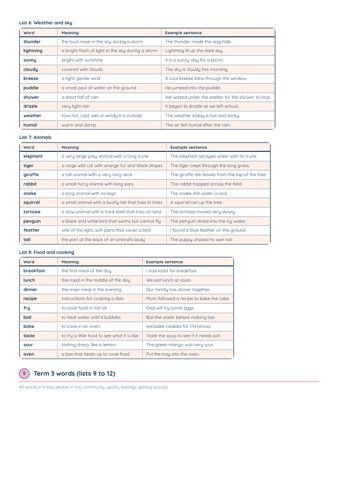
40 words in 4 lists: nature, weather and sky, animals, food and cooking.
| Word | Meaning | Example sentence |
|---|---|---|
| forest | a large area full of trees | Many animals live in the forest. |
| river | a large stream of water that flows to the sea | We walked along the river. |
| mountain | a very high hill | It took two hours to climb the mountain. |
| pond | a small area of still water | Fish swim in the pond at the park. |
| rock | a hard piece of stone | I sat on a rock to rest. |
| branch | a part of a tree that grows out from the trunk | A bird sat on a branch. |
| trunk | the thick main stem of a tree | The tree trunk was too wide to hug. |
| nest | a home that birds build for their eggs | There are three eggs in the nest. |
| stream | a small, narrow river | We dipped our feet in the cool stream. |
| nature | trees, plants, animals and everything not made by people | We enjoy nature on our walks. |
| Word | Meaning | Example sentence |
|---|---|---|
| thunder | the loud noise in the sky during a storm | The thunder made the dog hide. |
| lightning | a bright flash of light in the sky during a storm | Lightning lit up the dark sky. |
| sunny | bright with sunshine | It is a sunny day for a picnic. |
| cloudy | covered with clouds | The sky is cloudy this morning. |
| breeze | a light, gentle wind | A cool breeze blew through the window. |
| puddle | a small pool of water on the ground | He jumped into the puddle. |
| shower | a short fall of rain | We waited under the shelter for the shower to stop. |
| drizzle | very light rain | It began to drizzle as we left school. |
| weather | how hot, cold, wet or windy it is outside | The weather today is hot and sticky. |
| humid | warm and damp | The air felt humid after the rain. |
| Word | Meaning | Example sentence |
|---|---|---|
| elephant | a very large grey animal with a long trunk | The elephant sprayed water with its trunk. |
| tiger | a large wild cat with orange fur and black stripes | The tiger crept through the long grass. |
| giraffe | a tall animal with a very long neck | The giraffe ate leaves from the top of the tree. |
| rabbit | a small furry animal with long ears | The rabbit hopped across the field. |
| snake | a long animal with no legs | The snake slid under a rock. |
| squirrel | a small animal with a bushy tail that lives in trees | A squirrel ran up the tree. |
| tortoise | a slow animal with a hard shell that lives on land | The tortoise moved very slowly. |
| penguin | a black and white bird that swims but cannot fly | The penguin dived into the icy water. |
| feather | one of the light, soft parts that cover a bird | I found a blue feather on the ground. |
| tail | the part at the back of an animal's body | The puppy chased its own tail. |
| Word | Meaning | Example sentence |
|---|---|---|
| breakfast | the first meal of the day | I had toast for breakfast. |
| lunch | the meal in the middle of the day | We eat lunch at noon. |
| dinner | the main meal in the evening | Our family has dinner together. |
| recipe | instructions for cooking a dish | Mum followed a recipe to bake the cake. |
| fry | to cook food in hot oil | Dad will fry some eggs. |
| boil | to heat water until it bubbles | Boil the water before making tea. |
| bake | to cook in an oven | We bake cookies for Christmas. |
| taste | to try a little food to see what it is like | Taste the soup to see if it needs salt. |
| sour | tasting sharp, like a lemon | The green mango was very sour. |
| oven | a box that heats up to cook food | Put the tray into the oven. |
Term 3 words (lists 9 to 12)
40 words in 4 lists
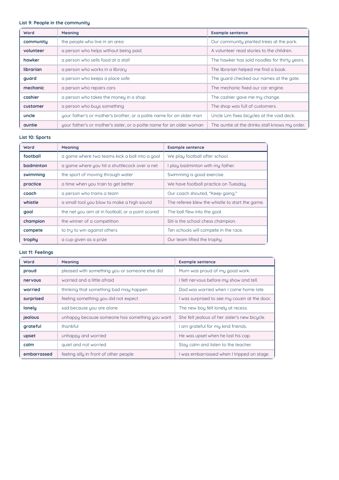
40 words in 4 lists: people in the community, sports, feelings, getting around.
| Word | Meaning | Example sentence |
|---|---|---|
| community | the people who live in an area | Our community planted trees at the park. |
| volunteer | a person who helps without being paid | A volunteer read stories to the children. |
| hawker | a person who sells food at a stall | The hawker has sold noodles for thirty years. |
| librarian | a person who works in a library | The librarian helped me find a book. |
| guard | a person who keeps a place safe | The guard checked our names at the gate. |
| mechanic | a person who repairs cars | The mechanic fixed our car engine. |
| cashier | a person who takes the money in a shop | The cashier gave me my change. |
| customer | a person who buys something | The shop was full of customers. |
| uncle | your father's or mother's brother, or a polite name for an older man | Uncle Lim fixes bicycles at the void deck. |
| auntie | your father's or mother's sister, or a polite name for an older woman | The auntie at the drinks stall knows my order. |
| Word | Meaning | Example sentence |
|---|---|---|
| football | a game where two teams kick a ball into a goal | We play football after school. |
| badminton | a game where you hit a shuttlecock over a net | I play badminton with my father. |
| swimming | the sport of moving through water | Swimming is good exercise. |
| practice | a time when you train to get better | We have football practice on Tuesday. |
| coach | a person who trains a team | Our coach shouted, "Keep going." |
| whistle | a small tool you blow to make a high sound | The referee blew the whistle to start the game. |
| goal | the net you aim at in football, or a point scored | The ball flew into the goal. |
| champion | the winner of a competition | Siti is the school chess champion. |
| compete | to try to win against others | Ten schools will compete in the race. |
| trophy | a cup given as a prize | Our team lifted the trophy. |
| Word | Meaning | Example sentence |
|---|---|---|
| proud | pleased with something you or someone else did | Mum was proud of my good work. |
| nervous | worried and a little afraid | I felt nervous before my show and tell. |
| worried | thinking that something bad may happen | Dad was worried when I came home late. |
| surprised | feeling something you did not expect | I was surprised to see my cousin at the door. |
| lonely | sad because you are alone | The new boy felt lonely at recess. |
| jealous | unhappy because someone has something you want | She felt jealous of her sister's new bicycle. |
| grateful | thankful | I am grateful for my kind friends. |
| upset | unhappy and worried | He was upset when he lost his cap. |
| calm | quiet and not worried | Stay calm and listen to the teacher. |
| embarrassed | feeling silly in front of other people | I was embarrassed when I tripped on stage. |
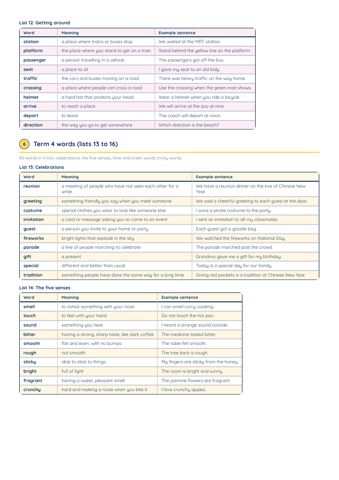
| Word | Meaning | Example sentence |
|---|---|---|
| station | a place where trains or buses stop | We waited at the MRT station. |
| platform | the place where you stand to get on a train | Stand behind the yellow line on the platform. |
| passenger | a person travelling in a vehicle | The passengers got off the bus. |
| seat | a place to sit | I gave my seat to an old lady. |
| traffic | the cars and buses moving on a road | There was heavy traffic on the way home. |
| crossing | a place where people can cross a road | Use the crossing when the green man shows. |
| helmet | a hard hat that protects your head | Wear a helmet when you ride a bicycle. |
| arrive | to reach a place | We will arrive at the zoo at nine. |
| depart | to leave | The coach will depart at noon. |
| direction | the way you go to get somewhere | Which direction is the beach? |
Term 4 words (lists 13 to 16)
40 words in 4 lists
40 words in 4 lists: celebrations, the five senses, time and order words, tricky words.
| Word | Meaning | Example sentence |
|---|---|---|
| reunion | a meeting of people who have not seen each other for a while | We have a reunion dinner on the eve of Chinese New Year. |
| greeting | something friendly you say when you meet someone | We said a cheerful greeting to each guest at the door. |
| costume | special clothes you wear to look like someone else | I wore a pirate costume to the party. |
| invitation | a card or message asking you to come to an event | I sent an invitation to all my classmates. |
| guest | a person you invite to your home or party | Each guest got a goodie bag. |
| fireworks | bright lights that explode in the sky | We watched the fireworks on National Day. |
| parade | a line of people marching to celebrate | The parade marched past the crowd. |
| gift | a present | Grandma gave me a gift for my birthday. |
| special | different and better than usual | Today is a special day for our family. |
| tradition | something people have done the same way for a long time | Giving red packets is a tradition at Chinese New Year. |
| Word | Meaning | Example sentence |
|---|---|---|
| smell | to notice something with your nose | I can smell curry cooking. |
| touch | to feel with your hand | Do not touch the hot pan. |
| sound | something you hear | I heard a strange sound outside. |
| bitter | having a strong, sharp taste, like dark coffee | The medicine tasted bitter. |
| smooth | flat and even, with no bumps | The table felt smooth. |
| rough | not smooth | The tree bark is rough. |
| sticky | able to stick to things | My fingers are sticky from the honey. |
| bright | full of light | The room is bright and sunny. |
| fragrant | having a sweet, pleasant smell | The jasmine flowers are fragrant. |
| crunchy | hard and making a noise when you bite it | I love crunchy apples. |
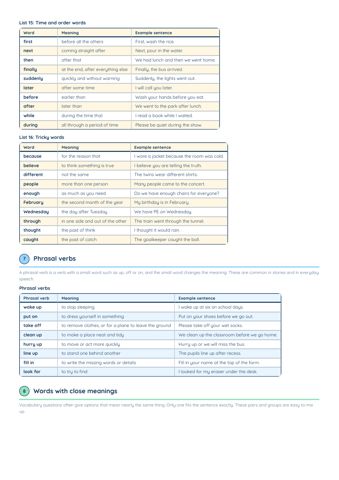
| Word | Meaning | Example sentence |
|---|---|---|
| first | before all the others | First, wash the rice. |
| next | coming straight after | Next, pour in the water. |
| then | after that | We had lunch and then we went home. |
| finally | at the end, after everything else | Finally, the bus arrived. |
| suddenly | quickly and without warning | Suddenly, the lights went out. |
| later | after some time | I will call you later. |
| before | earlier than | Wash your hands before you eat. |
| after | later than | We went to the park after lunch. |
| while | during the time that | I read a book while I waited. |
| during | all through a period of time | Please be quiet during the show. |
| Word | Meaning | Example sentence |
|---|---|---|
| because | for the reason that | I wore a jacket because the room was cold. |
| believe | to think something is true | I believe you are telling the truth. |
| different | not the same | The twins wear different shirts. |
| people | more than one person | Many people came to the concert. |
| enough | as much as you need | Do we have enough chairs for everyone? |
| February | the second month of the year | My birthday is in February. |
| Wednesday | the day after Tuesday | We have PE on Wednesday. |
| through | in one side and out of the other | The train went through the tunnel. |
| thought | the past of think | I thought it would rain. |
| caught | the past of catch | The goalkeeper caught the ball. |
Phrasal verbs
A phrasal verb is a verb with a small word such as up, off or on, and the small word changes the meaning. These are common in stories and in everyday speech.
| Phrasal verb | Meaning | Example sentence |
|---|---|---|
| wake up | to stop sleeping | I wake up at six on school days. |
| put on | to dress yourself in something | Put on your shoes before we go out. |
| take off | to remove clothes, or for a plane to leave the ground | Please take off your wet socks. |
| clean up | to make a place neat and tidy | We clean up the classroom before we go home. |
| hurry up | to move or act more quickly | Hurry up or we will miss the bus. |
| line up | to stand one behind another | The pupils line up after recess. |
| fill in | to write the missing words or details | Fill in your name at the top of the form. |
| look for | to try to find | I looked for my eraser under the desk. |
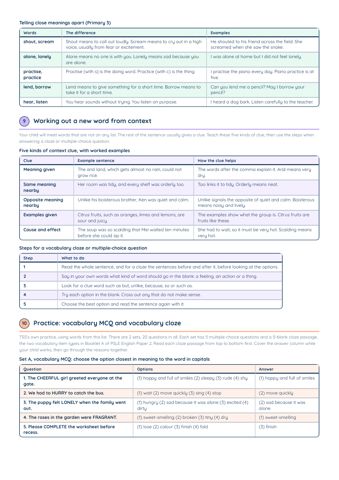
Words with close meanings
Vocabulary questions often give options that mean nearly the same thing. Only one fits the sentence exactly. These pairs and groups are easy to mix up.
| Words | The difference | Examples |
|---|---|---|
| shout, scream | Shout means to call out loudly. Scream means to cry out in a high voice, usually from fear or excitement. | He shouted to his friend across the field. She screamed when she saw the snake. |
| alone, lonely | Alone means no one is with you. Lonely means sad because you are alone. | I was alone at home but I did not feel lonely. |
| practise, practice | Practise (with s) is the doing word. Practice (with c) is the thing. | I practise the piano every day. Piano practice is at five. |
| lend, borrow | Lend means to give something for a short time. Borrow means to take it for a short time. | Can you lend me a pencil? May I borrow your pencil? |
| hear, listen | You hear sounds without trying. You listen on purpose. | I heard a dog bark. Listen carefully to the teacher. |
Working out a new word from context
Your child will meet words that are not on any list. The rest of the sentence usually gives a clue. Teach these five kinds of clue, then use the steps when answering a cloze or multiple-choice question.
| Clue | Example sentence | How the clue helps |
|---|---|---|
| Meaning given | The arid land, which gets almost no rain, could not grow rice. | The words after the comma explain it. Arid means very dry. |
| Same meaning nearby | Her room was tidy, and every shelf was orderly too. | Too links it to tidy. Orderly means neat. |
| Opposite meaning nearby | Unlike his boisterous brother, Ken was quiet and calm. | Unlike signals the opposite of quiet and calm. Boisterous means noisy and lively. |
| Examples given | Citrus fruits, such as oranges, limes and lemons, are sour and juicy. | The examples show what the group is. Citrus fruits are fruits like these. |
| Cause and effect | The soup was so scalding that Mei waited ten minutes before she could sip it. | She had to wait, so it must be very hot. Scalding means very hot. |
| Step | What to do |
|---|---|
| 1 | Read the whole sentence, and for a cloze the sentences before and after it, before looking at the options. |
| 2 | Say in your own words what kind of word should go in the blank: a feeling, an action or a thing. |
| 3 | Look for a clue word such as but, unlike, because, so or such as. |
| 4 | Try each option in the blank. Cross out any that do not make sense. |
| 5 | Choose the best option and read the sentence again with it. |
Practice: vocabulary MCQ and vocabulary cloze
20 questions, answers under each set
TSS's own practice, using words from this list. There are 2 sets, 20 questions in all. Each set has 5 multiple-choice questions and a 5-blank cloze passage, the two vocabulary item types in Booklet A of PSLE English Paper 2. Read each cloze passage from top to bottom first. Cover the answer column while your child works, then go through the reasons together.
| Question | Options |
|---|---|
| 1. The CHEERFUL girl greeted everyone at the gate. | (1) happy and full of smiles (2) sleepy (3) rude (4) shy |
| 2. We had to HURRY to catch the bus. | (1) wait (2) move quickly (3) sing (4) stop |
| 3. The puppy felt LONELY when the family went out. | (1) hungry (2) sad because it was alone (3) excited (4) dirty |
| 4. The roses in the garden were FRAGRANT. | (1) sweet-smelling (2) broken (3) tiny (4) dry |
| 5. Please COMPLETE the worksheet before recess. | (1) lose (2) colour (3) finish (4) fold |
Show answersHide answers
| No. | Answer |
|---|---|
| 1 | (1) happy and full of smiles |
| 2 | (2) move quickly |
| 3 | (2) sad because it was alone |
| 4 | (1) sweet-smelling |
| 5 | (3) finish |
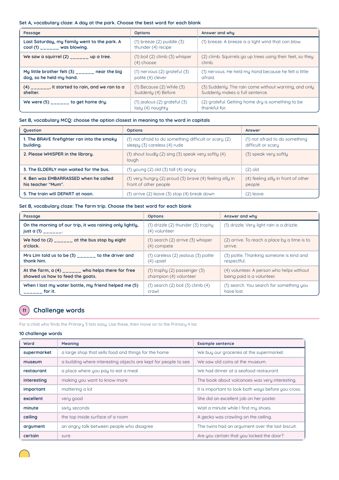
| Passage | Options |
|---|---|
| Last Saturday, my family went to the park. A cool (1) ______ was blowing. | (1) breeze (2) puddle (3) thunder (4) recipe |
| We saw a squirrel (2) ______ up a tree. | (1) boil (2) climb (3) whisper (4) choose |
| My little brother felt (3) ______ near the big dog, so he held my hand. | (1) nervous (2) grateful (3) polite (4) clever |
| (4) ______, it started to rain, and we ran to a shelter. | (1) Because (2) While (3) Suddenly (4) Before |
| We were (5) ______ to get home dry. | (1) jealous (2) grateful (3) lazy (4) naughty |
Show answersHide answers
| No. | Answer and why |
|---|---|
| 1 | (1) breeze. A breeze is a light wind that can blow. |
| 2 | (2) climb. Squirrels go up trees using their feet, so they climb. |
| 3 | (1) nervous. He held my hand because he felt a little afraid. |
| 4 | (3) Suddenly. The rain came without warning, and only Suddenly makes a full sentence. |
| 5 | (2) grateful. Getting home dry is something to be thankful for. |
| Question | Options |
|---|---|
| 1. The BRAVE firefighter ran into the smoky building. | (1) not afraid to do something difficult or scary (2) sleepy (3) careless (4) rude |
| 2. Please WHISPER in the library. | (1) shout loudly (2) sing (3) speak very softly (4) laugh |
| 3. The ELDERLY man waited for the bus. | (1) young (2) old (3) tall (4) angry |
| 4. Ben was EMBARRASSED when he called his teacher "Mum". | (1) very hungry (2) proud (3) brave (4) feeling silly in front of other people |
| 5. The train will DEPART at noon. | (1) arrive (2) leave (3) stop (4) break down |
Show answersHide answers
| No. | Answer |
|---|---|
| 1 | (1) not afraid to do something difficult or scary |
| 2 | (3) speak very softly |
| 3 | (2) old |
| 4 | (4) feeling silly in front of other people |
| 5 | (2) leave |
| Passage | Options |
|---|---|
| On the morning of our trip, it was raining only lightly, just a (1) ______. | (1) drizzle (2) thunder (3) trophy (4) volunteer |
| We had to (2) ______ at the bus stop by eight o'clock. | (1) search (2) arrive (3) whisper (4) compete |
| Mrs Lim told us to be (3) ______ to the driver and thank him. | (1) careless (2) jealous (3) polite (4) upset |
| At the farm, a (4) ______ who helps there for free showed us how to feed the goats. | (1) trophy (2) passenger (3) champion (4) volunteer |
| When I lost my water bottle, my friend helped me (5) ______ for it. | (1) search (2) boil (3) climb (4) crawl |
Show answersHide answers
| No. | Answer and why |
|---|---|
| 1 | (1) drizzle. Very light rain is a drizzle. |
| 2 | (2) arrive. To reach a place by a time is to arrive. |
| 3 | (3) polite. Thanking someone is kind and respectful. |
| 4 | (4) volunteer. A person who helps without being paid is a volunteer. |
| 5 | (1) search. You search for something you have lost. |
Challenge words
For a child who finds the Primary 3 lists easy. Use these, then move on to the Primary 4 list.
| Word | Meaning | Example sentence |
|---|---|---|
| supermarket | a large shop that sells food and things for the home | We buy our groceries at the supermarket. |
| museum | a building where interesting objects are kept for people to see | We saw old coins at the museum. |
| restaurant | a place where you pay to eat a meal | We had dinner at a seafood restaurant. |
| interesting | making you want to know more | The book about volcanoes was very interesting. |
| important | mattering a lot | It is important to look both ways before you cross. |
| excellent | very good | She did an excellent job on her poster. |
| minute | sixty seconds | Wait a minute while I find my shoes. |
| ceiling | the top inside surface of a room | A gecko was crawling on the ceiling. |
| argument | an angry talk between people who disagree | The twins had an argument over the last biscuit. |
| certain | sure | Are you certain that you locked the door? |
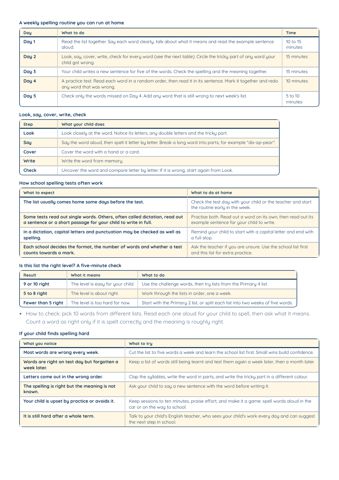
How to use this list
Each list has ten words, about right for one week. If a list is too much, split it over two weeks. A few minutes every day works better than one long session.
| Day | What to do | Time |
|---|---|---|
| Day 1 | Read the list together. Say each word clearly, talk about what it means and read the example sentence aloud. | 10 to 15 minutes |
| Day 2 | Look, say, cover, write, check for every word (see the next table). Circle the tricky part of any word your child got wrong. | 15 minutes |
| Day 3 | Your child writes a new sentence for five of the words. Check the spelling and the meaning together. | 15 minutes |
| Day 4 | A practice test. Read each word in a random order, then read it in its sentence. Mark it together and redo any word that was wrong. | 10 minutes |
| Day 5 | Check only the words missed on Day 4. Add any word that is still wrong to next week's list. | 5 to 10 minutes |
| Step | What your child does |
|---|---|
| Look | Look closely at the word. Notice its letters, any double letters and the tricky part. |
| Say | Say the word aloud, then spell it letter by letter. Break a long word into parts, for example "dis-ap-pear". |
| Cover | Cover the word with a hand or a card. |
| Write | Write the word from memory. |
| Check | Uncover the word and compare letter by letter. If it is wrong, start again from Look. |
| What to expect | What to do at home |
|---|---|
| The list usually comes home some days before the test. | Check the test day with your child or the teacher and start the routine early in the week. |
| Some tests read out single words. Others, often called dictation, read out a sentence or a short passage for your child to write in full. | Practise both. Read out a word on its own, then read out its example sentence for your child to write. |
| In a dictation, capital letters and punctuation may be checked as well as spelling. | Remind your child to start with a capital letter and end with a full stop. |
| Each school decides the format, the number of words and whether a test counts towards a mark. | Ask the teacher if you are unsure. Use the school list first and this list for extra practice. |
| Result | What it means | What to do |
|---|---|---|
| 9 or 10 right | The level is easy for your child. | Use the challenge words, then try lists from the Primary 4 list. |
| 5 to 8 right | The level is about right. | Work through the lists in order, one a week. |
| Fewer than 5 right | The level is too hard for now. | Start with the Primary 2 list, or split each list into two weeks of five words. |
- How to check: pick 10 words from different lists. Read each one aloud for your child to spell, then ask what it means. Count a word as right only if it is spelt correctly and the meaning is roughly right.
| What you notice | What to try |
|---|---|
| Most words are wrong every week. | Cut the list to five words a week and learn the school list first. Small wins build confidence. |
| Words are right on test day but forgotten a week later. | Keep a list of words still being learnt and test them again a week later, then a month later. |
| Letters come out in the wrong order. | Clap the syllables, write the word in parts, and write the tricky part in a different colour. |
| The spelling is right but the meaning is not known. | Ask your child to say a new sentence with the word before writing it. |
| Your child is upset by practice or avoids it. | Keep sessions to ten minutes, praise effort, and make it a game: spell words aloud in the car or on the way to school. |
| It is still hard after a whole term. | Talk to your child's English teacher, who sees your child's work every day and can suggest the next step in school. |
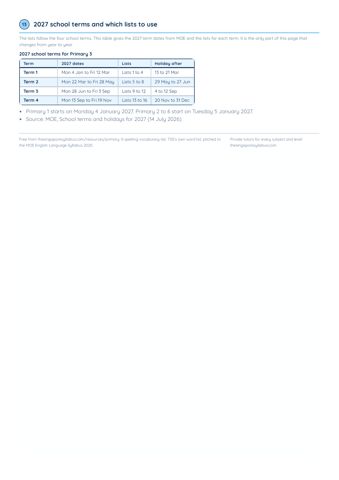
2027 school terms and which lists to use
The lists follow the four school terms. This table gives the 2027 term dates from MOE and the lists for each term. It is the only part of this page that changes from year to year.
| Term | 2027 dates | Lists | Holiday after |
|---|---|---|---|
| Term 1 | Mon 4 Jan to Fri 12 Mar | Lists 1 to 4 | 13 to 21 Mar |
| Term 2 | Mon 22 Mar to Fri 28 May | Lists 5 to 8 | 29 May to 27 Jun |
| Term 3 | Mon 28 Jun to Fri 3 Sep | Lists 9 to 12 | 4 to 12 Sep |
| Term 4 | Mon 13 Sep to Fri 19 Nov | Lists 13 to 16 | 20 Nov to 31 Dec |
- Primary 1 starts on Monday 4 January 2027. Primary 2 to 6 start on Tuesday 5 January 2027.
- Source: MOE, School terms and holidays for 2027 (14 July 2026).
Download the free PDFPDF · 12 pages · A4 portrait · free, no sign-up
Inside the PDF
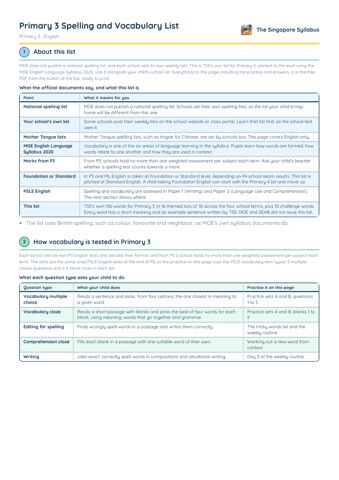
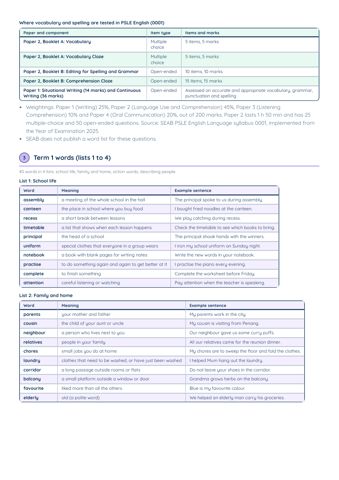
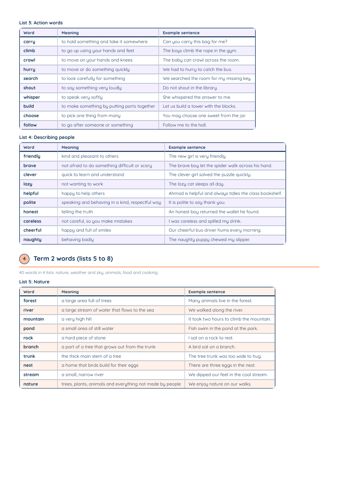
12 A4 pages, ready to print. Tap a page to open the PDF there.

Questions students ask
Does MOE publish a Primary 3 spelling list?
No. MOE does not publish a national spelling or vocabulary list for any primary level. Each school sets its own lists, so use this one alongside the list your child brings home.
How many spelling words should my child learn each week?
Each list here has 10 words, which suits one week. If your child finds that too many, split a list over two weeks and keep the daily practice short.
Do spelling tests count in Primary 3?
It depends on the school. From P3, schools hold no more than one weighted assessment per subject each term, and each school decides how its spelling tests are used. Ask your child's teacher.
How is vocabulary tested in Primary 3?
Each school sets its own P3 papers. The skills are the ones PSLE English tests later: choosing the closest meaning in multiple-choice questions, choosing the best word in a cloze passage, and spelling words correctly. This page has 20 practice questions of those kinds, with answers.
Are there practice questions with answers?
Yes. There are 20 vocabulary questions, multiple choice and cloze, in the two vocabulary item types of PSLE English Paper 2. Every answer has a short reason, so your child can see why the other options do not fit.
Does this list use British or American spelling?
British spelling, such as colour, favourite and neighbour. MOE's own English syllabus documents use British spelling too, for example behaviour, organise and programme.
What if my child's school list has different words?
Learn the school list first, since the school test uses it. Then use this list for extra words, and use the meanings and example sentences to help your child use each word, not only spell it.
What if my child finds spelling hard?
Cut the list to five words a week, learn the school list first and keep a list of words still being learnt to test again a week later. If it is still hard after a term, talk to your child's English teacher.
What comes after this list?
The Primary 4 list picks up where this one ends, with no word repeated. If your child spells 9 or 10 of a random 10 words correctly, use the challenge words and then move on to it.
Keep revising
- Primary English tuition1-to-1 English tutors for P1 to P6
- Primary 3 English tuitionWhat P3 English covers and how a tutor helps
- PSLE Math FormulasPSLE (Primary 1 to 6) · free PDF
- PSLE English Composition PhrasesPSLE (Primary 5 and 6) · free PDF
- PSLE Chinese Composition Phrases (好词好句)PSLE (Primary 5 and 6) · free PDF
- PSLE Science KeywordsPSLE (Primary 3 to 6) · free PDF
- Primary English Oral Practice (P3 to PSLE)Primary 3 to 6 and PSLE · free PDF
- Primary English Listening Comprehension Practice (P3 to PSLE)Primary 3 to 6 and PSLE · free PDF
- Primary English Composition Topics (P3 to PSLE)Primary 3 to 6 and PSLE · free PDF
- Primary 1 Maths WorksheetsPrimary 1 · free PDF
- Primary 2 Maths WorksheetsPrimary 2 · free PDF
- Primary 3 Maths WorksheetsPrimary 3 · free PDF
- Primary 1 English WorksheetsPrimary 1 · free PDF
- Primary 2 English WorksheetsPrimary 2 · free PDF
- Primary 3 English WorksheetsPrimary 3 · free PDF
- Primary 1 Spelling and Vocabulary ListPrimary 1 · free PDF
- Primary 2 Spelling and Vocabulary ListPrimary 2 · free PDF
- Primary 4 Spelling and Vocabulary ListPrimary 4 · free PDF
- Primary 5 Spelling and Vocabulary ListPrimary 5 · free PDF
- PSLE Vocabulary List (Primary 6)Primary 6 (PSLE) · free PDF
- PSLE Score calculatorAdd up the four AL grades
- All free resourcesPSLE, O-Level and A-Level
Source
- MOE, English Language Syllabus 2020, Primary Foundation English and Secondary G1
- MOE, Primary school subjects and syllabuses
- MOE, Learn for Life press release (28 September 2018)
- SEAB, PSLE English Language syllabus 0001 (implemented from 2025), Examination Format
- MOE, School terms and holidays for 2027 (14 July 2026)
The words, meanings, example sentences and practice items are our own. MOE does not publish a national spelling list. The syllabus, exam and term details come from the MOE, SEAB and school pages above, and if they differ, those pages are right. Tell us and we will fix it.