Free resource · Primary 3 to 6 and PSLE
Primary 3 to PSLE English Oral Practice: Free PDF
The PSLE English oral (Paper 4) is worth 40 of the 200 marks, 20%: Reading Aloud 15 marks and a Stimulus-based Conversation about a photo 25 marks, with 5 minutes to prepare and about 5 minutes in the exam room. This free set, also a printable PDF, has 12 original reading passages for Primary 3 to 6 and 13 conversation sets, with model answers, a home score guide and what to do when a child freezes.
How the PSLE English oral works
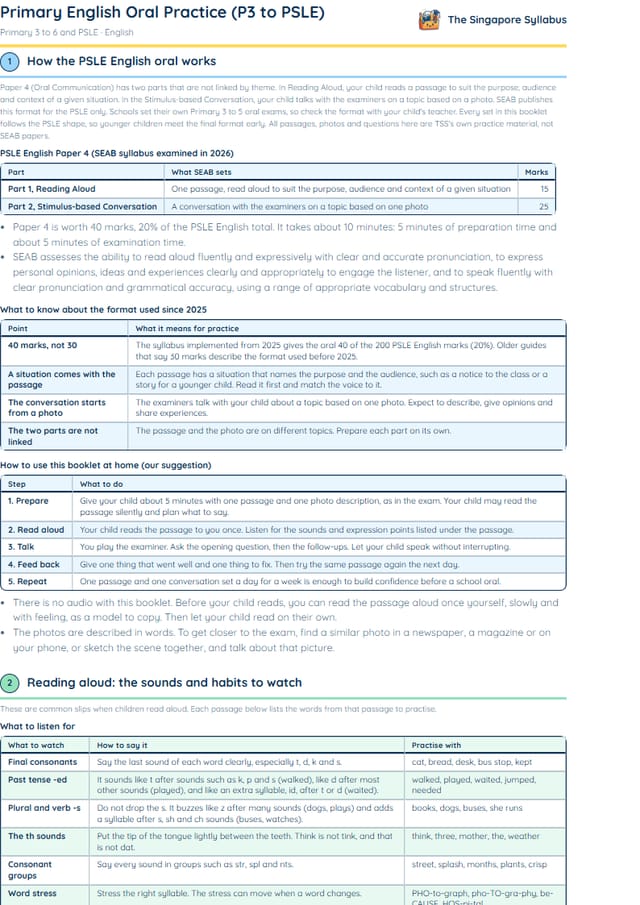
Paper 4 (Oral Communication) has two parts that are not linked by theme. In Reading Aloud, your child reads a passage to suit the purpose, audience and context of a given situation. In the Stimulus-based Conversation, your child talks with the examiners on a topic based on a photo. SEAB publishes this format for the PSLE only. Schools set their own Primary 3 to 5 oral exams, so check the format with your child's teacher. Every set in this booklet follows the PSLE shape, so younger children meet the final format early. All passages, photos and questions here are TSS's own practice material, not SEAB papers.
| Part | What SEAB sets | Marks |
|---|---|---|
| Part 1, Reading Aloud | One passage, read aloud to suit the purpose, audience and context of a given situation | 15 |
| Part 2, Stimulus-based Conversation | A conversation with the examiners on a topic based on one photo | 25 |
- Paper 4 is worth 40 marks, 20% of the PSLE English total. It takes about 10 minutes: 5 minutes of preparation time and about 5 minutes of examination time.
- SEAB assesses the ability to read aloud fluently and expressively with clear and accurate pronunciation, to express personal opinions, ideas and experiences clearly and appropriately to engage the listener, and to speak fluently with clear pronunciation and grammatical accuracy, using a range of appropriate vocabulary and structures.
| Point | What it means for practice |
|---|---|
| 40 marks, not 30 | The syllabus implemented from 2025 gives the oral 40 of the 200 PSLE English marks (20%). Older guides that say 30 marks describe the format used before 2025. |
| A situation comes with the passage | Each passage has a situation that names the purpose and the audience, such as a notice to the class or a story for a younger child. Read it first and match the voice to it. |
| The conversation starts from a photo | The examiners talk with your child about a topic based on one photo. Expect to describe, give opinions and share experiences. |
| The two parts are not linked | The passage and the photo are on different topics. Prepare each part on its own. |
| Step | What to do |
|---|---|
| 1. Prepare | Give your child about 5 minutes with one passage and one photo description, as in the exam. Your child may read the passage silently and plan what to say. |
| 2. Read aloud | Your child reads the passage to you once. Listen for the sounds and expression points listed under the passage. |
| 3. Talk | You play the examiner. Ask the opening question, then the follow-ups. Let your child speak without interrupting. |
| 4. Feed back | Give one thing that went well and one thing to fix. Then try the same passage again the next day. |
| 5. Repeat | One passage and one conversation set a day for a week is enough to build confidence before a school oral. |
- There is no audio with this booklet. Before your child reads, you can read the passage aloud once yourself, slowly and with feeling, as a model to copy. Then let your child read on their own.
- The photos are described in words. To get closer to the exam, find a similar photo in a newspaper, a magazine or on your phone, or sketch the scene together, and talk about that picture.
Reading aloud: the sounds and habits to watch
These are common slips when children read aloud. Each passage below lists the words from that passage to practise.
| What to watch | How to say it | Practise with |
|---|---|---|
| Final consonants | Say the last sound of each word clearly, especially t, d, k and s. | cat, bread, desk, bus stop, kept |
| Past tense -ed | It sounds like t after sounds such as k, p and s (walked), like d after most other sounds (played), and like an extra syllable, id, after t or d (waited). | walked, played, waited, jumped, needed |
| Plural and verb -s | Do not drop the s. It buzzes like z after many sounds (dogs, plays) and adds a syllable after s, sh and ch sounds (buses, watches). | books, dogs, buses, she runs |
| The th sounds | Put the tip of the tongue lightly between the teeth. Think is not tink, and that is not dat. | think, three, mother, the, weather |
| Consonant groups | Say every sound in groups such as str, spl and nts. | street, splash, months, plants, crisp |
| Word stress | Stress the right syllable. The stress can move when a word changes. | PHO-to-graph, pho-TO-gra-phy, be-CAUSE, HOS-pi-tal |
| Long and short vowels | Keep pairs apart so the meaning stays clear. | ship and sheep, full and fool, bed and bad |
| Pausing | Pause briefly at commas and a little longer at full stops. Do not stop in the middle of a phrase. | After lunch, we walked home. |
| Questions | The voice usually rises at the end of a yes or no question and falls at the end of a what, where or why question. | Are you ready? Where is it? |
| Purpose and audience | Match the voice to the situation. A notice to the class is clear and steady. A story for a younger child is warmer and livelier. | Read the situation line first and decide who you are speaking to. |
Primary 3 reading aloud passages
Three short passages, about 90 to 110 words each.
| Part | Practice passage |
|---|---|
| Situation | You are reading a short story to your younger cousin at bedtime. |
| Passage | Mei Ling had a small brown hamster called Biscuit. Every evening, Biscuit ran round and round on his little wheel. One night, Mei Ling heard a soft scratching sound under her bed. She switched on the lamp and looked around. The cage door was open. Biscuit was gone. Mei Ling searched behind the cupboard and inside her slippers. At last, she spotted two tiny eyes peeping out of her school bag. Biscuit was sitting on her pencil case, nibbling a cracker. “So that is where my snack went,” she laughed. |
| Sounds to watch | Groups: small, scratching, switched, spotted. Past tense: looked and searched end in t, spotted ends in id, laughed ends in t. Final sounds: bed, cage, gone. The th in that. |
| Expression to watch | Slow down and lower your voice at “The cage door was open. Biscuit was gone.” to show worry. Sound amused and relieved on the last line. |
| Part | Practice passage |
|---|---|
| Situation | You are the class monitor, reading a notice to your class. |
| Passage | Good morning, everyone. Our class will visit the Botanic Gardens next Friday. Please bring a water bottle, a cap and a small snack. We will meet in the school hall at half past seven. The bus will leave at eight o'clock sharp, so please be on time. Remember to wear your PE attire and comfortable shoes. If it rains, the trip will be moved to the following week. Please hand in your consent form to Mrs Tan by this Wednesday. Thank you. |
| Sounds to watch | Bottle with a clear t. Wednesday is said WENZ-day. Comfortable has three syllables, COMF-ta-ble. Final sounds: snack, hall, sharp, attire, form. |
| Expression to watch | Clear and steady, a little slower than a story. Stress the key facts: next Friday, half past seven, eight o'clock sharp, this Wednesday. |
| Part | Practice passage |
|---|---|
| Situation | You are reading a page from a nature book to your classmates. |
| Passage | Have you ever watched an ant carry a crumb? An ant can lift things much heavier than its own body. Ants live and work together in large groups called colonies. Each ant has a job. Some ants look after the eggs. Others go out to find food. When an ant finds something to eat, it leaves a trail of scent on the ground. The other ants follow this trail, one behind another, all the way to the food. That is why you often see ants marching in a neat line across the kitchen floor. |
| Sounds to watch | Watched ends in t. Scent has a silent c. Colonies is COL-o-nies. Groups: crumb, trail, ground. Final sounds: ants, eggs, food. |
| Expression to watch | Let the opening question rise at the end. Sound curious and interested, as if sharing a fact you enjoy. |
Primary 4 reading aloud passages
Three passages, about 110 to 130 words each.
| Part | Practice passage |
|---|---|
| Situation | You are reading your diary entry aloud to your class during a sharing session. |
| Passage | Today I took part in my first swimming competition. My stomach was churning as I stood on the starting block. The whistle blew and I dived into the cool water. I kicked as hard as I could, but halfway through the race, my goggles started to fill with water. I could hardly see the wall. For a moment, I thought about stopping. Then I heard my sister shouting my name from the stands. I gritted my teeth and kept going. I finished fourth, not first, but I was proud that I did not give up. Next time, I will check my goggles twice. |
| Sounds to watch | Stomach is STUM-uk. Whistle has a silent t. Halfway has a silent l. Past tense: dived ends in d, kicked and finished end in t, gritted ends in id. Group: churning, starting, stands. |
| Expression to watch | Build tension through the race, then slow down at “For a moment, I thought about stopping.” Lift your voice with pride at the end. |
| Part | Practice passage |
|---|---|
| Situation | You are giving a short talk to your class about how to grow a plant at home. |
| Passage | Growing a plant at home is easier than you might think. First, choose a pot with small holes at the bottom, so that extra water can drain away. Next, fill the pot with soil and press a seed gently into it, about as deep as your fingertip. Water the soil until it is damp, but not soggy. Place the pot near a sunny window. Check it every day. If the soil feels dry, add a little water. In about a week, a tiny green shoot should push through the soil. Be patient. Plants grow slowly, but watching them change is part of the fun. |
| Sounds to watch | Choose ends in a z sound. Soil has the oi sound. Patient is PAY-shent. Groups: drain, press, plants, slowly. Final sounds: damp, add, push. |
| Expression to watch | Sound like a friendly teacher. Pause briefly after First and Next. Stress the warning words: damp, but not soggy. |
| Part | Practice passage |
|---|---|
| Situation | You are reading the start of a mystery story to a group of friends. |
| Passage | The lights flickered twice and then went out. Ravi froze in the middle of the corridor. Somewhere behind him, a door creaked open. “Hello?” he called. His voice sounded thin and shaky. Nobody answered. He took one careful step forward, then another. Something brushed against his ankle. Ravi jumped and nearly dropped his torch. When he finally switched it on, he found himself face to face with a fluffy grey cat. It blinked at him, yawned, and padded away as if nothing had happened. Ravi laughed so loudly that the sound echoed down the empty corridor. |
| Sounds to watch | Past tense: flickered, yawned and echoed end in d, creaked, brushed and jumped end in t, padded ends in id. The th in then, thin and nothing. Corridor is COR-ri-dor. |
| Expression to watch | Read the first half slowly and quietly to build suspense. Let “Hello?” rise and sound unsure. Relax your voice when the cat appears and sound amused at the end. |
Primary 5 reading aloud passages
Three passages, about 130 to 150 words each.
| Part | Practice passage |
|---|---|
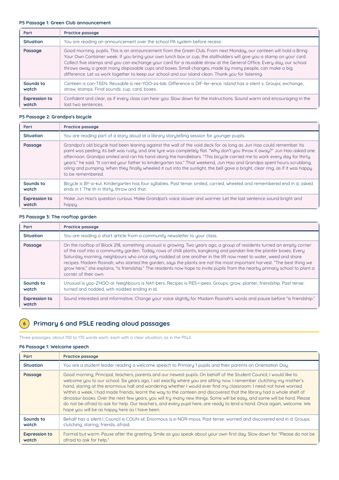
| Situation | You are reading an announcement over the school PA system before recess. |
| Passage | Good morning, pupils. This is an announcement from the Green Club. From next Monday, our canteen will hold a Bring Your Own Container week. If you bring your own lunch box or cup, the stallholders will give you a stamp on your card. Collect five stamps and you can exchange your card for a reusable straw at the General Office. Every day, our school throws away a great many disposable cups and boxes. Small changes, made by many people, can make a big difference. Let us work together to keep our school and our island clean. Thank you for listening. |
| Sounds to watch | Canteen is can-TEEN. Reusable is ree-YOO-za-ble. Difference is DIF-fer-ence. Island has a silent s. Groups: exchange, straw, stamps. Final sounds: cup, card, boxes. |
| Expression to watch | Confident and clear, as if every class can hear you. Slow down for the instructions. Sound warm and encouraging in the last two sentences. |
| Part | Practice passage |
|---|---|
| Situation | You are reading part of a story aloud at a library storytelling session for younger pupils. |
| Passage | Grandpa's old bicycle had been leaning against the wall of the void deck for as long as Jun Hao could remember. Its paint was peeling, its bell was rusty, and one tyre was completely flat. “Why don't you throw it away?” Jun Hao asked one afternoon. Grandpa smiled and ran his hand along the handlebars. “This bicycle carried me to work every day for thirty years,” he said. “It carried your father to kindergarten too.” That weekend, Jun Hao and Grandpa spent hours scrubbing, oiling and pumping. When they finally wheeled it out into the sunlight, the bell gave a bright, clear ring, as if it was happy to be remembered. |
| Sounds to watch | Bicycle is BY-si-kul. Kindergarten has four syllables. Past tense: smiled, carried, wheeled and remembered end in d, asked ends in t. The th in thirty, throw and that. |
| Expression to watch | Make Jun Hao's question curious. Make Grandpa's voice slower and warmer. Let the last sentence sound bright and happy. |
| Part | Practice passage |
|---|---|
| Situation | You are reading a short article from a community newsletter to your class. |
| Passage | On the rooftop of Block 218, something unusual is growing. Two years ago, a group of residents turned an empty corner of the roof into a community garden. Today, rows of chilli plants, kangkong and pandan line the planter boxes. Every Saturday morning, neighbours who once only nodded at one another in the lift now meet to water, weed and share recipes. Madam Rosnah, who started the garden, says the plants are not the most important harvest. “The best thing we grow here,” she explains, “is friendship.” The residents now hope to invite pupils from the nearby primary school to plant a corner of their own. |
| Sounds to watch | Unusual is yoo-ZHOO-al. Neighbours is NAY-bers. Recipes is RES-i-pees. Groups: grow, planter, friendship. Past tense: turned and nodded, with nodded ending in id. |
| Expression to watch | Sound interested and informative. Change your voice slightly for Madam Rosnah's words and pause before “is friendship.” |
Primary 6 and PSLE reading aloud passages
Three passages, about 150 to 170 words each, each with a clear situation, as in the PSLE.
| Part | Practice passage |
|---|---|
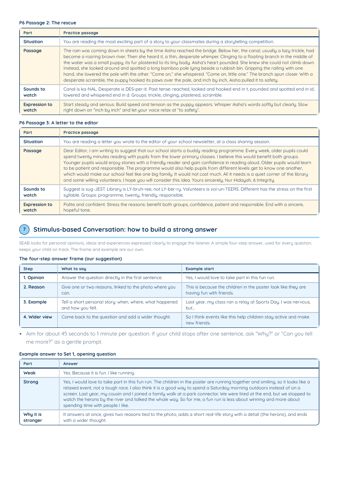
| Situation | You are a student leader reading a welcome speech to Primary 1 pupils and their parents on Orientation Day. |
| Passage | Good morning, Principal, teachers, parents and our newest pupils. On behalf of the Student Council, I would like to welcome you to our school. Six years ago, I sat exactly where you are sitting now. I remember clutching my mother's hand, staring at the enormous hall and wondering whether I would ever find my classroom. I need not have worried. Within a week, I had made friends, learnt the way to the canteen and discovered that the library had a whole shelf of dinosaur books. Over the next few years, you will try many new things. Some will be easy, and some will be hard. Please do not be afraid to ask for help. Our teachers, and every pupil here, are ready to lend a hand. Once again, welcome. We hope you will be as happy here as I have been. |
| Sounds to watch | Behalf has a silent l. Council is COUN-sil. Enormous is e-NOR-mous. Past tense: worried and discovered end in d. Groups: clutching, staring, friends, afraid. |
| Expression to watch | Formal but warm. Pause after the greeting. Smile as you speak about your own first day. Slow down for “Please do not be afraid to ask for help.” |
| Part | Practice passage |
|---|---|
| Situation | You are reading the most exciting part of a story to your classmates during a storytelling competition. |
| Passage | The rain was coming down in sheets by the time Aisha reached the bridge. Below her, the canal, usually a lazy trickle, had become a roaring brown river. Then she heard it, a thin, desperate whimper. Clinging to a floating branch in the middle of the water was a small puppy, its fur plastered to its tiny body. Aisha's heart pounded. She knew she could not climb down. Instead, she looked around and spotted a long bamboo pole lying beside a rubbish bin. Gripping the railing with one hand, she lowered the pole with the other. “Come on,” she whispered. “Come on, little one.” The branch spun closer. With a desperate scramble, the puppy hooked its paws over the pole, and inch by inch, Aisha pulled it to safety. |
| Sounds to watch | Canal is ka-NAL. Desperate is DES-per-it. Past tense: reached, looked and hooked end in t, pounded and spotted end in id, lowered and whispered end in d. Groups: trickle, clinging, plastered, scramble. |
| Expression to watch | Start steady and serious. Build speed and tension as the puppy appears. Whisper Aisha's words softly but clearly. Slow right down on “inch by inch” and let your voice relax at “to safety”. |
| Part | Practice passage |
|---|---|
| Situation | You are reading a letter you wrote to the editor of your school newsletter, at a class sharing session. |
| Passage | Dear Editor, I am writing to suggest that our school starts a buddy reading programme. Every week, older pupils could spend twenty minutes reading with pupils from the lower primary classes. I believe this would benefit both groups. Younger pupils would enjoy stories with a friendly reader and gain confidence in reading aloud. Older pupils would learn to be patient and responsible. The programme would also help pupils from different levels get to know one another, which would make our school feel like one big family. It would not cost much. All it needs is a quiet corner of the library and some willing volunteers. I hope you will consider this idea. Yours sincerely, Nur Hidayah, 6 Integrity. |
| Sounds to watch | Suggest is sug-JEST. Library is LY-bruh-ree, not LY-ber-ry. Volunteers is vol-un-TEERS. Different has the stress on the first syllable. Groups: programme, twenty, friendly, responsible. |
| Expression to watch | Polite and confident. Stress the reasons: benefit both groups, confidence, patient and responsible. End with a sincere, hopeful tone. |
Stimulus-based Conversation: how to build a strong answer
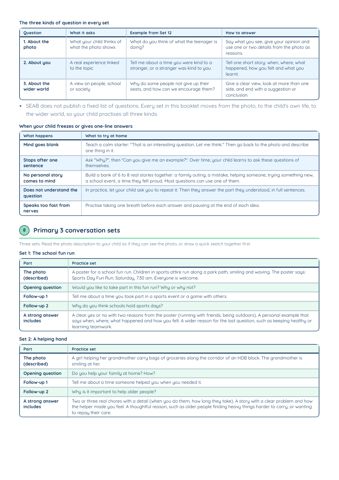
SEAB looks for personal opinions, ideas and experiences expressed clearly to engage the listener. A simple four-step answer, used for every question, keeps your child on track. The frame and example are our own.
| Step | What to say | Example start |
|---|---|---|
| 1. Opinion | Answer the question directly in the first sentence. | Yes, I would love to take part in this fun run. |
| 2. Reason | Give one or two reasons, linked to the photo where you can. | This is because the children in the poster look like they are having fun with friends. |
| 3. Example | Tell a short personal story: when, where, what happened and how you felt. | Last year, my class ran a relay at Sports Day. I was nervous, but... |
| 4. Wider view | Come back to the question and add a wider thought. | So I think events like this help children stay active and make new friends. |
- Aim for about 45 seconds to 1 minute per question. If your child stops after one sentence, ask “Why?” or “Can you tell me more?” as a gentle prompt.
| Part | Answer |
|---|---|
| Weak | Yes. Because it is fun. I like running. |
| Strong | Yes, I would love to take part in this fun run. The children in the poster are running together and smiling, so it looks like a relaxed event, not a tough race. I also think it is a good way to spend a Saturday morning outdoors instead of on a screen. Last year, my cousin and I joined a family walk at a park connector. We were tired at the end, but we stopped to watch the herons by the river and talked the whole way. So for me, a fun run is less about winning and more about spending time with people I like. |
| Why it is stronger | It answers at once, gives two reasons tied to the photo, adds a short real-life story with a detail (the herons), and ends with a wider thought. |
| Question | What it asks | Example from Set 12 | How to answer |
|---|---|---|---|
| 1. About the photo | What your child thinks of what the photo shows | What do you think of what the teenager is doing? | Say what you see, give your opinion and use one or two details from the photo as reasons. |
| 2. About you | A real experience linked to the topic | Tell me about a time you were kind to a stranger, or a stranger was kind to you. | Tell one short story: when, where, what happened, how you felt and what you learnt. |
| 3. About the wider world | A view on people, school or society | Why do some people not give up their seats, and how can we encourage them? | Give a clear view, look at more than one side, and end with a suggestion or conclusion. |
- SEAB does not publish a fixed list of questions. Every set in this booklet moves from the photo, to the child's own life, to the wider world, so your child practises all three kinds.
| What happens | What to try at home |
|---|---|
| Mind goes blank | Teach a calm starter: "That is an interesting question. Let me think." Then go back to the photo and describe one thing in it. |
| Stops after one sentence | Ask "Why?", then "Can you give me an example?". Over time, your child learns to ask these questions of themselves. |
| No personal story comes to mind | Build a bank of 6 to 8 real stories together: a family outing, a mistake, helping someone, trying something new, a school event, a time they felt proud. Most questions can use one of them. |
| Does not understand the question | In practice, let your child ask you to repeat it. Then they answer the part they understood, in full sentences. |
| Speaks too fast from nerves | Practise taking one breath before each answer and pausing at the end of each idea. |
Primary 3 conversation sets
Three sets. Read the photo description to your child as if they can see the photo, or draw a quick sketch together first.
| Part | Practice set |
|---|---|
| The photo (described) | A poster for a school fun run. Children in sports attire run along a park path, smiling and waving. The poster says: Sports Day Fun Run, Saturday, 7.30 am. Everyone is welcome. |
| Opening question | Would you like to take part in this fun run? Why or why not? |
| Follow-up 1 | Tell me about a time you took part in a sports event or a game with others. |
| Follow-up 2 | Why do you think schools hold sports days? |
| A strong answer includes | A clear yes or no with two reasons from the poster (running with friends, being outdoors). A personal example that says when, where, what happened and how you felt. A wider reason for the last question, such as keeping healthy or learning teamwork. |
| Part | Practice set |
|---|---|
| The photo (described) | A girl helping her grandmother carry bags of groceries along the corridor of an HDB block. The grandmother is smiling at her. |
| Opening question | Do you help your family at home? How? |
| Follow-up 1 | Tell me about a time someone helped you when you needed it. |
| Follow-up 2 | Why is it important to help older people? |
| A strong answer includes | Two or three real chores with a detail (when you do them, how long they take). A story with a clear problem and how the helper made you feel. A thoughtful reason, such as older people finding heavy things harder to carry, or wanting to repay their care. |
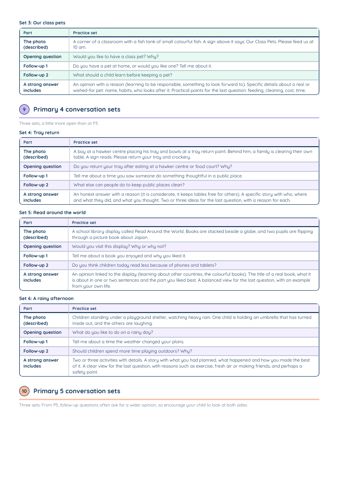
| Part | Practice set |
|---|---|
| The photo (described) | A corner of a classroom with a fish tank of small colourful fish. A sign above it says: Our Class Pets. Please feed us at 10 am. |
| Opening question | Would you like to have a class pet? Why? |
| Follow-up 1 | Do you have a pet at home, or would you like one? Tell me about it. |
| Follow-up 2 | What should a child learn before keeping a pet? |
| A strong answer includes | An opinion with a reason (learning to be responsible, something to look forward to). Specific details about a real or wished-for pet: name, habits, who looks after it. Practical points for the last question: feeding, cleaning, cost, time. |
Primary 4 conversation sets
Three sets, a little more open than at P3.
| Part | Practice set |
|---|---|
| The photo (described) | A boy at a hawker centre placing his tray and bowls at a tray return point. Behind him, a family is clearing their own table. A sign reads: Please return your tray and crockery. |
| Opening question | Do you return your tray after eating at a hawker centre or food court? Why? |
| Follow-up 1 | Tell me about a time you saw someone do something thoughtful in a public place. |
| Follow-up 2 | What else can people do to keep public places clean? |
| A strong answer includes | An honest answer with a reason (it is considerate, it keeps tables free for others). A specific story with who, where and what they did, and what you thought. Two or three ideas for the last question, with a reason for each. |
| Part | Practice set |
|---|---|
| The photo (described) | A school library display called Read Around the World. Books are stacked beside a globe, and two pupils are flipping through a picture book about Japan. |
| Opening question | Would you visit this display? Why or why not? |
| Follow-up 1 | Tell me about a book you enjoyed and why you liked it. |
| Follow-up 2 | Do you think children today read less because of phones and tablets? |
| A strong answer includes | An opinion linked to the display (learning about other countries, the colourful books). The title of a real book, what it is about in one or two sentences and the part you liked best. A balanced view for the last question, with an example from your own life. |
| Part | Practice set |
|---|---|
| The photo (described) | Children standing under a playground shelter, watching heavy rain. One child is holding an umbrella that has turned inside out, and the others are laughing. |
| Opening question | What do you like to do on a rainy day? |
| Follow-up 1 | Tell me about a time the weather changed your plans. |
| Follow-up 2 | Should children spend more time playing outdoors? Why? |
| A strong answer includes | Two or three activities with details. A story with what you had planned, what happened and how you made the best of it. A clear view for the last question, with reasons such as exercise, fresh air or making friends, and perhaps a safety point. |
Primary 5 conversation sets
Three sets. From P5, follow-up questions often ask for a wider opinion, so encourage your child to look at both sides.
| Part | Practice set |
|---|---|
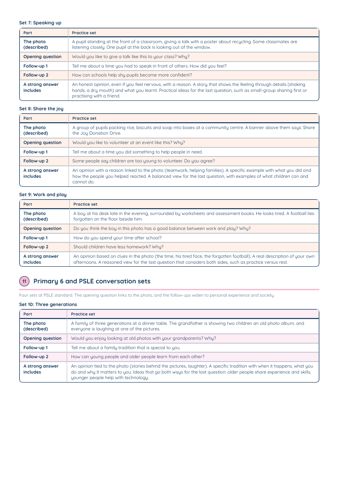
| The photo (described) | A pupil standing at the front of a classroom, giving a talk with a poster about recycling. Some classmates are listening closely. One pupil at the back is looking out of the window. |
| Opening question | Would you like to give a talk like this to your class? Why? |
| Follow-up 1 | Tell me about a time you had to speak in front of others. How did you feel? |
| Follow-up 2 | How can schools help shy pupils become more confident? |
| A strong answer includes | An honest opinion, even if you feel nervous, with a reason. A story that shows the feeling through details (shaking hands, a dry mouth) and what you learnt. Practical ideas for the last question, such as small-group sharing first or practising with a friend. |
| Part | Practice set |
|---|---|
| The photo (described) | A group of pupils packing rice, biscuits and soap into boxes at a community centre. A banner above them says: Share the Joy Donation Drive. |
| Opening question | Would you like to volunteer at an event like this? Why? |
| Follow-up 1 | Tell me about a time you did something to help people in need. |
| Follow-up 2 | Some people say children are too young to volunteer. Do you agree? |
| A strong answer includes | An opinion with a reason linked to the photo (teamwork, helping families). A specific example with what you did and how the people you helped reacted. A balanced view for the last question, with examples of what children can and cannot do. |
| Part | Practice set |
|---|---|
| The photo (described) | A boy at his desk late in the evening, surrounded by worksheets and assessment books. He looks tired. A football lies forgotten on the floor beside him. |
| Opening question | Do you think the boy in this photo has a good balance between work and play? Why? |
| Follow-up 1 | How do you spend your time after school? |
| Follow-up 2 | Should children have less homework? Why? |
| A strong answer includes | An opinion based on clues in the photo (the time, his tired face, the forgotten football). A real description of your own afternoons. A reasoned view for the last question that considers both sides, such as practice versus rest. |
Primary 6 and PSLE conversation sets
Four sets at PSLE standard. The opening question links to the photo, and the follow-ups widen to personal experience and society.
| Part | Practice set |
|---|---|
| The photo (described) | A family of three generations at a dinner table. The grandfather is showing two children an old photo album, and everyone is laughing at one of the pictures. |
| Opening question | Would you enjoy looking at old photos with your grandparents? Why? |
| Follow-up 1 | Tell me about a family tradition that is special to you. |
| Follow-up 2 | How can young people and older people learn from each other? |
| A strong answer includes | An opinion tied to the photo (stories behind the pictures, laughter). A specific tradition with when it happens, what you do and why it matters to you. Ideas that go both ways for the last question: older people share experience and skills, younger people help with technology. |
| Part | Practice set |
|---|---|
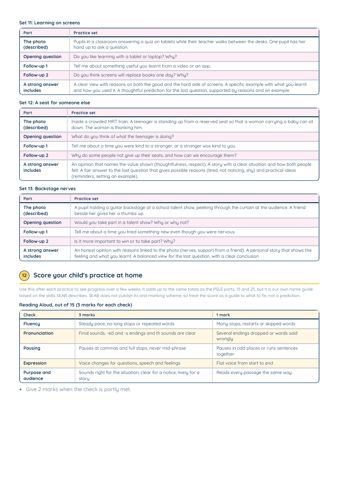
| The photo (described) | Pupils in a classroom answering a quiz on tablets while their teacher walks between the desks. One pupil has her hand up to ask a question. |
| Opening question | Do you like learning with a tablet or laptop? Why? |
| Follow-up 1 | Tell me about something useful you learnt from a video or an app. |
| Follow-up 2 | Do you think screens will replace books one day? Why? |
| A strong answer includes | A clear view with reasons on both the good and the hard side of screens. A specific example with what you learnt and how you used it. A thoughtful prediction for the last question, supported by reasons and an example. |
| Part | Practice set |
|---|---|
| The photo (described) | Inside a crowded MRT train. A teenager is standing up from a reserved seat so that a woman carrying a baby can sit down. The woman is thanking him. |
| Opening question | What do you think of what the teenager is doing? |
| Follow-up 1 | Tell me about a time you were kind to a stranger, or a stranger was kind to you. |
| Follow-up 2 | Why do some people not give up their seats, and how can we encourage them? |
| A strong answer includes | An opinion that names the value shown (thoughtfulness, respect). A story with a clear situation and how both people felt. A fair answer to the last question that gives possible reasons (tired, not noticing, shy) and practical ideas (reminders, setting an example). |
| Part | Practice set |
|---|---|
| The photo (described) | A pupil holding a guitar backstage at a school talent show, peeking through the curtain at the audience. A friend beside her gives her a thumbs up. |
| Opening question | Would you take part in a talent show? Why or why not? |
| Follow-up 1 | Tell me about a time you tried something new even though you were nervous. |
| Follow-up 2 | Is it more important to win or to take part? Why? |
| A strong answer includes | An honest opinion with reasons linked to the photo (nerves, support from a friend). A personal story that shows the feeling and what you learnt. A balanced view for the last question, with a clear conclusion. |
Score your child's practice at home
Use this after each practice to see progress over a few weeks. It adds up to the same totals as the PSLE parts, 15 and 25, but it is our own home guide based on the skills SEAB describes. SEAB does not publish its oral marking scheme, so treat the score as a guide to what to fix, not a prediction.
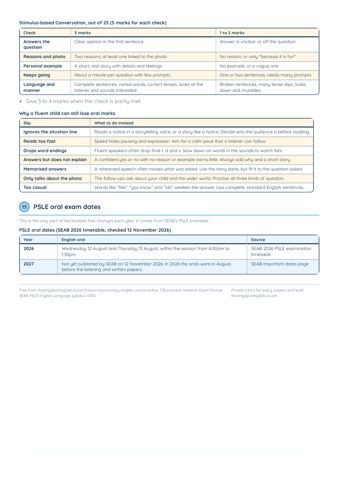
| Check | 3 marks | 1 mark |
|---|---|---|
| Fluency | Steady pace, no long stops or repeated words | Many stops, restarts or skipped words |
| Pronunciation | Final sounds, -ed and -s endings and th sounds are clear | Several endings dropped or words said wrongly |
| Pausing | Pauses at commas and full stops, never mid-phrase | Pauses in odd places or runs sentences together |
| Expression | Voice changes for questions, speech and feelings | Flat voice from start to end |
| Purpose and audience | Sounds right for the situation, clear for a notice, lively for a story | Reads every passage the same way |
- Give 2 marks when the check is partly met.
| Check | 5 marks | 1 to 2 marks |
|---|---|---|
| Answers the question | Clear opinion in the first sentence | Answer is unclear or off the question |
| Reasons and photo | Two reasons, at least one linked to the photo | No reason, or only "because it is fun" |
| Personal example | A short, real story with details and feelings | No example, or a vague one |
| Keeps going | About a minute per question with few prompts | One or two sentences, needs many prompts |
| Language and manner | Complete sentences, varied words, correct tenses, looks at the listener and sounds interested | Broken sentences, many tense slips, looks down and mumbles |
- Give 3 to 4 marks when the check is partly met.
| Slip | What to do instead |
|---|---|
| Ignores the situation line | Reads a notice in a storytelling voice, or a story like a notice. Decide who the audience is before reading. |
| Reads too fast | Speed hides pausing and expression. Aim for a calm pace that a listener can follow. |
| Drops word endings | Fluent speakers often drop final t, d and s. Slow down on words in the sounds to watch lists. |
| Answers but does not explain | A confident yes or no with no reason or example earns little. Always add why and a short story. |
| Memorised answers | A rehearsed speech often misses what was asked. Use the story bank, but fit it to the question asked. |
| Only talks about the photo | The follow-ups ask about your child and the wider world. Practise all three kinds of question. |
| Too casual | Words like "like", "you know" and "lah" weaken the answer. Use complete, standard English sentences. |
PSLE oral exam dates
This is the only part of the booklet that changes each year. It comes from SEAB's PSLE timetable.
| Year | English oral | Source |
|---|---|---|
| 2026 | Wednesday 12 August and Thursday 13 August, within the session from 8.00am to 1.30pm | SEAB 2026 PSLE examination timetable |
| 2027 | Not yet published by SEAB on 12 November 2026. In 2026 the orals were in August, before the listening and written papers. | SEAB important dates page |
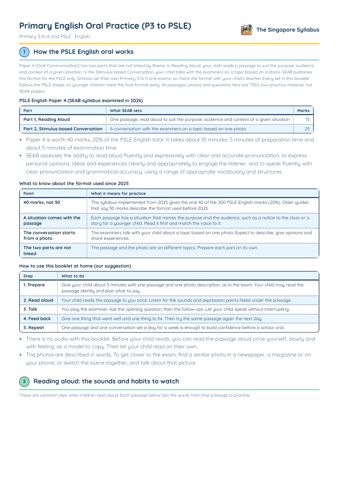
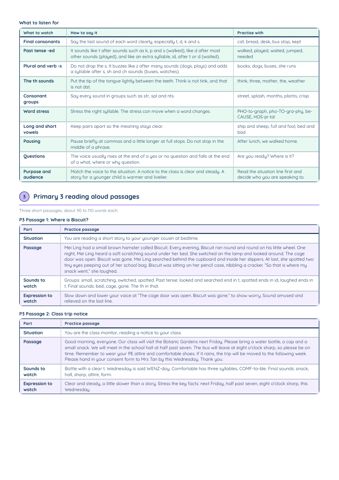
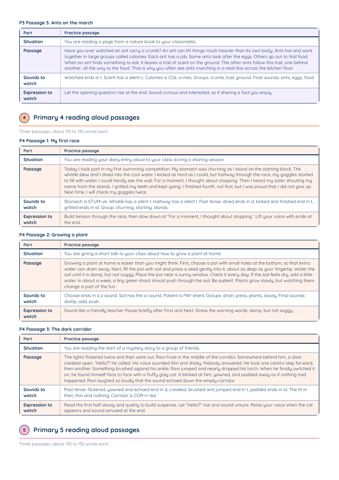
Download the free PDFPDF · 10 pages · A4 portrait · free, no sign-up
Inside the PDF
10 A4 pages, ready to print. Tap a page to open the PDF there.
Questions students ask
How is the PSLE English oral marked?
Paper 4 is worth 40 marks, 20% of the PSLE English total. Reading Aloud carries 15 marks and the Stimulus-based Conversation carries 25 marks. SEAB assesses reading aloud fluently and expressively with clear pronunciation, expressing opinions, ideas and experiences clearly, and speaking fluently with accurate grammar and a range of vocabulary.
How long is the PSLE English oral?
About 10 minutes in all. SEAB gives 5 minutes of preparation time and about 5 minutes of examination time for the two parts.
Is the reading passage on the same topic as the photo?
No. SEAB states that the two parts of the oral paper are not linked by theme. Prepare each part on its own.
What is the Primary 3 or Primary 4 English oral format?
SEAB publishes a format for the PSLE only. Schools set their own Primary 3 to 5 oral exams, so ask your child's teacher. Every set in this booklet uses the PSLE shape, so it works as practice at any level.
How long should my child talk for each conversation question?
SEAB does not set a length. We suggest about 45 seconds to 1 minute per question: an opinion, a reason, a short personal example and a closing thought.
How should my child practise reading aloud at home?
Read the situation line first and decide who the audience is. Read the passage silently, then aloud to a parent, who listens for the sounds and expression points listed under it. Read the same passage again the next day and listen for the difference.
Are these past PSLE oral passages or photos?
No. Every passage, photo description and question here is TSS's own practice material. SEAB papers are not reproduced.
Is the PSLE English oral 30 or 40 marks?
40 marks, 20% of PSLE English, under the SEAB syllabus implemented from 2025: Reading Aloud 15 marks and the Stimulus-based Conversation 25 marks. Guides that say 30 marks describe the format used before 2025.
When is the PSLE English oral?
SEAB sets the dates each year. In the 2026 timetable the English orals were on 12 and 13 August, before the listening and written papers. SEAB had not published the 2027 dates on 12 November 2026.
What if my child freezes or gives one-line answers?
Teach a calm starter such as "Let me think", then go back to the photo and describe one thing in it. At home, ask "Why?" and "Can you give me an example?" after short answers, and build a bank of 6 to 8 real stories your child can adapt.
Keep revising
- PSLE English paper by paperHow each PSLE English paper works
- Primary English tuitionOral, writing and comprehension help from P1 to PSLE
- PSLE English study guideSyllabus topics and the exam format
- PSLE Math FormulasPSLE (Primary 1 to 6) · free PDF
- PSLE English Composition PhrasesPSLE (Primary 5 and 6) · free PDF
- PSLE Chinese Composition Phrases (好词好句)PSLE (Primary 5 and 6) · free PDF
- PSLE Science KeywordsPSLE (Primary 3 to 6) · free PDF
- Primary English Listening Comprehension Practice (P3 to PSLE)Primary 3 to 6 and PSLE · free PDF
- Primary English Composition Topics (P3 to PSLE)Primary 3 to 6 and PSLE · free PDF
- Primary 1 Maths WorksheetsPrimary 1 · free PDF
- Primary 2 Maths WorksheetsPrimary 2 · free PDF
- Primary 3 Maths WorksheetsPrimary 3 · free PDF
- Primary 1 English WorksheetsPrimary 1 · free PDF
- Primary 2 English WorksheetsPrimary 2 · free PDF
- Primary 3 English WorksheetsPrimary 3 · free PDF
- Primary 1 Spelling and Vocabulary ListPrimary 1 · free PDF
- Primary 2 Spelling and Vocabulary ListPrimary 2 · free PDF
- Primary 3 Spelling and Vocabulary ListPrimary 3 · free PDF
- Primary 4 Spelling and Vocabulary ListPrimary 4 · free PDF
- Primary 5 Spelling and Vocabulary ListPrimary 5 · free PDF
- PSLE Vocabulary List (Primary 6)Primary 6 (PSLE) · free PDF
- PSLE Score calculatorAdd up the four AL grades
- All free resourcesPSLE, O-Level and A-Level
Source
- SEAB, PSLE English Language syllabus 0001 (examined in 2026), Examination Format
- SEAB, PSLE formats examined in 2026
- SEAB, 2026 PSLE examination timetable (PDF)
The passages, photo descriptions, questions and model answers are our own practice material. The exam format details come from the SEAB syllabus, and if they differ, the SEAB document is right. Tell us and we will fix it.