Free resource · Primary 1
Primary 1 Spelling List and Vocabulary Words: Free PDF
MOE does not publish a national Primary 1 spelling list, as each school sets its own. This free list gives 120 words for P1 in 12 themed lists of 10 across the four school terms, each with a simple meaning and an example sentence. It adds phonics patterns, 50 sight words, missing-letter practice with answers, 10 challenge words and a five-day routine to use at home.
About this list
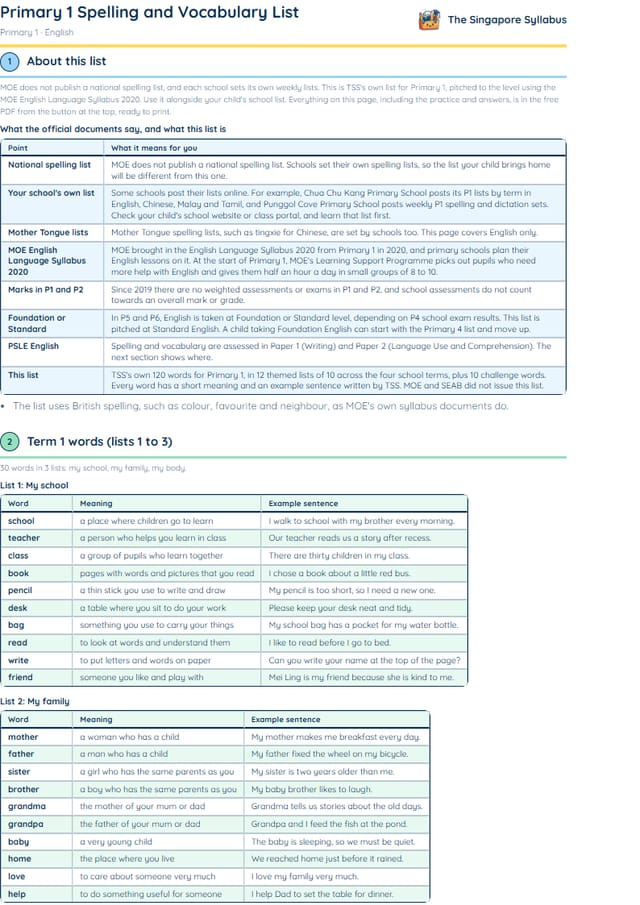
MOE does not publish a national spelling list, and each school sets its own weekly lists. This is TSS's own list for Primary 1, pitched to the level using the MOE English Language Syllabus 2020. Use it alongside your child's school list. Everything on this page, including the practice and answers, is in the free PDF from the button at the top, ready to print.
| Point | What it means for you |
|---|---|
| National spelling list | MOE does not publish a national spelling list. Schools set their own spelling lists, so the list your child brings home will be different from this one. |
| Your school's own list | Some schools post their lists online. For example, Chua Chu Kang Primary School posts its P1 lists by term in English, Chinese, Malay and Tamil, and Punggol Cove Primary School posts weekly P1 spelling and dictation sets. Check your child's school website or class portal, and learn that list first. |
| Mother Tongue lists | Mother Tongue spelling lists, such as tingxie for Chinese, are set by schools too. This page covers English only. |
| MOE English Language Syllabus 2020 | MOE brought in the English Language Syllabus 2020 from Primary 1 in 2020, and primary schools plan their English lessons on it. At the start of Primary 1, MOE's Learning Support Programme picks out pupils who need more help with English and gives them half an hour a day in small groups of 8 to 10. |
| Marks in P1 and P2 | Since 2019 there are no weighted assessments or exams in P1 and P2, and school assessments do not count towards an overall mark or grade. |
| Foundation or Standard | In P5 and P6, English is taken at Foundation or Standard level, depending on P4 school exam results. This list is pitched at Standard English. A child taking Foundation English can start with the Primary 4 list and move up. |
| PSLE English | Spelling and vocabulary are assessed in Paper 1 (Writing) and Paper 2 (Language Use and Comprehension). The next section shows where. |
| This list | TSS's own 120 words for Primary 1, in 12 themed lists of 10 across the four school terms, plus 10 challenge words. Every word has a short meaning and an example sentence written by TSS. MOE and SEAB did not issue this list. |
- The list uses British spelling, such as colour, favourite and neighbour, as MOE's own syllabus documents do.
Term 1 words (lists 1 to 3)
30 words in 3 lists
30 words in 3 lists: my school, my family, my body.
| Word | Meaning | Example sentence |
|---|---|---|
| school | a place where children go to learn | I walk to school with my brother every morning. |
| teacher | a person who helps you learn in class | Our teacher reads us a story after recess. |
| class | a group of pupils who learn together | There are thirty children in my class. |
| book | pages with words and pictures that you read | I chose a book about a little red bus. |
| pencil | a thin stick you use to write and draw | My pencil is too short, so I need a new one. |
| desk | a table where you sit to do your work | Please keep your desk neat and tidy. |
| bag | something you use to carry your things | My school bag has a pocket for my water bottle. |
| read | to look at words and understand them | I like to read before I go to bed. |
| write | to put letters and words on paper | Can you write your name at the top of the page? |
| friend | someone you like and play with | Mei Ling is my friend because she is kind to me. |
| Word | Meaning | Example sentence |
|---|---|---|
| mother | a woman who has a child | My mother makes me breakfast every day. |
| father | a man who has a child | My father fixed the wheel on my bicycle. |
| sister | a girl who has the same parents as you | My sister is two years older than me. |
| brother | a boy who has the same parents as you | My baby brother likes to laugh. |
| grandma | the mother of your mum or dad | Grandma tells us stories about the old days. |
| grandpa | the father of your mum or dad | Grandpa and I feed the fish at the pond. |
| baby | a very young child | The baby is sleeping, so we must be quiet. |
| home | the place where you live | We reached home just before it rained. |
| love | to care about someone very much | I love my family very much. |
| help | to do something useful for someone | I help Dad to set the table for dinner. |
| Word | Meaning | Example sentence |
|---|---|---|
| head | the top part of your body | Put on a cap to cover your head from the sun. |
| hand | the part at the end of your arm | Raise your hand if you know the answer. |
| foot | the part at the end of your leg that you stand on | I hurt my foot when I kicked the ball. |
| eye | the part of your body you see with | Close one eye and look through the hole. |
| ear | the part of your body you hear with | The cat has a black ear and a white ear. |
| nose | the part of your face you smell with | I can smell the bread with my nose. |
| mouth | the part of your face you eat and talk with | Cover your mouth when you yawn. |
| arm | the long part of your body between your shoulder and your hand | Dad lifted me up with one arm. |
| leg | the long part of your body you walk with | The table has one short leg, so it wobbles. |
| teeth | the hard white parts in your mouth that you bite with | I brush my teeth twice a day. |
Term 2 words (lists 4 to 6)
30 words in 3 lists
30 words in 3 lists: food, animals, at home.
| Word | Meaning | Example sentence |
|---|---|---|
| rice | small white grains that we cook and eat | We had chicken rice for lunch. |
| egg | a round thing laid by a hen that we can cook and eat | Mum cooked an egg for my breakfast. |
| milk | a white drink that comes from cows | I drink a glass of milk every night. |
| bread | a food made from flour and baked in an oven | We spread jam on the bread. |
| fish | an animal that lives in water, or its meat that we eat | Grandma steamed a fish for dinner. |
| apple | a round fruit that can be red or green | I pack an apple in my lunch box. |
| banana | a long yellow fruit | The monkey peeled the banana and ate it. |
| water | the clear liquid that we drink | Drink some water after you run. |
| cake | a sweet baked food, often for a party | We shared a chocolate cake at my party. |
| hungry | wanting to eat | I was so hungry that I ate two bowls of noodles. |
| Word | Meaning | Example sentence |
|---|---|---|
| cat | a small furry animal kept as a pet | The cat is sleeping on the sofa. |
| dog | an animal that barks, often kept as a pet | Our dog wags its tail when we come home. |
| bird | an animal with feathers and wings | A bird is building a nest in the tree. |
| duck | a bird that swims and says quack | The duck swam across the pond. |
| frog | a small green animal that jumps and lives near water | The frog jumped onto a big leaf. |
| cow | a large farm animal that gives us milk | The cow is eating grass in the field. |
| pig | a pink farm animal with a curly tail | The pig rolled in the mud. |
| lion | a big wild cat with a loud roar | The lion is resting under a tree. |
| monkey | a clever animal that climbs trees | The monkey swung from branch to branch. |
| zoo | a place where people go to see wild animals | We saw a white tiger at the zoo. |
| Word | Meaning | Example sentence |
|---|---|---|
| door | something you open to go in or out of a room | Please close the door when you leave. |
| window | an opening in a wall with glass to let in light | I can see the playground from my window. |
| bed | the furniture you sleep on | I make my bed every morning. |
| chair | a seat for one person | Pull your chair closer to the table. |
| table | furniture with a flat top and legs | We eat dinner at the table together. |
| kitchen | the room where food is cooked | Mum is baking cookies in the kitchen. |
| lamp | a light that you can switch on and off | Switch off the lamp before you sleep. |
| cup | a small container you drink from | I drink warm milk from my cup. |
| clean | not dirty | My hands are clean after I wash them. |
| sleep | to rest with your eyes closed | Babies sleep for many hours a day. |
Term 3 words (lists 7 to 9)
30 words in 3 lists
30 words in 3 lists: colours and shapes, weather, toys and play.
| Word | Meaning | Example sentence |
|---|---|---|
| red | the colour of a ripe tomato | She wore a red dress to the party. |
| blue | the colour of a clear sky | I painted the sea blue. |
| green | the colour of grass and leaves | The traffic light turned green. |
| yellow | the colour of a ripe banana | The sun is yellow in my drawing. |
| black | the darkest colour, like the night sky | Our cat has black fur. |
| white | the colour of snow and milk | The clouds are white and fluffy. |
| circle | a round shape like a ring | Draw a circle for the face. |
| square | a shape with four equal sides | The window is shaped like a square. |
| big | large in size | An elephant is a big animal. |
| small | little in size | The ant is very small. |
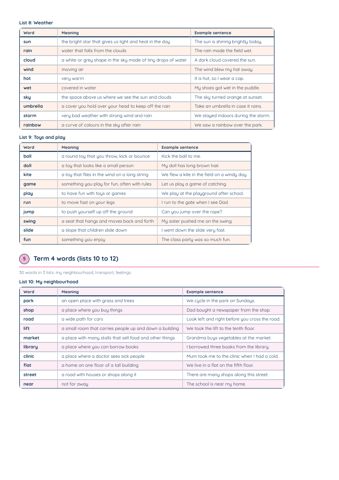
| Word | Meaning | Example sentence |
|---|---|---|
| sun | the bright star that gives us light and heat in the day | The sun is shining brightly today. |
| rain | water that falls from the clouds | The rain made the field wet. |
| cloud | a white or grey shape in the sky made of tiny drops of water | A dark cloud covered the sun. |
| wind | moving air | The wind blew my hat away. |
| hot | very warm | It is hot, so I wear a cap. |
| wet | covered in water | My shoes got wet in the puddle. |
| sky | the space above us where we see the sun and clouds | The sky turned orange at sunset. |
| umbrella | a cover you hold over your head to keep off the rain | Take an umbrella in case it rains. |
| storm | very bad weather with strong wind and rain | We stayed indoors during the storm. |
| rainbow | a curve of colours in the sky after rain | We saw a rainbow over the park. |
| Word | Meaning | Example sentence |
|---|---|---|
| ball | a round toy that you throw, kick or bounce | Kick the ball to me. |
| doll | a toy that looks like a small person | My doll has long brown hair. |
| kite | a toy that flies in the wind on a long string | We flew a kite in the field on a windy day. |
| game | something you play for fun, often with rules | Let us play a game of catching. |
| play | to have fun with toys or games | We play at the playground after school. |
| run | to move fast on your legs | I run to the gate when I see Dad. |
| jump | to push yourself up off the ground | Can you jump over the rope? |
| swing | a seat that hangs and moves back and forth | My sister pushed me on the swing. |
| slide | a slope that children slide down | I went down the slide very fast. |
| fun | something you enjoy | The class party was so much fun. |
Term 4 words (lists 10 to 12)
30 words in 3 lists
30 words in 3 lists: my neighbourhood, transport, feelings.
| Word | Meaning | Example sentence |
|---|---|---|
| park | an open place with grass and trees | We cycle in the park on Sundays. |
| shop | a place where you buy things | Dad bought a newspaper from the shop. |
| road | a wide path for cars | Look left and right before you cross the road. |
| lift | a small room that carries people up and down a building | We took the lift to the tenth floor. |
| market | a place with many stalls that sell food and other things | Grandma buys vegetables at the market. |
| library | a place where you can borrow books | I borrowed three books from the library. |
| clinic | a place where a doctor sees sick people | Mum took me to the clinic when I had a cold. |
| flat | a home on one floor of a tall building | We live in a flat on the fifth floor. |
| street | a road with houses or shops along it | There are many shops along this street. |
| near | not far away | The school is near my home. |
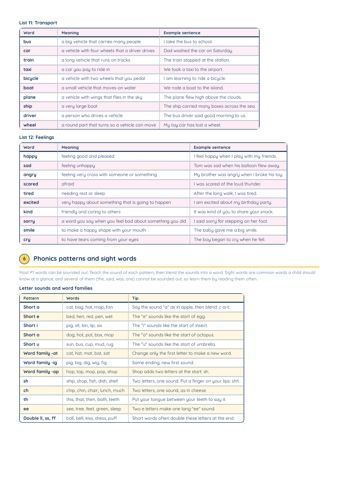
| Word | Meaning | Example sentence |
|---|---|---|
| bus | a big vehicle that carries many people | I take the bus to school. |
| car | a vehicle with four wheels that a driver drives | Dad washed the car on Saturday. |
| train | a long vehicle that runs on tracks | The train stopped at the station. |
| taxi | a car you pay to ride in | We took a taxi to the airport. |
| bicycle | a vehicle with two wheels that you pedal | I am learning to ride a bicycle. |
| boat | a small vehicle that moves on water | We rode a boat to the island. |
| plane | a vehicle with wings that flies in the sky | The plane flew high above the clouds. |
| ship | a very large boat | The ship carried many boxes across the sea. |
| driver | a person who drives a vehicle | The bus driver said good morning to us. |
| wheel | a round part that turns so a vehicle can move | My toy car has lost a wheel. |
| Word | Meaning | Example sentence |
|---|---|---|
| happy | feeling good and pleased | I feel happy when I play with my friends. |
| sad | feeling unhappy | Tom was sad when his balloon flew away. |
| angry | feeling very cross with someone or something | My brother was angry when I broke his toy. |
| scared | afraid | I was scared of the loud thunder. |
| tired | needing rest or sleep | After the long walk, I was tired. |
| excited | very happy about something that is going to happen | I am excited about my birthday party. |
| kind | friendly and caring to others | It was kind of you to share your snack. |
| sorry | a word you say when you feel bad about something you did | I said sorry for stepping on her foot. |
| smile | to make a happy shape with your mouth | The baby gave me a big smile. |
| cry | to have tears coming from your eyes | The boy began to cry when he fell. |
Phonics patterns and sight words
Most P1 words can be sounded out. Teach the sound of each pattern, then blend the sounds into a word. Sight words are common words a child should know at a glance, and several of them (the, said, was, one) cannot be sounded out, so learn them by reading them often.
| Pattern | Words | Tip |
|---|---|---|
| Short a | cat, bag, hat, map, fan | Say the sound "a" as in apple, then blend: c-a-t. |
| Short e | bed, hen, red, pen, wet | The "e" sounds like the start of egg. |
| Short i | pig, sit, bin, lip, six | The "i" sounds like the start of insect. |
| Short o | dog, hot, pot, box, mop | The "o" sounds like the start of octopus. |
| Short u | sun, bus, cup, mud, rug | The "u" sounds like the start of umbrella. |
| Word family -at | cat, hat, mat, bat, sat | Change only the first letter to make a new word. |
| Word family -ig | pig, big, dig, wig, fig | Same ending, new first sound. |
| Word family -op | hop, top, mop, pop, shop | Shop adds two letters at the start: sh. |
| sh | ship, shop, fish, dish, shell | Two letters, one sound. Put a finger on your lips: shh. |
| ch | chip, chin, chair, lunch, much | Two letters, one sound, as in cheese. |
| th | this, that, then, bath, teeth | Put your tongue between your teeth to say it. |
| ee | see, tree, feet, green, sleep | Two e letters make one long "ee" sound. |
| Double ll, ss, ff | ball, bell, kiss, dress, puff | Short words often double these letters at the end. |
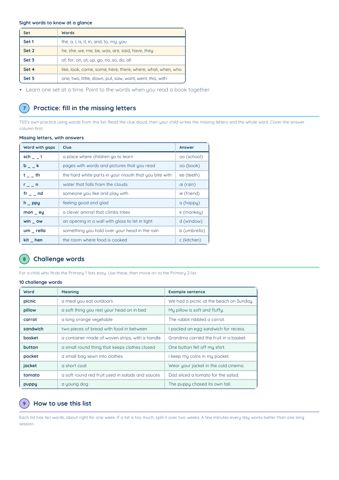
| Set | Words |
|---|---|
| Set 1 | the, a, I, is, it, in, and, to, my, you |
| Set 2 | he, she, we, me, be, was, are, said, have, they |
| Set 3 | of, for, on, at, up, go, no, so, do, all |
| Set 4 | like, look, come, some, here, there, where, what, when, who |
| Set 5 | one, two, little, down, put, saw, want, went, this, with |
- Learn one set at a time. Point to the words when you read a book together.
Practice: fill in the missing letters
TSS's own practice using words from this list. Read the clue aloud, then your child writes the missing letters and the whole word. Cover the answer column first.
| Word with gaps | Clue |
|---|---|
| sch _ _ l | a place where children go to learn |
| b _ _ k | pages with words and pictures that you read |
| t _ _ th | the hard white parts in your mouth that you bite with |
| r _ _ n | water that falls from the clouds |
| fr _ _ nd | someone you like and play with |
| h _ ppy | feeling good and glad |
| mon _ ey | a clever animal that climbs trees |
| win _ ow | an opening in a wall with glass to let in light |
| um _ rella | something you hold over your head in the rain |
| kit _ hen | the room where food is cooked |
Show answersHide answers
| No. | Answer |
|---|---|
| 1 | oo (school) |
| 2 | oo (book) |
| 3 | ee (teeth) |
| 4 | ai (rain) |
| 5 | ie (friend) |
| 6 | a (happy) |
| 7 | k (monkey) |
| 8 | d (window) |
| 9 | b (umbrella) |
| 10 | c (kitchen) |
Challenge words
For a child who finds the Primary 1 lists easy. Use these, then move on to the Primary 2 list.
| Word | Meaning | Example sentence |
|---|---|---|
| picnic | a meal you eat outdoors | We had a picnic at the beach on Sunday. |
| pillow | a soft thing you rest your head on in bed | My pillow is soft and fluffy. |
| carrot | a long orange vegetable | The rabbit nibbled a carrot. |
| sandwich | two pieces of bread with food in between | I packed an egg sandwich for recess. |
| basket | a container made of woven strips, with a handle | Grandma carried the fruit in a basket. |
| button | a small round thing that keeps clothes closed | One button fell off my shirt. |
| a small bag sewn into clothes | I keep my coins in my pocket. | |
| jacket | a short coat | Wear your jacket in the cold cinema. |
| tomato | a soft round red fruit used in salads and sauces | Dad sliced a tomato for the salad. |
| puppy | a young dog | The puppy chased its own tail. |
How to use this list
Each list has ten words, about right for one week. If a list is too much, split it over two weeks. A few minutes every day works better than one long session.
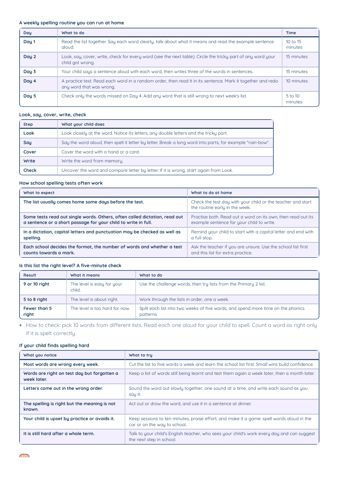
| Day | What to do | Time |
|---|---|---|
| Day 1 | Read the list together. Say each word clearly, talk about what it means and read the example sentence aloud. | 10 to 15 minutes |
| Day 2 | Look, say, cover, write, check for every word (see the next table). Circle the tricky part of any word your child got wrong. | 15 minutes |
| Day 3 | Your child says a sentence aloud with each word, then writes three of the words in sentences. | 15 minutes |
| Day 4 | A practice test. Read each word in a random order, then read it in its sentence. Mark it together and redo any word that was wrong. | 10 minutes |
| Day 5 | Check only the words missed on Day 4. Add any word that is still wrong to next week's list. | 5 to 10 minutes |
| Step | What your child does |
|---|---|
| Look | Look closely at the word. Notice its letters, any double letters and the tricky part. |
| Say | Say the word aloud, then spell it letter by letter. Break a long word into parts, for example "rain-bow". |
| Cover | Cover the word with a hand or a card. |
| Write | Write the word from memory. |
| Check | Uncover the word and compare letter by letter. If it is wrong, start again from Look. |
| What to expect | What to do at home |
|---|---|
| The list usually comes home some days before the test. | Check the test day with your child or the teacher and start the routine early in the week. |
| Some tests read out single words. Others, often called dictation, read out a sentence or a short passage for your child to write in full. | Practise both. Read out a word on its own, then read out its example sentence for your child to write. |
| In a dictation, capital letters and punctuation may be checked as well as spelling. | Remind your child to start with a capital letter and end with a full stop. |
| Each school decides the format, the number of words and whether a test counts towards a mark. | Ask the teacher if you are unsure. Use the school list first and this list for extra practice. |
| Result | What it means | What to do |
|---|---|---|
| 9 or 10 right | The level is easy for your child. | Use the challenge words, then try lists from the Primary 2 list. |
| 5 to 8 right | The level is about right. | Work through the lists in order, one a week. |
| Fewer than 5 right | The level is too hard for now. | Split each list into two weeks of five words, and spend more time on the phonics patterns. |
- How to check: pick 10 words from different lists. Read each one aloud for your child to spell. Count a word as right only if it is spelt correctly.
| What you notice | What to try |
|---|---|
| Most words are wrong every week. | Cut the list to five words a week and learn the school list first. Small wins build confidence. |
| Words are right on test day but forgotten a week later. | Keep a list of words still being learnt and test them again a week later, then a month later. |
| Letters come out in the wrong order. | Sound the word out slowly together, one sound at a time, and write each sound as you say it. |
| The spelling is right but the meaning is not known. | Act out or draw the word, and use it in a sentence at dinner. |
| Your child is upset by practice or avoids it. | Keep sessions to ten minutes, praise effort, and make it a game: spell words aloud in the car or on the way to school. |
| It is still hard after a whole term. | Talk to your child's English teacher, who sees your child's work every day and can suggest the next step in school. |
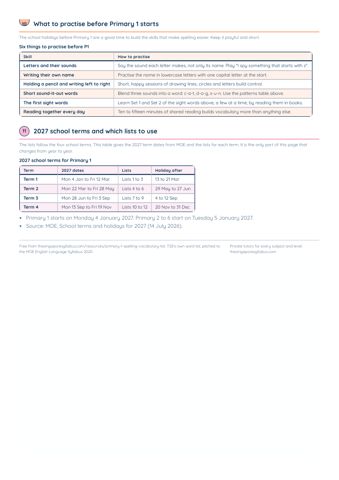
What to practise before Primary 1 starts
The school holidays before Primary 1 are a good time to build the skills that make spelling easier. Keep it playful and short.
| Skill | How to practise |
|---|---|
| Letters and their sounds | Say the sound each letter makes, not only its name. Play "I spy something that starts with s". |
| Writing their own name | Practise the name in lowercase letters with one capital letter at the start. |
| Holding a pencil and writing left to right | Short, happy sessions of drawing lines, circles and letters build control. |
| Short sound-it-out words | Blend three sounds into a word: c-a-t, d-o-g, s-u-n. Use the patterns table above. |
| The first sight words | Learn Set 1 and Set 2 of the sight words above, a few at a time, by reading them in books. |
| Reading together every day | Ten to fifteen minutes of shared reading builds vocabulary more than anything else. |
2027 school terms and which lists to use
The lists follow the four school terms. This table gives the 2027 term dates from MOE and the lists for each term. It is the only part of this page that changes from year to year.
| Term | 2027 dates | Lists | Holiday after |
|---|---|---|---|
| Term 1 | Mon 4 Jan to Fri 12 Mar | Lists 1 to 3 | 13 to 21 Mar |
| Term 2 | Mon 22 Mar to Fri 28 May | Lists 4 to 6 | 29 May to 27 Jun |
| Term 3 | Mon 28 Jun to Fri 3 Sep | Lists 7 to 9 | 4 to 12 Sep |
| Term 4 | Mon 13 Sep to Fri 19 Nov | Lists 10 to 12 | 20 Nov to 31 Dec |
- Primary 1 starts on Monday 4 January 2027. Primary 2 to 6 start on Tuesday 5 January 2027.
- Source: MOE, School terms and holidays for 2027 (14 July 2026).
Download the free PDFPDF · 8 pages · A4 portrait · free, no sign-up
Inside the PDF
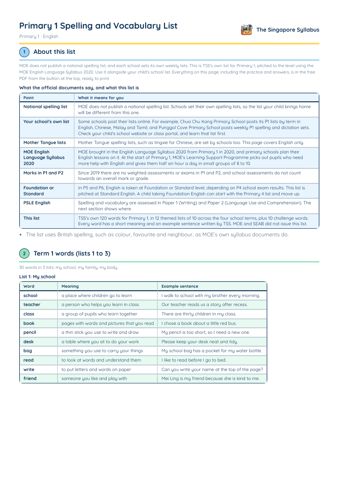
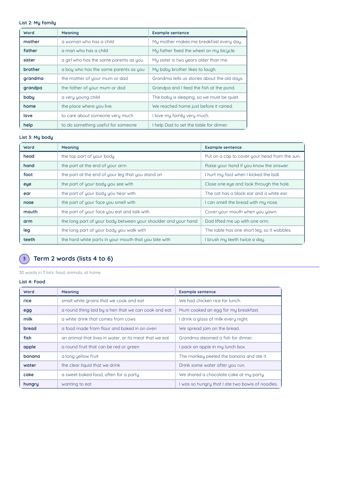
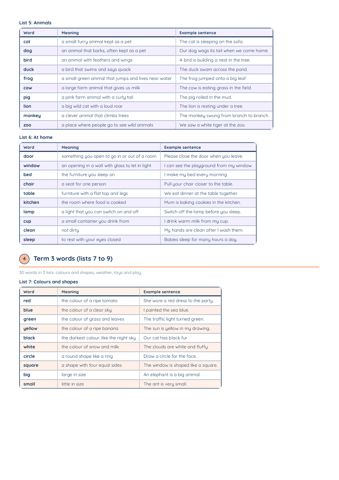
8 A4 pages, ready to print. Tap a page to open the PDF there.
Questions students ask
Does MOE publish a Primary 1 spelling list?
No. MOE does not publish a national spelling or vocabulary list for any primary level. Each school sets its own lists, so use this one alongside the list your child brings home.
How many spelling words should my child learn each week?
Each list here has 10 words, which suits one week. If your child finds that too many, split a list over two weeks and keep the daily practice short.
What if my child needs extra help with English in Primary 1?
MOE's Learning Support Programme identifies pupils at the start of Primary 1 who need more help with English. Trained teachers take them in small groups of 8 to 10 for half an hour a day. At home, the phonics patterns and sight words on this page are a good place to start.
Do spelling tests count in Primary 1?
Not towards a grade. Since 2019 MOE has removed weighted assessments and exams in P1 and P2, and school assessments do not count towards an overall mark or grade. Spelling tests still show you which words need more practice.
What should my child practise before Primary 1 starts?
Letter sounds, writing their own name, holding a pencil, sounding out short words such as cat and sun, the first sight words, and reading together every day. Keep sessions short and playful.
Does this page have Mother Tongue spelling lists?
No. Mother Tongue spelling lists, such as tingxie for Chinese, are set by each school, and this page covers English only. Some schools post their Mother Tongue lists on the school website.
Does this list use British or American spelling?
British spelling, such as colour, favourite and neighbour. MOE's own English syllabus documents use British spelling too, for example behaviour, organise and programme.
What if my child's school list has different words?
Learn the school list first, since the school test uses it. Then use this list for extra words, and use the meanings and example sentences to help your child use each word, not only spell it.
What if my child finds spelling hard?
Cut the list to five words a week, learn the school list first and keep a list of words still being learnt to test again a week later. If it is still hard after a term, talk to your child's English teacher.
What comes after this list?
The Primary 2 list picks up where this one ends, with no word repeated. If your child spells 9 or 10 of a random 10 words correctly, use the challenge words and then move on to it.
Keep revising
- Primary English tuition1-to-1 English tutors for P1 to P6
- Primary 1 English tuitionWhat P1 English covers and how a tutor helps
- PSLE Math FormulasPSLE (Primary 1 to 6) · free PDF
- PSLE English Composition PhrasesPSLE (Primary 5 and 6) · free PDF
- PSLE Chinese Composition Phrases (好词好句)PSLE (Primary 5 and 6) · free PDF
- PSLE Science KeywordsPSLE (Primary 3 to 6) · free PDF
- Primary English Oral Practice (P3 to PSLE)Primary 3 to 6 and PSLE · free PDF
- Primary English Listening Comprehension Practice (P3 to PSLE)Primary 3 to 6 and PSLE · free PDF
- Primary English Composition Topics (P3 to PSLE)Primary 3 to 6 and PSLE · free PDF
- Primary 1 Maths WorksheetsPrimary 1 · free PDF
- Primary 2 Maths WorksheetsPrimary 2 · free PDF
- Primary 3 Maths WorksheetsPrimary 3 · free PDF
- Primary 1 English WorksheetsPrimary 1 · free PDF
- Primary 2 English WorksheetsPrimary 2 · free PDF
- Primary 3 English WorksheetsPrimary 3 · free PDF
- Primary 2 Spelling and Vocabulary ListPrimary 2 · free PDF
- Primary 3 Spelling and Vocabulary ListPrimary 3 · free PDF
- Primary 4 Spelling and Vocabulary ListPrimary 4 · free PDF
- Primary 5 Spelling and Vocabulary ListPrimary 5 · free PDF
- PSLE Vocabulary List (Primary 6)Primary 6 (PSLE) · free PDF
- PSLE Score calculatorAdd up the four AL grades
- All free resourcesPSLE, O-Level and A-Level
Source
- Opera Estate Primary School, English Language (EL Syllabus 2020 introduced from Primary One)
- MOE, Learning support (primary)
- MOE, Primary school subjects and syllabuses
- MOE, Learn for Life press release (28 September 2018)
- Chua Chu Kang Primary School, P1 spelling lists (an example of a school's own lists)
- Punggol Cove Primary School, P1 English spelling test (an example of a school's own lists)
- MOE, School terms and holidays for 2027 (14 July 2026)
The words, meanings, example sentences and practice items are our own. MOE does not publish a national spelling list. The syllabus, exam and term details come from the MOE, SEAB and school pages above, and if they differ, those pages are right. Tell us and we will fix it.