Free resource · Primary 3
Primary 3 English Worksheets with Answers: Free PDF
This is a free sample set of Primary 3 English worksheets: 6 topics, 60 questions, with answers. Five sheets of 10 questions practise subject and verb agreement, tenses, pronouns, connectors and vocabulary in context. A story has 10 literal and inferential questions. They follow the MOE English Language Syllabus 2020, which moves pupils from beginning reading to close reading at literal and inferential levels.
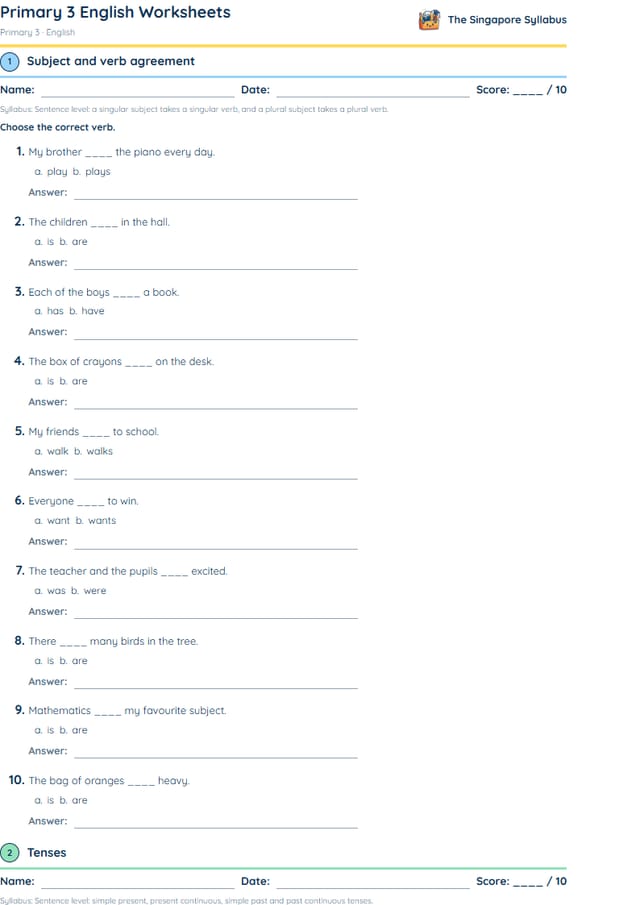
Subject and verb agreement
Syllabus: Sentence level: a singular subject takes a singular verb, and a plural subject takes a plural verb.
Choose the correct verb.
My brother ____ the piano every day.
- play
- plays
The children ____ in the hall.
- is
- are
Each of the boys ____ a book.
- has
- have
The box of crayons ____ on the desk.
- is
- are
My friends ____ to school.
- walk
- walks
Everyone ____ to win.
- want
- wants
The teacher and the pupils ____ excited.
- was
- were
There ____ many birds in the tree.
- is
- are
Mathematics ____ my favourite subject.
- is
- are
The bag of oranges ____ heavy.
- is
- are
Tenses
Syllabus: Sentence level: simple present, present continuous, simple past and past continuous tenses.
Choose the correct form of the verb. Look for clue words such as now, yesterday and every.
Look. The baby ____ now.
- sleeps
- is sleeping
The sun ____ in the east.
- rise
- rises
- rising
Last week, we ____ the zoo.
- visit
- visited
I ____ a book when the phone rang.
- was reading
- am reading
Every Sunday, Grandma ____ to the market.
- go
- goes
- going
Yesterday, Sam ____ his wallet.
- loses
- lost
Listen. Someone ____ at the door.
- is knocking
- knocks
While Mum was cooking, Dad ____ the car.
- was washing
- washes
Water ____ at 100 degrees Celsius.
- boil
- boils
Two days ago, it ____ heavily.
- rains
- rained
Pronouns
Syllabus: Word level: subject, object, possessive and reflexive pronouns.
Choose the correct pronoun.
This bag belongs to me. It is ____.
- mine
- my
- me
Sam and ____ went to the library.
- I
- me
Mrs Lee gave ____ some sweets.
- us
- we
The cat licked ____ paw.
- its
- it’s
Those pencils belong to Ken. They are ____.
- his
- him
- he
Please give the book to ____.
- her
- she
____ are playing in the field.
- They
- Them
Is this umbrella ____?
- yours
- your
Ali hurt ____ when he fell.
- himself
- herself
The teacher asked Mei and ____ to help.
- I
- me
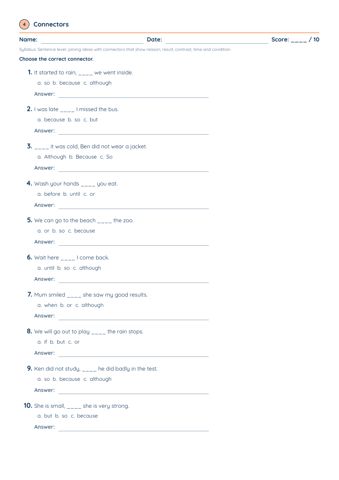
Connectors
Syllabus: Sentence level: joining ideas with connectors that show reason, result, contrast, time and condition.
Choose the correct connector.
It started to rain, ____ we went inside.
- so
- because
- although
I was late ____ I missed the bus.
- because
- so
- but
____ it was cold, Ben did not wear a jacket.
- Although
- Because
- So
Wash your hands ____ you eat.
- before
- until
- or
We can go to the beach ____ the zoo.
- or
- so
- because
Wait here ____ I come back.
- until
- so
- although
Mum smiled ____ she saw my good results.
- when
- or
- although
We will go out to play ____ the rain stops.
- if
- but
- or
Ken did not study, ____ he did badly in the test.
- so
- because
- although
She is small, ____ she is very strong.
- but
- so
- because
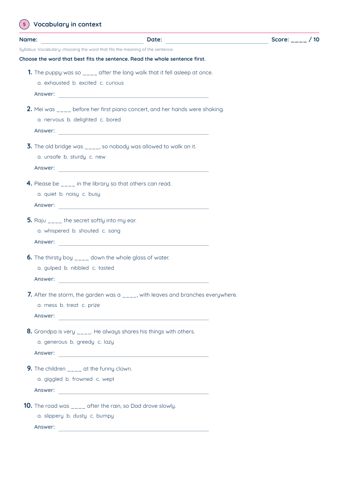
Vocabulary in context
Syllabus: Vocabulary: choosing the word that fits the meaning of the sentence.
Choose the word that best fits the sentence. Read the whole sentence first.
The puppy was so ____ after the long walk that it fell asleep at once.
- exhausted
- excited
- curious
Mei was ____ before her first piano concert, and her hands were shaking.
- nervous
- delighted
- bored
The old bridge was ____, so nobody was allowed to walk on it.
- unsafe
- sturdy
- new
Please be ____ in the library so that others can read.
- quiet
- noisy
- busy
Raju ____ the secret softly into my ear.
- whispered
- shouted
- sang
The thirsty boy ____ down the whole glass of water.
- gulped
- nibbled
- tasted
After the storm, the garden was a ____, with leaves and branches everywhere.
- mess
- treat
- prize
Grandpa is very ____. He always shares his things with others.
- generous
- greedy
- lazy
The children ____ at the funny clown.
- giggled
- frowned
- wept
The road was ____ after the rain, so Dad drove slowly.
- slippery
- dusty
- bumpy
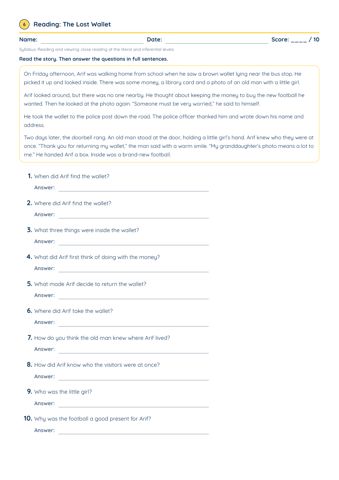
Reading: The Lost Wallet
Syllabus: Reading and viewing: close reading at the literal and inferential levels.
Read the story. Then answer the questions in full sentences.
On Friday afternoon, Arif was walking home from school when he saw a brown wallet lying near the bus stop. He picked it up and looked inside. There was some money, a library card and a photo of an old man with a little girl.
Arif looked around, but there was no one nearby. He thought about keeping the money to buy the new football he wanted. Then he looked at the photo again. “Someone must be very worried,” he said to himself.
He took the wallet to the police post down the road. The police officer thanked him and wrote down his name and address.
Two days later, the doorbell rang. An old man stood at the door, holding a little girl’s hand. Arif knew who they were at once. “Thank you for returning my wallet,” the man said with a warm smile. “My granddaughter’s photo means a lot to me.” He handed Arif a box. Inside was a brand-new football.
When did Arif find the wallet?
Where did Arif find the wallet?
What three things were inside the wallet?
What did Arif first think of doing with the money?
What made Arif decide to return the wallet?
Where did Arif take the wallet?
How do you think the old man knew where Arif lived?
How did Arif know who the visitors were at once?
Who was the little girl?
Why was the football a good present for Arif?
For parents
How to use this pack
- Do one worksheet at a time, soon after the school has covered that area.
- Let your child work alone, then mark with the answer key.
- For the story questions, accept an answer in your child's own words if it gives the same idea as the key.
- Near the end of the year, redo any worksheet your child found hard.
How Primary 3 English is assessed in school
- Primary 3 is the first year with weighted assessments. A school sets no more than one weighted assessment per subject in each school term.
- There is no mid-year exam. MOE removed mid-year exams at every primary level by 2023.
- Report books do not show class or level position, and marks are shown as whole numbers.
- Ask the form teacher for the dates and topics of each assessment, then use the matching worksheet in the week before.
If your child finds Primary 3 English hard
- Primary 3 asks for more inferential reading: working out answers from clues, not only finding a line in the story.
- Signs to watch: answering comprehension questions by copying a random line, mixing up tenses in writing, or very short compositions.
- After reading, ask how and why questions about the story, and ask your child to point to the clues.
- Talk to your child's English teacher early. MOE's Learning Support Programme (LSP) builds English skills in small groups of 8 to 10 for half an hour a day, led by trained teachers. Children are identified at the start of Primary 1.
Primary 3 spelling and vocabulary list · Primary 3 English tuition
Sources: MOE, Learn for Life press release (28 September 2018), MOE, forum reply on removing mid-year exams (8 February 2023), MOE, learning support programmes.
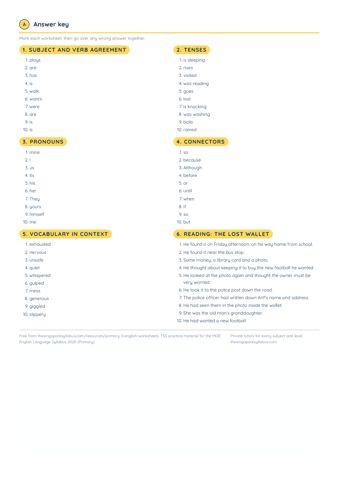
Answer key
Mark each worksheet, then go over any wrong answer together.
1. Subject and verb agreement
- plays
- are
- has
- is
- walk
- wants
- were
- are
- is
- is
2. Tenses
- is sleeping
- rises
- visited
- was reading
- goes
- lost
- is knocking
- was washing
- boils
- rained
3. Pronouns
- mine
- I
- us
- its
- his
- her
- They
- yours
- himself
- me
4. Connectors
- so
- because
- Although
- before
- or
- until
- when
- if
- so
- but
5. Vocabulary in context
- exhausted
- nervous
- unsafe
- quiet
- whispered
- gulped
- mess
- generous
- giggled
- slippery
6. Reading: The Lost Wallet
- He found it on Friday afternoon, on his way home from school.
- He found it near the bus stop.
- Some money, a library card and a photo.
- He thought about keeping it to buy the new football he wanted.
- He looked at the photo again and thought the owner must be very worried.
- He took it to the police post down the road.
- The police officer had written down Arif’s name and address.
- He had seen them in the photo inside the wallet.
- She was the old man’s granddaughter.
- He had wanted a new football.
Next steps
Download the free PDFPDF · 8 pages · A4 portrait · free, no sign-up
Inside the PDF
8 A4 pages, ready to print. Tap a page to open the PDF there.

Questions students ask
What English does a Primary 3 child learn?
Primary 3 is the start of middle primary in the MOE English Language Syllabus 2020. Pupils keep building grammar at word, phrase and sentence level. The syllabus also moves them from beginning reading to close reading at literal and inferential levels, using prior knowledge and clues in the text.
What is subject and verb agreement?
A singular subject takes a singular verb and a plural subject takes a plural verb, as in my brother plays and my friends play. Words like everyone and each take a singular verb.
What is an inferential question?
It asks for an answer the story does not state in one line. The child works it out from clues, such as how the old man in the story knew where Arif lived.
Does MOE publish a grammar list for Primary 3?
No. The 2020 syllabus describes the skills for each band of years but does not list grammar items year by year. The topics in this pack are chosen by us.
Are these worksheets from MOE or a school?
No. They are The Singapore Syllabus's own practice questions and stories. They are not school papers and MOE did not issue them.
How is Primary 3 English assessed in school?
Primary 3 is the first year with weighted assessments. A school sets no more than one weighted assessment per subject in each term, and there is no mid-year exam, as MOE removed mid-year exams at every primary level by 2023.
Does MOE publish a Primary 3 spelling list?
No. MOE does not publish a national spelling list, and schools set their own. Our Primary 3 spelling and vocabulary list has words to practise a few at a time.
Are the worksheets really free?
Yes. The PDF downloads with no sign-up, and every question and answer is also on this page.
How can my child do better at vocabulary questions?
Read the whole sentence first and look for a clue word, such as shaking for nervous. Then try each choice in the blank and pick the one that makes sense.
Keep revising
- All free worksheetsEvery free worksheet pack, P1 to P3
- Primary 3 English tuitionWhat P3 English covers, and a home tutor
- PSLE Math FormulasPSLE (Primary 1 to 6) · free PDF
- PSLE English Composition PhrasesPSLE (Primary 5 and 6) · free PDF
- PSLE Chinese Composition Phrases (好词好句)PSLE (Primary 5 and 6) · free PDF
- PSLE Science KeywordsPSLE (Primary 3 to 6) · free PDF
- Primary English Oral Practice (P3 to PSLE)Primary 3 to 6 and PSLE · free PDF
- Primary English Listening Comprehension Practice (P3 to PSLE)Primary 3 to 6 and PSLE · free PDF
- Primary English Composition Topics (P3 to PSLE)Primary 3 to 6 and PSLE · free PDF
- Primary 1 Maths WorksheetsPrimary 1 · free PDF
- Primary 2 Maths WorksheetsPrimary 2 · free PDF
- Primary 3 Maths WorksheetsPrimary 3 · free PDF
- Primary 1 English WorksheetsPrimary 1 · free PDF
- Primary 2 English WorksheetsPrimary 2 · free PDF
- Primary 1 Spelling and Vocabulary ListPrimary 1 · free PDF
- Primary 2 Spelling and Vocabulary ListPrimary 2 · free PDF
- Primary 3 Spelling and Vocabulary ListPrimary 3 · free PDF
- Primary 4 Spelling and Vocabulary ListPrimary 4 · free PDF
- Primary 5 Spelling and Vocabulary ListPrimary 5 · free PDF
- PSLE Vocabulary List (Primary 6)Primary 6 (PSLE) · free PDF
- PSLE Score calculatorAdd up the four AL grades
- All free resourcesPSLE, O-Level and A-Level
Source
The worksheets and stories are our own practice material, written for the MOE English Language Syllabus 2020 (Primary). They are not issued by MOE. MOE does not publish a list of grammar items for each year, so the topics are our choice. Tell us and we will fix it.