Free resource · Primary 3
Primary 3 Maths Worksheets with Answers: Free PDF
This is a free sample set of Primary 3 Maths worksheets: 8 topics, 88 questions, with answers. There is one sheet of 10 to 12 questions for each of eight P3 topics in the MOE 2021 syllabus: numbers to 10 000, addition and subtraction up to 4 digits, multiplication and division with remainders, fractions, money and measurement, time, angles and lines, and area and perimeter. Worked examples show long division, related fractions, compound units, durations, the right angle check, area against perimeter and a two-step bar model. The parents' notes show what each weighted assessment and the end-of-year exam covered in real 2024 and 2025 school papers, with links.
- 10 pages
- A4 portrait
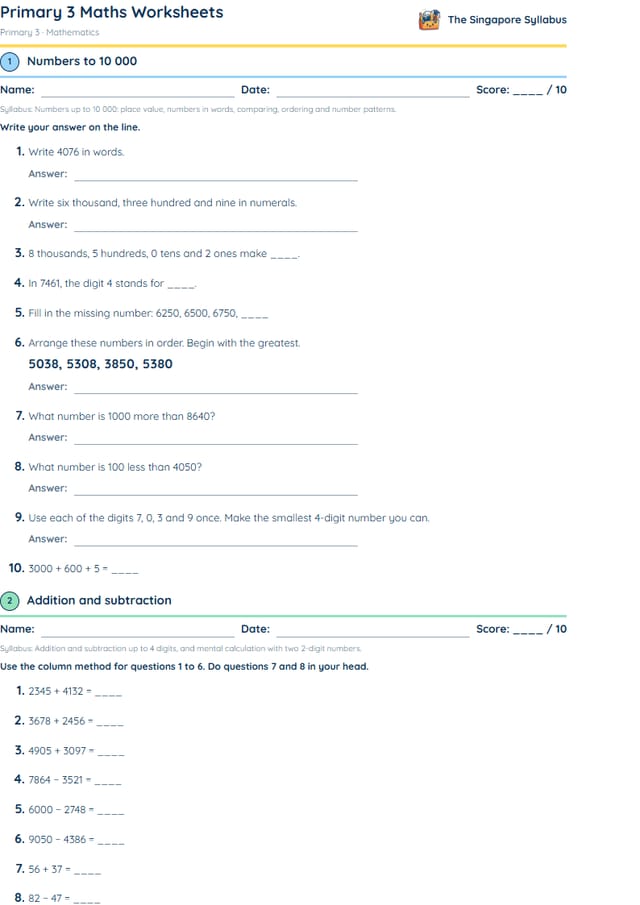
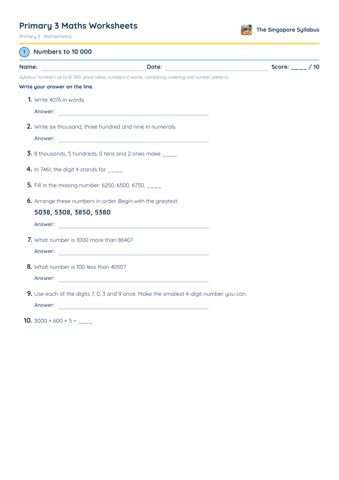
Numbers to 10 000
Syllabus: Numbers up to 10 000: place value, numbers in words, comparing, ordering and number patterns.
Write your answer on the line.
Write 4076 in words.
Write six thousand, three hundred and nine in numerals.
8 thousands, 5 hundreds, 0 tens and 2 ones make ____.
In 7461, the digit 4 stands for ____.
Fill in the missing number: 6250, 6500, 6750, ____
Arrange these numbers in order. Begin with the greatest.
5038, 5308, 3850, 5380
What number is 1000 more than 8640?
What number is 100 less than 4050?
Use each of the digits 7, 0, 3 and 9 once. Make the smallest 4-digit number you can.
3000 + 600 + 5 = ____
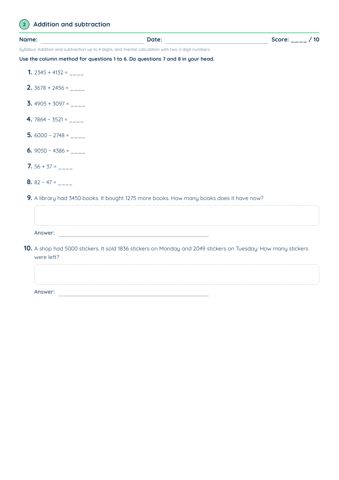
Addition and subtraction
Syllabus: Addition and subtraction up to 4 digits, and mental calculation with two 2-digit numbers.
Use the column method for questions 1 to 6. Do questions 7 and 8 in your head.
Worked example
A shop sold 1250 pens in May. It sold 380 fewer pens in June than in May. How many pens did it sell in the two months?
| May | 1250 | |||||||||||||||||||
|---|---|---|---|---|---|---|---|---|---|---|---|---|---|---|---|---|---|---|---|---|
| June | ? | 380 fewer | ||||||||||||||||||
- Draw a bar for May. Draw June's bar shorter, and mark the missing 380 with a dashed part.
- Step 1, find June: 1250 − 380 = 870.
- Step 2, find the total: 1250 + 870 = 2120.
- Check: 2120 − 1250 = 870, and 870 + 380 = 1250.
Answer: The shop sold 2120 pens in the two months.
2345 + 4132 = ____
3678 + 2456 = ____
4905 + 3097 = ____
7864 − 3521 = ____
6000 − 2748 = ____
9050 − 4386 = ____
56 + 37 = ____
82 − 47 = ____
A library had 3450 books. It bought 1275 more books. How many books does it have now?
A shop had 5000 stickers. It sold 1836 stickers on Monday and 2049 stickers on Tuesday. How many stickers were left?
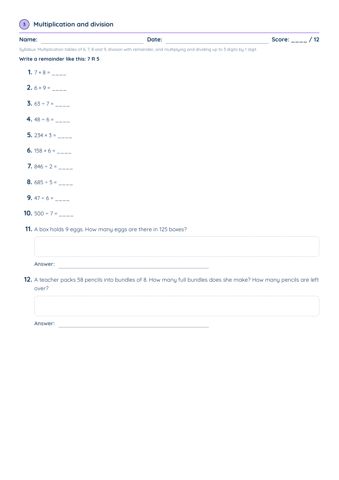
Multiplication and division
Syllabus: Multiplication tables of 6, 7, 8 and 9, division with remainder, and multiplying and dividing up to 3 digits by 1 digit.
Write a remainder like this: 7 R 5
Worked example
95 ÷ 4 = ____
- Divide the tens: 9 tens ÷ 4 = 2 tens R 1 ten.
- Rename the 1 ten as 10 ones. 10 ones and 5 ones make 15 ones.
- Divide the ones: 15 ÷ 4 = 3 R 3.
- Check: 4 × 23 = 92, and 92 + 3 = 95.
Answer: 23 R 3
7 × 8 = ____
6 × 9 = ____
63 ÷ 7 = ____
48 ÷ 6 = ____
234 × 3 = ____
158 × 6 = ____
846 ÷ 2 = ____
685 ÷ 5 = ____
47 ÷ 6 = ____
500 ÷ 7 = ____
A box holds 9 eggs. How many eggs are there in 125 boxes?
A teacher packs 58 pencils into bundles of 8. How many full bundles does she make? How many pencils are left over?
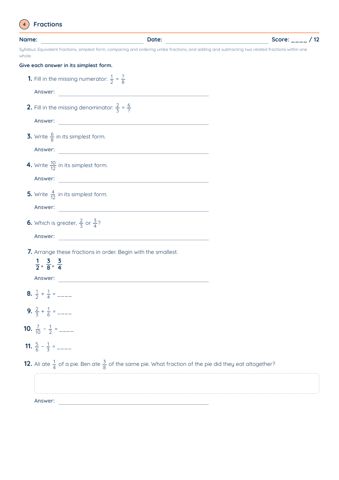
Fractions
Syllabus: Equivalent fractions, simplest form, comparing and ordering unlike fractions, and adding and subtracting two related fractions within one whole.
Give each answer in its simplest form.
Worked example
13 + 16 = ____
- The denominators are different. 6 is a multiple of 3, so change thirds to sixths.
- 13 = 26, because 1 × 2 = 2 and 3 × 2 = 6.
- 26 + 16 = 36.
- Simplify: 36 = 12, dividing the top and bottom by 3.
Answer: 12
Fill in the missing numerator: 12 = ?8
Fill in the missing denominator: 23 = 6?
Write 68 in its simplest form.
Write 1012 in its simplest form.
Write 412 in its simplest form.
Which is greater, 23 or 34?
Arrange these fractions in order. Begin with the smallest.
12, 38, 34
12 + 14 = ____
23 + 16 = ____
710 − 12 = ____
56 − 13 = ____
Ali ate 14 of a pie. Ben ate 38 of the same pie. What fraction of the pie did they eat altogether?
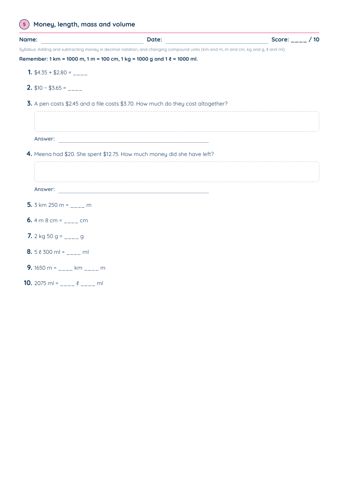
Money, length, mass and volume
Syllabus: Adding and subtracting money in decimal notation, and changing compound units (km and m, m and cm, kg and g, ℓ and ml).
Remember: 1 km = 1000 m, 1 m = 100 cm, 1 kg = 1000 g and 1 ℓ = 1000 ml.
Worked example
3 m 6 cm = ____ cm
- 1 m = 100 cm, so 3 m = 300 cm.
- Add the 6 cm: 300 cm + 6 cm = 306 cm.
- Take care: 6 cm is not 60 cm.
Answer: 306 cm
$4.35 + $2.80 = ____
$10 − $3.65 = ____
A pen costs $2.45 and a file costs $3.70. How much do they cost altogether?
Meena had $20. She spent $12.75. How much money did she have left?
3 km 250 m = ____ m
4 m 8 cm = ____ cm
2 kg 50 g = ____ g
5 ℓ 300 ml = ____ ml
1650 m = ____ km ____ m
2075 ml = ____ ℓ ____ ml
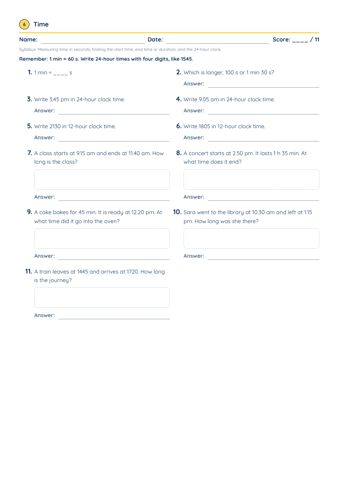
Time
Syllabus: Measuring time in seconds, finding the start time, end time or duration, and the 24-hour clock.
Remember: 1 min = 60 s. Write 24-hour times with four digits, like 1545.
Worked example
A lesson starts at 10.45 am and ends at 1.20 pm. How long is the lesson?
- Count on to the next hour: 10.45 am to 11.00 am is 15 min.
- Count on in hours: 11.00 am to 1.00 pm is 2 h.
- Count on the rest: 1.00 pm to 1.20 pm is 20 min.
- Add up: 2 h + 15 min + 20 min = 2 h 35 min.
Answer: 2 h 35 min
1 min = ____ s
Which is longer, 100 s or 1 min 30 s?
Write 3.45 pm in 24-hour clock time.
Write 9.05 am in 24-hour clock time.
Write 2130 in 12-hour clock time.
Write 1805 in 12-hour clock time.
A class starts at 9.15 am and ends at 11.40 am. How long is the class?
A concert starts at 2.50 pm. It lasts 1 h 35 min. At what time does it end?
A cake bakes for 45 min. It is ready at 12.20 pm. At what time did it go into the oven?
Sara went to the library at 10.30 am and left at 1.15 pm. How long was she there?
A train leaves at 1445 and arrives at 1720. How long is the journey?
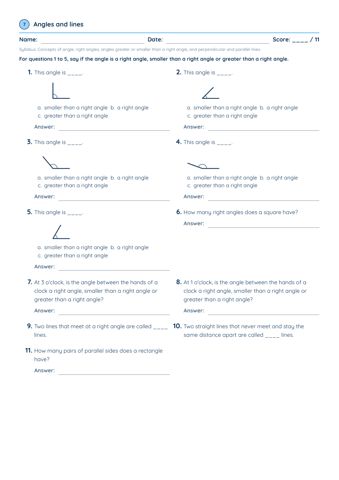
Angles and lines
Syllabus: Concepts of angle, right angles, angles greater or smaller than a right angle, and perpendicular and parallel lines.
For questions 1 to 5, say if the angle is a right angle, smaller than a right angle or greater than a right angle.
Worked example
How can you tell if an angle is a right angle?
- Fold a sheet of paper twice to make a square corner. That corner is a right angle.
- Put the corner on the point where the two arms meet, with one edge along one arm.
- If the other arm lies along the other edge, it is a right angle. If it falls inside the corner, the angle is smaller. If it falls outside, the angle is greater.
Answer: Compare it with a square corner.
This angle is ____.
Angle: picture a clock face. One arm points to 3, and the other arm points to 12.
- smaller than a right angle
- a right angle
- greater than a right angle
This angle is ____.
Angle: picture a clock face. One arm points to 3, and the other arm points between 1 and 2.
- smaller than a right angle
- a right angle
- greater than a right angle
This angle is ____.
Angle: picture a clock face. One arm points to 3, and the other arm points between 10 and 11.
- smaller than a right angle
- a right angle
- greater than a right angle
This angle is ____.
Angle: picture a clock face. One arm points to 3, and the other arm points between 9 and 10.
- smaller than a right angle
- a right angle
- greater than a right angle
This angle is ____.
Angle: picture a clock face. One arm points to 3, and the other arm points to 1.
- smaller than a right angle
- a right angle
- greater than a right angle
How many right angles does a square have?
At 3 o'clock, is the angle between the hands of a clock a right angle, smaller than a right angle or greater than a right angle?
At 1 o'clock, is the angle between the hands of a clock a right angle, smaller than a right angle or greater than a right angle?
Two lines that meet at a right angle are called ____ lines.
Two straight lines that never meet and stay the same distance apart are called ____ lines.
How many pairs of parallel sides does a rectangle have?
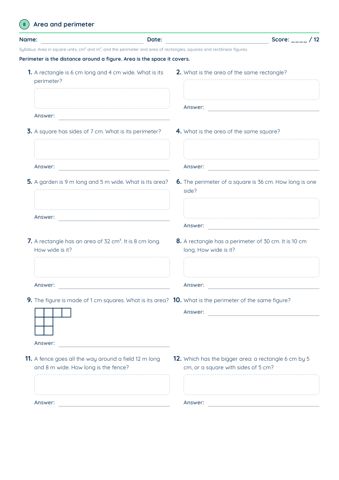
Area and perimeter
Syllabus: Area in square units, cm² and m², and the perimeter and area of rectangles, squares and rectilinear figures.
Perimeter is the distance around a figure. Area is the space it covers.
Worked example
A rectangle is 5 cm long and 3 cm wide. Find its perimeter and its area.
- Perimeter is the distance around: 5 cm + 3 cm + 5 cm + 3 cm = 16 cm.
- Area is the space covered: 5 cm × 3 cm = 15 cm².
- Perimeter is a length, so its unit is cm. Area is in square units, so its unit is cm².
Answer: Perimeter 16 cm, area 15 cm²
A rectangle is 6 cm long and 4 cm wide. What is its perimeter?
What is the area of the same rectangle?
A square has sides of 7 cm. What is its perimeter?
What is the area of the same square?
A garden is 9 m long and 5 m wide. What is its area?
The perimeter of a square is 36 cm. How long is one side?
A rectangle has an area of 32 cm². It is 8 cm long. How wide is it?
A rectangle has a perimeter of 30 cm. It is 10 cm long. How wide is it?
The figure is made of 1 cm squares. What is its area?
Figure: 3 rows of 1 cm squares. Row 1 has 4 squares, Row 2 has 2 squares, Row 3 has 2 squares, and the rows line up on the left.
What is the perimeter of the same figure?
A fence goes all the way around a field 12 m long and 8 m wide. How long is the fence?
Which has the bigger area: a rectangle 6 cm by 5 cm, or a square with sides of 5 cm?
For parents
How to use this pack
- Pick the topic the school is teaching now. Each topic is one worksheet with its answers.
- Read the worked example together, then let your child try the questions alone.
- For every word problem, ask your child to draw the bar model first. It shows which operation to use.
- Mark the worksheet with the answer key. Ask your child to explain each wrong answer, then redo it a few days later.
- Near the end of the year, redo any worksheet your child found hard.
How Primary 3 Maths is assessed in school
- Primary 3 is the first year with weighted assessments. A school sets no more than one weighted assessment per subject in each school term.
- There is no mid-year exam. MOE removed mid-year exams at every primary level by 2023.
- Report books do not show class or level position, and marks are shown as whole numbers.
- Ask the form teacher for the dates and topics of each assessment, then use the matching worksheet in the week before.
What each weighted assessment and the end-of-year exam covered
- Primary 3 is the first year with weighted assessments (WA). TSS's free papers library has 36 Primary 3 Maths papers from 2024 and 2025, with answers. They include 13 weighted assessments and 18 end-of-year exams.
| Assessment | Topics tested | Our worksheets | Real school papers |
|---|---|---|---|
| WA1 | Numbers to 10 000, adding and subtracting, multiplying and dividing, money, number patterns | 1, 2, 3, 5 | Tao Nan 2025, Nan Hua 2025, Henry Park 2024, St Hilda's 2024 |
| WA2 | Angles, perpendicular and parallel lines, bar graphs and fractions, with money and multiplying and dividing | 3, 4, 5, 7 | Northland 2025, Maha Bodhi 2025, St Hilda's 2025, Raffles Girls' 2024 |
| WA3 | Fractions, angles and lines, length and mass | 4, 5, 7 | ACS (Junior) 2025, Nan Hua 2025, Rosyth 2024 |
| End-of-year exam | Every Primary 3 topic, including time, area and perimeter, and volume. Most papers are out of 50 marks. | All | Henry Park 2025, Ai Tong 2025, Raffles Girls' 2025, Rosyth 2024 |
- Schools number their weighted assessments in order through the year, and MOE allows no more than one per subject in a term. Dates and topics differ by school, so check the school's assessment plan or ask the form teacher.
- In the week before an assessment, do the matching worksheets, then one real paper of the same kind under timed conditions.
- Each paper page has the question paper and its answer key, free to download.
If your child finds Primary 3 Maths hard
- Primary 3 is a step up: bigger numbers, two-step word problems, and new topics such as fractions, angles, and area and perimeter.
- Signs to watch: not knowing the 6, 7, 8 and 9 times tables, mixing up area and perimeter, or leaving out the units.
- Practise one times table a week, and say each step of a word problem out loud with a bar model.
- Talk to your child's Maths teacher early. MOE's Learning Support for Mathematics (LSM) gives extra lessons in small groups, led by trained teachers, from Primary 1 to Primary 4. Children are identified at the start of Primary 1, and others can join in Primary 2, 3 or 4 if needed.
Before Primary 4
- Primary 4 Maths moves on to numbers up to 100 000, dividing 4-digit numbers by a 1-digit number, and measuring angles in degrees.
- Over the school holidays, keep the times tables and the column method sharp, and redo any worksheet your child found hard.
Sources: MOE, Learn for Life press release (28 September 2018), MOE, forum reply on removing mid-year exams (8 February 2023), MOE, learning support programmes.
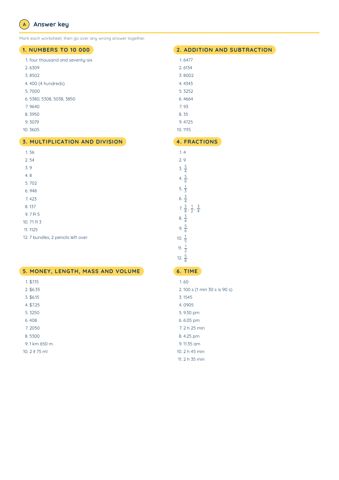
Answer key
Mark each worksheet, then go over any wrong answer together.
1. Numbers to 10 000
- four thousand and seventy-six
- 6309
- 8502
- 400 (4 hundreds)
- 7000
- 5380, 5308, 5038, 3850
- 9640
- 3950
- 3079
- 3605
2. Addition and subtraction
- 6477
- 6134
- 8002
- 4343
- 3252
- 4664
- 93
- 35
- 4725
- 1115
3. Multiplication and division
- 56
- 54
- 9
- 8
- 702
- 948
- 423
- 137
- 7 R 5
- 71 R 3
- 1125
- 7 bundles, 2 pencils left over
4. Fractions
- 4
- 9
- 34
- 56
- 13
- 34
- 38, 12, 34
- 34
- 56
- 15
- 12
- 58
5. Money, length, mass and volume
- $7.15
- $6.35
- $6.15
- $7.25
- 3250
- 408
- 2050
- 5300
- 1 km 650 m
- 2 ℓ 75 ml
6. Time
- 60
- 100 s (1 min 30 s is 90 s)
- 1545
- 0905
- 9.30 pm
- 6.05 pm
- 2 h 25 min
- 4.25 pm
- 11.35 am
- 2 h 45 min
- 2 h 35 min
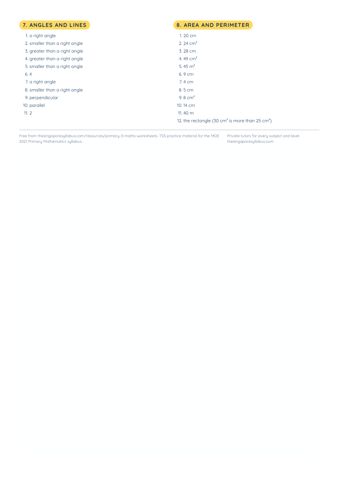
7. Angles and lines
- a right angle
- smaller than a right angle
- greater than a right angle
- greater than a right angle
- smaller than a right angle
- 4
- a right angle
- smaller than a right angle
- perpendicular
- parallel
- 2
8. Area and perimeter
- 20 cm
- 24 cm²
- 28 cm
- 49 cm²
- 45 m²
- 9 cm
- 4 cm
- 5 cm
- 8 cm²
- 14 cm
- 40 m
- the rectangle (30 cm² is more than 25 cm²)
Next steps
Download the free PDFPDF · 10 pages · A4 portrait · free, no sign-up
Inside the PDF
10 A4 pages, ready to print. Tap a page to open the PDF there.
Questions students ask
What does Primary 3 Maths cover in Singapore?
The MOE 2021 Primary Mathematics syllabus lists numbers up to 10 000, addition and subtraction up to 4 digits, the tables of 6, 7, 8 and 9, division with remainder, equivalent fractions, money, compound units of length, mass and volume, time and the 24-hour clock, angles, perpendicular and parallel lines, area and perimeter, and bar graphs for Primary 3.
What angles does a Primary 3 child learn?
P3 pupils learn what an angle is and sort angles into right angles, angles smaller than a right angle and angles greater than a right angle. Measuring angles in degrees comes later, in Primary 4.
What fractions are in Primary 3 Maths?
Equivalent fractions, writing a fraction in its simplest form, comparing and ordering unlike fractions, and adding and subtracting two related fractions within one whole, such as 1/2 and 1/4. The denominators are 12 or less.
Is area and perimeter in Primary 3?
Yes. P3 pupils learn what area and perimeter mean, measure area in square units, cm² and m², and find the perimeter and area of rectangles and squares and the perimeter of rectilinear figures.
How hard is division in Primary 3?
P3 pupils divide within the times tables, divide with a remainder, and divide numbers up to 3 digits by a 1-digit number. Dividing a 4-digit number comes in Primary 4.
Are these worksheets from MOE or a school?
No. They are The Singapore Syllabus's own practice questions, written to match the topics MOE lists for Primary 3. They are not school papers and MOE did not issue them. The PDF is free, with no sign-up.
How is Primary 3 Maths assessed in school?
Primary 3 is the first year with weighted assessments. A school sets no more than one weighted assessment per subject in each term, and there is no mid-year exam, as MOE removed mid-year exams at every primary level by 2023. In the 2024 and 2025 school papers on TSS, WA1 tested numbers, the four operations and money, WA2 and WA3 added fractions, angles, lines and graphs, and the end-of-year exam covered every topic, mostly out of 50 marks.
What is a bar model?
A bar model is a drawing of bars that shows the parts and the whole in a word problem, or how two amounts compare. It helps a child decide whether to add, subtract, multiply or divide. The addition and subtraction worksheet has a worked bar model example.
Where can my child practise with real P3 school papers?
The parents' notes on this page list real 2024 and 2025 weighted assessments and end-of-year exams from schools such as Henry Park, Ai Tong, Raffles Girls', Rosyth, Tao Nan and Nan Hua, with links. TSS's free Primary 3 and 4 Maths papers page has 36 Primary 3 papers, each with its answer key.
Is there practice for the 6, 7, 8 and 9 times tables?
Yes. The multiplication and division worksheet starts with facts from the 6, 7, 8 and 9 tables, then uses them in longer sums and word problems. Saying one table out loud each day helps too.
Keep revising
- All free worksheetsEvery free worksheet pack, P1 to P3
- Primary 3 Maths tuitionThe P3 topics and a home tutor
- PSLE Math FormulasPSLE (Primary 1 to 6) · free PDF
- PSLE English Composition PhrasesPSLE (Primary 5 and 6) · free PDF
- PSLE Chinese Composition Phrases (好词好句)PSLE (Primary 5 and 6) · free PDF
- PSLE Science KeywordsPSLE (Primary 3 to 6) · free PDF
- Primary English Oral Practice (P3 to PSLE)Primary 3 to 6 and PSLE · free PDF
- Primary English Listening Comprehension Practice (P3 to PSLE)Primary 3 to 6 and PSLE · free PDF
- Primary English Composition Topics (P3 to PSLE)Primary 3 to 6 and PSLE · free PDF
- Primary 1 Maths WorksheetsPrimary 1 · free PDF
- Primary 2 Maths WorksheetsPrimary 2 · free PDF
- Primary 1 English WorksheetsPrimary 1 · free PDF
- Primary 2 English WorksheetsPrimary 2 · free PDF
- Primary 3 English WorksheetsPrimary 3 · free PDF
- Primary 1 Spelling and Vocabulary ListPrimary 1 · free PDF
- Primary 2 Spelling and Vocabulary ListPrimary 2 · free PDF
- Primary 3 Spelling and Vocabulary ListPrimary 3 · free PDF
- Primary 4 Spelling and Vocabulary ListPrimary 4 · free PDF
- Primary 5 Spelling and Vocabulary ListPrimary 5 · free PDF
- PSLE Vocabulary List (Primary 6)Primary 6 (PSLE) · free PDF
- PSLE Score calculatorAdd up the four AL grades
- All free resourcesPSLE, O-Level and A-Level
Source
- MOE, 2021 Primary Mathematics Syllabus P1 to P6 (updated October 2025)
- MOE, Primary school subjects and syllabuses
The worksheets are our own practice material, written for the MOE 2021 Primary Mathematics syllabus. They are not issued by MOE. If a topic here differs from the MOE document, the MOE document is right. Tell us and we will fix it.