Free resource · Primary 1
Primary 1 English Worksheets with Answers: Free PDF
This is a free sample set of Primary 1 English worksheets: 6 topics, 57 questions, with answers. Five grammar sheets of 10 questions practise capital letters and full stops, one and many, a or an, is, am and are, and the pronouns he, she, it, they and we. A short story has 7 questions. Primary 1 has no exams or weighted assessments, so use them as practice. They follow the MOE English Language Syllabus 2020.
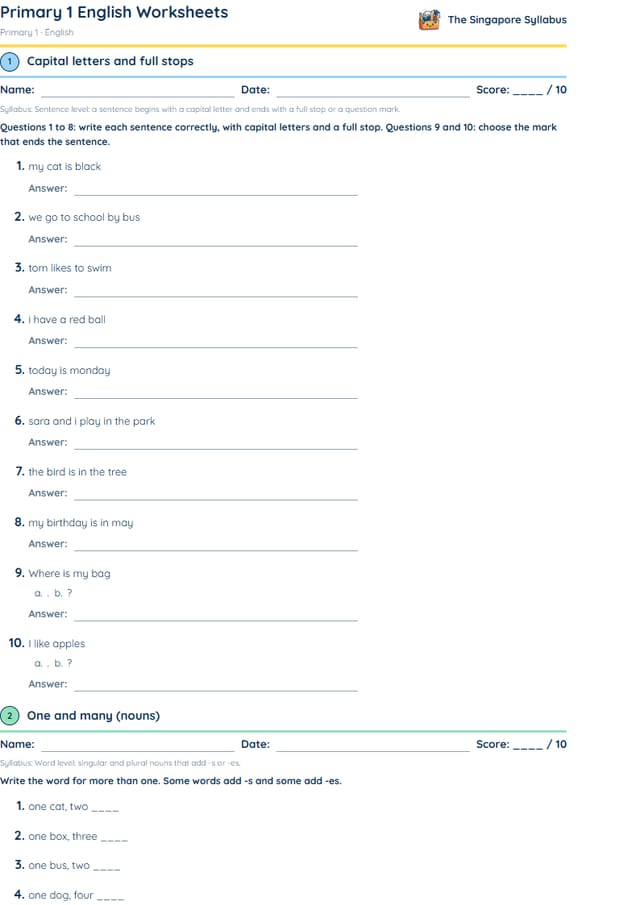
Capital letters and full stops
Syllabus: Sentence level: a sentence begins with a capital letter and ends with a full stop or a question mark.
Questions 1 to 8: write each sentence correctly, with capital letters and a full stop. Questions 9 and 10: choose the mark that ends the sentence.
my cat is black
we go to school by bus
tom likes to swim
i have a red ball
today is monday
sara and i play in the park
the bird is in the tree
my birthday is in may
Where is my bag
- .
- ?
I like apples
- .
- ?
One and many (nouns)
Syllabus: Word level: singular and plural nouns that add -s or -es.
Write the word for more than one. Some words add -s and some add -es.
one cat, two ____
one box, three ____
one bus, two ____
one dog, four ____
one brush, two ____
one book, five ____
one watch, two ____
one fox, three ____
one egg, six ____
one dish, two ____
a or an
Syllabus: Word level: the articles a and an.
Write a or an. Use an before a word that begins with a vowel sound (a, e, i, o, u).
____ apple
____ dog
____ egg
____ umbrella
____ book
____ orange
____ ball
____ ant
____ hat
____ ice cream
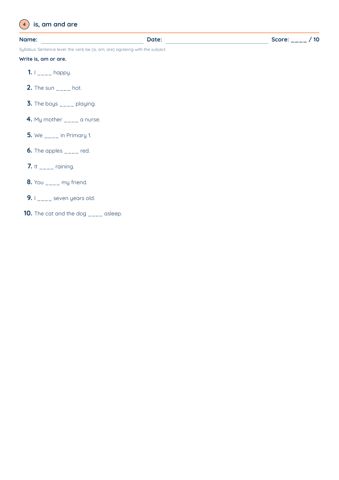
is, am and are
Syllabus: Sentence level: the verb be (is, am, are) agreeing with the subject.
Write is, am or are.
I ____ happy.
The sun ____ hot.
The boys ____ playing.
My mother ____ a nurse.
We ____ in Primary 1.
The apples ____ red.
It ____ raining.
You ____ my friend.
I ____ seven years old.
The cat and the dog ____ asleep.
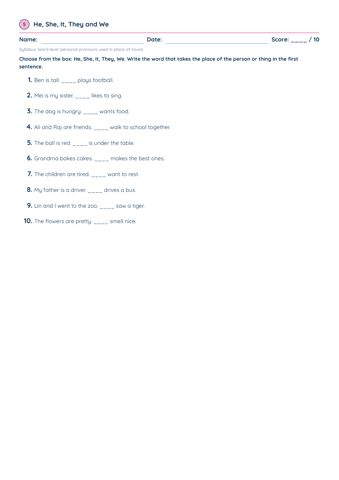
He, She, It, They and We
Syllabus: Word level: personal pronouns used in place of nouns.
Choose from the box: He, She, It, They, We. Write the word that takes the place of the person or thing in the first sentence.
Ben is tall. ____ plays football.
Mei is my sister. ____ likes to sing.
The dog is hungry. ____ wants food.
Ali and Raj are friends. ____ walk to school together.
The ball is red. ____ is under the table.
Grandma bakes cakes. ____ makes the best ones.
The children are tired. ____ want to rest.
My father is a driver. ____ drives a bus.
Lin and I went to the zoo. ____ saw a tiger.
The flowers are pretty. ____ smell nice.
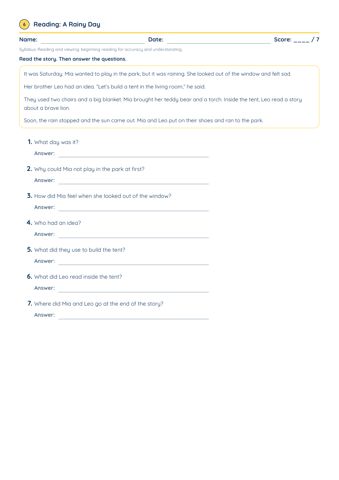
Reading: A Rainy Day
Syllabus: Reading and viewing: beginning reading for accuracy and understanding.
Read the story. Then answer the questions.
It was Saturday. Mia wanted to play in the park, but it was raining. She looked out of the window and felt sad.
Her brother Leo had an idea. “Let’s build a tent in the living room,” he said.
They used two chairs and a big blanket. Mia brought her teddy bear and a torch. Inside the tent, Leo read a story about a brave lion.
Soon, the rain stopped and the sun came out. Mia and Leo put on their shoes and ran to the park.
What day was it?
Why could Mia not play in the park at first?
How did Mia feel when she looked out of the window?
Who had an idea?
What did they use to build the tent?
What did Leo read inside the tent?
Where did Mia and Leo go at the end of the story?
For parents
How to use this pack
- Do one worksheet at a time, in a short sitting.
- Read the instructions aloud together. Many Primary 1 children are still learning to read them alone.
- Mark with the answer key. For the story questions, accept an answer in your child's own words if it gives the same idea as the key.
- Read the story aloud together, then let your child read it alone.
- Near the end of the year, redo any worksheet your child found hard.
How Primary 1 English is assessed in school
- Primary 1 and 2 have no weighted assessments and no exams. MOE removed them from 2019, so no test at these levels counts towards an overall mark or grade.
- Teachers still use short class assessments to check what each child understands. Schools report learning at these levels with descriptions in words, not marks.
- Weighted assessments start in Primary 3, with no more than one per subject in each school term. There are no mid-year exams at any primary level. MOE removed them by 2023.
- So these worksheets are practice, not a test. Use them to find gaps early, while nothing is being graded.
If your child finds English hard
- Signs to watch: guessing words from the first letter, avoiding reading aloud, or not being able to retell a short story.
- Read together every day, even for ten minutes. Point to each word as you read.
- Schools set their own spelling lists. MOE does not publish one for each level. Practise the school's list a few words at a time: fill in missing letters, pick the right spelling, then write a short dictation.
- Talk to your child's English teacher early. MOE's Learning Support Programme (LSP) builds English skills in small groups of 8 to 10 for half an hour a day, led by trained teachers. Children are identified at the start of Primary 1.
Primary 1 spelling and vocabulary list · Primary 1 English tuition
Sources: MOE, Learn for Life press release (28 September 2018), MOE, forum reply on removing mid-year exams (8 February 2023), MOE, learning support programmes.
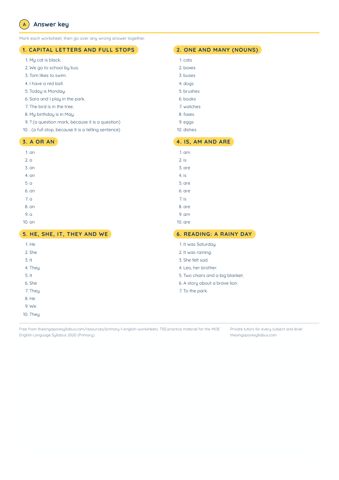
Answer key
Mark each worksheet, then go over any wrong answer together.
1. Capital letters and full stops
- My cat is black.
- We go to school by bus.
- Tom likes to swim.
- I have a red ball.
- Today is Monday.
- Sara and I play in the park.
- The bird is in the tree.
- My birthday is in May.
- ? (a question mark, because it is a question)
- . (a full stop, because it is a telling sentence)
2. One and many (nouns)
- cats
- boxes
- buses
- dogs
- brushes
- books
- watches
- foxes
- eggs
- dishes
3. a or an
- an
- a
- an
- an
- a
- an
- a
- an
- a
- an
4. is, am and are
- am
- is
- are
- is
- are
- are
- is
- are
- am
- are
5. He, She, It, They and We
- He
- She
- It
- They
- It
- She
- They
- He
- We
- They
6. Reading: A Rainy Day
- It was Saturday.
- It was raining.
- She felt sad.
- Leo, her brother.
- Two chairs and a big blanket.
- A story about a brave lion.
- To the park.
Next steps
Download the free PDFPDF · 7 pages · A4 portrait · free, no sign-up
Inside the PDF
7 A4 pages, ready to print. Tap a page to open the PDF there.
Questions students ask
What English does a Primary 1 child learn in Singapore?
The MOE English Language Syllabus 2020 gives attention to phonemic awareness, phonics and early literacy skills at the start of Primary 1. It teaches grammar explicitly, focusing on words, phrases and sentences, and builds vocabulary at every level.
Does MOE publish a grammar list for Primary 1?
No. The 2020 syllabus describes the skills for lower primary (Primary 1 and 2) but does not list grammar items year by year. The topics in this pack are ones P1 children commonly practise, chosen by us.
When does a child use a and when an?
Use an before a word that starts with a vowel sound, as in an apple or an umbrella. Use a before a word that starts with a consonant sound, as in a dog or a ball.
When does a plural add -es instead of -s?
Most nouns add -s, like cats and books. Nouns that end in s, x, ch or sh add -es, like buses, boxes, watches and brushes.
Are these worksheets from MOE or a school?
No. They are The Singapore Syllabus's own practice questions and stories. They are not school papers and MOE did not issue them.
Are there exams in Primary 1 English?
No. MOE removed all weighted assessments and exams for Primary 1 and 2 from 2019. Teachers still check understanding with short class assessments, which do not count towards a mark or grade.
Does MOE publish a Primary 1 spelling list?
No. MOE does not publish a national spelling list, and schools set their own. Our Primary 1 spelling and vocabulary list has words to practise.
Are the worksheets really free?
Yes. The PDF downloads with no sign-up, and every question and answer is also on this page.
How can I help my child with the reading passage?
Read the story aloud together first, then let your child read it alone. Ask them to point to the line in the story that gives each answer.
Keep revising
- All free worksheetsEvery free worksheet pack, P1 to P3
- Primary 1 English tuitionWhat P1 English covers, and a home tutor
- PSLE Math FormulasPSLE (Primary 1 to 6) · free PDF
- PSLE English Composition PhrasesPSLE (Primary 5 and 6) · free PDF
- PSLE Chinese Composition Phrases (好词好句)PSLE (Primary 5 and 6) · free PDF
- PSLE Science KeywordsPSLE (Primary 3 to 6) · free PDF
- Primary English Oral Practice (P3 to PSLE)Primary 3 to 6 and PSLE · free PDF
- Primary English Listening Comprehension Practice (P3 to PSLE)Primary 3 to 6 and PSLE · free PDF
- Primary English Composition Topics (P3 to PSLE)Primary 3 to 6 and PSLE · free PDF
- Primary 1 Maths WorksheetsPrimary 1 · free PDF
- Primary 2 Maths WorksheetsPrimary 2 · free PDF
- Primary 3 Maths WorksheetsPrimary 3 · free PDF
- Primary 2 English WorksheetsPrimary 2 · free PDF
- Primary 3 English WorksheetsPrimary 3 · free PDF
- Primary 1 Spelling and Vocabulary ListPrimary 1 · free PDF
- Primary 2 Spelling and Vocabulary ListPrimary 2 · free PDF
- Primary 3 Spelling and Vocabulary ListPrimary 3 · free PDF
- Primary 4 Spelling and Vocabulary ListPrimary 4 · free PDF
- Primary 5 Spelling and Vocabulary ListPrimary 5 · free PDF
- PSLE Vocabulary List (Primary 6)Primary 6 (PSLE) · free PDF
- PSLE Score calculatorAdd up the four AL grades
- All free resourcesPSLE, O-Level and A-Level
Source
The worksheets and stories are our own practice material, written for the MOE English Language Syllabus 2020 (Primary). They are not issued by MOE. MOE does not publish a list of grammar items for each year, so the topics are our choice. Tell us and we will fix it.