Free resource · Primary 2
Primary 2 Spelling List and Vocabulary Words: Free PDF
MOE does not publish a national Primary 2 spelling list, as each school sets its own. This free list gives 120 words for P2 in 12 themed lists of 10 across the four school terms, each with a simple meaning and an example sentence. It adds spelling patterns, 20 sight words, missing-letter practice with answers, 10 challenge words and a five-day routine to use at home.
About this list
MOE does not publish a national spelling list, and each school sets its own weekly lists. This is TSS's own list for Primary 2, pitched to the level using the MOE English Language Syllabus 2020. Use it alongside your child's school list. Everything on this page, including the practice and answers, is in the free PDF from the button at the top, ready to print.
| Point | What it means for you |
|---|---|
| National spelling list | MOE does not publish a national spelling list. Schools set their own spelling lists, so the list your child brings home will be different from this one. |
| Your school's own list | Some schools post their weekly lists on the school website or class portal. Learn that list first, as the school test uses it. |
| Mother Tongue lists | Mother Tongue spelling lists, such as tingxie for Chinese, are set by schools too. This page covers English only. |
| MOE English Language Syllabus 2020 | MOE brought in the English Language Syllabus 2020 from Primary 1 in 2020, and primary schools plan their English lessons on it. Pupils who joined MOE's Learning Support Programme in Primary 1 get extra help with English in small groups. |
| Marks in P1 and P2 | Since 2019 there are no weighted assessments or exams in P1 and P2, and school assessments do not count towards an overall mark or grade. |
| Foundation or Standard | In P5 and P6, English is taken at Foundation or Standard level, depending on P4 school exam results. This list is pitched at Standard English. A child taking Foundation English can start with the Primary 4 list and move up. |
| PSLE English | Spelling and vocabulary are assessed in Paper 1 (Writing) and Paper 2 (Language Use and Comprehension). The next section shows where. |
| This list | TSS's own 120 words for Primary 2, in 12 themed lists of 10 across the four school terms, plus 10 challenge words. Every word has a short meaning and an example sentence written by TSS. MOE and SEAB did not issue this list. |
- The list uses British spelling, such as colour, favourite and neighbour, as MOE's own syllabus documents do.
Term 1 words (lists 1 to 3)
30 words in 3 lists
30 words in 3 lists: friends and classmates, in the classroom, days and time.
| Word | Meaning | Example sentence |
|---|---|---|
| share | to let others use or have part of something | Let us share the crayons. |
| together | with each other | We built the sandcastle together. |
| classmate | a pupil in the same class as you | My classmate lent me an eraser. |
| lend | to let someone use something for a short time | Can you lend me your ruler? |
| borrow | to take something and give it back later | I will borrow a storybook from Ali. |
| laugh | to make sounds because something is funny | We laugh at Dad's silly jokes. |
| secret | something you do not tell other people | Can you keep a secret? |
| promise | to say that you will surely do something | I promise to return your pencil tomorrow. |
| quarrel | to argue with someone in an angry way | The twins quarrel over the last sweet. |
| forgive | to stop being angry with someone | I forgive you for taking my seat. |
| Word | Meaning | Example sentence |
|---|---|---|
| eraser | a small object that rubs out pencil marks | I used my eraser to fix the mistake. |
| ruler | a flat stick for measuring and drawing straight lines | Draw a line with your ruler. |
| crayon | a stick of coloured wax for drawing | She drew a sun with a yellow crayon. |
| whiteboard | a smooth white board that the teacher writes on | The teacher wrote the date on the whiteboard. |
| answer | what you say or write when someone asks a question | Raise your hand to give the answer. |
| question | something you ask to find something out | I have a question about the story. |
| listen | to pay attention to sounds | Listen carefully to the instructions. |
| spell | to say or write the letters of a word in order | Can you spell the word "house"? |
| lesson | a time when you are taught something | Our Maths lesson is after recess. |
| homework | schoolwork that you do at home | I finish my homework before dinner. |
| Word | Meaning | Example sentence |
|---|---|---|
| Monday | the day after Sunday | We have art on Monday. |
| Saturday | the day before Sunday | We go swimming every Saturday. |
| morning | the early part of the day | I eat breakfast in the morning. |
| afternoon | the part of the day after lunch and before evening | We nap in the afternoon. |
| evening | the part of the day before night | We take a walk in the evening. |
| today | this day | Today is my grandma's birthday. |
| tomorrow | the day after today | Tomorrow we are going to the beach. |
| yesterday | the day before today | Yesterday it rained all day. |
| clock | something that shows the time | The clock on the wall says three o'clock. |
| early | before the usual time | I woke up early to watch the sunrise. |
Term 2 words (lists 4 to 6)
30 words in 3 lists
30 words in 3 lists: at the hawker centre, in the garden, by the sea.
| Word | Meaning | Example sentence |
|---|---|---|
| noodles | long thin strips of food made from flour | I slurped up my noodles. |
| soup | a hot liquid food | The soup was too hot to drink. |
| spicy | having a hot, burning taste | The curry is very spicy. |
| sweet | tasting like sugar | This mango is very sweet. |
| stall | a small shop at a market or hawker centre | The drinks stall is next to ours. |
| queue | a line of people waiting their turn | We stood in a long queue for chicken rice. |
| order | to ask for the food or drink you want to buy | Dad will order a plate of fried rice. |
| bowl | a round deep dish for food | She ate a bowl of porridge. |
| spoon | a tool for eating soup and rice | Use a spoon to eat your soup. |
| delicious | tasting very good | The satay was delicious. |
| Word | Meaning | Example sentence |
|---|---|---|
| plant | a living thing that grows in soil | We water the plant every day. |
| seed | a small part of a plant that grows into a new plant | I planted a seed in a pot. |
| flower | the coloured part of a plant | The flower smells nice. |
| leaf | a flat green part of a plant | A leaf fell from the tree. |
| grow | to get bigger | The puppy will grow into a big dog. |
| soil | the earth that plants grow in | Put the seed into the soil. |
| insect | a small creature with six legs | An ant is an insect. |
| butterfly | an insect with large, colourful wings | A butterfly landed on the flower. |
| bee | a flying insect that makes honey | The bee buzzed around the flowers. |
| garden | a piece of land where plants grow | Grandpa grows chillies in his garden. |
| Word | Meaning | Example sentence |
|---|---|---|
| beach | the sandy land next to the sea | We built a sandcastle at the beach. |
| sand | tiny bits of rock found on beaches | The sand was hot under my feet. |
| wave | a moving line of water on the sea | A big wave splashed us. |
| shell | the hard outer cover of some sea animals | I found a pink shell on the beach. |
| crab | a sea animal with claws that walks sideways | The crab ran into its hole. |
| turtle | an animal with a hard shell that swims in the sea | The turtle swam slowly past the boat. |
| swim | to move through water using your arms and legs | I can swim across the pool. |
| island | land with water all around it | Singapore is an island. |
| sea | the large body of salt water that covers much of the Earth | The sea looks calm today. |
| shark | a big fish with sharp teeth | We saw a shark at the aquarium. |
Term 3 words (lists 7 to 9)
30 words in 3 lists
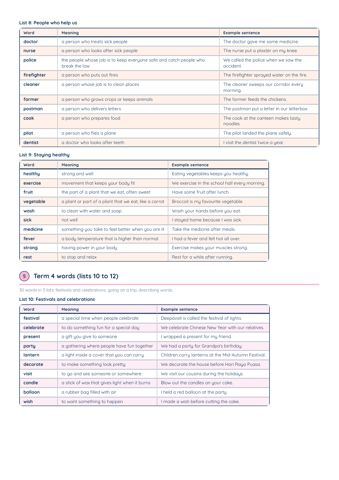
30 words in 3 lists: sports and games, people who help us, staying healthy.
| Word | Meaning | Example sentence |
|---|---|---|
| race | a contest to see who is fastest | I came in second in the race. |
| team | a group of people who play together | Our team won the match. |
| win | to come first in a game or contest | We hope to win the football match. |
| lose | not to win | It is fine to lose if you tried your best. |
| score | to get a point or goal in a game | Ravi kicked the ball to score a goal. |
| catch | to take hold of something moving through the air | Catch the ball with both hands. |
| throw | to send something through the air with your hand | Throw the beanbag into the basket. |
| kick | to hit something with your foot | Kick the ball into the net. |
| cheer | to shout to support someone | We cheer for our classmates at Sports Day. |
| medal | a metal disc given as a prize | She won a gold medal for running. |
| Word | Meaning | Example sentence |
|---|---|---|
| doctor | a person who treats sick people | The doctor gave me some medicine. |
| nurse | a person who looks after sick people | The nurse put a plaster on my knee. |
| police | the people whose job is to keep everyone safe and catch people who break the law | We called the police when we saw the accident. |
| firefighter | a person who puts out fires | The firefighter sprayed water on the fire. |
| cleaner | a person whose job is to clean places | The cleaner sweeps our corridor every morning. |
| farmer | a person who grows crops or keeps animals | The farmer feeds the chickens. |
| postman | a person who delivers letters | The postman put a letter in our letterbox. |
| cook | a person who prepares food | The cook at the canteen makes tasty noodles. |
| pilot | a person who flies a plane | The pilot landed the plane safely. |
| dentist | a doctor who looks after teeth | I visit the dentist twice a year. |
| Word | Meaning | Example sentence |
|---|---|---|
| healthy | strong and well | Eating vegetables keeps you healthy. |
| exercise | movement that keeps your body fit | We exercise in the school hall every morning. |
| fruit | the part of a plant that we eat, often sweet | Have some fruit after lunch. |
| vegetable | a plant or part of a plant that we eat, like a carrot | Broccoli is my favourite vegetable. |
| wash | to clean with water and soap | Wash your hands before you eat. |
| sick | not well | I stayed home because I was sick. |
| medicine | something you take to feel better when you are ill | Take the medicine after meals. |
| fever | a body temperature that is higher than normal | I had a fever and felt hot all over. |
| strong | having power in your body | Exercise makes your muscles strong. |
| rest | to stop and relax | Rest for a while after running. |
Term 4 words (lists 10 to 12)
30 words in 3 lists
30 words in 3 lists: festivals and celebrations, going on a trip, describing words.
| Word | Meaning | Example sentence |
|---|---|---|
| festival | a special time when people celebrate | Deepavali is called the festival of lights. |
| celebrate | to do something fun for a special day | We celebrate Chinese New Year with our relatives. |
| present | a gift you give to someone | I wrapped a present for my friend. |
| party | a gathering where people have fun together | We had a party for Grandpa's birthday. |
| lantern | a light inside a cover that you can carry | Children carry lanterns at the Mid-Autumn Festival. |
| decorate | to make something look pretty | We decorate the house before Hari Raya Puasa. |
| visit | to go and see someone or somewhere | We visit our cousins during the holidays. |
| candle | a stick of wax that gives light when it burns | Blow out the candles on your cake. |
| balloon | a rubber bag filled with air | I held a red balloon at the party. |
| wish | to want something to happen | I made a wish before cutting the cake. |
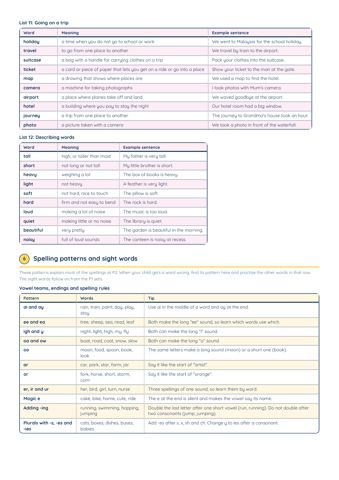
| Word | Meaning | Example sentence |
|---|---|---|
| holiday | a time when you do not go to school or work | We went to Malaysia for the school holiday. |
| travel | to go from one place to another | We travel by train to the airport. |
| suitcase | a bag with a handle for carrying clothes on a trip | Pack your clothes into the suitcase. |
| ticket | a card or piece of paper that lets you get on a ride or go into a place | Show your ticket to the man at the gate. |
| map | a drawing that shows where places are | We used a map to find the hotel. |
| camera | a machine for taking photographs | I took photos with Mum's camera. |
| airport | a place where planes take off and land | We waved goodbye at the airport. |
| hotel | a building where you pay to stay the night | Our hotel room had a big window. |
| journey | a trip from one place to another | The journey to Grandma's house took an hour. |
| photo | a picture taken with a camera | We took a photo in front of the waterfall. |
| Word | Meaning | Example sentence |
|---|---|---|
| tall | high, or taller than most | My father is very tall. |
| short | not long or not tall | My little brother is short. |
| heavy | weighing a lot | The box of books is heavy. |
| light | not heavy | A feather is very light. |
| soft | not hard, nice to touch | The pillow is soft. |
| hard | firm and not easy to bend | The rock is hard. |
| loud | making a lot of noise | The music is too loud. |
| quiet | making little or no noise | The library is quiet. |
| beautiful | very pretty | The garden is beautiful in the morning. |
| noisy | full of loud sounds | The canteen is noisy at recess. |
Spelling patterns and sight words
These patterns explain most of the spellings at P2. When your child gets a word wrong, find its pattern here and practise the other words in that row. The sight words follow on from the P1 sets.
| Pattern | Words | Tip |
|---|---|---|
| ai and ay | rain, train, paint, day, play, stay | Use ai in the middle of a word and ay at the end. |
| ee and ea | tree, sheep, sea, read, leaf | Both make the long "ee" sound, so learn which words use which. |
| igh and y | night, light, high, my, fly | Both can make the long "i" sound. |
| oa and ow | boat, road, coat, snow, slow | Both can make the long "o" sound. |
| oo | moon, food, spoon, book, look | The same letters make a long sound (moon) or a short one (book). |
| ar | car, park, star, farm, jar | Say it like the start of "artist". |
| or | fork, horse, short, storm, corn | Say it like the start of "orange". |
| er, ir and ur | her, bird, girl, turn, nurse | Three spellings of one sound, so learn them by word. |
| Magic e | cake, bike, home, cute, ride | The e at the end is silent and makes the vowel say its name. |
| Adding -ing | running, swimming, hopping, jumping | Double the last letter after one short vowel (run, running). Do not double after two consonants (jump, jumping). |
| Plurals with -s, -es and -ies | cats, boxes, dishes, buses, babies | Add -es after s, x, sh and ch. Change y to ies after a consonant. |
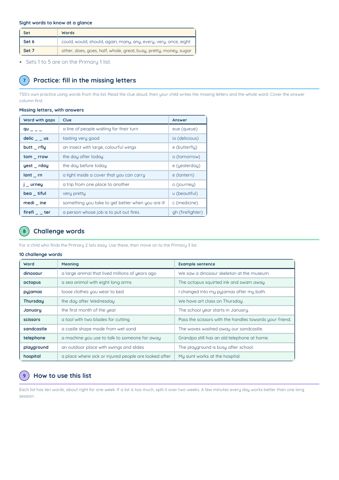
| Set | Words |
|---|---|
| Set 6 | could, would, should, again, many, any, every, very, once, eight |
| Set 7 | other, does, goes, half, whole, great, busy, pretty, money, sugar |
- Sets 1 to 5 are on the Primary 1 list.
Practice: fill in the missing letters
TSS's own practice using words from this list. Read the clue aloud, then your child writes the missing letters and the whole word. Cover the answer column first.
| Word with gaps | Clue |
|---|---|
| qu _ _ _ | a line of people waiting for their turn |
| delic _ _ us | tasting very good |
| butt _ rfly | an insect with large, colourful wings |
| tom _ rrow | the day after today |
| yest _ rday | the day before today |
| lant _ rn | a light inside a cover that you can carry |
| j _ urney | a trip from one place to another |
| bea _ tiful | very pretty |
| medi _ ine | something you take to get better when you are ill |
| firefi _ _ ter | a person whose job is to put out fires |
Show answersHide answers
| No. | Answer |
|---|---|
| 1 | eue (queue) |
| 2 | io (delicious) |
| 3 | e (butterfly) |
| 4 | o (tomorrow) |
| 5 | e (yesterday) |
| 6 | e (lantern) |
| 7 | o (journey) |
| 8 | u (beautiful) |
| 9 | c (medicine) |
| 10 | gh (firefighter) |
Challenge words
For a child who finds the Primary 2 lists easy. Use these, then move on to the Primary 3 list.
| Word | Meaning | Example sentence |
|---|---|---|
| dinosaur | a large animal that lived millions of years ago | We saw a dinosaur skeleton at the museum. |
| octopus | a sea animal with eight long arms | The octopus squirted ink and swam away. |
| pyjamas | loose clothes you wear to bed | I changed into my pyjamas after my bath. |
| Thursday | the day after Wednesday | We have art class on Thursday. |
| January | the first month of the year | The school year starts in January. |
| scissors | a tool with two blades for cutting | Pass the scissors with the handles towards your friend. |
| sandcastle | a castle shape made from wet sand | The waves washed away our sandcastle. |
| telephone | a machine you use to talk to someone far away | Grandpa still has an old telephone at home. |
| playground | an outdoor place with swings and slides | The playground is busy after school. |
| hospital | a place where sick or injured people are looked after | My aunt works at the hospital. |
How to use this list
Each list has ten words, about right for one week. If a list is too much, split it over two weeks. A few minutes every day works better than one long session.
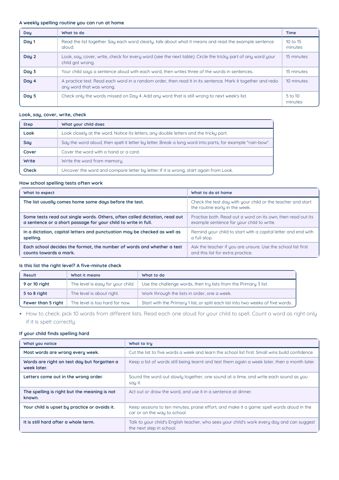
| Day | What to do | Time |
|---|---|---|
| Day 1 | Read the list together. Say each word clearly, talk about what it means and read the example sentence aloud. | 10 to 15 minutes |
| Day 2 | Look, say, cover, write, check for every word (see the next table). Circle the tricky part of any word your child got wrong. | 15 minutes |
| Day 3 | Your child says a sentence aloud with each word, then writes three of the words in sentences. | 15 minutes |
| Day 4 | A practice test. Read each word in a random order, then read it in its sentence. Mark it together and redo any word that was wrong. | 10 minutes |
| Day 5 | Check only the words missed on Day 4. Add any word that is still wrong to next week's list. | 5 to 10 minutes |
| Step | What your child does |
|---|---|
| Look | Look closely at the word. Notice its letters, any double letters and the tricky part. |
| Say | Say the word aloud, then spell it letter by letter. Break a long word into parts, for example "rain-bow". |
| Cover | Cover the word with a hand or a card. |
| Write | Write the word from memory. |
| Check | Uncover the word and compare letter by letter. If it is wrong, start again from Look. |
| What to expect | What to do at home |
|---|---|
| The list usually comes home some days before the test. | Check the test day with your child or the teacher and start the routine early in the week. |
| Some tests read out single words. Others, often called dictation, read out a sentence or a short passage for your child to write in full. | Practise both. Read out a word on its own, then read out its example sentence for your child to write. |
| In a dictation, capital letters and punctuation may be checked as well as spelling. | Remind your child to start with a capital letter and end with a full stop. |
| Each school decides the format, the number of words and whether a test counts towards a mark. | Ask the teacher if you are unsure. Use the school list first and this list for extra practice. |
| Result | What it means | What to do |
|---|---|---|
| 9 or 10 right | The level is easy for your child. | Use the challenge words, then try lists from the Primary 3 list. |
| 5 to 8 right | The level is about right. | Work through the lists in order, one a week. |
| Fewer than 5 right | The level is too hard for now. | Start with the Primary 1 list, or split each list into two weeks of five words. |
- How to check: pick 10 words from different lists. Read each one aloud for your child to spell. Count a word as right only if it is spelt correctly.
| What you notice | What to try |
|---|---|
| Most words are wrong every week. | Cut the list to five words a week and learn the school list first. Small wins build confidence. |
| Words are right on test day but forgotten a week later. | Keep a list of words still being learnt and test them again a week later, then a month later. |
| Letters come out in the wrong order. | Sound the word out slowly together, one sound at a time, and write each sound as you say it. |
| The spelling is right but the meaning is not known. | Act out or draw the word, and use it in a sentence at dinner. |
| Your child is upset by practice or avoids it. | Keep sessions to ten minutes, praise effort, and make it a game: spell words aloud in the car or on the way to school. |
| It is still hard after a whole term. | Talk to your child's English teacher, who sees your child's work every day and can suggest the next step in school. |
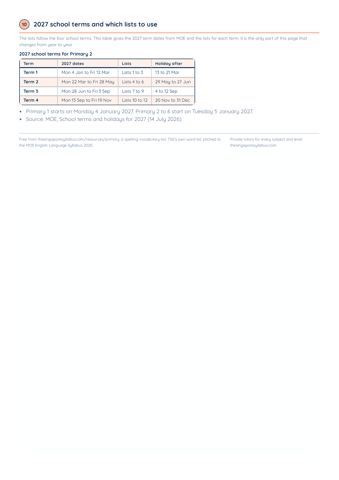
2027 school terms and which lists to use
The lists follow the four school terms. This table gives the 2027 term dates from MOE and the lists for each term. It is the only part of this page that changes from year to year.
| Term | 2027 dates | Lists | Holiday after |
|---|---|---|---|
| Term 1 | Mon 4 Jan to Fri 12 Mar | Lists 1 to 3 | 13 to 21 Mar |
| Term 2 | Mon 22 Mar to Fri 28 May | Lists 4 to 6 | 29 May to 27 Jun |
| Term 3 | Mon 28 Jun to Fri 3 Sep | Lists 7 to 9 | 4 to 12 Sep |
| Term 4 | Mon 13 Sep to Fri 19 Nov | Lists 10 to 12 | 20 Nov to 31 Dec |
- Primary 1 starts on Monday 4 January 2027. Primary 2 to 6 start on Tuesday 5 January 2027.
- Source: MOE, School terms and holidays for 2027 (14 July 2026).
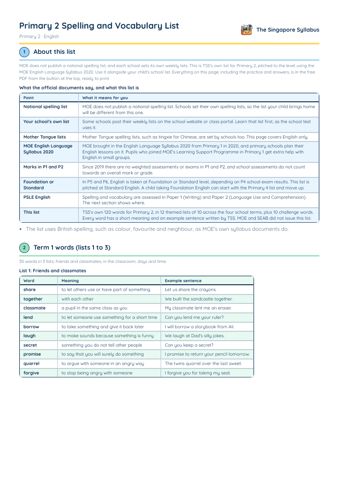
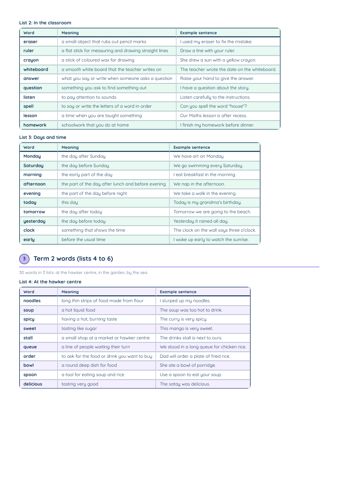
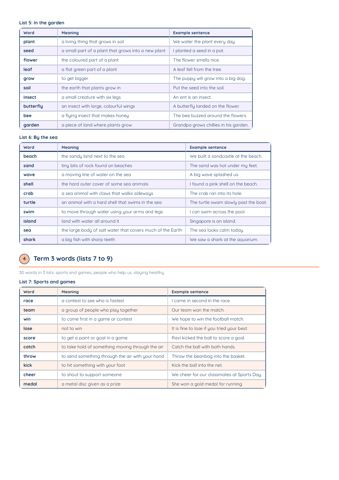
Download the free PDFPDF · 8 pages · A4 portrait · free, no sign-up
Inside the PDF
8 A4 pages, ready to print. Tap a page to open the PDF there.
Questions students ask
Does MOE publish a Primary 2 spelling list?
No. MOE does not publish a national spelling or vocabulary list for any primary level. Each school sets its own lists, so use this one alongside the list your child brings home.
How many spelling words should my child learn each week?
Each list here has 10 words, which suits one week. If your child finds that too many, split a list over two weeks and keep the daily practice short.
Do spelling tests count in Primary 2?
Not towards a grade. Since 2019 MOE has removed weighted assessments and exams in P1 and P2, and school assessments do not count towards an overall mark or grade. Spelling tests still show you which words need more practice.
Does this page have Mother Tongue spelling lists?
No. Mother Tongue spelling lists, such as tingxie for Chinese, are set by each school, and this page covers English only. Some schools post their Mother Tongue lists on the school website.
What are sight words?
Sight words are common words a child should read and spell at a glance, such as could, would and again. Many cannot be sounded out, so they are learnt by seeing them often. This page lists 20 for P2, after the 50 on the P1 list.
Does this list use British or American spelling?
British spelling, such as colour, favourite and neighbour. MOE's own English syllabus documents use British spelling too, for example behaviour, organise and programme.
What if my child's school list has different words?
Learn the school list first, since the school test uses it. Then use this list for extra words, and use the meanings and example sentences to help your child use each word, not only spell it.
What if my child finds spelling hard?
Cut the list to five words a week, learn the school list first and keep a list of words still being learnt to test again a week later. If it is still hard after a term, talk to your child's English teacher.
What comes after this list?
The Primary 3 list picks up where this one ends, with no word repeated. If your child spells 9 or 10 of a random 10 words correctly, use the challenge words and then move on to it.
Keep revising
- Primary English tuition1-to-1 English tutors for P1 to P6
- Primary 2 English tuitionWhat P2 English covers and how a tutor helps
- PSLE Math FormulasPSLE (Primary 1 to 6) · free PDF
- PSLE English Composition PhrasesPSLE (Primary 5 and 6) · free PDF
- PSLE Chinese Composition Phrases (好词好句)PSLE (Primary 5 and 6) · free PDF
- PSLE Science KeywordsPSLE (Primary 3 to 6) · free PDF
- Primary English Oral Practice (P3 to PSLE)Primary 3 to 6 and PSLE · free PDF
- Primary English Listening Comprehension Practice (P3 to PSLE)Primary 3 to 6 and PSLE · free PDF
- Primary English Composition Topics (P3 to PSLE)Primary 3 to 6 and PSLE · free PDF
- Primary 1 Maths WorksheetsPrimary 1 · free PDF
- Primary 2 Maths WorksheetsPrimary 2 · free PDF
- Primary 3 Maths WorksheetsPrimary 3 · free PDF
- Primary 1 English WorksheetsPrimary 1 · free PDF
- Primary 2 English WorksheetsPrimary 2 · free PDF
- Primary 3 English WorksheetsPrimary 3 · free PDF
- Primary 1 Spelling and Vocabulary ListPrimary 1 · free PDF
- Primary 3 Spelling and Vocabulary ListPrimary 3 · free PDF
- Primary 4 Spelling and Vocabulary ListPrimary 4 · free PDF
- Primary 5 Spelling and Vocabulary ListPrimary 5 · free PDF
- PSLE Vocabulary List (Primary 6)Primary 6 (PSLE) · free PDF
- PSLE Score calculatorAdd up the four AL grades
- All free resourcesPSLE, O-Level and A-Level
Source
- Opera Estate Primary School, English Language (EL Syllabus 2020 introduced from Primary One)
- MOE, Learning support (primary)
- MOE, Primary school subjects and syllabuses
- MOE, Learn for Life press release (28 September 2018)
- MOE, School terms and holidays for 2027 (14 July 2026)
The words, meanings, example sentences and practice items are our own. MOE does not publish a national spelling list. The syllabus, exam and term details come from the MOE, SEAB and school pages above, and if they differ, those pages are right. Tell us and we will fix it.