Free resource · Primary 3 to 6 and PSLE
Primary English Listening Comprehension Practice: Free PDF
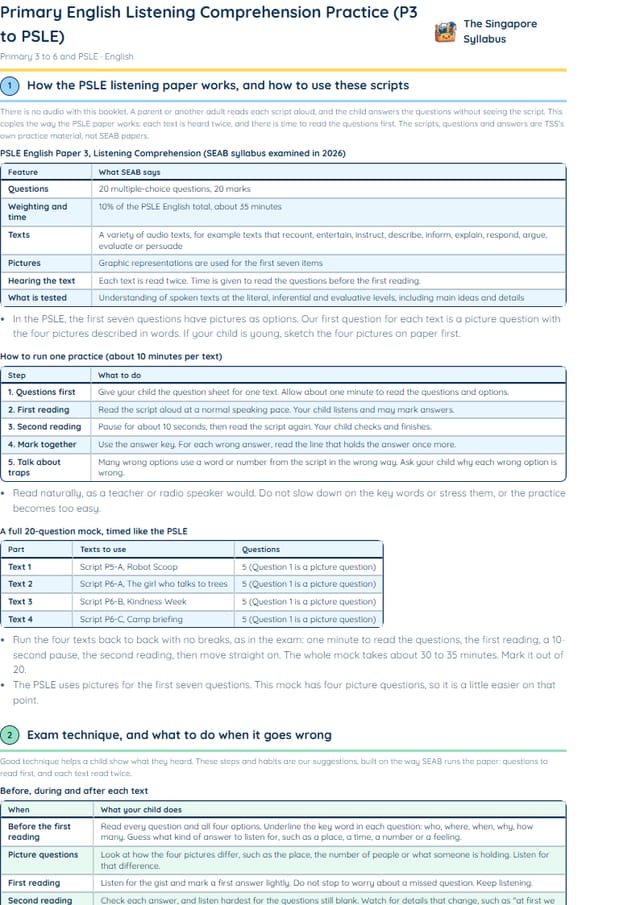
PSLE English Paper 3 has 20 multiple-choice questions worth 20 marks (10%) and takes about 35 minutes. Each text is read twice, and the first seven questions use pictures as options. This free set, also a printable PDF, has 9 original scripts a parent reads aloud, 45 questions with a reasoned answer key, a timed 20-question mock, and the technique to use before and during each text. There is no audio.
How the PSLE listening paper works, and how to use these scripts
There is no audio with this booklet. A parent or another adult reads each script aloud, and the child answers the questions without seeing the script. This copies the way the PSLE paper works: each text is heard twice, and there is time to read the questions first. The scripts, questions and answers are TSS's own practice material, not SEAB papers.
| Feature | What SEAB says |
|---|---|
| Questions | 20 multiple-choice questions, 20 marks |
| Weighting and time | 10% of the PSLE English total, about 35 minutes |
| Texts | A variety of audio texts, for example texts that recount, entertain, instruct, describe, inform, explain, respond, argue, evaluate or persuade |
| Pictures | Graphic representations are used for the first seven items |
| Hearing the text | Each text is read twice. Time is given to read the questions before the first reading. |
| What is tested | Understanding of spoken texts at the literal, inferential and evaluative levels, including main ideas and details |
- In the PSLE, the first seven questions have pictures as options. Our first question for each text is a picture question with the four pictures described in words. If your child is young, sketch the four pictures on paper first.
| Step | What to do |
|---|---|
| 1. Questions first | Give your child the question sheet for one text. Allow about one minute to read the questions and options. |
| 2. First reading | Read the script aloud at a normal speaking pace. Your child listens and may mark answers. |
| 3. Second reading | Pause for about 10 seconds, then read the script again. Your child checks and finishes. |
| 4. Mark together | Use the answer key. For each wrong answer, read the line that holds the answer once more. |
| 5. Talk about traps | Many wrong options use a word or number from the script in the wrong way. Ask your child why each wrong option is wrong. |
- Read naturally, as a teacher or radio speaker would. Do not slow down on the key words or stress them, or the practice becomes too easy.
| Part | Texts to use | Questions |
|---|---|---|
| Text 1 | Script P5-A, Robot Scoop | 5 (Question 1 is a picture question) |
| Text 2 | Script P6-A, The girl who talks to trees | 5 (Question 1 is a picture question) |
| Text 3 | Script P6-B, Kindness Week | 5 (Question 1 is a picture question) |
| Text 4 | Script P6-C, Camp briefing | 5 (Question 1 is a picture question) |
- Run the four texts back to back with no breaks, as in the exam: one minute to read the questions, the first reading, a 10-second pause, the second reading, then move straight on. The whole mock takes about 30 to 35 minutes. Mark it out of 20.
- The PSLE uses pictures for the first seven questions. This mock has four picture questions, so it is a little easier on that point.
Exam technique, and what to do when it goes wrong
Good technique helps a child show what they heard. These steps and habits are our suggestions, built on the way SEAB runs the paper: questions to read first, and each text read twice.
| When | What your child does |
|---|---|
| Before the first reading | Read every question and all four options. Underline the key word in each question: who, where, when, why, how many. Guess what kind of answer to listen for, such as a place, a time, a number or a feeling. |
| Picture questions | Look at how the four pictures differ, such as the place, the number of people or what someone is holding. Listen for that difference. |
| First reading | Listen for the gist and mark a first answer lightly. Do not stop to worry about a missed question. Keep listening. |
| Second reading | Check each answer, and listen hardest for the questions still blank. Watch for details that change, such as "at first we planned Friday, but it moved to Saturday". |
| After the text | Answer every question and never leave one blank. Then turn straight to the next text's questions. |
| Clue | What it often signals | Example |
|---|---|---|
| Feeling words | The speaker names the feeling directly | "I was so relieved when..." |
| Contrast words | The real point or feeling comes after the turn | "It looked easy, but...", "However..." |
| Voice | Fast and high often means excited or worried. Slow and low often means sad, tired or serious. | A parent reading can show this. Ask your child what the voice told them. |
| Exclamations and sighs | Surprise, delight or disappointment | "Oh no", "Finally" |
| What the speaker does next | Actions show feelings that are not named | "She slammed the door" suggests anger. |
| What happens | What to do |
|---|---|
| Misses an answer in the first reading | Leave it, keep listening, and listen for it in the second reading. Each text is read twice. |
| Still unsure after the second reading | Cross out options that were clearly wrong, then choose from the rest. Never leave it blank. |
| Panics after a hard text | Take one slow breath, then read the next text's questions. Each text is a fresh start. |
| Changes answers at the end | Change an answer only when the second reading clearly gave a different fact. |
| In practice at home | Mark together calmly and read the key line again. Talk about why the trap option was tempting. |
| Habit | How to do it |
|---|---|
| Short news clips | Listen to a two to three minute English news report together. Ask your child for who, what, where and why. |
| Podcasts and audiobooks | Play a story or a children's podcast in the car or at meals. Stop now and then and ask what just happened. |
| Announcements | Point out announcements at MRT stations, malls and school. Ask what the listener must do and when. |
| Retell | After a show or a talk, your child retells it to you in 30 seconds, in order. |
| Spot the change | Read a short paragraph with one detail changed on the second reading. Your child names what changed. |
- A few minutes most days helps more than a long session once a week.
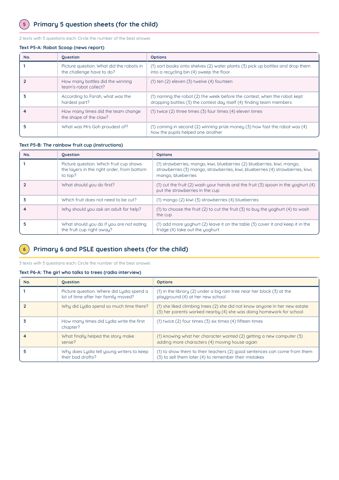
Primary 3 question sheets (for the child)
2 texts with 5 questions each. Circle the number of the best answer.
| No. | Question | Options |
|---|---|---|
| 1 | Picture question. Which bottle did Mr Lim find? | (1) a yellow bottle with a blue cap and a rocket sticker (2) a blue bottle with a yellow cap and a rocket sticker (3) a blue bottle with a yellow cap and a star sticker (4) a blue bottle with a yellow cap and a name label |
| 2 | Where did Mr Lim find the bottle? | (1) in the canteen (2) in the PE room (3) on the field near the basketball court (4) beside the school gate |
| 3 | When did Mr Lim find the bottle? | (1) before school yesterday (2) after yesterday's PE lesson (3) during recess today (4) after school today |
| 4 | What should the owner of the bottle do? | (1) wait for Mr Lim at the field (2) go to the PE room during recess today or tomorrow (3) tell the form teacher (4) go to the General Office after school |
| 5 | What is Mr Lim's main advice to all pupils? | (1) bring a bigger bottle (2) do not bring bottles to PE lessons (3) write your name on all your things (4) keep your bottle in your PE bag |
| No. | Question | Options |
|---|---|---|
| 1 | Picture question. What fruit did Siti ask for? | (1) six apples and a bunch of bananas (2) six oranges and a bunch of grapes (3) six oranges and a bunch of bananas (4) three oranges and a bunch of bananas |
| 2 | What was the wet market like? | (1) quiet and clean (2) noisy, crowded and slippery (3) empty and dry (4) noisy but empty |
| 3 | How much did the fruit cost? | (1) three dollars (2) six dollars (3) seven dollars (4) ten dollars |
| 4 | Why did the stallholder give Siti some grapes? | (1) she had paid him too much (2) he thought she was a good helper (3) the grapes were going bad (4) her mother had asked for them |
| 5 | How did Siti feel at the end? | (1) tired (2) worried (3) happy (4) disappointed |
Primary 4 question sheets (for the child)
2 texts with 5 questions each. Circle the number of the best answer.
| No. | Question | Options |
|---|---|---|
| 1 | Picture question. Which animal might the group see by the stream if they are lucky? | (1) a squirrel (2) a monkey (3) a kingfisher (4) a turtle |
| 2 | How long will the walk take? | (1) about ten minutes (2) about half an hour (3) about an hour (4) about two hours |
| 3 | Why must visitors stay on the path? | (1) the ground beside it can be muddy (2) there are snakes beside it (3) it is the shortest way (4) the guide cannot see them otherwise |
| 4 | Why should visitors not feed the monkeys? | (1) the food may make them sick (2) food makes them bold and they may snatch bags (3) monkey food is too expensive (4) monkeys only eat leaves |
| 5 | What will happen at the halfway point? | (1) the group will turn back (2) the group will have lunch (3) the group will rest for ten minutes (4) the group will meet another guide |
| No. | Question | Options |
|---|---|---|
| 1 | Picture question. What will Amir and Wen Xin buy for Kai? | (1) a football (2) coloured pencils and a sketchbook (3) two sketchbooks and a card (4) a card only |
| 2 | How much money do Amir and Wen Xin have altogether? | (1) $12 (2) $15 (3) $27 (4) $30 |
| 3 | Why did they decide not to buy coloured pencils? | (1) the pencils were too expensive (2) Kai already has lots of pencils (3) the bookshop had sold out (4) Kai does not like drawing |
| 4 | Why can Amir not go to the bookshop on Wednesday? | (1) he has tuition (2) the bookshop is closed (3) it is Kai's birthday (4) he is visiting his grandmother |
| 5 | When and where will they meet? | (1) on Wednesday at the MRT station (2) on Thursday at the school gate at two (3) on Friday at the bookshop (4) on Thursday at the MRT station at nine |
Primary 5 question sheets (for the child)
2 texts with 5 questions each. Circle the number of the best answer.
| No. | Question | Options |
|---|---|---|
| 1 | Picture question. What did the robots in the challenge have to do? | (1) sort books onto shelves (2) water plants (3) pick up bottles and drop them into a recycling bin (4) sweep the floor |
| 2 | How many bottles did the winning team's robot collect? | (1) ten (2) eleven (3) twelve (4) fourteen |
| 3 | According to Farah, what was the hardest part? | (1) naming the robot (2) the week before the contest, when the robot kept dropping bottles (3) the contest day itself (4) finding team members |
| 4 | How many times did the team change the shape of the claw? | (1) twice (2) three times (3) four times (4) eleven times |
| 5 | What was Mrs Goh proudest of? | (1) coming in second (2) winning prize money (3) how fast the robot was (4) how the pupils helped one another |
| No. | Question | Options |
|---|---|---|
| 1 | Picture question. Which fruit cup shows the layers in the right order, from bottom to top? | (1) strawberries, mango, kiwi, blueberries (2) blueberries, kiwi, mango, strawberries (3) mango, strawberries, kiwi, blueberries (4) strawberries, kiwi, mango, blueberries |
| 2 | What should you do first? | (1) cut the fruit (2) wash your hands and the fruit (3) spoon in the yoghurt (4) put the strawberries in the cup |
| 3 | Which fruit does not need to be cut? | (1) mango (2) kiwi (3) strawberries (4) blueberries |
| 4 | Why should you ask an adult for help? | (1) to choose the fruit (2) to cut the fruit (3) to buy the yoghurt (4) to wash the cup |
| 5 | What should you do if you are not eating the fruit cup right away? | (1) add more yoghurt (2) leave it on the table (3) cover it and keep it in the fridge (4) take out the yoghurt |
Primary 6 and PSLE question sheets (for the child)
3 texts with 5 questions each. Circle the number of the best answer.
| No. | Question | Options |
|---|---|---|
| 1 | Picture question. Where did Lydia spend a lot of time after her family moved? | (1) in the library (2) under a big rain tree near her block (3) at the playground (4) at her new school |
| 2 | Why did Lydia spend so much time there? | (1) she liked climbing trees (2) she did not know anyone in her new estate (3) her parents worked nearby (4) she was doing homework for school |
| 3 | How many times did Lydia write the first chapter? | (1) twice (2) four times (3) six times (4) fifteen times |
| 4 | What finally helped the story make sense? | (1) knowing what her character wanted (2) getting a new computer (3) adding more characters (4) moving house again |
| 5 | Why does Lydia tell young writers to keep their bad drafts? | (1) to show them to their teachers (2) good sentences can come from them (3) to sell them later (4) to remember their mistakes |
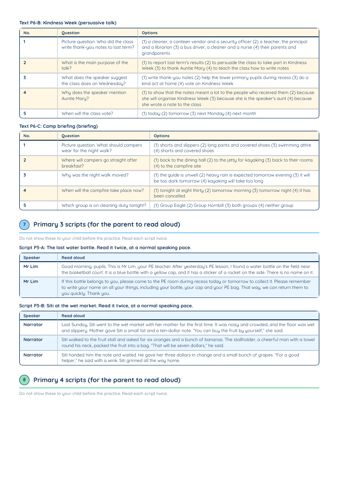
| No. | Question | Options |
|---|---|---|
| 1 | Picture question. Who did the class write thank-you notes to last term? | (1) a cleaner, a canteen vendor and a security officer (2) a teacher, the principal and a librarian (3) a bus driver, a cleaner and a nurse (4) their parents and grandparents |
| 2 | What is the main purpose of the talk? | (1) to report last term's results (2) to persuade the class to take part in Kindness Week (3) to thank Auntie Mary (4) to teach the class how to write notes |
| 3 | What does the speaker suggest the class does on Wednesday? | (1) write thank-you notes (2) help the lower primary pupils during recess (3) do a kind act at home (4) vote on Kindness Week |
| 4 | Why does the speaker mention Auntie Mary? | (1) to show that the notes meant a lot to the people who received them (2) because she will organise Kindness Week (3) because she is the speaker's aunt (4) because she wrote a note to the class |
| 5 | When will the class vote? | (1) today (2) tomorrow (3) next Monday (4) next month |
| No. | Question | Options |
|---|---|---|
| 1 | Picture question. What should campers wear for the night walk? | (1) shorts and slippers (2) long pants and covered shoes (3) swimming attire (4) shorts and covered shoes |
| 2 | Where will campers go straight after breakfast? | (1) back to the dining hall (2) to the jetty for kayaking (3) back to their rooms (4) to the campfire site |
| 3 | Why was the night walk moved? | (1) the guide is unwell (2) heavy rain is expected tomorrow evening (3) it will be too dark tomorrow (4) kayaking will take too long |
| 4 | When will the campfire take place now? | (1) tonight at eight thirty (2) tomorrow morning (3) tomorrow night (4) it has been cancelled |
| 5 | Which group is on cleaning duty tonight? | (1) Group Eagle (2) Group Hornbill (3) both groups (4) neither group |
Primary 3 scripts (for the parent to read aloud)
Do not show these to your child before the practice. Read each script twice.
| Speaker | Read aloud |
|---|---|
| Mr Lim | Good morning, pupils. This is Mr Lim, your PE teacher. After yesterday's PE lesson, I found a water bottle on the field near the basketball court. It is a blue bottle with a yellow cap, and it has a sticker of a rocket on the side. There is no name on it. |
| Mr Lim | If this bottle belongs to you, please come to the PE room during recess today or tomorrow to collect it. Please remember to write your name on all your things, including your bottle, your cap and your PE bag. That way, we can return them to you quickly. Thank you. |
| Speaker | Read aloud |
|---|---|
| Narrator | Last Sunday, Siti went to the wet market with her mother for the first time. It was noisy and crowded, and the floor was wet and slippery. Mother gave Siti a small list and a ten-dollar note. “You can buy the fruit by yourself,” she said. |
| Narrator | Siti walked to the fruit stall and asked for six oranges and a bunch of bananas. The stallholder, a cheerful man with a towel round his neck, packed the fruit into a bag. “That will be seven dollars,” he said. |
| Narrator | Siti handed him the note and waited. He gave her three dollars in change and a small bunch of grapes. “For a good helper,” he said with a wink. Siti grinned all the way home. |
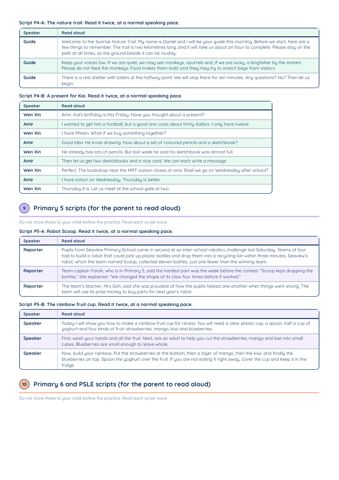
Primary 4 scripts (for the parent to read aloud)
Do not show these to your child before the practice. Read each script twice.
| Speaker | Read aloud |
|---|---|
| Guide | Welcome to the Sunrise Nature Trail. My name is Daniel and I will be your guide this morning. Before we start, here are a few things to remember. The trail is two kilometres long, and it will take us about an hour to complete. Please stay on the path at all times, as the ground beside it can be muddy. |
| Guide | Keep your voices low. If we are quiet, we may see monkeys, squirrels and, if we are lucky, a kingfisher by the stream. Please do not feed the monkeys. Food makes them bold, and they may try to snatch bags from visitors. |
| Guide | There is a rest shelter with toilets at the halfway point. We will stop there for ten minutes. Any questions? No? Then let us begin. |
| Speaker | Read aloud |
|---|---|
| Wen Xin | Amir, Kai's birthday is this Friday. Have you thought about a present? |
| Amir | I wanted to get him a football, but a good one costs about thirty dollars. I only have twelve. |
| Wen Xin | I have fifteen. What if we buy something together? |
| Amir | Good idea. He loves drawing. How about a set of coloured pencils and a sketchbook? |
| Wen Xin | He already has lots of pencils. But last week he said his sketchbook was almost full. |
| Amir | Then let us get two sketchbooks and a nice card. We can each write a message. |
| Wen Xin | Perfect. The bookshop near the MRT station closes at nine. Shall we go on Wednesday after school? |
| Amir | I have tuition on Wednesday. Thursday is better. |
| Wen Xin | Thursday it is. Let us meet at the school gate at two. |
Primary 5 scripts (for the parent to read aloud)
Do not show these to your child before the practice. Read each script twice.
| Speaker | Read aloud |
|---|---|
| Reporter | Pupils from Seaview Primary School came in second at an inter-school robotics challenge last Saturday. Teams of four had to build a robot that could pick up plastic bottles and drop them into a recycling bin within three minutes. Seaview's robot, which the team named Scoop, collected eleven bottles, just one fewer than the winning team. |
| Reporter | Team captain Farah, who is in Primary 5, said the hardest part was the week before the contest. “Scoop kept dropping the bottles,” she explained. “We changed the shape of its claw four times before it worked.” |
| Reporter | The team's teacher, Mrs Goh, said she was proudest of how the pupils helped one another when things went wrong. The team will use its prize money to buy parts for next year's robot. |
| Speaker | Read aloud |
|---|---|
| Speaker | Today I will show you how to make a rainbow fruit cup for recess. You will need a clear plastic cup, a spoon, half a cup of yoghurt and four kinds of fruit: strawberries, mango, kiwi and blueberries. |
| Speaker | First, wash your hands and all the fruit. Next, ask an adult to help you cut the strawberries, mango and kiwi into small cubes. Blueberries are small enough to leave whole. |
| Speaker | Now, build your rainbow. Put the strawberries at the bottom, then a layer of mango, then the kiwi, and finally the blueberries on top. Spoon the yoghurt over the fruit. If you are not eating it right away, cover the cup and keep it in the fridge. |
Primary 6 and PSLE scripts (for the parent to read aloud)
Do not show these to your child before the practice. Read each script twice.
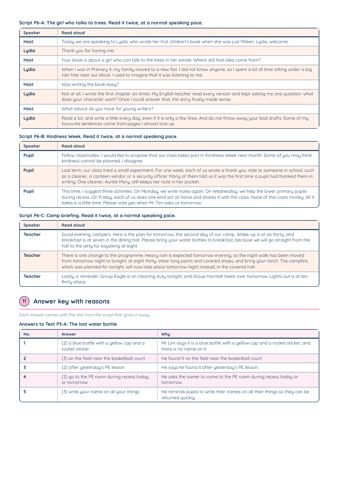
| Speaker | Read aloud |
|---|---|
| Host | Today we are speaking to Lydia, who wrote her first children's book when she was just fifteen. Lydia, welcome. |
| Lydia | Thank you for having me. |
| Host | Your book is about a girl who can talk to the trees in her estate. Where did that idea come from? |
| Lydia | When I was in Primary 4, my family moved to a new flat. I did not know anyone, so I spent a lot of time sitting under a big rain tree near our block. I used to imagine that it was listening to me. |
| Host | Was writing the book easy? |
| Lydia | Not at all. I wrote the first chapter six times. My English teacher read every version and kept asking me one question: what does your character want? Once I could answer that, the story finally made sense. |
| Host | What advice do you have for young writers? |
| Lydia | Read a lot, and write a little every day, even if it is only a few lines. And do not throw away your bad drafts. Some of my favourite sentences came from pages I almost tore up. |
| Speaker | Read aloud |
|---|---|
| Pupil | Fellow classmates, I would like to propose that our class takes part in Kindness Week next month. Some of you may think kindness cannot be planned. I disagree. |
| Pupil | Last term, our class tried a small experiment. For one week, each of us wrote a thank-you note to someone in school, such as a cleaner, a canteen vendor or a security officer. Many of them told us it was the first time a pupil had thanked them in writing. One cleaner, Auntie Mary, still keeps her note in her pocket. |
| Pupil | This time, I suggest three activities. On Monday, we write notes again. On Wednesday, we help the lower primary pupils during recess. On Friday, each of us does one kind act at home and shares it with the class. None of this costs money. All it takes is a little time. Please vote yes when Mr Tan asks us tomorrow. |
| Speaker | Read aloud |
|---|---|
| Teacher | Good evening, campers. Here is the plan for tomorrow, the second day of our camp. Wake-up is at six thirty, and breakfast is at seven in the dining hall. Please bring your water bottles to breakfast, because we will go straight from the hall to the jetty for kayaking at eight. |
| Teacher | There is one change to the programme. Heavy rain is expected tomorrow evening, so the night walk has been moved from tomorrow night to tonight, at eight thirty. Wear long pants and covered shoes, and bring your torch. The campfire, which was planned for tonight, will now take place tomorrow night instead, in the covered hall. |
| Teacher | Lastly, a reminder. Group Eagle is on cleaning duty tonight, and Group Hornbill takes over tomorrow. Lights out is at ten thirty sharp. |
Answer key with reasons
Each answer comes with the line from the script that gives it away.
| No. | Answer | Why |
|---|---|---|
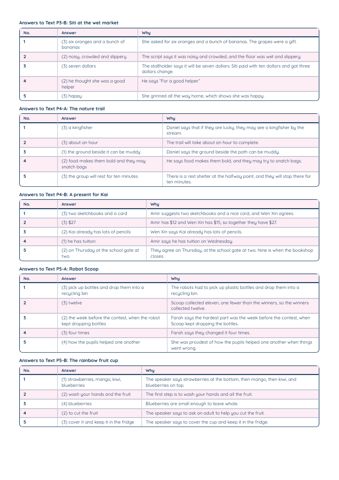
| 1 | (2) a blue bottle with a yellow cap and a rocket sticker | Mr Lim says it is a blue bottle with a yellow cap and a rocket sticker, and there is no name on it. |
| 2 | (3) on the field near the basketball court | He found it on the field near the basketball court. |
| 3 | (2) after yesterday's PE lesson | He says he found it after yesterday's PE lesson. |
| 4 | (2) go to the PE room during recess today or tomorrow | He asks the owner to come to the PE room during recess today or tomorrow. |
| 5 | (3) write your name on all your things | He reminds pupils to write their names on all their things so they can be returned quickly. |
| No. | Answer | Why |
|---|---|---|
| 1 | (3) six oranges and a bunch of bananas | She asked for six oranges and a bunch of bananas. The grapes were a gift. |
| 2 | (2) noisy, crowded and slippery | The script says it was noisy and crowded, and the floor was wet and slippery. |
| 3 | (3) seven dollars | The stallholder says it will be seven dollars. Siti paid with ten dollars and got three dollars change. |
| 4 | (2) he thought she was a good helper | He says “For a good helper.” |
| 5 | (3) happy | She grinned all the way home, which shows she was happy. |
| No. | Answer | Why |
|---|---|---|
| 1 | (3) a kingfisher | Daniel says that if they are lucky, they may see a kingfisher by the stream. |
| 2 | (3) about an hour | The trail will take about an hour to complete. |
| 3 | (1) the ground beside it can be muddy | Daniel says the ground beside the path can be muddy. |
| 4 | (2) food makes them bold and they may snatch bags | He says food makes them bold, and they may try to snatch bags. |
| 5 | (3) the group will rest for ten minutes | There is a rest shelter at the halfway point, and they will stop there for ten minutes. |
| No. | Answer | Why |
|---|---|---|
| 1 | (3) two sketchbooks and a card | Amir suggests two sketchbooks and a nice card, and Wen Xin agrees. |
| 2 | (3) $27 | Amir has $12 and Wen Xin has $15, so together they have $27. |
| 3 | (2) Kai already has lots of pencils | Wen Xin says Kai already has lots of pencils. |
| 4 | (1) he has tuition | Amir says he has tuition on Wednesday. |
| 5 | (2) on Thursday at the school gate at two | They agree on Thursday, at the school gate at two. Nine is when the bookshop closes. |
| No. | Answer | Why |
|---|---|---|
| 1 | (3) pick up bottles and drop them into a recycling bin | The robots had to pick up plastic bottles and drop them into a recycling bin. |
| 2 | (3) twelve | Scoop collected eleven, one fewer than the winners, so the winners collected twelve. |
| 3 | (2) the week before the contest, when the robot kept dropping bottles | Farah says the hardest part was the week before the contest, when Scoop kept dropping the bottles. |
| 4 | (3) four times | Farah says they changed it four times. |
| 5 | (4) how the pupils helped one another | She was proudest of how the pupils helped one another when things went wrong. |
| No. | Answer | Why |
|---|---|---|
| 1 | (1) strawberries, mango, kiwi, blueberries | The speaker says strawberries at the bottom, then mango, then kiwi, and blueberries on top. |
| 2 | (2) wash your hands and the fruit | The first step is to wash your hands and all the fruit. |
| 3 | (4) blueberries | Blueberries are small enough to leave whole. |
| 4 | (2) to cut the fruit | The speaker says to ask an adult to help you cut the fruit. |
| 5 | (3) cover it and keep it in the fridge | The speaker says to cover the cup and keep it in the fridge. |
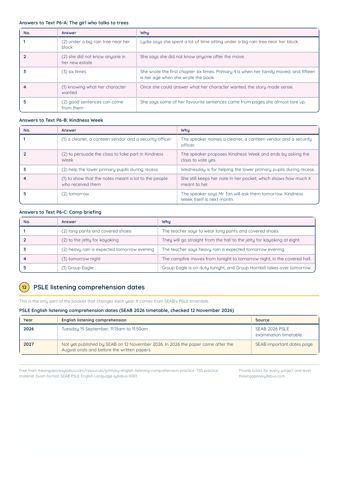
| No. | Answer | Why |
|---|---|---|
| 1 | (2) under a big rain tree near her block | Lydia says she spent a lot of time sitting under a big rain tree near her block. |
| 2 | (2) she did not know anyone in her new estate | She says she did not know anyone after the move. |
| 3 | (3) six times | She wrote the first chapter six times. Primary 4 is when her family moved, and fifteen is her age when she wrote the book. |
| 4 | (1) knowing what her character wanted | Once she could answer what her character wanted, the story made sense. |
| 5 | (2) good sentences can come from them | She says some of her favourite sentences came from pages she almost tore up. |
| No. | Answer | Why |
|---|---|---|
| 1 | (1) a cleaner, a canteen vendor and a security officer | The speaker names a cleaner, a canteen vendor and a security officer. |
| 2 | (2) to persuade the class to take part in Kindness Week | The speaker proposes Kindness Week and ends by asking the class to vote yes. |
| 3 | (2) help the lower primary pupils during recess | Wednesday is for helping the lower primary pupils during recess. |
| 4 | (1) to show that the notes meant a lot to the people who received them | She still keeps her note in her pocket, which shows how much it meant to her. |
| 5 | (2) tomorrow | The speaker says Mr Tan will ask them tomorrow. Kindness Week itself is next month. |
| No. | Answer | Why |
|---|---|---|
| 1 | (2) long pants and covered shoes | The teacher says to wear long pants and covered shoes. |
| 2 | (2) to the jetty for kayaking | They will go straight from the hall to the jetty for kayaking at eight. |
| 3 | (2) heavy rain is expected tomorrow evening | The teacher says heavy rain is expected tomorrow evening. |
| 4 | (3) tomorrow night | The campfire moves from tonight to tomorrow night, in the covered hall. |
| 5 | (1) Group Eagle | Group Eagle is on duty tonight, and Group Hornbill takes over tomorrow. |
PSLE listening comprehension dates
This is the only part of the booklet that changes each year. It comes from SEAB's PSLE timetable.
| Year | English listening comprehension | Source |
|---|---|---|
| 2026 | Tuesday 15 September, 11.15am to 11.50am | SEAB 2026 PSLE examination timetable |
| 2027 | Not yet published by SEAB on 12 November 2026. In 2026 the paper came after the August orals and before the written papers. | SEAB important dates page |
Download the free PDFPDF · 9 pages · A4 portrait · free, no sign-up
Inside the PDF
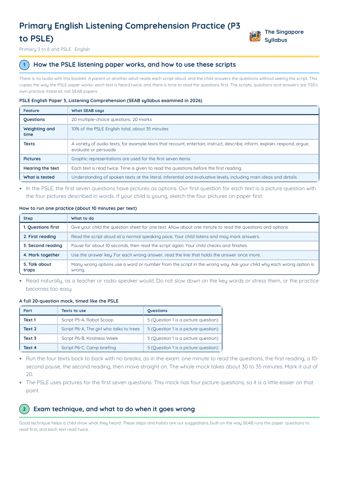
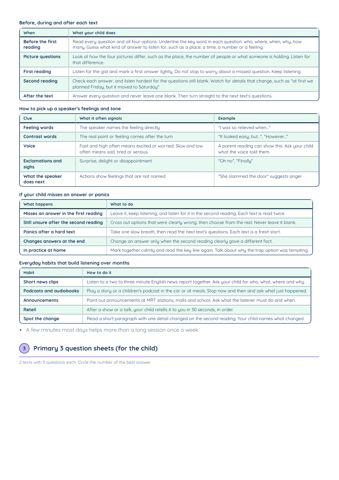
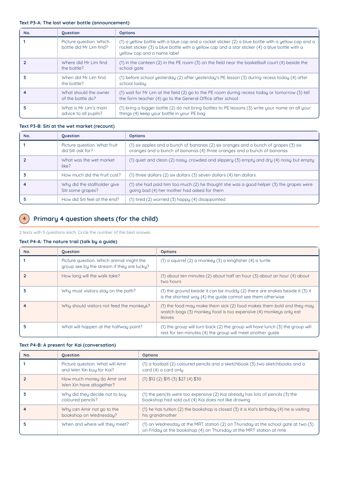
9 A4 pages, ready to print. Tap a page to open the PDF there.
Questions students ask
Is there audio for these listening practices?
No. A parent or another adult reads each script aloud at a normal speaking pace, twice, while the child answers. The child should not see the script until the questions are marked.
How many questions are in the PSLE English listening paper?
20 multiple-choice questions worth 20 marks, which is 10% of the PSLE English total. The paper takes about 35 minutes.
Is each listening text read twice in the PSLE?
Yes. SEAB states that each text is read twice, and time is given to read the questions before the first reading. Practise the same way at home.
What are the picture questions in PSLE listening?
SEAB uses graphic representations for the first seven items, so the options are pictures. In this booklet the first question for each text is a picture question with the four pictures described in words. Younger children can sketch them first.
Why does my child get listening questions wrong?
Wrong options often reuse a word or number from the text in the wrong way, or give a detail that was later changed. Ask your child to say why each wrong option is wrong, using the answer key's reasons.
Which texts come up in PSLE listening?
SEAB says the texts may recount, entertain, instruct, describe, inform, explain, respond, argue, evaluate or persuade. This booklet covers announcements, recounts, a guide's talk, a conversation, a news report, instructions, an interview, a persuasive talk and a briefing.
Are these past PSLE listening papers?
No. All 9 scripts and 45 questions are TSS's own practice material. SEAB papers are not reproduced.
What should my child do before the recording starts?
Read every question and option, underline the key word in each question, and guess the kind of answer to listen for, such as a place, a time or a number. For picture questions, spot how the four pictures differ.
Is there a full timed mock paper?
Yes. Scripts P5-A, P6-A, P6-B and P6-C together make 20 questions. Read them back to back, each twice, and the mock takes about 30 to 35 minutes, close to the PSLE paper.
When is the PSLE listening comprehension paper?
SEAB sets the dates each year. In the 2026 timetable the English listening paper was on 15 September, from 11.15am to 11.50am. SEAB had not published the 2027 dates on 12 November 2026.
Keep revising
- PSLE English paper by paperHow each PSLE English paper works
- Primary English tuitionOral, writing and comprehension help from P1 to PSLE
- PSLE English study guideSyllabus topics and the exam format
- PSLE Math FormulasPSLE (Primary 1 to 6) · free PDF
- PSLE English Composition PhrasesPSLE (Primary 5 and 6) · free PDF
- PSLE Chinese Composition Phrases (好词好句)PSLE (Primary 5 and 6) · free PDF
- PSLE Science KeywordsPSLE (Primary 3 to 6) · free PDF
- Primary English Oral Practice (P3 to PSLE)Primary 3 to 6 and PSLE · free PDF
- Primary English Composition Topics (P3 to PSLE)Primary 3 to 6 and PSLE · free PDF
- Primary 1 Maths WorksheetsPrimary 1 · free PDF
- Primary 2 Maths WorksheetsPrimary 2 · free PDF
- Primary 3 Maths WorksheetsPrimary 3 · free PDF
- Primary 1 English WorksheetsPrimary 1 · free PDF
- Primary 2 English WorksheetsPrimary 2 · free PDF
- Primary 3 English WorksheetsPrimary 3 · free PDF
- Primary 1 Spelling and Vocabulary ListPrimary 1 · free PDF
- Primary 2 Spelling and Vocabulary ListPrimary 2 · free PDF
- Primary 3 Spelling and Vocabulary ListPrimary 3 · free PDF
- Primary 4 Spelling and Vocabulary ListPrimary 4 · free PDF
- Primary 5 Spelling and Vocabulary ListPrimary 5 · free PDF
- PSLE Vocabulary List (Primary 6)Primary 6 (PSLE) · free PDF
- PSLE Score calculatorAdd up the four AL grades
- All free resourcesPSLE, O-Level and A-Level
Source
- SEAB, PSLE English Language syllabus 0001 (examined in 2026), Examination Format
- SEAB, PSLE formats examined in 2026
- SEAB, 2026 PSLE examination timetable (PDF)
The scripts, questions and answers are our own practice material. There is no audio: a parent reads each script aloud. The exam format details come from the SEAB syllabus, and if they differ, the SEAB document is right. Tell us and we will fix it.