Free resource · Primary 2
Primary 2 English Worksheets with Answers: Free PDF
This is a free sample set of Primary 2 English worksheets: 6 topics, 58 questions, with answers. Five sheets of 10 questions practise the simple past tense, prepositions, describing words, the joining words and, but and because, and opposites and word meanings. A short story has 8 comprehension questions. Primary 2 has no exams or weighted assessments, so use them as practice. They follow the MOE English Language Syllabus 2020.
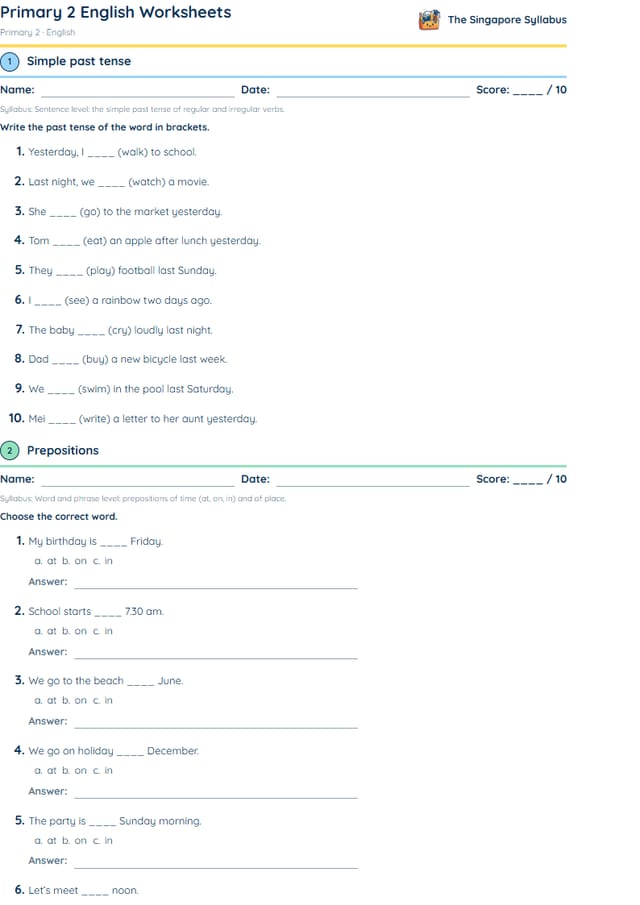
Simple past tense
Syllabus: Sentence level: the simple past tense of regular and irregular verbs.
Write the past tense of the word in brackets.
Yesterday, I ____ (walk) to school.
Last night, we ____ (watch) a movie.
She ____ (go) to the market yesterday.
Tom ____ (eat) an apple after lunch yesterday.
They ____ (play) football last Sunday.
I ____ (see) a rainbow two days ago.
The baby ____ (cry) loudly last night.
Dad ____ (buy) a new bicycle last week.
We ____ (swim) in the pool last Saturday.
Mei ____ (write) a letter to her aunt yesterday.
Prepositions
Syllabus: Word and phrase level: prepositions of time (at, on, in) and of place.
Choose the correct word.
My birthday is ____ Friday.
- at
- on
- in
School starts ____ 7.30 am.
- at
- on
- in
We go to the beach ____ June.
- at
- on
- in
We go on holiday ____ December.
- at
- on
- in
The party is ____ Sunday morning.
- at
- on
- in
Let’s meet ____ noon.
- at
- on
- in
Put the book ____ the table.
- on
- at
- in
Sam sits ____ Ali and Ben. He is in the middle.
- between
- under
- on
The ball rolled ____ the bed, so Mum had to bend down low to get it.
- under
- on
- at
The cat is hiding ____ the box, so I can only see its tail sticking out of the top.
- in
- on
- at
Describing words (adjectives)
Syllabus: Word level: adjectives that describe nouns.
Choose a word from the box to complete each sentence. Use each word once: tall, hot, sweet, heavy, noisy, empty, soft, bright, cold, sharp.
The giraffe is a very ____ animal.
Be careful, the soup is ____.
The sugar tastes ____.
The box of books is too ____ to lift.
The classroom was ____ when everyone was shouting.
The bottle is ____ because I drank all the water.
My pillow is ____ and comfortable.
The sun is very ____ in my eyes, so I will wear a cap.
Wear a jacket. It is ____ outside.
Use the knife carefully. It is very ____.
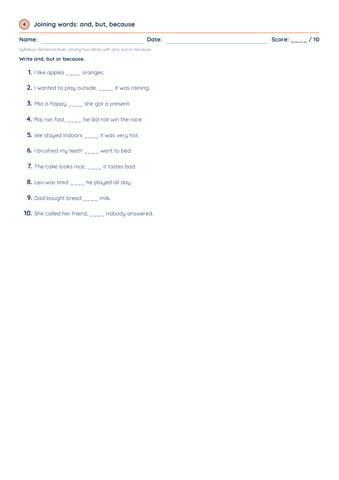
Joining words: and, but, because
Syllabus: Sentence level: joining two ideas with and, but or because.
Write and, but or because.
I like apples ____ oranges.
I wanted to play outside, ____ it was raining.
Mia is happy ____ she got a present.
Raj ran fast, ____ he did not win the race.
We stayed indoors ____ it was very hot.
I brushed my teeth ____ went to bed.
The cake looks nice, ____ it tastes bad.
Leo was tired ____ he played all day.
Dad bought bread ____ milk.
She called her friend, ____ nobody answered.
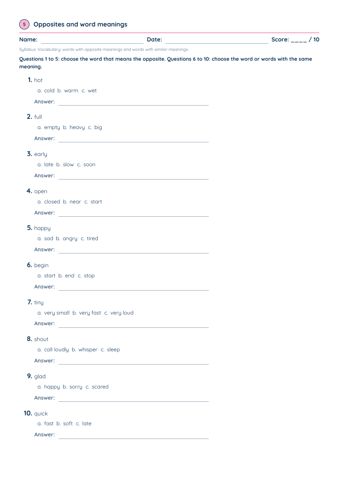
Opposites and word meanings
Syllabus: Vocabulary: words with opposite meanings and words with similar meanings.
Questions 1 to 5: choose the word that means the opposite. Questions 6 to 10: choose the word or words with the same meaning.
hot
- cold
- warm
- wet
full
- empty
- heavy
- big
early
- late
- slow
- soon
open
- closed
- near
- start
happy
- sad
- angry
- tired
begin
- start
- end
- stop
tiny
- very small
- very fast
- very loud
shout
- call loudly
- whisper
- sleep
glad
- happy
- sorry
- scared
quick
- fast
- soft
- late
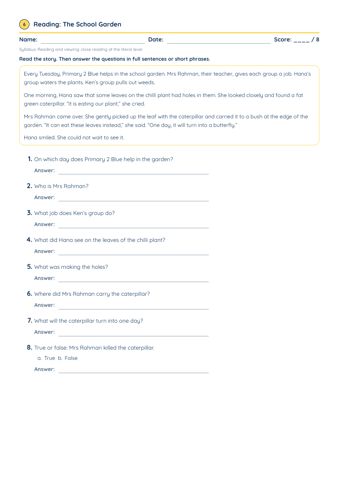
Reading: The School Garden
Syllabus: Reading and viewing: close reading at the literal level.
Read the story. Then answer the questions in full sentences or short phrases.
Every Tuesday, Primary 2 Blue helps in the school garden. Mrs Rahman, their teacher, gives each group a job. Hana’s group waters the plants. Ken’s group pulls out weeds.
One morning, Hana saw that some leaves on the chilli plant had holes in them. She looked closely and found a fat green caterpillar. “It is eating our plant,” she cried.
Mrs Rahman came over. She gently picked up the leaf with the caterpillar and carried it to a bush at the edge of the garden. “It can eat these leaves instead,” she said. “One day, it will turn into a butterfly.”
Hana smiled. She could not wait to see it.
On which day does Primary 2 Blue help in the garden?
Who is Mrs Rahman?
What job does Ken’s group do?
What did Hana see on the leaves of the chilli plant?
What was making the holes?
Where did Mrs Rahman carry the caterpillar?
What will the caterpillar turn into one day?
True or false: Mrs Rahman killed the caterpillar.
- True
- False
For parents
How to use this pack
- Do one worksheet at a time, soon after the school has covered that area.
- Let your child work alone, then mark with the answer key.
- For the story questions, accept an answer in your child's own words if it gives the same idea as the key.
- Ask your child to read each wrong sentence aloud with the correct word. Hearing it helps the right form stick.
- Near the end of the year, redo any worksheet your child found hard.
How Primary 2 English is assessed in school
- Primary 1 and 2 have no weighted assessments and no exams. MOE removed them from 2019, so no test at these levels counts towards an overall mark or grade.
- Teachers still use short class assessments to check what each child understands. Schools report learning at these levels with descriptions in words, not marks.
- Weighted assessments start in Primary 3, with no more than one per subject in each school term. There are no mid-year exams at any primary level. MOE removed them by 2023.
- So these worksheets are practice, not a test. Use them to find gaps early, while nothing is being graded.
If your child finds English hard
- Signs to watch: reading slowly word by word, mixing up past and present tense, or writing sentences without full stops.
- Read together every day and talk about the story. Ask who, where, what happened and why.
- Schools set their own spelling and dictation lists. MOE does not publish one for each level. Practise the school's list a few words a day: fill in missing letters, pick the right spelling, then write a short dictation read out by a parent.
- Talk to your child's English teacher early. MOE's Learning Support Programme (LSP) builds English skills in small groups of 8 to 10 for half an hour a day, led by trained teachers. Children are identified at the start of Primary 1.
Primary 2 spelling and vocabulary list · Primary 2 English tuition
Before Primary 3
- Primary 3 is the start of middle primary in the MOE English syllabus. Reading moves on to close reading at literal and inferential levels.
- Over the school holidays, read a little every day and write a few sentences about each book.
Sources: MOE, Learn for Life press release (28 September 2018), MOE, forum reply on removing mid-year exams (8 February 2023), MOE, learning support programmes.
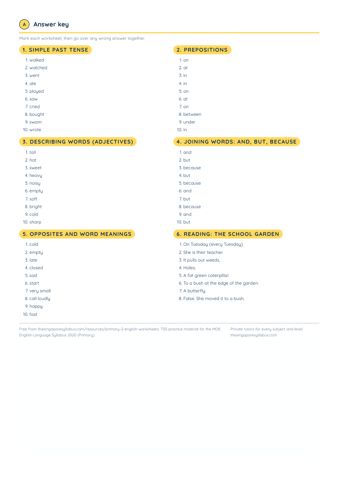
Answer key
Mark each worksheet, then go over any wrong answer together.
1. Simple past tense
- walked
- watched
- went
- ate
- played
- saw
- cried
- bought
- swam
- wrote
2. Prepositions
- on
- at
- in
- in
- on
- at
- on
- between
- under
- in
3. Describing words (adjectives)
- tall
- hot
- sweet
- heavy
- noisy
- empty
- soft
- bright
- cold
- sharp
4. Joining words: and, but, because
- and
- but
- because
- but
- because
- and
- but
- because
- and
- but
5. Opposites and word meanings
- cold
- empty
- late
- closed
- sad
- start
- very small
- call loudly
- happy
- fast
6. Reading: The School Garden
- On Tuesday (every Tuesday).
- She is their teacher.
- It pulls out weeds.
- Holes.
- A fat green caterpillar.
- To a bush at the edge of the garden.
- A butterfly.
- False. She moved it to a bush.
Next steps
Download the free PDFPDF · 7 pages · A4 portrait · free, no sign-up
Inside the PDF
7 A4 pages, ready to print. Tap a page to open the PDF there.
Questions students ask
What English grammar does a Primary 2 child learn?
The MOE English Language Syllabus 2020 teaches grammar explicitly in lower primary, focusing on words, phrases and sentences before text level grammar in upper primary. It does not list items by year, so this pack practises common P2 areas: past tense, prepositions, adjectives and joining words.
What is the simple past tense?
It shows that something already happened. Many verbs add -ed, like walked and played. Some change their spelling, like go to went, eat to ate and buy to bought, and these have to be learnt.
When do we use at, on and in for time?
Use at for a clock time, like at 7.30 am or at noon. Use on for days and dates, like on Friday. Use in for months, years and parts of the day, like in June or in the morning. MOE does not publish a grammar list for each year, so the topics in this pack are chosen by us.
Are these worksheets from MOE or a school?
No. They are The Singapore Syllabus's own practice questions and stories. They are not school papers and MOE did not issue them.
Are there exams in Primary 2 English?
No. MOE removed all weighted assessments and exams for Primary 1 and 2 from 2019. Teachers still check understanding with short class assessments, which do not count towards a mark or grade.
Does MOE publish a Primary 2 spelling list?
No. Schools set their own spelling and dictation lists, and MOE does not publish a national one. Our Primary 2 spelling and vocabulary list has words to practise a few at a time.
Are there real Primary 2 English school papers here?
No. TSS does not publish school English papers for Primary 2, and Primary 2 has no exams, so class tests are short checks. The worksheets here practise one area at a time, each with its answers.
Are the worksheets really free?
Yes. The PDF downloads with no sign-up, and every question and answer is also on this page.
How should my child answer the comprehension questions?
Read the whole story first, then find the sentence that answers each question. Encourage short, complete answers that use words from the question.
Keep revising
- All free worksheetsEvery free worksheet pack, P1 to P3
- Primary 2 English tuitionWhat P2 English covers, and a home tutor
- PSLE Math FormulasPSLE (Primary 1 to 6) · free PDF
- PSLE English Composition PhrasesPSLE (Primary 5 and 6) · free PDF
- PSLE Chinese Composition Phrases (好词好句)PSLE (Primary 5 and 6) · free PDF
- PSLE Science KeywordsPSLE (Primary 3 to 6) · free PDF
- Primary English Oral Practice (P3 to PSLE)Primary 3 to 6 and PSLE · free PDF
- Primary English Listening Comprehension Practice (P3 to PSLE)Primary 3 to 6 and PSLE · free PDF
- Primary English Composition Topics (P3 to PSLE)Primary 3 to 6 and PSLE · free PDF
- Primary 1 Maths WorksheetsPrimary 1 · free PDF
- Primary 2 Maths WorksheetsPrimary 2 · free PDF
- Primary 3 Maths WorksheetsPrimary 3 · free PDF
- Primary 1 English WorksheetsPrimary 1 · free PDF
- Primary 3 English WorksheetsPrimary 3 · free PDF
- Primary 1 Spelling and Vocabulary ListPrimary 1 · free PDF
- Primary 2 Spelling and Vocabulary ListPrimary 2 · free PDF
- Primary 3 Spelling and Vocabulary ListPrimary 3 · free PDF
- Primary 4 Spelling and Vocabulary ListPrimary 4 · free PDF
- Primary 5 Spelling and Vocabulary ListPrimary 5 · free PDF
- PSLE Vocabulary List (Primary 6)Primary 6 (PSLE) · free PDF
- PSLE Score calculatorAdd up the four AL grades
- All free resourcesPSLE, O-Level and A-Level
Source
The worksheets and stories are our own practice material, written for the MOE English Language Syllabus 2020 (Primary). They are not issued by MOE. MOE does not publish a list of grammar items for each year, so the topics are our choice. Tell us and we will fix it.