Free resource · Primary 4
Primary 4 Vocabulary List and Spelling Words: Free PDF
MOE does not publish a national Primary 4 spelling list, as each school sets its own. This free list gives 160 words for P4 in 16 themed lists of 10 across the four school terms, each with a simple meaning and an example sentence. It adds idioms and phrasal verbs, words with close meanings, 20 vocabulary MCQ and cloze questions with answers, 10 challenge words and a five-day routine to use at home.
About this list
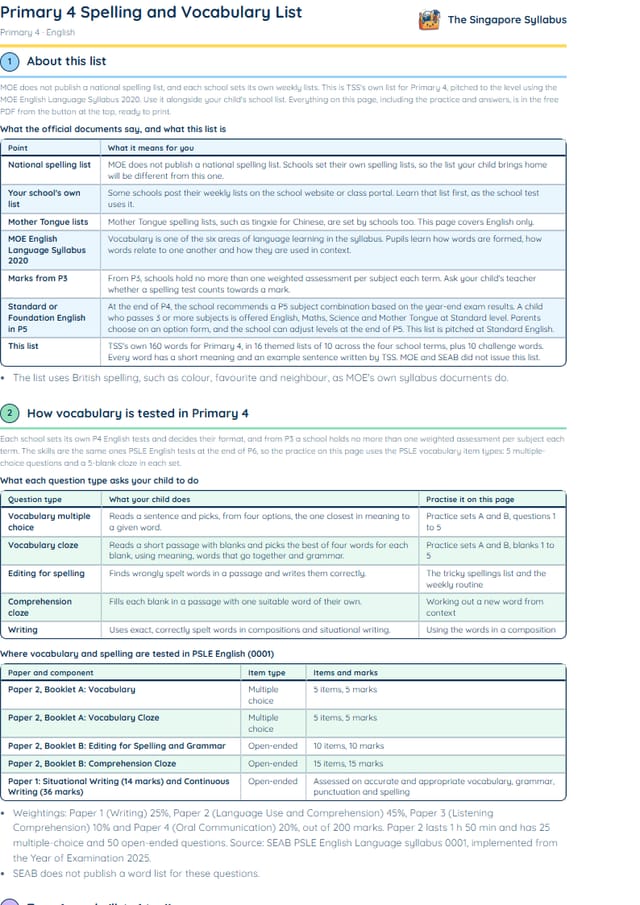
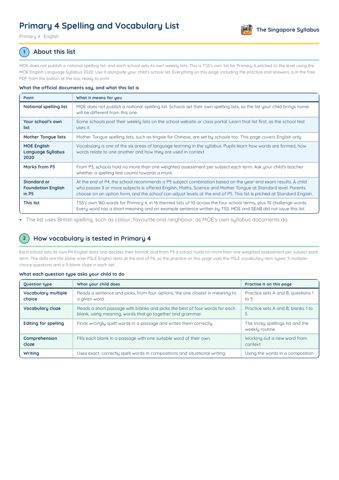
MOE does not publish a national spelling list, and each school sets its own weekly lists. This is TSS's own list for Primary 4, pitched to the level using the MOE English Language Syllabus 2020. Use it alongside your child's school list. Everything on this page, including the practice and answers, is in the free PDF from the button at the top, ready to print.
| Point | What it means for you |
|---|---|
| National spelling list | MOE does not publish a national spelling list. Schools set their own spelling lists, so the list your child brings home will be different from this one. |
| Your school's own list | Some schools post their weekly lists on the school website or class portal. Learn that list first, as the school test uses it. |
| Mother Tongue lists | Mother Tongue spelling lists, such as tingxie for Chinese, are set by schools too. This page covers English only. |
| MOE English Language Syllabus 2020 | Vocabulary is one of the six areas of language learning in the syllabus. Pupils learn how words are formed, how words relate to one another and how they are used in context. |
| Marks from P3 | From P3, schools hold no more than one weighted assessment per subject each term. Ask your child's teacher whether a spelling test counts towards a mark. |
| Standard or Foundation English in P5 | At the end of P4, the school recommends a P5 subject combination based on the year-end exam results. A child who passes 3 or more subjects is offered English, Maths, Science and Mother Tongue at Standard level. Parents choose on an option form, and the school can adjust levels at the end of P5. This list is pitched at Standard English. |
| This list | TSS's own 160 words for Primary 4, in 16 themed lists of 10 across the four school terms, plus 10 challenge words. Every word has a short meaning and an example sentence written by TSS. MOE and SEAB did not issue this list. |
- The list uses British spelling, such as colour, favourite and neighbour, as MOE's own syllabus documents do.
How vocabulary is tested in Primary 4
Each school sets its own P4 English tests and decides their format, and from P3 a school holds no more than one weighted assessment per subject each term. The skills are the same ones PSLE English tests at the end of P6, so the practice on this page uses the PSLE vocabulary item types: 5 multiple-choice questions and a 5-blank cloze in each set.
| Question type | What your child does | Practise it on this page |
|---|---|---|
| Vocabulary multiple choice | Reads a sentence and picks, from four options, the one closest in meaning to a given word. | Practice sets A and B, questions 1 to 5 |
| Vocabulary cloze | Reads a short passage with blanks and picks the best of four words for each blank, using meaning, words that go together and grammar. | Practice sets A and B, blanks 1 to 5 |
| Editing for spelling | Finds wrongly spelt words in a passage and writes them correctly. | The tricky spellings list and the weekly routine |
| Comprehension cloze | Fills each blank in a passage with one suitable word of their own. | Working out a new word from context |
| Writing | Uses exact, correctly spelt words in compositions and situational writing. | Using the words in a composition |
| Paper and component | Item type | Items and marks |
|---|---|---|
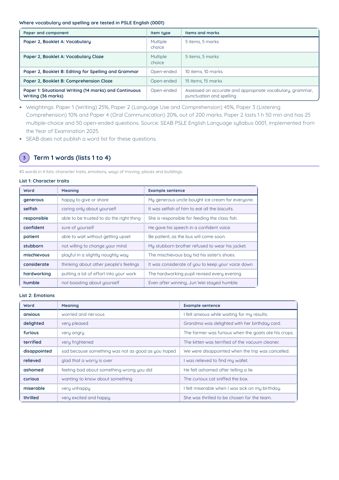
| Paper 2, Booklet A: Vocabulary | Multiple choice | 5 items, 5 marks |
| Paper 2, Booklet A: Vocabulary Cloze | Multiple choice | 5 items, 5 marks |
| Paper 2, Booklet B: Editing for Spelling and Grammar | Open-ended | 10 items, 10 marks |
| Paper 2, Booklet B: Comprehension Cloze | Open-ended | 15 items, 15 marks |
| Paper 1: Situational Writing (14 marks) and Continuous Writing (36 marks) | Open-ended | Assessed on accurate and appropriate vocabulary, grammar, punctuation and spelling |
- Weightings: Paper 1 (Writing) 25%, Paper 2 (Language Use and Comprehension) 45%, Paper 3 (Listening Comprehension) 10% and Paper 4 (Oral Communication) 20%, out of 200 marks. Paper 2 lasts 1 h 50 min and has 25 multiple-choice and 50 open-ended questions. Source: SEAB PSLE English Language syllabus 0001, implemented from the Year of Examination 2025.
- SEAB does not publish a word list for these questions.
Term 1 words (lists 1 to 4)
40 words in 4 lists
40 words in 4 lists: character traits, emotions, ways of moving, places and buildings.
| Word | Meaning | Example sentence |
|---|---|---|
| generous | happy to give or share | My generous uncle bought ice cream for everyone. |
| selfish | caring only about yourself | It was selfish of him to eat all the biscuits. |
| responsible | able to be trusted to do the right thing | She is responsible for feeding the class fish. |
| confident | sure of yourself | He gave his speech in a confident voice. |
| patient | able to wait without getting upset | Be patient, as the bus will come soon. |
| stubborn | not willing to change your mind | My stubborn brother refused to wear his jacket. |
| mischievous | playful in a slightly naughty way | The mischievous boy hid his sister's shoes. |
| considerate | thinking about other people's feelings | It was considerate of you to keep your voice down. |
| hardworking | putting a lot of effort into your work | The hardworking pupil revised every evening. |
| humble | not boasting about yourself | Even after winning, Jun Wei stayed humble. |
| Word | Meaning | Example sentence |
|---|---|---|
| anxious | worried and nervous | I felt anxious while waiting for my results. |
| delighted | very pleased | Grandma was delighted with her birthday card. |
| furious | very angry | The farmer was furious when the goats ate his crops. |
| terrified | very frightened | The kitten was terrified of the vacuum cleaner. |
| disappointed | sad because something was not as good as you hoped | We were disappointed when the trip was cancelled. |
| relieved | glad that a worry is over | I was relieved to find my wallet. |
| ashamed | feeling bad about something wrong you did | He felt ashamed after telling a lie. |
| curious | wanting to know about something | The curious cat sniffed the box. |
| miserable | very unhappy | I felt miserable when I was sick on my birthday. |
| thrilled | very excited and happy | She was thrilled to be chosen for the team. |
| Word | Meaning | Example sentence |
|---|---|---|
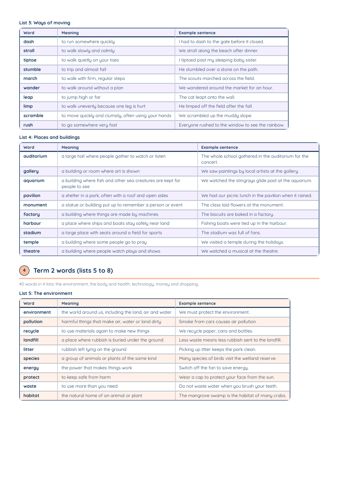
| dash | to run somewhere quickly | I had to dash to the gate before it closed. |
| stroll | to walk slowly and calmly | We stroll along the beach after dinner. |
| tiptoe | to walk quietly on your toes | I tiptoed past my sleeping baby sister. |
| stumble | to trip and almost fall | He stumbled over a stone on the path. |
| march | to walk with firm, regular steps | The scouts marched across the field. |
| wander | to walk around without a plan | We wandered around the market for an hour. |
| leap | to jump high or far | The cat leapt onto the wall. |
| limp | to walk unevenly because one leg is hurt | He limped off the field after the fall. |
| scramble | to move quickly and clumsily, often using your hands | We scrambled up the muddy slope. |
| rush | to go somewhere very fast | Everyone rushed to the window to see the rainbow. |
| Word | Meaning | Example sentence |
|---|---|---|
| auditorium | a large hall where people gather to watch or listen | The whole school gathered in the auditorium for the concert. |
| gallery | a building or room where art is shown | We saw paintings by local artists at the gallery. |
| aquarium | a building where fish and other sea creatures are kept for people to see | We watched the stingrays glide past at the aquarium. |
| pavilion | a shelter in a park, often with a roof and open sides | We had our picnic lunch in the pavilion when it rained. |
| monument | a statue or building put up to remember a person or event | The class laid flowers at the monument. |
| factory | a building where things are made by machines | The biscuits are baked in a factory. |
| harbour | a place where ships and boats stay safely near land | Fishing boats were tied up in the harbour. |
| stadium | a large place with seats around a field for sports | The stadium was full of fans. |
| temple | a building where some people go to pray | We visited a temple during the holidays. |
| theatre | a building where people watch plays and shows | We watched a musical at the theatre. |
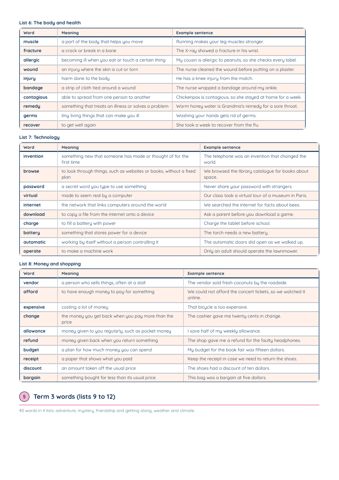
Term 2 words (lists 5 to 8)
40 words in 4 lists
40 words in 4 lists: the environment, the body and health, technology, money and shopping.
| Word | Meaning | Example sentence |
|---|---|---|
| environment | the world around us, including the land, air and water | We must protect the environment. |
| pollution | harmful things that make air, water or land dirty | Smoke from cars causes air pollution. |
| recycle | to use materials again to make new things | We recycle paper, cans and bottles. |
| landfill | a place where rubbish is buried under the ground | Less waste means less rubbish sent to the landfill. |
| litter | rubbish left lying on the ground | Picking up litter keeps the park clean. |
| species | a group of animals or plants of the same kind | Many species of birds visit the wetland reserve. |
| energy | the power that makes things work | Switch off the fan to save energy. |
| protect | to keep safe from harm | Wear a cap to protect your face from the sun. |
| waste | to use more than you need | Do not waste water when you brush your teeth. |
| habitat | the natural home of an animal or plant | The mangrove swamp is the habitat of many crabs. |
| Word | Meaning | Example sentence |
|---|---|---|
| muscle | a part of the body that helps you move | Running makes your leg muscles stronger. |
| fracture | a crack or break in a bone | The X-ray showed a fracture in his wrist. |
| allergic | becoming ill when you eat or touch a certain thing | My cousin is allergic to peanuts, so she checks every label. |
| wound | an injury where the skin is cut or torn | The nurse cleaned the wound before putting on a plaster. |
| injury | harm done to the body | He has a knee injury from the match. |
| bandage | a strip of cloth tied around a wound | The nurse wrapped a bandage around my ankle. |
| contagious | able to spread from one person to another | Chickenpox is contagious, so she stayed at home for a week. |
| remedy | something that treats an illness or solves a problem | Warm honey water is Grandma's remedy for a sore throat. |
| germs | tiny living things that can make you ill | Washing your hands gets rid of germs. |
| recover | to get well again | She took a week to recover from the flu. |
| Word | Meaning | Example sentence |
|---|---|---|
| invention | something new that someone has made or thought of for the first time | The telephone was an invention that changed the world. |
| browse | to look through things, such as websites or books, without a fixed plan | We browsed the library catalogue for books about space. |
| password | a secret word you type to use something | Never share your password with strangers. |
| virtual | made to seem real by a computer | Our class took a virtual tour of a museum in Paris. |
| internet | the network that links computers around the world | We searched the internet for facts about bees. |
| download | to copy a file from the internet onto a device | Ask a parent before you download a game. |
| charge | to fill a battery with power | Charge the tablet before school. |
| battery | something that stores power for a device | The torch needs a new battery. |
| automatic | working by itself without a person controlling it | The automatic doors slid open as we walked up. |
| operate | to make a machine work | Only an adult should operate the lawnmower. |
| Word | Meaning | Example sentence |
|---|---|---|
| vendor | a person who sells things, often at a stall | The vendor sold fresh coconuts by the roadside. |
| afford | to have enough money to pay for something | We could not afford the concert tickets, so we watched it online. |
| expensive | costing a lot of money | That bicycle is too expensive. |
| change | the money you get back when you pay more than the price | The cashier gave me twenty cents in change. |
| allowance | money given to you regularly, such as pocket money | I save half of my weekly allowance. |
| refund | money given back when you return something | The shop gave me a refund for the faulty headphones. |
| budget | a plan for how much money you can spend | My budget for the book fair was fifteen dollars. |
| receipt | a paper that shows what you paid | Keep the receipt in case we need to return the shoes. |
| discount | an amount taken off the usual price | The shoes had a discount of ten dollars. |
| bargain | something bought for less than its usual price | This bag was a bargain at five dollars. |
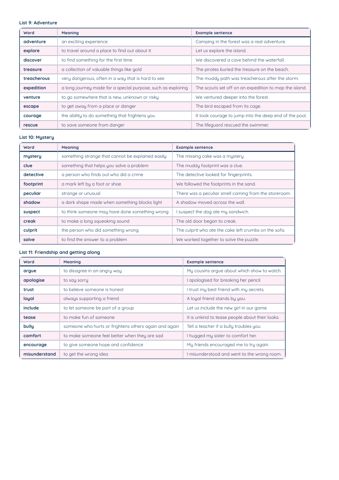
Term 3 words (lists 9 to 12)
40 words in 4 lists
40 words in 4 lists: adventure, mystery, friendship and getting along, weather and climate.
| Word | Meaning | Example sentence |
|---|---|---|
| adventure | an exciting experience | Camping in the forest was a real adventure. |
| explore | to travel around a place to find out about it | Let us explore the island. |
| discover | to find something for the first time | We discovered a cave behind the waterfall. |
| treasure | a collection of valuable things like gold | The pirates buried the treasure on the beach. |
| treacherous | very dangerous, often in a way that is hard to see | The muddy path was treacherous after the storm. |
| expedition | a long journey made for a special purpose, such as exploring | The scouts set off on an expedition to map the island. |
| venture | to go somewhere that is new, unknown or risky | We ventured deeper into the forest. |
| escape | to get away from a place or danger | The bird escaped from its cage. |
| courage | the ability to do something that frightens you | It took courage to jump into the deep end of the pool. |
| rescue | to save someone from danger | The lifeguard rescued the swimmer. |
| Word | Meaning | Example sentence |
|---|---|---|
| mystery | something strange that cannot be explained easily | The missing cake was a mystery. |
| clue | something that helps you solve a problem | The muddy footprint was a clue. |
| detective | a person who finds out who did a crime | The detective looked for fingerprints. |
| footprint | a mark left by a foot or shoe | We followed the footprints in the sand. |
| peculiar | strange or unusual | There was a peculiar smell coming from the storeroom. |
| shadow | a dark shape made when something blocks light | A shadow moved across the wall. |
| suspect | to think someone may have done something wrong | I suspect the dog ate my sandwich. |
| creak | to make a long squeaking sound | The old door began to creak. |
| culprit | the person who did something wrong | The culprit who ate the cake left crumbs on the sofa. |
| solve | to find the answer to a problem | We worked together to solve the puzzle. |
| Word | Meaning | Example sentence |
|---|---|---|
| argue | to disagree in an angry way | My cousins argue about which show to watch. |
| apologise | to say sorry | I apologised for breaking her pencil. |
| trust | to believe someone is honest | I trust my best friend with my secrets. |
| loyal | always supporting a friend | A loyal friend stands by you. |
| include | to let someone be part of a group | Let us include the new girl in our game. |
| tease | to make fun of someone | It is unkind to tease people about their looks. |
| bully | someone who hurts or frightens others again and again | Tell a teacher if a bully troubles you. |
| comfort | to make someone feel better when they are sad | I hugged my sister to comfort her. |
| encourage | to give someone hope and confidence | My friends encouraged me to try again. |
| misunderstand | to get the wrong idea | I misunderstood and went to the wrong room. |
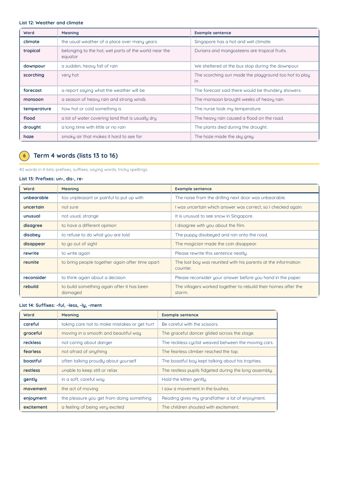
| Word | Meaning | Example sentence |
|---|---|---|
| climate | the usual weather of a place over many years | Singapore has a hot and wet climate. |
| tropical | belonging to the hot, wet parts of the world near the equator | Durians and mangosteens are tropical fruits. |
| downpour | a sudden, heavy fall of rain | We sheltered at the bus stop during the downpour. |
| scorching | very hot | The scorching sun made the playground too hot to play in. |
| forecast | a report saying what the weather will be | The forecast said there would be thundery showers. |
| monsoon | a season of heavy rain and strong winds | The monsoon brought weeks of heavy rain. |
| temperature | how hot or cold something is | The nurse took my temperature. |
| flood | a lot of water covering land that is usually dry | The heavy rain caused a flood on the road. |
| drought | a long time with little or no rain | The plants died during the drought. |
| haze | smoky air that makes it hard to see far | The haze made the sky grey. |
Term 4 words (lists 13 to 16)
40 words in 4 lists
40 words in 4 lists: prefixes, suffixes, saying words, tricky spellings.
| Word | Meaning | Example sentence |
|---|---|---|
| unbearable | too unpleasant or painful to put up with | The noise from the drilling next door was unbearable. |
| uncertain | not sure | I was uncertain which answer was correct, so I checked again. |
| unusual | not usual, strange | It is unusual to see snow in Singapore. |
| disagree | to have a different opinion | I disagree with you about the film. |
| disobey | to refuse to do what you are told | The puppy disobeyed and ran onto the road. |
| disappear | to go out of sight | The magician made the coin disappear. |
| rewrite | to write again | Please rewrite this sentence neatly. |
| reunite | to bring people together again after time apart | The lost boy was reunited with his parents at the information counter. |
| reconsider | to think again about a decision | Please reconsider your answer before you hand in the paper. |
| rebuild | to build something again after it has been damaged | The villagers worked together to rebuild their homes after the storm. |
| Word | Meaning | Example sentence |
|---|---|---|
| careful | taking care not to make mistakes or get hurt | Be careful with the scissors. |
| graceful | moving in a smooth and beautiful way | The graceful dancer glided across the stage. |
| reckless | not caring about danger | The reckless cyclist weaved between the moving cars. |
| fearless | not afraid of anything | The fearless climber reached the top. |
| boastful | often talking proudly about yourself | The boastful boy kept talking about his trophies. |
| restless | unable to keep still or relax | The restless pupils fidgeted during the long assembly. |
| gently | in a soft, careful way | Hold the kitten gently. |
| movement | the act of moving | I saw a movement in the bushes. |
| enjoyment | the pleasure you get from doing something | Reading gives my grandfather a lot of enjoyment. |
| excitement | a feeling of being very excited | The children shouted with excitement. |
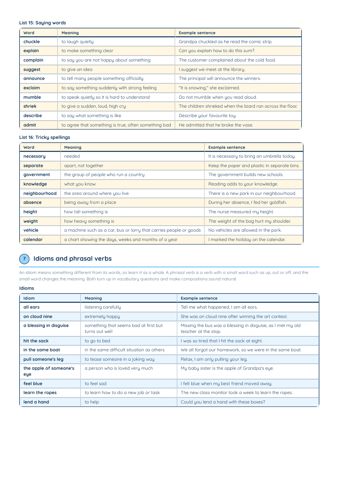
| Word | Meaning | Example sentence |
|---|---|---|
| chuckle | to laugh quietly | Grandpa chuckled as he read the comic strip. |
| explain | to make something clear | Can you explain how to do this sum? |
| complain | to say you are not happy about something | The customer complained about the cold food. |
| suggest | to give an idea | I suggest we meet at the library. |
| announce | to tell many people something officially | The principal will announce the winners. |
| exclaim | to say something suddenly with strong feeling | "It is snowing," she exclaimed. |
| mumble | to speak quietly so it is hard to understand | Do not mumble when you read aloud. |
| shriek | to give a sudden, loud, high cry | The children shrieked when the lizard ran across the floor. |
| describe | to say what something is like | Describe your favourite toy. |
| admit | to agree that something is true, often something bad | He admitted that he broke the vase. |
| Word | Meaning | Example sentence |
|---|---|---|
| necessary | needed | It is necessary to bring an umbrella today. |
| separate | apart, not together | Keep the paper and plastic in separate bins. |
| government | the group of people who run a country | The government builds new schools. |
| knowledge | what you know | Reading adds to your knowledge. |
| neighbourhood | the area around where you live | There is a new park in our neighbourhood. |
| absence | being away from a place | During her absence, I fed her goldfish. |
| height | how tall something is | The nurse measured my height. |
| weight | how heavy something is | The weight of the bag hurt my shoulder. |
| vehicle | a machine such as a car, bus or lorry that carries people or goods | No vehicles are allowed in the park. |
| calendar | a chart showing the days, weeks and months of a year | I marked the holiday on the calendar. |
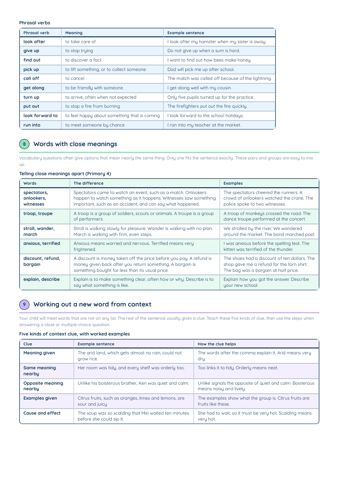
Idioms and phrasal verbs
An idiom means something different from its words, so learn it as a whole. A phrasal verb is a verb with a small word such as up, out or off, and the small word changes the meaning. Both turn up in vocabulary questions and make compositions sound natural.
| Idiom | Meaning | Example sentence |
|---|---|---|
| all ears | listening carefully | Tell me what happened, I am all ears. |
| on cloud nine | extremely happy | She was on cloud nine after winning the art contest. |
| a blessing in disguise | something that seems bad at first but turns out well | Missing the bus was a blessing in disguise, as I met my old teacher at the stop. |
| hit the sack | to go to bed | I was so tired that I hit the sack at eight. |
| in the same boat | in the same difficult situation as others | We all forgot our homework, so we were in the same boat. |
| pull someone's leg | to tease someone in a joking way | Relax, I am only pulling your leg. |
| the apple of someone's eye | a person who is loved very much | My baby sister is the apple of Grandpa's eye. |
| feel blue | to feel sad | I felt blue when my best friend moved away. |
| learn the ropes | to learn how to do a new job or task | The new class monitor took a week to learn the ropes. |
| lend a hand | to help | Could you lend a hand with these boxes? |
| Phrasal verb | Meaning | Example sentence |
|---|---|---|
| look after | to take care of | I look after my hamster when my sister is away. |
| give up | to stop trying | Do not give up when a sum is hard. |
| find out | to discover a fact | I want to find out how bees make honey. |
| pick up | to lift something, or to collect someone | Dad will pick me up after school. |
| call off | to cancel | The match was called off because of the lightning. |
| get along | to be friendly with someone | I get along well with my cousin. |
| turn up | to arrive, often when not expected | Only five pupils turned up for the practice. |
| put out | to stop a fire from burning | The firefighters put out the fire quickly. |
| look forward to | to feel happy about something that is coming | I look forward to the school holidays. |
| run into | to meet someone by chance | I ran into my teacher at the market. |
Words with close meanings
Vocabulary questions often give options that mean nearly the same thing. Only one fits the sentence exactly. These pairs and groups are easy to mix up.
| Words | The difference | Examples |
|---|---|---|
| spectators, onlookers, witnesses | Spectators came to watch an event, such as a match. Onlookers happen to watch something as it happens. Witnesses saw something important, such as an accident, and can say what happened. | The spectators cheered the runners. A crowd of onlookers watched the crane. The police spoke to two witnesses. |
| troop, troupe | A troop is a group of soldiers, scouts or animals. A troupe is a group of performers. | A troop of monkeys crossed the road. The dance troupe performed at the concert. |
| stroll, wander, march | Stroll is walking slowly for pleasure. Wander is walking with no plan. March is walking with firm, even steps. | We strolled by the river. We wandered around the market. The band marched past. |
| anxious, terrified | Anxious means worried and nervous. Terrified means very frightened. | I was anxious before the spelling test. The kitten was terrified of the thunder. |
| discount, refund, bargain | A discount is money taken off the price before you pay. A refund is money given back after you return something. A bargain is something bought for less than its usual price. | The shoes had a discount of ten dollars. The shop gave me a refund for the torn shirt. The bag was a bargain at half price. |
| explain, describe | Explain is to make something clear, often how or why. Describe is to say what something is like. | Explain how you got the answer. Describe your new school. |
Working out a new word from context
Your child will meet words that are not on any list. The rest of the sentence usually gives a clue. Teach these five kinds of clue, then use the steps when answering a cloze or multiple-choice question.
| Clue | Example sentence | How the clue helps |
|---|---|---|
| Meaning given | The arid land, which gets almost no rain, could not grow rice. | The words after the comma explain it. Arid means very dry. |
| Same meaning nearby | Her room was tidy, and every shelf was orderly too. | Too links it to tidy. Orderly means neat. |
| Opposite meaning nearby | Unlike his boisterous brother, Ken was quiet and calm. | Unlike signals the opposite of quiet and calm. Boisterous means noisy and lively. |
| Examples given | Citrus fruits, such as oranges, limes and lemons, are sour and juicy. | The examples show what the group is. Citrus fruits are fruits like these. |
| Cause and effect | The soup was so scalding that Mei waited ten minutes before she could sip it. | She had to wait, so it must be very hot. Scalding means very hot. |
| Step | What to do |
|---|---|
| 1 | Read the whole sentence, and for a cloze the sentences before and after it, before looking at the options. |
| 2 | Say in your own words what kind of word should go in the blank: a feeling, an action or a thing. |
| 3 | Look for a clue word such as but, unlike, because, so or such as. |
| 4 | Try each option in the blank. Cross out any that do not make sense. |
| 5 | Choose the best option and read the sentence again with it. |
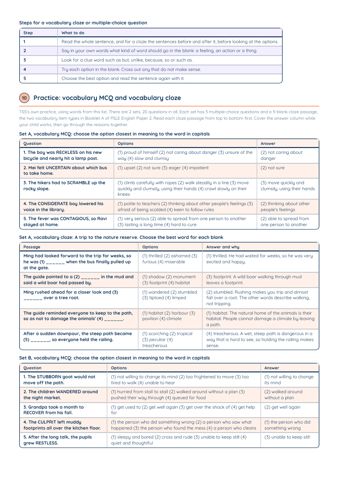
Practice: vocabulary MCQ and vocabulary cloze
20 questions, answers under each set
TSS's own practice, using words from this list. There are 2 sets, 20 questions in all. Each set has 5 multiple-choice questions and a 5-blank cloze passage, the two vocabulary item types in Booklet A of PSLE English Paper 2. Read each cloze passage from top to bottom first. Cover the answer column while your child works, then go through the reasons together.
| Question | Options |
|---|---|
| 1. The boy was RECKLESS on his new bicycle and nearly hit a lamp post. | (1) proud of himself (2) not caring about danger (3) unsure of the way (4) slow and clumsy |
| 2. Mei felt UNCERTAIN about which bus to take home. | (1) upset (2) not sure (3) eager (4) impatient |
| 3. The hikers had to SCRAMBLE up the rocky slope. | (1) climb carefully with ropes (2) walk steadily in a line (3) move quickly and clumsily, using their hands (4) crawl slowly on their knees |
| 4. The CONSIDERATE boy lowered his voice in the library. | (1) polite to teachers (2) thinking about other people's feelings (3) afraid of being scolded (4) keen to follow rules |
| 5. The fever was CONTAGIOUS, so Ravi stayed at home. | (1) very serious (2) able to spread from one person to another (3) lasting a long time (4) hard to cure |
Show answersHide answers
| No. | Answer |
|---|---|
| 1 | (2) not caring about danger |
| 2 | (2) not sure |
| 3 | (3) move quickly and clumsily, using their hands |
| 4 | (2) thinking about other people's feelings |
| 5 | (2) able to spread from one person to another |
| Passage | Options |
|---|---|
| Ming had looked forward to the trip for weeks, so he was (1) ______ when the bus finally pulled up at the gate. | (1) thrilled (2) ashamed (3) furious (4) miserable |
| The guide pointed to a (2) ______ in the mud and said a wild boar had passed by. | (1) shadow (2) monument (3) footprint (4) habitat |
| Ming rushed ahead for a closer look and (3) ______ over a tree root. | (1) wandered (2) stumbled (3) tiptoed (4) limped |
| The guide reminded everyone to keep to the path, so as not to damage the animals' (4) ______. | (1) habitat (2) harbour (3) pavilion (4) climate |
| After a sudden downpour, the steep path became (5) ______, so everyone held the railing. | (1) scorching (2) tropical (3) peculiar (4) treacherous |
Show answersHide answers
| No. | Answer and why |
|---|---|
| 1 | (1) thrilled. He had waited for weeks, so he was very excited and happy. |
| 2 | (3) footprint. A wild boar walking through mud leaves a footprint. |
| 3 | (2) stumbled. Rushing makes you trip and almost fall over a root. The other words describe walking, not tripping. |
| 4 | (1) habitat. The natural home of the animals is their habitat. People cannot damage a climate by leaving a path. |
| 5 | (4) treacherous. A wet, steep path is dangerous in a way that is hard to see, so holding the railing makes sense. |
| Question | Options |
|---|---|
| 1. The STUBBORN goat would not move off the path. | (1) not willing to change its mind (2) too frightened to move (3) too tired to walk (4) unable to hear |
| 2. The children WANDERED around the night market. | (1) hurried from stall to stall (2) walked around without a plan (3) pushed their way through (4) queued for food |
| 3. Grandpa took a month to RECOVER from his fall. | (1) get used to (2) get well again (3) get over the shock of (4) get help for |
| 4. The CULPRIT left muddy footprints all over the kitchen floor. | (1) the person who did something wrong (2) a person who saw what happened (3) the person who found the mess (4) a person who cleans |
| 5. After the long talk, the pupils grew RESTLESS. | (1) sleepy and bored (2) cross and rude (3) unable to keep still (4) quiet and thoughtful |
Show answersHide answers
| No. | Answer |
|---|---|
| 1 | (1) not willing to change its mind |
| 2 | (2) walked around without a plan |
| 3 | (2) get well again |
| 4 | (1) the person who did something wrong |
| 5 | (3) unable to keep still |
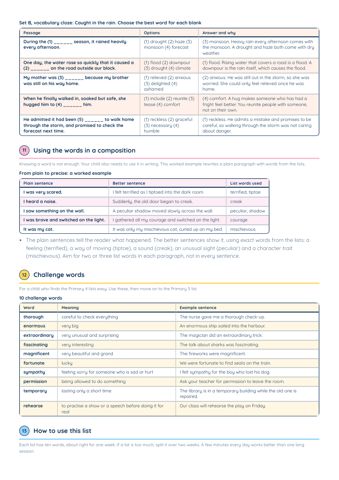
| Passage | Options |
|---|---|
| During the (1) ______ season, it rained heavily every afternoon. | (1) drought (2) haze (3) monsoon (4) forecast |
| One day, the water rose so quickly that it caused a (2) ______ on the road outside our block. | (1) flood (2) downpour (3) drought (4) climate |
| My mother was (3) ______ because my brother was still on his way home. | (1) relieved (2) anxious (3) delighted (4) ashamed |
| When he finally walked in, soaked but safe, she hugged him to (4) ______ him. | (1) include (2) reunite (3) tease (4) comfort |
| He admitted it had been (5) ______ to walk home through the storm, and promised to check the forecast next time. | (1) reckless (2) graceful (3) necessary (4) humble |
Show answersHide answers
| No. | Answer and why |
|---|---|
| 1 | (3) monsoon. Heavy rain every afternoon comes with the monsoon. A drought and haze both come with dry weather. |
| 2 | (1) flood. Rising water that covers a road is a flood. A downpour is the rain itself, which causes the flood. |
| 3 | (2) anxious. He was still out in the storm, so she was worried. She could only feel relieved once he was home. |
| 4 | (4) comfort. A hug makes someone who has had a fright feel better. You reunite people with someone, not on their own. |
| 5 | (1) reckless. He admits a mistake and promises to be careful, so walking through the storm was not caring about danger. |
Using the words in a composition
Knowing a word is not enough. Your child also needs to use it in writing. This worked example rewrites a plain paragraph with words from the lists.
| Plain sentence | Better sentence | List words used |
|---|---|---|
| I was very scared. | I felt terrified as I tiptoed into the dark room. | terrified, tiptoe |
| I heard a noise. | Suddenly, the old door began to creak. | creak |
| I saw something on the wall. | A peculiar shadow moved slowly across the wall. | peculiar, shadow |
| I was brave and switched on the light. | I gathered all my courage and switched on the light. | courage |
| It was my cat. | It was only my mischievous cat, curled up on my bed. | mischievous |
- The plain sentences tell the reader what happened. The better sentences show it, using exact words from the lists: a feeling (terrified), a way of moving (tiptoe), a sound (creak), an unusual sight (peculiar) and a character trait (mischievous). Aim for two or three list words in each paragraph, not in every sentence.
Challenge words
For a child who finds the Primary 4 lists easy. Use these, then move on to the Primary 5 list.
| Word | Meaning | Example sentence |
|---|---|---|
| thorough | careful to check everything | The nurse gave me a thorough check-up. |
| enormous | very big | An enormous ship sailed into the harbour. |
| extraordinary | very unusual and surprising | The magician did an extraordinary trick. |
| fascinating | very interesting | The talk about sharks was fascinating. |
| magnificent | very beautiful and grand | The fireworks were magnificent. |
| fortunate | lucky | We were fortunate to find seats on the train. |
| sympathy | feeling sorry for someone who is sad or hurt | I felt sympathy for the boy who lost his dog. |
| permission | being allowed to do something | Ask your teacher for permission to leave the room. |
| temporary | lasting only a short time | The library is in a temporary building while the old one is repaired. |
| rehearse | to practise a show or a speech before doing it for real | Our class will rehearse the play on Friday. |
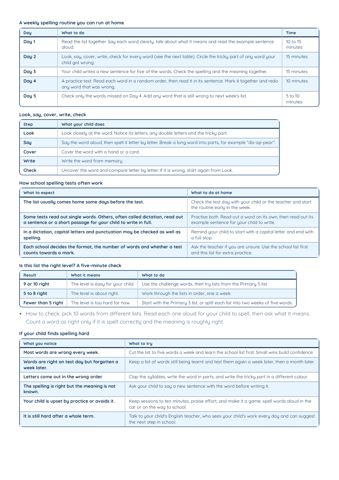
How to use this list
Each list has ten words, about right for one week. If a list is too much, split it over two weeks. A few minutes every day works better than one long session.
| Day | What to do | Time |
|---|---|---|
| Day 1 | Read the list together. Say each word clearly, talk about what it means and read the example sentence aloud. | 10 to 15 minutes |
| Day 2 | Look, say, cover, write, check for every word (see the next table). Circle the tricky part of any word your child got wrong. | 15 minutes |
| Day 3 | Your child writes a new sentence for five of the words. Check the spelling and the meaning together. | 15 minutes |
| Day 4 | A practice test. Read each word in a random order, then read it in its sentence. Mark it together and redo any word that was wrong. | 10 minutes |
| Day 5 | Check only the words missed on Day 4. Add any word that is still wrong to next week's list. | 5 to 10 minutes |
| Step | What your child does |
|---|---|
| Look | Look closely at the word. Notice its letters, any double letters and the tricky part. |
| Say | Say the word aloud, then spell it letter by letter. Break a long word into parts, for example "dis-ap-pear". |
| Cover | Cover the word with a hand or a card. |
| Write | Write the word from memory. |
| Check | Uncover the word and compare letter by letter. If it is wrong, start again from Look. |
| What to expect | What to do at home |
|---|---|
| The list usually comes home some days before the test. | Check the test day with your child or the teacher and start the routine early in the week. |
| Some tests read out single words. Others, often called dictation, read out a sentence or a short passage for your child to write in full. | Practise both. Read out a word on its own, then read out its example sentence for your child to write. |
| In a dictation, capital letters and punctuation may be checked as well as spelling. | Remind your child to start with a capital letter and end with a full stop. |
| Each school decides the format, the number of words and whether a test counts towards a mark. | Ask the teacher if you are unsure. Use the school list first and this list for extra practice. |
| Result | What it means | What to do |
|---|---|---|
| 9 or 10 right | The level is easy for your child. | Use the challenge words, then try lists from the Primary 5 list. |
| 5 to 8 right | The level is about right. | Work through the lists in order, one a week. |
| Fewer than 5 right | The level is too hard for now. | Start with the Primary 3 list, or split each list into two weeks of five words. |
- How to check: pick 10 words from different lists. Read each one aloud for your child to spell, then ask what it means. Count a word as right only if it is spelt correctly and the meaning is roughly right.
| What you notice | What to try |
|---|---|
| Most words are wrong every week. | Cut the list to five words a week and learn the school list first. Small wins build confidence. |
| Words are right on test day but forgotten a week later. | Keep a list of words still being learnt and test them again a week later, then a month later. |
| Letters come out in the wrong order. | Clap the syllables, write the word in parts, and write the tricky part in a different colour. |
| The spelling is right but the meaning is not known. | Ask your child to say a new sentence with the word before writing it. |
| Your child is upset by practice or avoids it. | Keep sessions to ten minutes, praise effort, and make it a game: spell words aloud in the car or on the way to school. |
| It is still hard after a whole term. | Talk to your child's English teacher, who sees your child's work every day and can suggest the next step in school. |
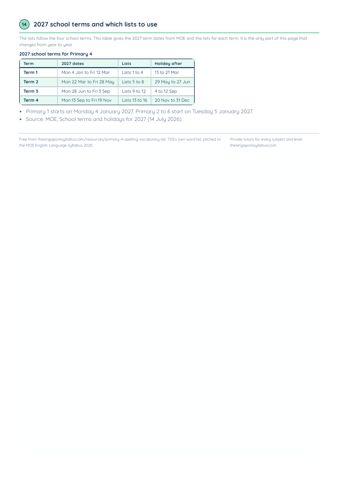
2027 school terms and which lists to use
The lists follow the four school terms. This table gives the 2027 term dates from MOE and the lists for each term. It is the only part of this page that changes from year to year.
| Term | 2027 dates | Lists | Holiday after |
|---|---|---|---|
| Term 1 | Mon 4 Jan to Fri 12 Mar | Lists 1 to 4 | 13 to 21 Mar |
| Term 2 | Mon 22 Mar to Fri 28 May | Lists 5 to 8 | 29 May to 27 Jun |
| Term 3 | Mon 28 Jun to Fri 3 Sep | Lists 9 to 12 | 4 to 12 Sep |
| Term 4 | Mon 13 Sep to Fri 19 Nov | Lists 13 to 16 | 20 Nov to 31 Dec |
- Primary 1 starts on Monday 4 January 2027. Primary 2 to 6 start on Tuesday 5 January 2027.
- Source: MOE, School terms and holidays for 2027 (14 July 2026).
Download the free PDFPDF · 12 pages · A4 portrait · free, no sign-up
Inside the PDF
12 A4 pages, ready to print. Tap a page to open the PDF there.
Questions students ask
Does MOE publish a Primary 4 spelling list?
No. MOE does not publish a national spelling or vocabulary list for any primary level. Each school sets its own lists, so use this one alongside the list your child brings home.
How many spelling words should my child learn each week?
Each list here has 10 words, which suits one week. If your child finds that too many, split a list over two weeks and keep the daily practice short.
Do spelling tests count in Primary 4?
It depends on the school. From P3, schools hold no more than one weighted assessment per subject each term, and each school decides how its spelling tests are used. Ask your child's teacher.
How do P4 results affect English in P5?
At the end of P4, the school recommends a subject combination for P5 based on the year-end exam results. A child who passes 3 or more subjects is offered all four subjects, including English, at Standard level. Parents then fill in an option form, and the school can adjust levels at the end of P5.
How is vocabulary tested in Primary 4?
Each school sets its own P4 papers. The skills are the ones PSLE English tests later: choosing the closest meaning in multiple-choice questions, choosing the best word in a cloze passage, and spelling words correctly. This page has 20 practice questions of those kinds, with answers.
Are there practice questions with answers?
Yes. There are 20 vocabulary questions, multiple choice and cloze, in the two vocabulary item types of PSLE English Paper 2. Every answer has a short reason, so your child can see why the other options do not fit.
Does this list use British or American spelling?
British spelling, such as colour, favourite and neighbour. MOE's own English syllabus documents use British spelling too, for example behaviour, organise and programme.
What if my child's school list has different words?
Learn the school list first, since the school test uses it. Then use this list for extra words, and use the meanings and example sentences to help your child use each word, not only spell it.
What if my child finds spelling hard?
Cut the list to five words a week, learn the school list first and keep a list of words still being learnt to test again a week later. If it is still hard after a term, talk to your child's English teacher.
What comes after this list?
The Primary 5 list picks up where this one ends, with no word repeated. If your child spells 9 or 10 of a random 10 words correctly, use the challenge words and then move on to it.
Keep revising
- Primary English tuition1-to-1 English tutors for P1 to P6
- Primary 4 English tuitionWhat P4 English covers and how a tutor helps
- PSLE Math FormulasPSLE (Primary 1 to 6) · free PDF
- PSLE English Composition PhrasesPSLE (Primary 5 and 6) · free PDF
- PSLE Chinese Composition Phrases (好词好句)PSLE (Primary 5 and 6) · free PDF
- PSLE Science KeywordsPSLE (Primary 3 to 6) · free PDF
- Primary English Oral Practice (P3 to PSLE)Primary 3 to 6 and PSLE · free PDF
- Primary English Listening Comprehension Practice (P3 to PSLE)Primary 3 to 6 and PSLE · free PDF
- Primary English Composition Topics (P3 to PSLE)Primary 3 to 6 and PSLE · free PDF
- Primary 1 Maths WorksheetsPrimary 1 · free PDF
- Primary 2 Maths WorksheetsPrimary 2 · free PDF
- Primary 3 Maths WorksheetsPrimary 3 · free PDF
- Primary 1 English WorksheetsPrimary 1 · free PDF
- Primary 2 English WorksheetsPrimary 2 · free PDF
- Primary 3 English WorksheetsPrimary 3 · free PDF
- Primary 1 Spelling and Vocabulary ListPrimary 1 · free PDF
- Primary 2 Spelling and Vocabulary ListPrimary 2 · free PDF
- Primary 3 Spelling and Vocabulary ListPrimary 3 · free PDF
- Primary 5 Spelling and Vocabulary ListPrimary 5 · free PDF
- PSLE Vocabulary List (Primary 6)Primary 6 (PSLE) · free PDF
- PSLE Score calculatorAdd up the four AL grades
- All free resourcesPSLE, O-Level and A-Level
Source
- MOE, English Language Syllabus 2020, Primary Foundation English and Secondary G1
- MOE, Primary school subjects and syllabuses
- MOE, Subject-based banding (primary)
- MOE, Learn for Life press release (28 September 2018)
- SEAB, PSLE English Language syllabus 0001 (implemented from 2025), Examination Format
- MOE, School terms and holidays for 2027 (14 July 2026)
The words, meanings, example sentences and practice items are our own. MOE does not publish a national spelling list. The syllabus, exam and term details come from the MOE, SEAB and school pages above, and if they differ, those pages are right. Tell us and we will fix it.