Free resource · Primary 1
Primary 1 Maths Worksheets with Answers: Free PDF
This is a free sample set of Primary 1 Maths worksheets: 8 topics, 80 questions, with answers. There is one sheet of 10 questions for each P1 topic in the MOE 2021 syllabus: numbers to 100, addition and subtraction within 20 and within 100, multiplication and division, money, length in centimetres, time, and shapes with picture graphs. Worked examples show number bonds, the column method and a bar model. Primary 1 has no exams or weighted assessments, so use them as practice, alongside the real school class tests listed in the parents' notes.
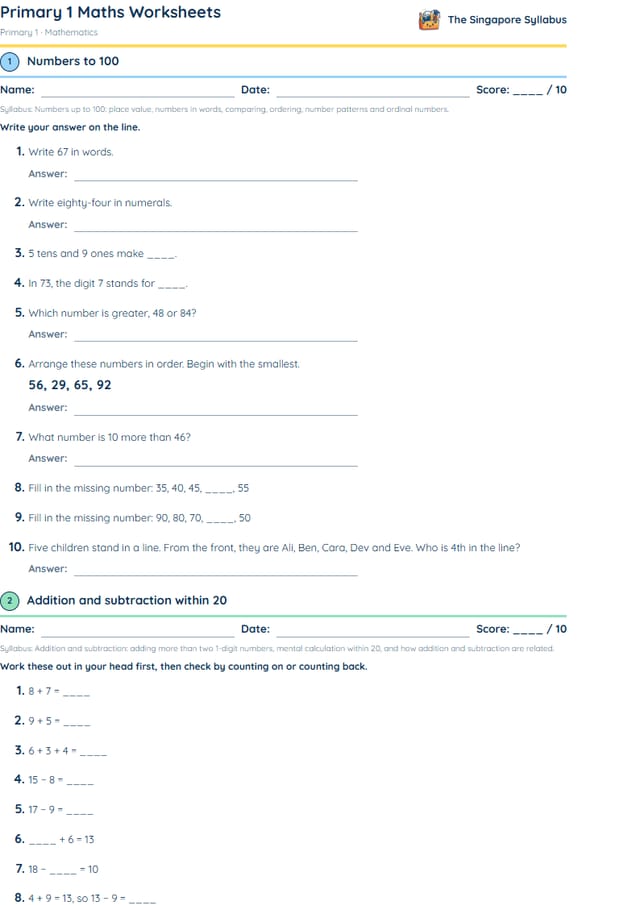
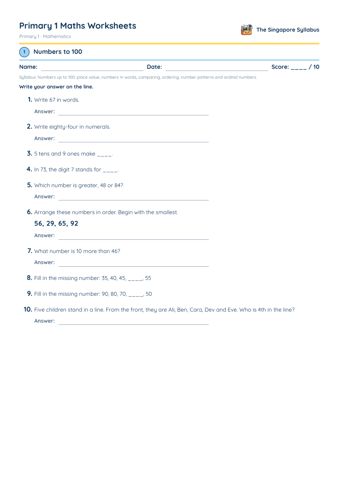
Numbers to 100
Syllabus: Numbers up to 100: place value, numbers in words, comparing, ordering, number patterns and ordinal numbers.
Write your answer on the line.
Write 67 in words.
Write eighty-four in numerals.
5 tens and 9 ones make ____.
In 73, the digit 7 stands for ____.
Which number is greater, 48 or 84?
Arrange these numbers in order. Begin with the smallest.
56, 29, 65, 92
What number is 10 more than 46?
Fill in the missing number: 35, 40, 45, ____, 55
Fill in the missing number: 90, 80, 70, ____, 50
Five children stand in a line. From the front, they are Ali, Ben, Cara, Dev and Eve. Who is 4th in the line?
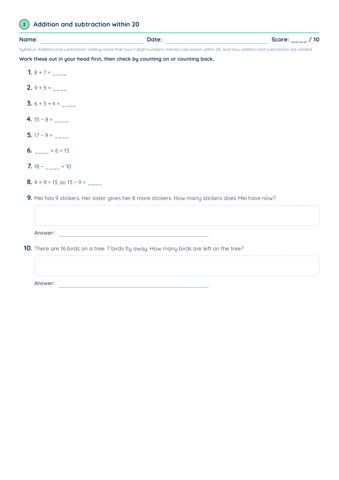
Addition and subtraction within 20
Syllabus: Addition and subtraction: adding more than two 1-digit numbers, mental calculation within 20, and how addition and subtraction are related.
Work these out in your head first, then check by counting on or counting back.
Worked example
Work out 8 + 5 with a number bond.
- 8 needs 2 more to make 10. Break 5 into 2 and 3.
- 8 + 2 = 10
- 10 + 3 = 13
- Check by counting back: 13 − 5 = 8.
Answer: 8 + 5 = 13
Worked example
Ali has 7 red cars and 6 blue cars. How many cars does he have?
| Ali's cars | 7 red | 6 blue | ||||||||||||||||||
|---|---|---|---|---|---|---|---|---|---|---|---|---|---|---|---|---|---|---|---|---|
| Total | ? cars | |||||||||||||||||||
- Draw one bar for all of Ali's cars. Split it into two parts: 7 red and 6 blue.
- The two parts make the whole bar, so add: 7 + 6.
- Use a number bond: 7 + 3 = 10, and 10 + 3 = 13.
Answer: Ali has 13 cars.
8 + 7 = ____
9 + 5 = ____
6 + 3 + 4 = ____
15 − 8 = ____
17 − 9 = ____
____ + 6 = 13
18 − ____ = 10
4 + 9 = 13, so 13 − 9 = ____
Mei has 9 stickers. Her sister gives her 8 more stickers. How many stickers does Mei have now?
There are 16 birds on a tree. 7 birds fly away. How many birds are left on the tree?
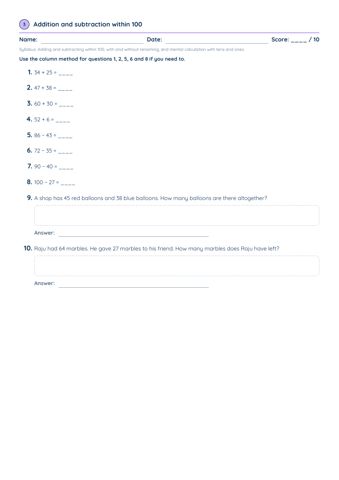
Addition and subtraction within 100
Syllabus: Adding and subtracting within 100, with and without renaming, and mental calculation with tens and ones.
Use the column method for questions 1, 2, 5, 6 and 8 if you need to.
Worked example
Work out 56 + 27 with the column method.
- Write 56 above 27, ones under ones and tens under tens.
- Add the ones: 6 + 7 = 13. Write 3 in the ones column and rename 10 ones as 1 ten.
- Add the tens: 5 + 2 + 1 = 8 tens.
- Check: 83 − 27 = 56.
Answer: 56 + 27 = 83
34 + 25 = ____
47 + 38 = ____
60 + 30 = ____
52 + 6 = ____
86 − 43 = ____
72 − 35 = ____
90 − 40 = ____
100 − 27 = ____
A shop has 45 red balloons and 38 blue balloons. How many balloons are there altogether?
Raju had 64 marbles. He gave 27 marbles to his friend. How many marbles does Raju have left?
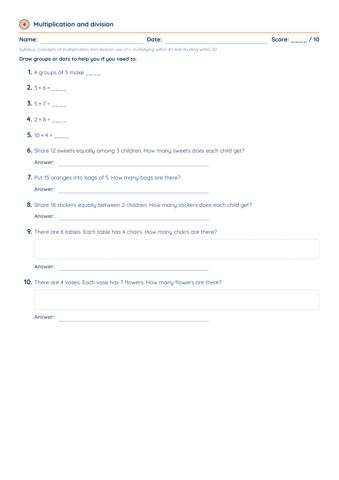
Multiplication and division
Syllabus: Concepts of multiplication and division, use of ×, multiplying within 40 and dividing within 20.
Draw groups or dots to help you if you need to.
Worked example
There are 3 plates. Each plate has 4 strawberries. How many strawberries are there?
- Draw 3 circles for the plates and 4 dots in each circle.
- Count in fours: 4, 8, 12.
- 3 groups of 4 is 3 × 4 = 12.
Answer: 12 strawberries
4 groups of 5 make ____.
3 × 6 = ____
5 × 7 = ____
2 × 8 = ____
10 × 4 = ____
Share 12 sweets equally among 3 children. How many sweets does each child get?
Put 15 oranges into bags of 5. How many bags are there?
Share 18 stickers equally between 2 children. How many stickers does each child get?
There are 6 tables. Each table has 4 chairs. How many chairs are there?
There are 4 vases. Each vase has 7 flowers. How many flowers are there?
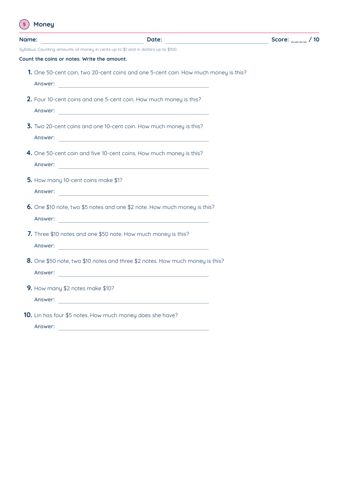
Money
Syllabus: Counting amounts of money in cents up to $1 and in dollars up to $100.
Count the coins or notes. Write the amount.
Worked example
One 20-cent coin, one 10-cent coin and two 5-cent coins. How much money is this?
- Start with the coin worth the most: 20 cents.
- Count on 10 cents: 30 cents.
- Count on 5 cents and 5 cents: 35 cents, 40 cents.
Answer: 40 cents
One 50-cent coin, two 20-cent coins and one 5-cent coin. How much money is this?
Four 10-cent coins and one 5-cent coin. How much money is this?
Two 20-cent coins and one 10-cent coin. How much money is this?
One 50-cent coin and five 10-cent coins. How much money is this?
How many 10-cent coins make $1?
One $10 note, two $5 notes and one $2 note. How much money is this?
Three $10 notes and one $50 note. How much money is this?
One $50 note, two $10 notes and three $2 notes. How much money is this?
How many $2 notes make $10?
Lin has four $5 notes. How much money does she have?
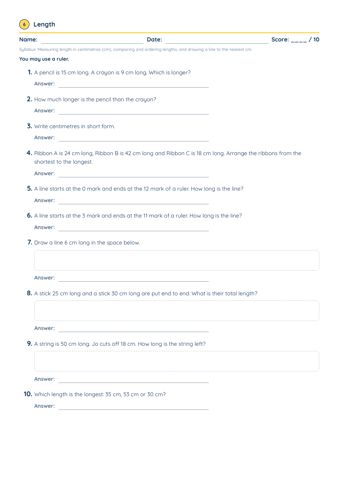
Length
Syllabus: Measuring length in centimetres (cm), comparing and ordering lengths, and drawing a line to the nearest cm.
You may use a ruler.
A pencil is 15 cm long. A crayon is 9 cm long. Which is longer?
How much longer is the pencil than the crayon?
Write centimetres in short form.
Ribbon A is 24 cm long, Ribbon B is 42 cm long and Ribbon C is 18 cm long. Arrange the ribbons from the shortest to the longest.
A line starts at the 0 mark and ends at the 12 mark of a ruler. How long is the line?
A line starts at the 3 mark and ends at the 11 mark of a ruler. How long is the line?
Draw a line 6 cm long in the space below.
A stick 25 cm long and a stick 30 cm long are put end to end. What is their total length?
A string is 50 cm long. Jo cuts off 18 cm. How long is the string left?
Which length is the longest: 35 cm, 53 cm or 30 cm?
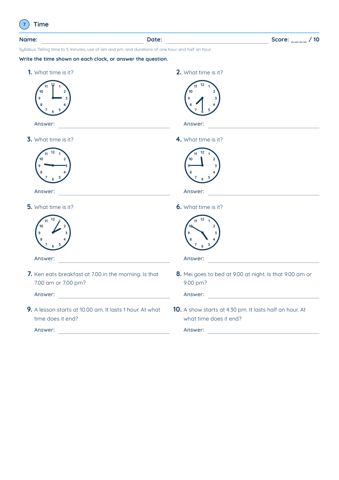
Time
Syllabus: Telling time to 5 minutes, use of am and pm, and durations of one hour and half an hour.
Write the time shown on each clock, or answer the question.
Worked example
The short hand is between 8 and 9. The long hand points at 4. What time is it?
- The short hand shows the hour. It has passed 8 but not reached 9, so the hour is 8.
- The long hand shows the minutes. Count in fives from 12 to 4: 5, 10, 15, 20.
- Write the hour, a dot, then the minutes.
Answer: 8.20 (20 minutes past 8)
What time is it?
Clock: the short hand points at 3, and the long hand points at 12.
What time is it?
Clock: the short hand is halfway between 7 and 8, and the long hand points at 6.
What time is it?
Clock: the short hand is just past 9, and the long hand points at 3.
What time is it?
Clock: the short hand is close to 12, and the long hand points at 9.
What time is it?
Clock: the short hand is just past 2, and the long hand points at 1.
What time is it?
Clock: the short hand is close to 5, and the long hand points at 10.
Ken eats breakfast at 7.00 in the morning. Is that 7.00 am or 7.00 pm?
Mei goes to bed at 9.00 at night. Is that 9.00 am or 9.00 pm?
A lesson starts at 10.00 am. It lasts 1 hour. At what time does it end?
A show starts at 4.30 pm. It lasts half an hour. At what time does it end?
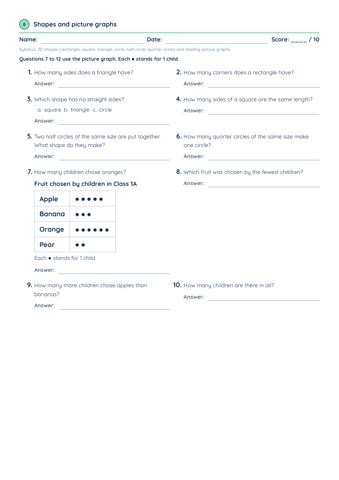
Shapes and picture graphs
Syllabus: 2D shapes (rectangle, square, triangle, circle, half circle, quarter circle) and reading picture graphs.
Questions 7 to 12 use the picture graph. Each ● stands for 1 child.
How many sides does a triangle have?
How many corners does a rectangle have?
Which shape has no straight sides?
- square
- triangle
- circle
How many sides of a square are the same length?
Two half circles of the same size are put together. What shape do they make?
How many quarter circles of the same size make one circle?
How many children chose oranges?
Fruit chosen by children in Class 1A Apple ●●●●● Banana ●●● Orange ●●●●●● Pear ●● Each ● stands for 1 child.
Which fruit was chosen by the fewest children?
How many more children chose apples than bananas?
How many children are there in all?
For parents
How to use this pack
- Pick the topic the school is teaching now. Each topic is one worksheet of 10 questions.
- Read the worked example together, then let your child try the questions alone.
- Use real things where you can: coins for money, a ruler for length and a clock at home for time.
- Mark the worksheet with the answer key. Ask your child to explain each wrong answer out loud, then redo it a few days later.
- Near the end of the year, redo any worksheet your child found hard.
How Primary 1 Maths is assessed in school
- Primary 1 and 2 have no weighted assessments and no exams. MOE removed them from 2019, so no test at these levels counts towards an overall mark or grade.
- Teachers still use short class assessments to check what each child understands. Schools report learning at these levels with descriptions in words, not marks.
- Weighted assessments start in Primary 3, with no more than one per subject in each school term. There are no mid-year exams at any primary level. MOE removed them by 2023.
- So these worksheets are practice, not a test. Use them to find gaps early, while nothing is being graded.
What schools test, and when
- Primary 1 has no exams, but most schools give short class tests or reviews after each group of topics. TSS's free papers library has 42 real Primary 1 Maths tests and reviews from 16 schools, with answers.
| When | Topics tested | Our worksheets | Real school papers |
|---|---|---|---|
| Early in the year (by Term 2) | Numbers to 20, adding and subtracting within 20, ordinal numbers, 2D shapes | 1, 2, 8 | Ai Tong 2018 Term 2 Mini Test, Rosyth Topical Review (Term 2), Henry Park 2023 Quiz 2 |
| Middle of the year (Term 3) | Numbers to 100, adding and subtracting within 100, length, picture graphs | 1, 3, 6, 8 | Ai Tong 2018 Term 3 Mini Test, Tao Nan 2022 Review 2, Henry Park 2022 Numbers to 100 Test |
| End of the year (Term 4) | Multiplication and division, time, money, with more length and graphs | 4, 5, 6, 7 | Ai Tong 2018 Term 4 Mini Test 1, Nan Hua Term 4 Test 2, Tao Nan 2022 Review 3 |
- The term labels come from papers that name a term (Ai Tong, Rosyth and Nan Hua). The others are numbered in order through the year. Schools set their own order, so check the school's term letter or ask the teacher.
- Use the matching worksheet in the week before a class test, then try one real paper on the same topics.
- Each paper page has the question paper and its answer key, free to download.
If your child finds Maths hard
- Signs to watch: guessing instead of working it out, not being able to say how they got an answer, or getting upset at Maths homework.
- Go back to objects and pictures. Count real coins, draw groups of dots, and draw the bar before writing the number sentence.
- Practise number bonds to 10 for a few minutes a day. They make adding and subtracting within 20 much easier.
- Talk to your child's Maths teacher early. MOE's Learning Support for Mathematics (LSM) gives extra lessons in small groups, led by trained teachers, from Primary 1 to Primary 4. Children are identified at the start of Primary 1, and others can join in Primary 2, 3 or 4 if needed.
Getting a K2 child ready for Primary 1 Maths
- MOE says most children starting Primary 1 can recite 1 to 10 in order, recognise those numbers in numerals and words, and tell whether one group of up to 10 objects has more, fewer or the same as another.
- MOE warns against preparing children too much academically before Primary 1. Counting, sorting and talking about numbers in daily life is enough.
- Teachers adjust their support for children who start at different points, and support programmes exist for children who need more.
Sources: MOE, Learn for Life press release (28 September 2018), MOE, forum reply on removing mid-year exams (8 February 2023), MOE, learning support programmes, MOE, supporting your child's move to Primary 1.
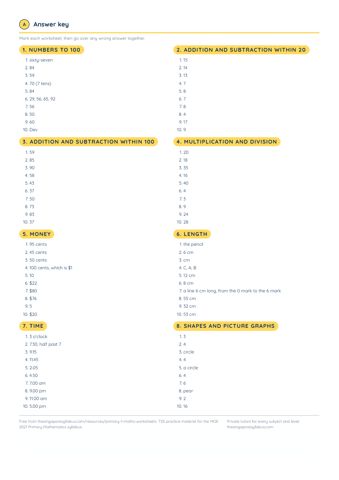
Answer key
Mark each worksheet, then go over any wrong answer together.
1. Numbers to 100
- sixty-seven
- 84
- 59
- 70 (7 tens)
- 84
- 29, 56, 65, 92
- 56
- 50
- 60
- Dev
2. Addition and subtraction within 20
- 15
- 14
- 13
- 7
- 8
- 7
- 8
- 4
- 17
- 9
3. Addition and subtraction within 100
- 59
- 85
- 90
- 58
- 43
- 37
- 50
- 73
- 83
- 37
4. Multiplication and division
- 20
- 18
- 35
- 16
- 40
- 4
- 3
- 9
- 24
- 28
5. Money
- 95 cents
- 45 cents
- 50 cents
- 100 cents, which is $1
- 10
- $22
- $80
- $76
- 5
- $20
6. Length
- the pencil
- 6 cm
- cm
- C, A, B
- 12 cm
- 8 cm
- a line 6 cm long, from the 0 mark to the 6 mark
- 55 cm
- 32 cm
- 53 cm
7. Time
- 3 o'clock
- 7.30, half past 7
- 9.15
- 11.45
- 2.05
- 4.50
- 7.00 am
- 9.00 pm
- 11.00 am
- 5.00 pm
8. Shapes and picture graphs
- 3
- 4
- circle
- 4
- a circle
- 4
- 6
- pear
- 2
- 16
Next steps
Download the free PDFPDF · 9 pages · A4 portrait · free, no sign-up
Inside the PDF
9 A4 pages, ready to print. Tap a page to open the PDF there.
Questions students ask
What does Primary 1 Maths cover in Singapore?
The MOE 2021 Primary Mathematics syllabus lists numbers up to 100, addition and subtraction within 100, the ideas of multiplication and division, money, length in centimetres, telling time to 5 minutes, 2D shapes and picture graphs for Primary 1.
Is multiplication in the Primary 1 Maths syllabus?
Yes. P1 pupils learn what multiplication and division mean and use the × sign. The syllabus limits P1 to multiplying within 40 and dividing within 20. The ÷ sign and the times tables of 2, 3, 4, 5 and 10 come in Primary 2.
What should a Primary 1 child know about time?
The syllabus asks P1 pupils to tell the time to 5 minutes, use am and pm, use the short forms h and min, and know how long one hour and half an hour are. Telling the time to the minute comes in Primary 2.
Does Primary 1 Maths use dollars and cents together?
Not yet. In P1 children count money in cents up to $1 and in dollars up to $100. Writing amounts like $3.45 in decimal notation and changing dollars to cents are Primary 2 topics.
Are these worksheets from MOE or a school?
No. They are The Singapore Syllabus's own practice questions, written to match the topics MOE lists for Primary 1. They are not school papers and MOE did not issue them.
Are there exams in Primary 1?
No. MOE removed all weighted assessments and exams for Primary 1 and 2 from 2019. Teachers still check understanding with short class assessments, which do not count towards a mark or grade.
What is a bar model?
A bar model is a drawing of bars that shows the parts and the whole in a word problem, or how two amounts compare. It helps a child decide whether to add, subtract, multiply or divide. The addition and subtraction within 20 worksheet has a worked bar model example.
How should my child use these worksheets?
Do one topic at a time, after the school has taught it. Mark with the answer key, talk through any wrong answer, and redo it a few days later. The PDF is free, with no sign-up.
Where can my child practise with real P1 school papers?
The parents' notes on this page list real Primary 1 class tests from schools such as Ai Tong, Rosyth, Nan Hua, Tao Nan and Henry Park, by time of year, with links. TSS's free Primary 1 and 2 Maths papers page has 42 Primary 1 tests and reviews, each with its answer key.
When is each Primary 1 Maths topic taught?
Schools set their own order. In the real P1 class tests on TSS, numbers to 20 and adding within 20 come by Term 2, numbers to 100, length and picture graphs in Term 3, and multiplication, division, time and money in Term 4.
Keep revising
- All free worksheetsEvery free worksheet pack, P1 to P3
- Primary Maths tuitionA home tutor who follows the school topics
- PSLE Math FormulasPSLE (Primary 1 to 6) · free PDF
- PSLE English Composition PhrasesPSLE (Primary 5 and 6) · free PDF
- PSLE Chinese Composition Phrases (好词好句)PSLE (Primary 5 and 6) · free PDF
- PSLE Science KeywordsPSLE (Primary 3 to 6) · free PDF
- Primary English Oral Practice (P3 to PSLE)Primary 3 to 6 and PSLE · free PDF
- Primary English Listening Comprehension Practice (P3 to PSLE)Primary 3 to 6 and PSLE · free PDF
- Primary English Composition Topics (P3 to PSLE)Primary 3 to 6 and PSLE · free PDF
- Primary 2 Maths WorksheetsPrimary 2 · free PDF
- Primary 3 Maths WorksheetsPrimary 3 · free PDF
- Primary 1 English WorksheetsPrimary 1 · free PDF
- Primary 2 English WorksheetsPrimary 2 · free PDF
- Primary 3 English WorksheetsPrimary 3 · free PDF
- Primary 1 Spelling and Vocabulary ListPrimary 1 · free PDF
- Primary 2 Spelling and Vocabulary ListPrimary 2 · free PDF
- Primary 3 Spelling and Vocabulary ListPrimary 3 · free PDF
- Primary 4 Spelling and Vocabulary ListPrimary 4 · free PDF
- Primary 5 Spelling and Vocabulary ListPrimary 5 · free PDF
- PSLE Vocabulary List (Primary 6)Primary 6 (PSLE) · free PDF
- PSLE Score calculatorAdd up the four AL grades
- All free resourcesPSLE, O-Level and A-Level
Source
- MOE, 2021 Primary Mathematics Syllabus P1 to P6 (updated October 2025)
- MOE, Primary school subjects and syllabuses
The worksheets are our own practice material, written for the MOE 2021 Primary Mathematics syllabus. They are not issued by MOE. If a topic here differs from the MOE document, the MOE document is right. Tell us and we will fix it.