Free resource · Primary 6
Primary 6 Maths Worksheets with Answers: Free PDF
This is a free sample set of Primary 6 Maths worksheets: 6 topics, 60 questions, with answers. There is one sheet of 10 questions for each of six P6 topics: dividing fractions, percentage, ratio, algebra, area and circumference of circle, and average. Worked examples show how to divide by a fraction, find the whole from a percentage, share an amount in a ratio with a bar model and solve an equation. These are our own practice questions, not past PSLE questions. The pack is a sample of the TSS Primary 6 Maths Assessment Book, which has 8 chapters.
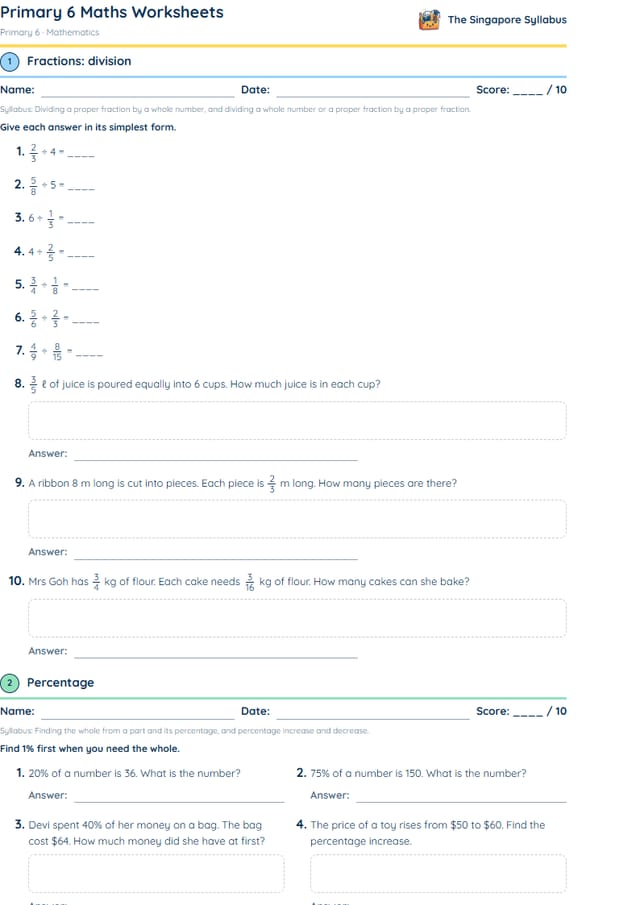
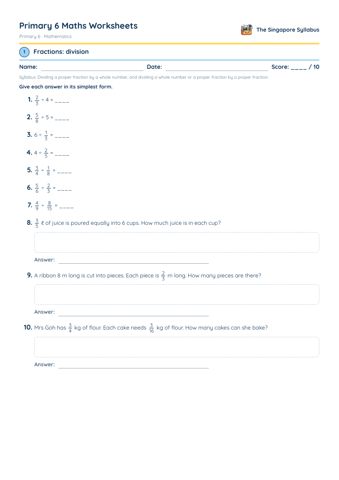
- 7 pages
- A4 portrait
Fractions: division
Syllabus: Dividing a proper fraction by a whole number, and dividing a whole number or a proper fraction by a proper fraction.
Give each answer in its simplest form.
Worked example
34 ÷ 25 = ____
- Dividing by a fraction is the same as multiplying by the fraction turned upside down.
- 34 ÷ 25 = 34 × 52
- Multiply the numerators and the denominators: 158.
- Write the improper fraction as a mixed number: 15 ÷ 8 = 1 R 7.
Answer: 1 78
23 ÷ 4 = ____
58 ÷ 5 = ____
6 ÷ 13 = ____
4 ÷ 25 = ____
34 ÷ 18 = ____
56 ÷ 23 = ____
49 ÷ 815 = ____
35 ℓ of juice is poured equally into 6 cups. How much juice is in each cup?
A ribbon 8 m long is cut into pieces. Each piece is 23 m long. How many pieces are there?
Mrs Goh has 34 kg of flour. Each cake needs 316 kg of flour. How many cakes can she bake?
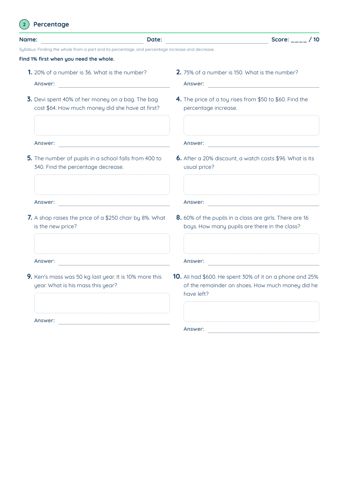
Percentage
Syllabus: Finding the whole from a part and its percentage, and percentage increase and decrease.
Find 1% first when you need the whole.
Worked example
30% of a number is 45. What is the number?
- 30% of the number is 45.
- 1% of the number is 45 ÷ 30 = 1.5.
- 100% of the number is 1.5 × 100 = 150.
- Check: 30% of 150 = 45.
Answer: 150
20% of a number is 36. What is the number?
75% of a number is 150. What is the number?
Devi spent 40% of her money on a bag. The bag cost $64. How much money did she have at first?
The price of a toy rises from $50 to $60. Find the percentage increase.
The number of pupils in a school falls from 400 to 340. Find the percentage decrease.
After a 20% discount, a watch costs $96. What is its usual price?
A shop raises the price of a $250 chair by 8%. What is the new price?
60% of the pupils in a class are girls. There are 16 boys. How many pupils are there in the class?
Ken's mass was 50 kg last year. It is 10% more this year. What is his mass this year?
Ali had $600. He spent 30% of it on a phone and 25% of the remainder on shoes. How much money did he have left?
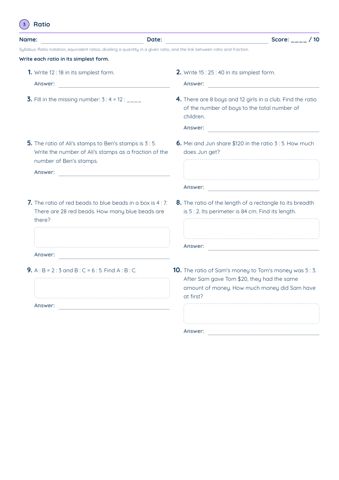
Ratio
Syllabus: Ratio notation, equivalent ratios, dividing a quantity in a given ratio, and the link between ratio and fraction.
Write each ratio in its simplest form.
Worked example
Ann and Ben share $90 in the ratio 2 : 3. How much does Ben get?
| Ann | 2 units | |||||||||||||||||||
|---|---|---|---|---|---|---|---|---|---|---|---|---|---|---|---|---|---|---|---|---|
| Ben | 3 units | |||||||||||||||||||
- Ann has 2 units and Ben has 3 units, so there are 5 units in all.
- 5 units = $90, so 1 unit = $90 ÷ 5 = $18.
- Ben has 3 units: 3 × $18 = $54.
- Check: Ann gets $36, and $36 + $54 = $90.
Answer: Ben gets $54.
Write 12 : 18 in its simplest form.
Write 15 : 25 : 40 in its simplest form.
Fill in the missing number: 3 : 4 = 12 : ____
There are 8 boys and 12 girls in a club. Find the ratio of the number of boys to the total number of children.
The ratio of Ali's stamps to Ben's stamps is 3 : 5. Write the number of Ali's stamps as a fraction of the number of Ben's stamps.
Mei and Jun share $120 in the ratio 3 : 5. How much does Jun get?
The ratio of red beads to blue beads in a box is 4 : 7. There are 28 red beads. How many blue beads are there?
The ratio of the length of a rectangle to its breadth is 5 : 2. Its perimeter is 84 cm. Find its length.
A : B = 2 : 3 and B : C = 6 : 5. Find A : B : C.
The ratio of Sam's money to Tom's money was 5 : 3. After Sam gave Tom $20, they had the same amount of money. How much money did Sam have at first?
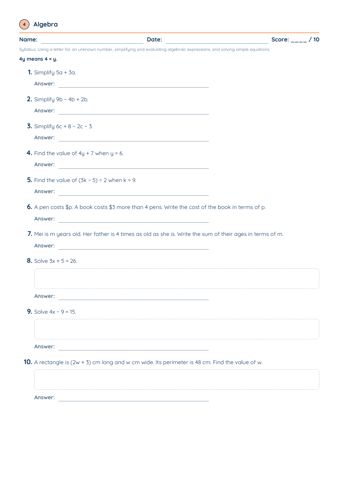
Algebra
Syllabus: Using a letter for an unknown number, simplifying and evaluating algebraic expressions, and solving simple equations.
4y means 4 × y.
Worked example
Solve 2x + 7 = 19.
- Take 7 from both sides: 2x = 19 − 7 = 12.
- Divide both sides by 2: x = 12 ÷ 2 = 6.
- Check: 2 × 6 + 7 = 19.
Answer: x = 6
Simplify 5a + 3a.
Simplify 9b − 4b + 2b.
Simplify 6c + 8 − 2c − 3.
Find the value of 4y + 7 when y = 6.
Find the value of (3k − 5) ÷ 2 when k = 9.
A pen costs $p. A book costs $3 more than 4 pens. Write the cost of the book in terms of p.
Mei is m years old. Her father is 4 times as old as she is. Write the sum of their ages in terms of m.
Solve 3x + 5 = 26.
Solve 4x − 9 = 15.
A rectangle is (2w + 3) cm long and w cm wide. Its perimeter is 48 cm. Find the value of w.
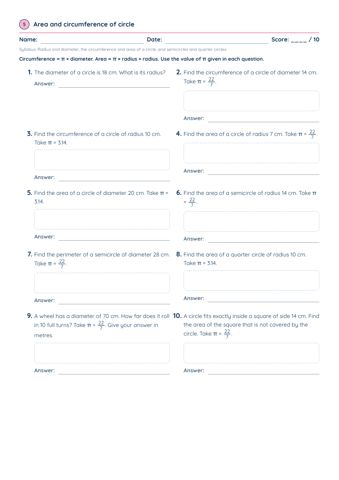
Area and circumference of circle
Syllabus: Radius and diameter, the circumference and area of a circle, and semicircles and quarter circles.
Circumference = π × diameter. Area = π × radius × radius. Use the value of π given in each question.
The diameter of a circle is 18 cm. What is its radius?
Find the circumference of a circle of diameter 14 cm. Take π = 227.
Find the circumference of a circle of radius 10 cm. Take π = 3.14.
Find the area of a circle of radius 7 cm. Take π = 227.
Find the area of a circle of diameter 20 cm. Take π = 3.14.
Find the area of a semicircle of radius 14 cm. Take π = 227.
Find the perimeter of a semicircle of diameter 28 cm. Take π = 227.
Find the area of a quarter circle of radius 10 cm. Take π = 3.14.
A wheel has a diameter of 70 cm. How far does it roll in 10 full turns? Take π = 227. Give your answer in metres.
A circle fits exactly inside a square of side 14 cm. Find the area of the square that is not covered by the circle. Take π = 227.
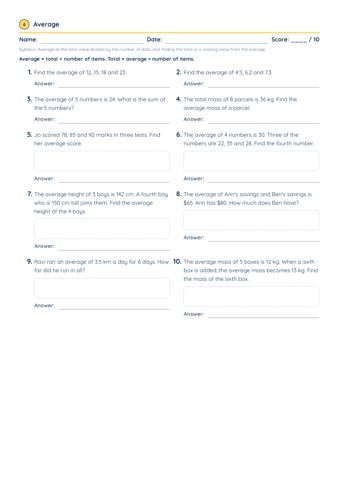
Average
Syllabus: Average as the total value divided by the number of data, and finding the total or a missing value from the average.
Average = total ÷ number of items. Total = average × number of items.
Find the average of 12, 15, 18 and 23.
Find the average of 4.5, 6.2 and 7.3.
The average of 5 numbers is 24. What is the sum of the 5 numbers?
The total mass of 8 parcels is 36 kg. Find the average mass of a parcel.
Jo scored 78, 85 and 92 marks in three tests. Find her average score.
The average of 4 numbers is 30. Three of the numbers are 22, 35 and 28. Find the fourth number.
The average height of 3 boys is 142 cm. A fourth boy who is 150 cm tall joins them. Find the average height of the 4 boys.
The average of Ann's savings and Ben's savings is $65. Ann has $80. How much does Ben have?
Ravi ran an average of 3.5 km a day for 6 days. How far did he run in all?
The average mass of 5 boxes is 12 kg. When a sixth box is added, the average mass becomes 13 kg. Find the mass of the sixth box.
For parents
How to use this pack
- Pick the topic the school is teaching now. Each topic is one worksheet of 10 questions with its answers.
- Read the worked example together where there is one, then let your child try the questions alone.
- Ask your child to show the working for every word problem, not just the answer.
- Mark the worksheet with the answer key. Ask your child to explain each wrong answer, then redo it a few days later.
How Primary 6 Maths is assessed in school
- A school sets no more than one weighted assessment per subject in each school term.
- There is no mid-year exam. MOE removed mid-year exams at every primary level by 2023.
- Report books do not show class or level position, and marks are shown as whole numbers.
- Primary 6 ends with the PSLE. From 2026, Paper 1 is 50 marks in 1 hour 10 minutes with no calculator, and Paper 2 is 50 marks in 1 hour 20 minutes with a calculator.
- No formula list is printed in the PSLE Mathematics paper, so the circle formulas on worksheet 5 have to be learnt by heart.
If your child finds Primary 6 Maths hard
- Signs to watch: not knowing which amount is 100% in a percentage question, mixing up the order of a ratio, or using the diameter where the radius is needed.
- For ratio and percentage word problems, draw the bars and label the units before writing any number sentence.
- Redo the Primary 5 worksheets on fractions and percentage if the Primary 6 ones feel too hard. The Primary 6 topics build on them.
When your child wants more practice
- This pack is a free sample. It has one worksheet for 6 of the 8 chapters in the TSS Primary 6 Maths Assessment Book.
- The book is a printable PDF of 360 pages. It has notes with worked examples for every chapter, 284 questions, answers that show the working, and the Preliminary Practice Examination.
- Read real questions from the book on its sample questions page before you decide.
Primary 6 Maths book: sample questions · Primary 6 Maths Assessment Book
Sources: MOE, Learn for Life press release (28 September 2018), MOE, forum reply on removing mid-year exams (8 February 2023), MOE, learning support programmes, SEAB, PSLE Mathematics (0008) for examination from 2026.
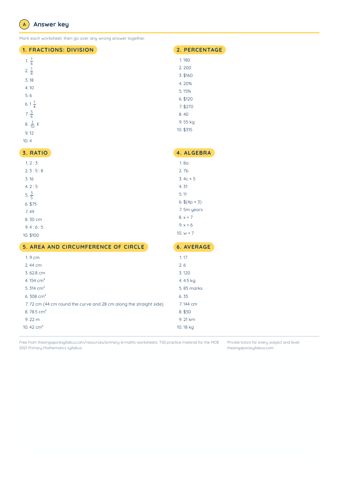
Answer key
Mark each worksheet, then go over any wrong answer together.
1. Fractions: division
- 16
- 18
- 18
- 10
- 6
- 1 14
- 56
- 110 ℓ
- 12
- 4
2. Percentage
- 180
- 200
- $160
- 20%
- 15%
- $120
- $270
- 40
- 55 kg
- $315
3. Ratio
- 2 : 3
- 3 : 5 : 8
- 16
- 2 : 5
- 35
- $75
- 49
- 30 cm
- 4 : 6 : 5
- $100
4. Algebra
- 8a
- 7b
- 4c + 5
- 31
- 11
- $(4p + 3)
- 5m years
- x = 7
- x = 6
- w = 7
5. Area and circumference of circle
- 9 cm
- 44 cm
- 62.8 cm
- 154 cm²
- 314 cm²
- 308 cm²
- 72 cm (44 cm round the curve and 28 cm along the straight side)
- 78.5 cm²
- 22 m
- 42 cm²
6. Average
- 17
- 6
- 120
- 4.5 kg
- 85 marks
- 35
- 144 cm
- $50
- 21 km
- 18 kg
Next steps
Questions students ask
What is in the Primary 6 Maths worksheets?
Six worksheets of 10 questions each: dividing fractions, percentage, ratio, algebra, area and circumference of circle, and average. A full answer key comes at the end.
Do the Primary 6 Maths worksheets come with answers?
Yes. The answer key lists every answer, one list per worksheet. It is on this page and on the last page of the PDF.
Are these past PSLE Maths questions?
No. They are The Singapore Syllabus's own practice questions, written for the Primary 6 topics in the MOE 2021 Primary Mathematics syllabus. They are not PSLE or school papers, and MOE and SEAB did not issue them.
How is this free pack different from the TSS Primary 6 Maths book?
The pack is a sample: one sheet of 10 questions for 6 topics. The TSS Primary 6 Maths Assessment Book is a printable PDF of 360 pages with 8 chapters, notes with worked examples, 284 questions, answers that show the working and a preliminary practice examination. The questions in this pack are not taken from the book.
Which value of π do the circle questions use?
Each question states the value to use, either 22/7 or 3.14. Use the value the question gives.
How do you divide by a fraction?
Multiply by the fraction turned upside down. So 3/4 ÷ 1/8 is 3/4 × 8, which is 6.
How should my child use these worksheets?
Do one topic at a time, after the school has taught it. Mark with the answer key, ask your child to explain each wrong answer, and redo it a few days later. The PDF is free, with no sign-up.
Keep revising
- All free worksheetsEvery free worksheet pack, P1 to P6
- Primary 6 Maths tuitionThe P6 topics and a home tutor
- Primary 6 Maths book: sample questionsReal questions from the TSS book, with worked answers
- PSLE Math FormulasPSLE (Primary 1 to 6) · free PDF
- PSLE English Composition PhrasesPSLE (Primary 5 and 6) · free PDF
- PSLE Chinese Composition Phrases (好词好句)PSLE (Primary 5 and 6) · free PDF
- PSLE Score calculatorAdd up the four AL grades
- All free resourcesPSLE, O-Level and A-Level
More for this stage: PSLE Science Keywords, Primary English Oral Practice (P3 to PSLE), Primary English Listening Comprehension Practice (P3 to PSLE), Primary English Composition Topics (P3 to PSLE), Primary 1 Maths Worksheets, Primary 2 Maths Worksheets, Primary 3 Maths Worksheets, Primary 4 Maths Worksheets, Primary 5 Maths Worksheets, Primary 1 English Worksheets, Primary 2 English Worksheets, Primary 3 English Worksheets, Primary 1 Spelling and Vocabulary List, Primary 2 Spelling and Vocabulary List, Primary 3 Spelling and Vocabulary List, Primary 4 Spelling and Vocabulary List, Primary 5 Spelling and Vocabulary List, PSLE Vocabulary List (Primary 6).
Source
- MOE, 2021 Primary Mathematics Syllabus P1 to P6 (updated October 2025)
- MOE, Primary school subjects and syllabuses
The worksheets are our own practice material, written for the MOE 2021 Primary Mathematics syllabus. They are not issued by MOE or SEAB. If a topic here differs from the MOE document, the MOE document is right. Tell us and we will fix it.