Primary 5 Maths Tuition Singapore
The foundation year for a strong PSLE
Get matched with a tutor
- Typical rate
- S$35 to S$75/hr
- Your shortlist
- 2 to 4 tutors in 16h
- Wrong fit?
- Free re-match
★★★★★
tutors who teach with heart and seamless process, love their curated shortlist and in-house materials TSS is a W 👍🏻
Primary 5 Maths Tuition rates in Singapore
Real ranges by level and tutor tier. We re-match free if the fit is wrong.
| Level | Undergrad | Full-time | Ex-MOE / NIE |
|---|---|---|---|
| Lower Primary (P1-P4) | S$30-40/hr | S$40-55/hr | S$50-65/hr |
| Upper Primary / PSLE (P5-P6) | S$35-50/hr | S$45-60/hr | S$55-75/hr |
Rates are current Singapore market norms. Final rate is set on tutor match and depends on tutor tier, level and lesson frequency. See full pricing page.
Where Primary 5 Maths catches children out
P5 is the first upper primary year. The topics are new, the problem sums are longer, and calculators are used for the first time, though many skills must still be done without one.
Order of operations errors, such as working out 20 - 4 x 3 from left to right and getting 48 instead of 8.
Multiplying fractions is fine on its own, but in a problem sum your child cannot tell whether to multiply by the fraction or subtract it.
In discount questions, the discount amount is given as the final answer instead of the price after discount.
Triangle area is worked out with a slanted side as the height instead of the perpendicular height.
1 more
Water tank questions confuse the height of the water with the height of the tank, or skip the step from cm³ to litres.
Most of these are method errors, and they are far easier to correct in P5 than in the P6 revision year.
The grade, explained
How PSLE Achievement Levels work
Each subject gets an AL from 1 (best) to 8. The four ALs add up to the PSLE score, from 4 to 32.
- AL190 and above
- AL285 to 89
- AL380 to 84
- AL475 to 79
- AL565 to 74
- AL645 to 64
- AL720 to 44
- AL8Below 20
Source: MOE PSLE scoring.
The P5 Standard syllabus, grouped for lessons
The 2021 MOE syllabus introduces percentage, rate, triangle area, volume and angle properties in P5. Ratio, algebra, circles and average follow in P6, so P5 is about making the new number topics secure.
Whole numbers, fractions and decimals
Larger numbers and calculation rules, with fractions now multiplied and linked to division.
Topics covered
- Numbers up to 10 million
- Order of operations and brackets
- A fraction as the result of a division, and fractions as decimals
- Adding and subtracting mixed numbers
- Multiplying fractions, whole numbers and mixed numbers
- Multiplying and dividing decimals by 10, 100, 1,000 and their multiples
- Converting measurements between units in decimal form
Percentage and rate
Two new topics that connect Maths to shopping, savings and everyday quantities.
Topics covered
- Expressing a part of a whole as a percentage
- Finding a percentage part of a whole
- Discount, GST and annual interest
- Rate as an amount per unit
- Finding rate, total amount or number of units
Area of triangle and volume
Base and height of a triangle, then three-dimensional measurement with cubes, cuboids and tanks.
Topics covered
- Base and height of a triangle
- Area of a triangle
- Composite figures of rectangles, squares and triangles
- Volume of cubes and cuboids in cm³ and m³
- Drawing cubes and cuboids on isometric grid
- Volume of liquid in a rectangular tank
- Linking litres and millilitres with cm³
Angles, triangles and four-sided figures
Angle facts used to find unknown angles without extra construction lines.
Topics covered
- Angles on a straight line and at a point
- Vertically opposite angles
- Isosceles, equilateral and right-angled triangles
- Angle sum of a triangle
- Parallelograms, rhombuses and trapeziums
- Finding unknown angles
Meet one of our tutors
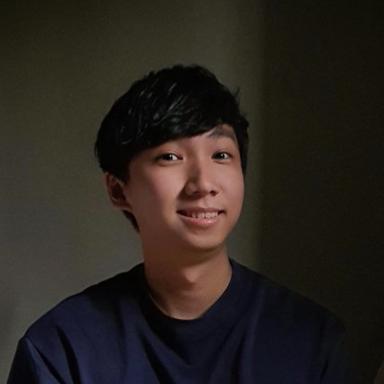
Theon Teo, Founder and Mathematics Tutor
Credentials: DigiPen Institute of Technology Singapore, Game Development and Computer Science. 3 years teaching Primary and Secondary Mathematics.
Specialises in: PSLE Mathematics, O-Level Elementary Mathematics 4052 (SEC G3 K310), O-Level Additional Mathematics 4049 (SEC G3 K341)
Track record: Coaches Primary and Secondary Mathematics and Additional Mathematics against the current SEAB syllabus codes, including the SEC G3 codes that replace the O-Level from 2027.
A note from Theon: "I founded The Singapore Syllabus to make 1-to-1 home tuition that is rigorous, MOE-aligned and accountable. We match each family to tutors suited to their child's level and goals, coach to the latest SEAB syllabus, and re-match free if the fit is wrong."
Read more
Primary 5 Maths Tuition: a guide for parents
Primary 5 is where much of the PSLE groundwork is laid. The P5 MOE Maths syllabus introduces several demanding topics: multiplying fractions, percentage (including discount, GST and interest), rate, the area of triangles and composite figures, the volume of cubes, cuboids and tanks, and the angle properties of triangles and four-sided figures. Ratio, algebra, circles and average follow in P6. P5 is also where Paper 2 problem sums shift from single-step to multi-step, and where the gap between the top quartile and the rest of the cohort opens up. Gaps left open in P5 carry into the P6 revision year.
Read the full guide
Our P5 Maths home tutors map weekly lessons to the school topical schedule and pre-empt the next CA / WA topic 1 to 2 weeks ahead, so school assessments and tuition reinforce each other. A key P5 focus is model-drawing discipline, the units-and-parts and before-and-after heuristics that the PSLE mark scheme rewards with method marks even when the final answer is wrong. We coach these by name and practise them on past exam papers and school-style problem sums. Outcomes vary by start grade and study time; parents can ask the tutor for updates at any time.
A common P5 percentage question: a bag costs $80 and is sold at a 15% discount, and 9% GST is then charged on the discounted price. How much does the customer pay? Many children stop at the discount of $12, or add 9% to $80. The correct steps are: discounted price $80 minus $12 = $68, GST is 9% of $68 = $6.12, so the total is $74.12.
A tutor teaches your child to write one line per step and label each amount, so a marker can follow the method even if one calculation slips. Discount, GST and annual interest are in the P5 syllabus because they tie percentage to daily life, and working set out line by line is how longer PSLE Paper 2 questions are marked.
Official syllabus: MOE Singapore · SEAB Singapore
Reviews on Google
5.0 average on our Google Business Profile. Read them on Google
TSS stands out compared to other agencies I’ve tried. Everything was smooth from finding a tutor to starting lessons.
TSS made finding a tutor really easy. Alicia was super efficient, and my tutor has been amazing so far.
Google review
Tss is very outstanding compared to other tuition centre as they are very patient with the engagement i had with them.
xinyu · Google review
Been matched with a tutor through us? Leave a review on Google
Primary 5 Maths Tuition: frequently asked questions
How is P5 Foundation Maths different from Standard?
P5 Foundation Maths revisits earlier topics such as whole numbers, factors, fractions, decimals, area and perimeter, angles and graphs, and adds rate and volume of cubes and cuboids. Standard Maths moves on to percentage, triangle area, angle properties and fraction multiplication in P5. Foundation never covers ratio, algebra or circles. A tutor should teach to the level your child actually takes.
How much does Primary 5 Maths tuition cost?
P5 is in our Upper Primary rate band. Typical hourly rates are S$35 to S$50 for an undergraduate tutor, S$45 to S$60 for a full-time tutor, and S$55 to S$75 for an ex-MOE teacher. Most P5 families book one lesson a week of 1.5 hours, and we send a shortlist of tutor profiles within 16 hours of your request.
Can my child use a calculator in P5?
Calculators are introduced in P5, but the syllabus marks many P5 skills as without calculator, including order of operations, multiplying fractions, and multiplying or dividing by 10, 100 and 1,000. At PSLE, Paper 1 does not allow calculators at all. A tutor keeps mental and written methods sharp while your child learns to use a calculator sensibly in longer problem sums.
How is P5 Maths assessed in school?
P5 has weighted assessments during the year and an end-of-year exam, with no mid-year exam. School papers usually include multiple-choice, short-answer and longer structured questions, where written working can earn method marks even if the final answer is wrong. A tutor goes through each returned paper with your child to find the method errors that cost marks.
Last updated
Get started with Primary 5 Maths Tuition
Tell us your child's school, level and target exam timeline.