Primary 4 Maths Tuition Singapore
The year before PSLE content starts in earnest
Get matched with a tutor
- Typical rate
- S$30 to S$75/hr
- Your shortlist
- 2 to 4 tutors in 16h
- Wrong fit?
- Free re-match
★★★★★
My tutor is always on time, well-prepared, and makes difficult topics much easier to understand.
Primary 4 Maths Tuition rates in Singapore
Hourly rates by level. Each bar runs from a part-time tutor to an ex-MOE teacher.
Rates by type of tutor, as a table
| Level | Part-time / undergrad | Full-time | Ex-MOE or NIE-trained |
|---|---|---|---|
| Lower Primary (P1-P4) | S$30-40/hr | S$40-55/hr | S$50-65/hr |
| Upper Primary / PSLE (P5-P6) | S$35-50/hr | S$45-60/hr | S$55-75/hr |
The final rate is set when you choose a tutor. See all rates on the pricing page.
What parents notice in Primary 4 Maths
P4 brings in decimals, factors and multiples, angles in degrees and the first composite figures, all in one year.
Decimals are lined up by the last digit instead of the decimal point, so 3.5 + 1.25 is not written as 4.75.
Factors and multiples are mixed up, so a question on common multiples gets a list of factors.
Mixed numbers and improper fractions cause trouble, especially when two fractions have different denominators.
Composite area questions are started without splitting the figure, so a side is used twice or missed.
1 more
The protractor is read on the wrong scale, so a 50 degree angle is recorded as 130 degrees.
These gaps matter more in P4 than before, because the P5 and P6 topics are built on fractions and decimals.
The grade, explained
How PSLE Achievement Levels work
Each subject gets an AL from 1 (best) to 8. The four ALs add up to the PSLE score, from 4 to 32.
- AL190 and above
- AL285 to 89
- AL380 to 84
- AL475 to 79
- AL565 to 74
- AL645 to 64
- AL720 to 44
- AL8Below 20
Source: MOE PSLE scoring.
How the P4 syllabus is taught
P4 closes the lower primary block of the 2021 MOE syllabus and has the widest spread of new topics of any primary year. A tutor groups them like this.
Whole numbers, factors and multiples
Numbers to 100,000, rounding, and the factor and multiple ideas that later support fractions.
Topics covered
- Numbers to 100,000
- Rounding to the nearest 10, 100 or 1,000
- Factors, multiples and how they relate
- Common factors and common multiples
- Multiplying up to 4 digits by 1 digit and 3 digits by 2 digits
- Dividing up to 4 digits by 1 digit
Fractions and decimals
Mixed numbers, fractions of a set, and decimals to three places, with links between fractions and decimals.
Topics covered
- Mixed numbers and improper fractions
- Fraction of a set
- Adding and subtracting fractions with up to two different denominators
- Decimals to 3 places: tenths, hundredths, thousandths
- Converting between decimals and fractions
- Rounding decimals to a whole number, 1 or 2 places
- Adding and subtracting decimals, and multiplying or dividing them by a 1-digit number
Angles, shapes and composite area
Measuring in degrees, properties of rectangles and squares, symmetry, nets, and area and perimeter of composite figures.
Topics covered
- Naming, measuring and drawing angles in degrees
- Properties of rectangles and squares
- Line symmetry on a square grid
- Nets of cubes, cuboids, prisms and pyramids
- Finding a missing side from the area or perimeter
- Area and perimeter of figures made of rectangles and squares
Tables, line graphs and pie charts
Reading data in three forms, which P4 school papers often combine with other topics.
Topics covered
- Completing a table from given data
- Reading and interpreting tables
- Reading and interpreting line graphs
- Reading and interpreting pie charts
Meet one of our tutors
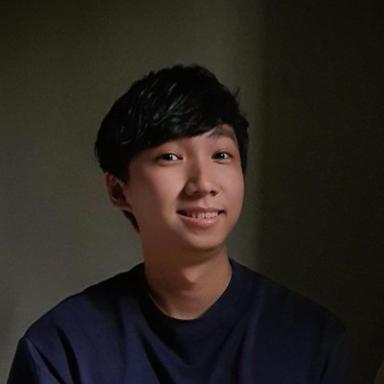
Theon Teo, Founder and Mathematics Tutor
Credentials: DigiPen Institute of Technology Singapore, Game Development and Computer Science. 3 years teaching Primary and Secondary Mathematics.
Specialises in: PSLE Mathematics, O-Level Elementary Mathematics 4052 (SEC G3 K310), O-Level Additional Mathematics 4049 (SEC G3 K341)
Track record: Coaches Primary and Secondary Mathematics and Additional Mathematics against the current SEAB syllabus codes, including the SEC G3 codes that replace the O-Level from 2027.
A note from Theon: "I founded The Singapore Syllabus to make 1-to-1 home tuition that is rigorous, MOE-aligned and accountable. We match each family to tutors suited to their child's level and goals, coach to the latest SEAB syllabus, and re-match free if the fit is wrong."
Read more
More about TheonShow less
Primary 4 Maths Tuition: a guide for parents
Primary 4 Maths closes the lower-primary block. The P4 MOE syllabus covers whole numbers to 100,000, factors and multiples, the four operations with larger numbers, mixed numbers and improper fractions, fractions of a set, decimals to three places, area and perimeter of composite rectangles and squares, angles, symmetry, nets, and tables, line graphs and pie charts. At the end of P4 the school recommends whether each subject is taken at Standard or Foundation level in P5 and P6, so P4 results matter for what comes next.
Read the full guide
A P4 home tutor secures fractions and decimals, which the P5 and P6 PSLE topics (ratio, percentage, rate) are built on, and extends model drawing to the harder before-and-after and part-whole problems. Lessons follow the school topic schedule and the tutor works on the weighted assessments your child actually sits. You hear plainly which topics are secure and which need more time before P5.
A typical P4 composite figure is an L-shape made from a 10 cm by 6 cm rectangle with a 4 cm by 2 cm piece cut from one corner. Many children find the area correctly (60 minus 8 is 52 cm²) but then get the perimeter wrong by subtracting the edges of the missing piece.
In fact, cutting a rectangle from a corner leaves the perimeter unchanged at 10 + 6 + 10 + 6 = 32 cm, because the two new inside edges replace the two edges that were removed. A tutor teaches your child to mark every side length on the diagram first, then walk around the shape adding each one, rather than relying on a rule. That habit carries into P5, where triangles join composite figures, and P6, where semicircles and quarter circles are added.
Official syllabus: MOE Singapore · SEAB Singapore
Reviews on Google
5.0 average on our Google Business Profile. Read them on Google
TSS stands out compared to other agencies I’ve tried. Everything was smooth from finding a tutor to starting lessons.
TSS made finding a tutor really easy. Alicia was super efficient, and my tutor has been amazing so far.
Google review
Tss is very outstanding compared to other tuition centre as they are very patient with the engagement i had with them.
xinyu · Google review
Been matched with a tutor through us? Leave a review on Google
Primary 4 Maths Tuition: frequently asked questions
What is the Standard or Foundation decision at the end of P4?
At the end of P4, the school recommends whether your child takes each subject at Standard or Foundation level in P5 and P6, based on P4 results. Foundation Maths covers fewer topics and leaves out ratio, algebra and circles. At PSLE, Foundation subjects are graded A to C and count as AL6 to AL8 in the PSLE Score. Ask the school if you are unsure how it decides.
How much does Primary 4 Maths tuition cost?
P4 is still in our Lower Primary rate band. Typical hourly rates are S$30 to S$40 for an undergraduate tutor, S$40 to S$55 for a full-time tutor, and S$50 to S$65 for an ex-MOE teacher. Rates rise from P5, so some families start in P4 to secure fractions and decimals before the upper primary years.
Why do decimals cause so much trouble in P4?
Decimals look like whole numbers, so children apply whole-number rules. They think 0.25 is bigger than 0.3 because 25 is bigger than 3, or line digits up from the right. The P4 syllabus covers decimals to three places, rounding and converting to fractions. A tutor uses place-value charts and money, then mixed practice, until your child compares and adds decimals by the decimal point every time.
How is P4 Maths assessed?
P4 pupils sit weighted assessments during the year and an end-of-year exam set by the school. There is no mid-year exam. The end-of-year result feeds the Standard or Foundation recommendation, so it carries more weight than in P3. A tutor works on the topics in each upcoming assessment, using your child's returned school papers as the guide.
Last updated
Get started with Primary 4 Maths Tuition
Tell us your child's school, level and target exam timeline.