Free resource · O-Level and SEC (G3)
E-Math Formula Sheet (O-Level 4052 and SEC): Free PDF
The O-Level E-Math paper prints a short list of formulae: compound interest, the cone and sphere formulas, the area of a triangle using sine, arc length and sector area in radians, the sine and cosine rules, and the mean and standard deviation. Everything else, including the quadratic formula and Pythagoras' theorem, has to be memorised.
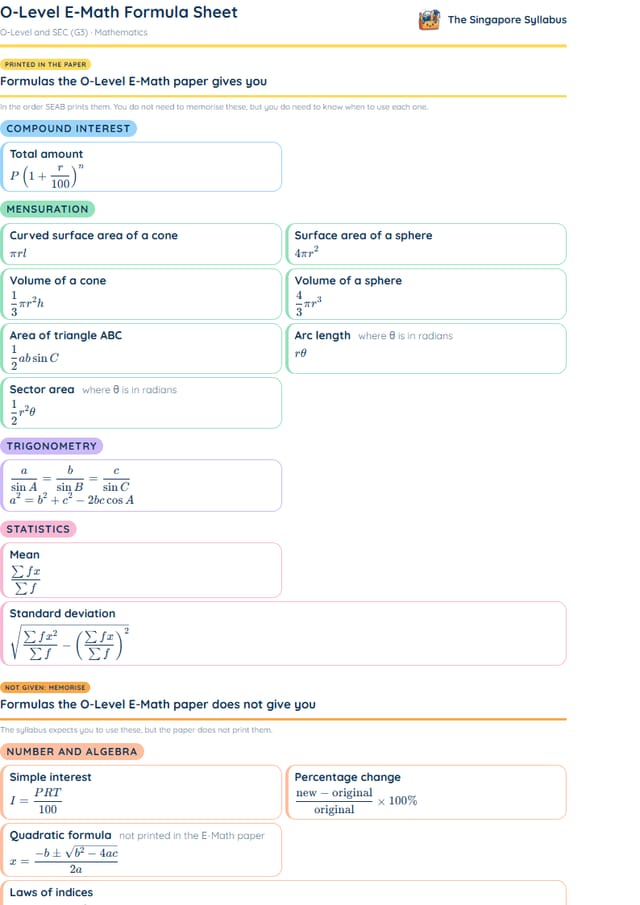
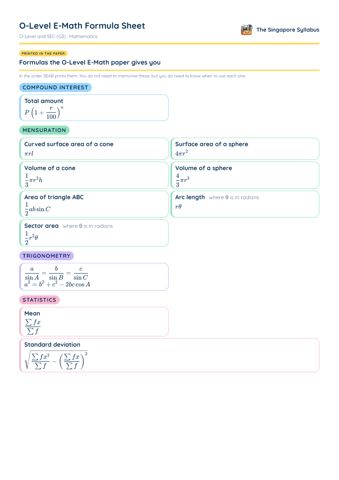
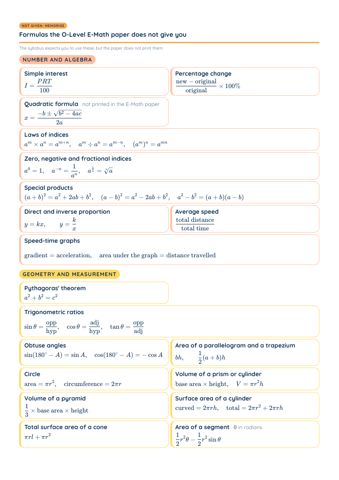
- 5 pages
- A4 portrait
Printed in the paper
Formulas the O-Level E-Math paper gives you
In the order SEAB prints them. You do not need to memorise these, but you do need to know when to use each one.
Compound interest
- Total amount
Mensuration
- Curved surface area of a cone
- Surface area of a sphere
- Volume of a cone
- Volume of a sphere
- Area of triangle ABC
- Arc lengthwhere θ is in radians
- Sector areawhere θ is in radians
Trigonometry
- Sine rule
- Cosine rule
Statistics
- Mean
- Standard deviation
Not given: memorise
Formulas the O-Level E-Math paper does not give you
The syllabus expects you to use these, but the paper does not print them.
Number and algebra
- Simple interest
- Percentage change
- Quadratic formulanot printed in the E-Math paper
- Laws of indices
- Zero, negative and fractional indices
- Special products
- Direct and inverse proportion
- Average speed
- Speed-time graphs
- gradientaccelerationarea under the graphdistance travelled
Geometry and measurement
- Pythagoras' theorem
- Trigonometric ratios
- Obtuse angles
- Area of a parallelogram and a trapezium
- Circle
- Volume of a prism or cylinder
- Volume of a pyramid
- Surface area of a cylinder
- Total surface area of a cone
- Area of a segmentθ in radians
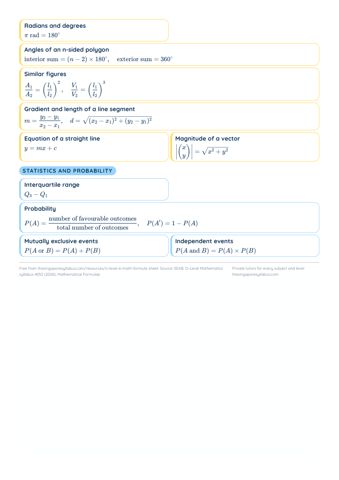
- Radians and degrees
- Angles of an n-sided polygon
- Similar figures
- Gradient and length of a line segment
- Equation of a straight line
Vectors
- Magnitude of a vector
- Vector from A to Ba and b are the position vectors of A and B
- Midpoint M of AB
- Parallel vectorsk is a number. If k is negative, p points the opposite way
- Collinear points A, B, Cthe vectors are parallel and share point B
Number patterns
- nth term of a linear sequencea is the first term, d the common difference
- nth term of a quadratic sequencethe second difference is 2a. Find b and c from the first two terms
- Is a number in the sequence?it is in the sequence only if n is a positive whole number
Units and standard form
- Area and volume units
- Speed units
- Standard form
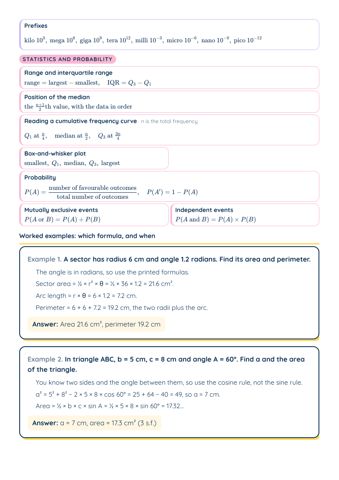
- Prefixes
Statistics and probability
- Range and interquartile range
- Position of the median
- the th value, with the data in order
- Reading a cumulative frequency curven is the total frequency
- Box-and-whisker plot
- Probability
- Mutually exclusive events
- Independent events
Facts and methods to quote in your working
Angle properties
Write the reason beside each angle you find. Markers look for it.
- Angles on a straight line
- add up to 180°.
- Angles at a point
- add up to 360°.
- Vertically opposite angles
- are equal.
- Corresponding angles, parallel lines
- are equal.
- Alternate angles, parallel lines
- are equal.
- Interior angles, parallel lines
- add up to 180°.
- Angle sum of a triangle
- is 180°. An exterior angle equals the sum of the two interior opposite angles.
- Isosceles triangle
- the base angles are equal.
Circle properties
- Angle in a semicircle
- is 90°.
- Tangent and radius
- a tangent is perpendicular to the radius at the point of contact.
- Tangents from an external point
- are equal in length.
- Angle at the centre
- is twice the angle at the circumference standing on the same arc.
- Angles in the same segment
- are equal.
- Angles in opposite segments
- add up to 180°, so opposite angles of a cyclic quadrilateral add up to 180°.
- Perpendicular from the centre to a chord
- bisects the chord.
- Equal chords
- are the same distance from the centre.
Congruence and similarity tests
- Congruent triangles
- SSS, SAS, ASA or AAS, and RHS for right-angled triangles.
- Similar triangles
- AA (two pairs of equal angles), SSS (all three pairs of sides in the same ratio) or SAS (two pairs of sides in the same ratio and the angles between them equal).
- Similar figures and solids
- lengths scale by k, areas by k² and volumes by k³.
Worked examples: which formula, and when
A sector has radius 6 cm and angle 1.2 radians. Find its area and perimeter.
- The angle is in radians, so use the printed formulas.
- Sector area = ½ × r² × θ = ½ × 36 × 1.2 = 21.6 cm².
- Arc length = r × θ = 6 × 1.2 = 7.2 cm.
- Perimeter = 6 + 6 + 7.2 = 19.2 cm, the two radii plus the arc.
Answer: Area 21.6 cm², perimeter 19.2 cm
In triangle ABC, b = 5 cm, c = 8 cm and angle A = 60°. Find a and the area of the triangle.
- You know two sides and the angle between them, so use the cosine rule, not the sine rule.
- a² = 5² + 8² − 2 × 5 × 8 × cos 60° = 25 + 64 − 40 = 49, so a = 7 cm.
- Area = ½ × b × c × sin A = ½ × 5 × 8 × sin 60° = 17.32…
Answer: a = 7 cm, area = 17.3 cm² (3 s.f.)
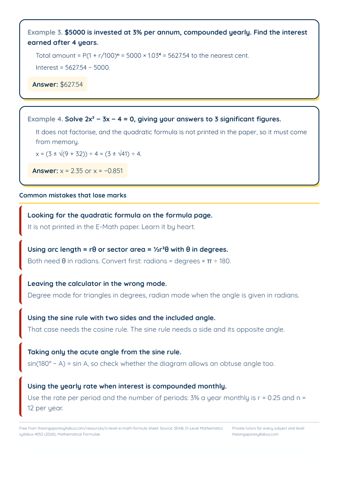
$5000 is invested at 3% per annum, compounded yearly. Find the interest earned after 4 years.
- Total amount = P(1 + r/100)ⁿ = 5000 × 1.03⁴ = 5627.54 to the nearest cent.
- Interest = 5627.54 − 5000.
Answer: $627.54
Solve 2x² − 3x − 4 = 0, giving your answers to 3 significant figures.
- It does not factorise, and the quadratic formula is not printed in the paper, so it must come from memory.
- x = (3 ± √(9 + 32)) ÷ 4 = (3 ± √41) ÷ 4.
Answer: x = 2.35 or x = −0.851
Common mistakes that lose marks
- Looking for the quadratic formula on the formula page. It is not printed in the E-Math paper. Learn it by heart.
- Using arc length = rθ or sector area = ½r²θ with θ in degrees. Both need θ in radians. Convert first: radians = degrees × π ÷ 180.
- Leaving the calculator in the wrong mode. Degree mode for triangles in degrees, radian mode when the angle is given in radians.
- Using the sine rule with two sides and the included angle. That case needs the cosine rule. The sine rule needs a side and its opposite angle.
- Taking only the acute angle from the sine rule. sin(180° − A) = sin A, so check whether the diagram allows an obtuse angle too.
- Using the yearly rate when interest is compounded monthly. Use the rate per period and the number of periods: 3% a year monthly is r = 0.25 and n = 12 per year.
Self-test: the formulas the paper does not give
Say or write the answer first, then tap to check.
What is the quadratic formula?
x = (−b ± √(b² − 4ac)) ÷ 2a, for ax² + bx + c = 0.
Volume of a pyramid?
One third × base area × height.
Area of a trapezium?
½ × (sum of the parallel sides) × height.
Area of a segment, with θ in radians?
½r²θ − ½r² sin θ, the sector minus the triangle.
Simple interest?
I = PRT ÷ 100.
nth term of a linear sequence?
Tₙ = a + (n − 1)d.
Gradient and length of the line from (x₁, y₁) to (x₂, y₂)?
Gradient (y₂ − y₁) ÷ (x₂ − x₁), length √((x₂ − x₁)² + (y₂ − y₁)²).
How do you show that A, B and C are collinear with vectors?
Show that AB = k × BC for a number k. The vectors are parallel and share point B.
Interquartile range?
Upper quartile minus lower quartile, Q₃ − Q₁.
Convert 72 km/h to m/s.
72 ÷ 3.6 = 20 m/s.
G2 Mathematics, G3 Mathematics and A-Math: which sheet is yours
The G2 and G3 Mathematics papers print the same 12 formulas. What differs is the content tested and the paper length. A-Math has its own list.
| SEC G2 Mathematics (K210) | SEC G3 Mathematics (K310) and O-Level 4052 | SEC G3 Additional Maths (K341) | |
|---|---|---|---|
| Formula list printed | The same 12 as G3: compound interest, cone, sphere, ½ab sin C, arc and sector in radians, sine and cosine rules, mean and standard deviation | The 12 on this sheet | Quadratic formula, binomial expansion, trigonometric identities, sine and cosine rules, area of a triangle |
| Quadratic formula | Tested but not printed | Tested but not printed | Printed |
| Vectors, matrices, sets and Venn diagrams | Not in the syllabus | In the syllabus | Assumes G3 Mathematics |
| Congruence and similarity tests | Not in the syllabus | In the syllabus | Used in plane geometry proofs |
| Radians, sine and cosine rules, circle properties, quartiles | In the syllabus, but underlined: tested only in one optional Paper 2 question | In the syllabus | Radians and trigonometry in more depth |
| Papers | Two papers, 2 h and 70 marks each | Two papers, 2 h 15 min and 90 marks each | Two papers, 2 h 15 min and 90 marks each |
| Calculator | Allowed in both papers | Allowed in both papers | Allowed in both papers |
A revision plan for the sheet, Sec 3 into Sec 4
For a student in Sec 3 now who sits the SEC G3 Mathematics paper in 2027. The written papers are expected in October and November 2027, as the O-Level papers were. Check SEAB's timetable when it is out.
- Nov and Dec 2026 Learn the formulas the paper does not give. Do the self-test above twice a week until every answer comes without a pause.
- Jan to Mar 2027 In topical practice, write the formula you are using before each answer and find it on the printed list or the memorise list.
- Apr to Jun 2027 Start full papers under time, with only the printed formula page beside you, as in the exam.
- Jul and Aug 2027 After the prelims, list every mark lost to a wrong or forgotten formula and redo those questions a week later.
- Sep and Oct 2027 Keep the self-test going weekly and do one timed paper a week. Check the calculator mode before every paper.
Questions students ask
Is the quadratic formula given in the O-Level E-Math paper?
No. The E-Math list of formulae does not include the quadratic formula, so you must know x = (−b ± √(b² − 4ac)) ÷ 2a by heart. It is printed only in the A-Math paper.
Is the formula sheet the same for the 2027 SEC (G3) Mathematics paper?
Yes. The SEC G3 Mathematics syllabus K310 for 2027 prints the same list of formulae as the final O-Level syllabus 4052, so this sheet works for both.
Do I get the formula for the volume of a pyramid?
No. Only the cone and sphere formulas are printed. The volume of a pyramid, one third of the base area times the height, has to be memorised, together with the areas of a trapezium and a circle.
Keep revising
- O-Level E-Math study guideA guide for every syllabus topic
- Secondary Maths tuitionE-Math and A-Math, Sec 1 to the SEC
- O-Level A-Math Formula SheetO-Level and SEC (G3) · free PDF
- O-Level Chemistry Periodic TableO-Level and SEC (G3) · free PDF
- O-Level Physics Formula SheetO-Level and SEC (G3) · free PDF
- Free exam calculatorsPSLE Score, L1R5 and UAS
- All free resourcesPSLE, O-Level and A-Level
More for this stage: O-Level Chemistry Qualitative Analysis Notes, SEC English Writing and Oral Checklists, SEC Social Studies Answer Guide, SEC English Oral and Essay Topics.
Source
- SEAB, O-Level Mathematics syllabus 4052 (2026), Mathematical Formulae
- SEAB, SEC G3 Mathematics syllabus K310 (2027), Mathematical Formulae
- SEAB, SEC G2 Mathematics syllabus K210 (2027), Mathematical Formulae
The exam paper itself is what counts on the day. If anything here differs from the SEAB document, the SEAB document is right. Tell us and we will fix it.