Free resource · SEC (G3 and G2)
SEC English Writing and Oral Checklists 2027: Free PDF
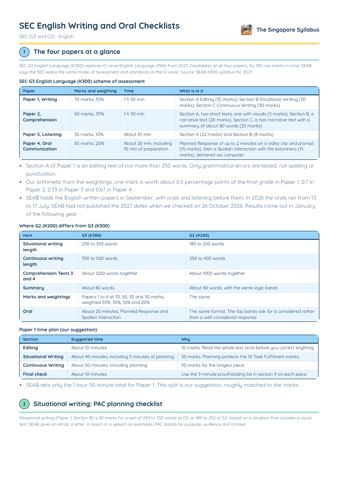
SEC G3 English Language (K300) has four papers: Writing (70 marks, 35%), Comprehension (50 marks, 35%), Listening (30 marks, 10%) and Oral Communication (30 marks, 20%). These printable checklists cover PAC planning and formats for situational writing, quick checks for continuous writing, the 10 minutes of oral preparation and the Spoken Interaction, comprehension and summary, and a final 5-minute proofread, with notes for G2 (K200).
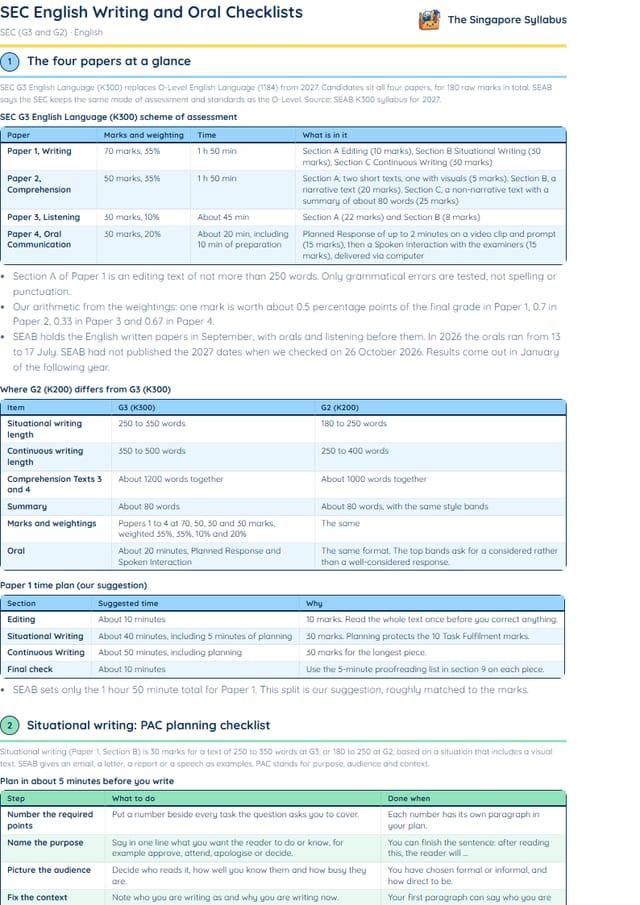
The four papers at a glance
SEC G3 English Language (K300) replaces O-Level English Language (1184) from 2027. Candidates sit all four papers, for 180 raw marks in total. SEAB says the SEC keeps the same mode of assessment and standards as the O-Level. Source: SEAB K300 syllabus for 2027.
| Paper | Marks and weighting | Time | What is in it |
|---|---|---|---|
| Paper 1, Writing | 70 marks, 35% | 1 h 50 min | Section A Editing (10 marks), Section B Situational Writing (30 marks), Section C Continuous Writing (30 marks) |
| Paper 2, Comprehension | 50 marks, 35% | 1 h 50 min | Section A, two short texts, one with visuals (5 marks). Section B, a narrative text (20 marks). Section C, a non-narrative text with a summary of about 80 words (25 marks) |
| Paper 3, Listening | 30 marks, 10% | About 45 min | Section A (22 marks) and Section B (8 marks) |
| Paper 4, Oral Communication | 30 marks, 20% | About 20 min, including 10 min of preparation | Planned Response of up to 2 minutes on a video clip and prompt (15 marks), then a Spoken Interaction with the examiners (15 marks), delivered via computer |
- Section A of Paper 1 is an editing text of not more than 250 words. Only grammatical errors are tested, not spelling or punctuation.
- Our arithmetic from the weightings: one mark is worth about 0.5 percentage points of the final grade in Paper 1, 0.7 in Paper 2, 0.33 in Paper 3 and 0.67 in Paper 4.
- SEAB holds the English written papers in September, with orals and listening before them. In 2026 the orals ran from 13 to 17 July. SEAB had not published the 2027 dates when we checked on 26 October 2026. Results come out in January of the following year.
| Item | G3 (K300) | G2 (K200) |
|---|---|---|
| Situational writing length | 250 to 350 words | 180 to 250 words |
| Continuous writing length | 350 to 500 words | 250 to 400 words |
| Comprehension Texts 3 and 4 | About 1200 words together | About 1000 words together |
| Summary | About 80 words | About 80 words, with the same style bands |
| Marks and weightings | Papers 1 to 4 at 70, 50, 30 and 30 marks, weighted 35%, 35%, 10% and 20% | The same |
| Oral | About 20 minutes, Planned Response and Spoken Interaction | The same format. The top bands ask for a considered rather than a well-considered response. |
| Section | Suggested time | Why |
|---|---|---|
| Editing | About 10 minutes | 10 marks. Read the whole text once before you correct anything. |
| Situational Writing | About 40 minutes, including 5 minutes of planning | 30 marks. Planning protects the 10 Task Fulfilment marks. |
| Continuous Writing | About 50 minutes, including planning | 30 marks for the longest piece. |
| Final check | About 10 minutes | Use the 5-minute proofreading list in section 9 on each piece. |
- SEAB sets only the 1 hour 50 minute total for Paper 1. This split is our suggestion, roughly matched to the marks.
Situational writing: PAC planning checklist
Situational writing (Paper 1, Section B) is 30 marks for a text of 250 to 350 words at G3, or 180 to 250 at G2, based on a situation that includes a visual text. SEAB gives an email, a letter, a report or a speech as examples. PAC stands for purpose, audience and context.
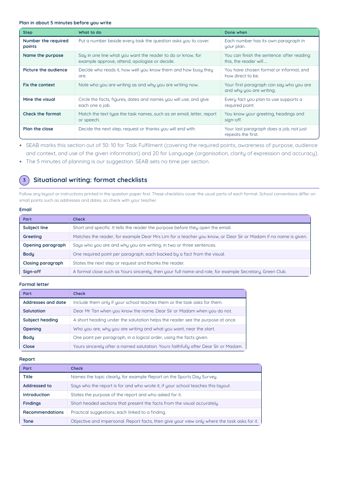
| Step | What to do | Done when |
|---|---|---|
| Number the required points | Put a number beside every task the question asks you to cover. | Each number has its own paragraph in your plan. |
| Name the purpose | Say in one line what you want the reader to do or know, for example approve, attend, apologise or decide. | You can finish the sentence: after reading this, the reader will ... |
| Picture the audience | Decide who reads it, how well you know them and how busy they are. | You have chosen formal or informal, and how direct to be. |
| Fix the context | Note who you are writing as and why you are writing now. | Your first paragraph can say who you are and why you are writing. |
| Mine the visual | Circle the facts, figures, dates and names you will use, and give each one a job. | Every fact you plan to use supports a required point. |
| Check the format | Match the text type the task names, such as an email, letter, report or speech. | You know your greeting, headings and sign-off. |
| Plan the close | Decide the next step, request or thanks you will end with. | Your last paragraph does a job, not just repeats the first. |
- SEAB marks this section out of 30: 10 for Task Fulfilment (covering the required points, awareness of purpose, audience and context, and use of the given information) and 20 for Language (organisation, clarity of expression and accuracy).
- The 5 minutes of planning is our suggestion. SEAB sets no time per section.
Situational writing: format checklists
Follow any layout or instructions printed in the question paper first. These checklists cover the usual parts of each format. School conventions differ on small points such as addresses and dates, so check with your teacher.
| Part | Check |
|---|---|
| Subject line | Short and specific. It tells the reader the purpose before they open the email. |
| Greeting | Matches the reader, for example Dear Mrs Lim for a teacher you know, or Dear Sir or Madam if no name is given. |
| Opening paragraph | Says who you are and why you are writing, in two or three sentences. |
| Body | One required point per paragraph, each backed by a fact from the visual. |
| Closing paragraph | States the next step or request and thanks the reader. |
| Sign-off | A formal close such as Yours sincerely, then your full name and role, for example Secretary, Green Club. |
| Part | Check |
|---|---|
| Addresses and date | Include them only if your school teaches them or the task asks for them. |
| Salutation | Dear Mr Tan when you know the name. Dear Sir or Madam when you do not. |
| Subject heading | A short heading under the salutation helps the reader see the purpose at once. |
| Opening | Who you are, why you are writing and what you want, near the start. |
| Body | One point per paragraph, in a logical order, using the facts given. |
| Close | Yours sincerely after a named salutation. Yours faithfully after Dear Sir or Madam. |
| Part | Check |
|---|---|
| Title | Names the topic clearly, for example Report on the Sports Day Survey. |
| Addressed to | Says who the report is for and who wrote it, if your school teaches this layout. |
| Introduction | States the purpose of the report and who asked for it. |
| Findings | Short headed sections that present the facts from the visual accurately. |
| Recommendations | Practical suggestions, each linked to a finding. |
| Tone | Objective and impersonal. Report facts, then give your view only where the task asks for it. |
| Part | Check |
|---|---|
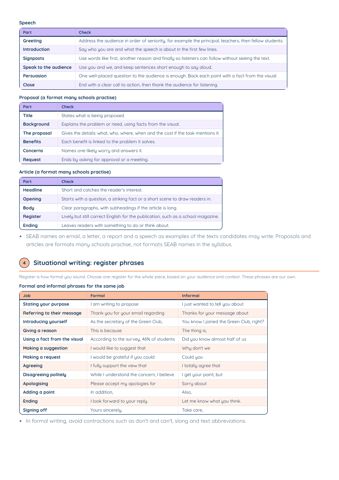
| Greeting | Address the audience in order of seniority, for example the principal, teachers, then fellow students. |
| Introduction | Say who you are and what the speech is about in the first few lines. |
| Signposts | Use words like first, another reason and finally so listeners can follow without seeing the text. |
| Speak to the audience | Use you and we, and keep sentences short enough to say aloud. |
| Persuasion | One well-placed question to the audience is enough. Back each point with a fact from the visual. |
| Close | End with a clear call to action, then thank the audience for listening. |
| Part | Check |
|---|---|
| Title | States what is being proposed. |
| Background | Explains the problem or need, using facts from the visual. |
| The proposal | Gives the details: what, who, where, when and the cost if the task mentions it. |
| Benefits | Each benefit is linked to the problem it solves. |
| Concerns | Names one likely worry and answers it. |
| Request | Ends by asking for approval or a meeting. |
| Part | Check |
|---|---|
| Headline | Short and catches the reader's interest. |
| Opening | Starts with a question, a striking fact or a short scene to draw readers in. |
| Body | Clear paragraphs, with subheadings if the article is long. |
| Register | Lively but still correct English for the publication, such as a school magazine. |
| Ending | Leaves readers with something to do or think about. |
- SEAB names an email, a letter, a report and a speech as examples of the texts candidates may write. Proposals and articles are formats many schools practise, not formats SEAB names in the syllabus.
Situational writing: register phrases
Register is how formal you sound. Choose one register for the whole piece, based on your audience and context. These phrases are our own.
| Job | Formal | Informal |
|---|---|---|
| Stating your purpose | I am writing to propose | I just wanted to tell you about |
| Referring to their message | Thank you for your email regarding | Thanks for your message about |
| Introducing yourself | As the secretary of the Green Club, | You know I joined the Green Club, right? |
| Giving a reason | This is because | The thing is, |
| Using a fact from the visual | According to the survey, 46% of students | Did you know almost half of us |
| Making a suggestion | I would like to suggest that | Why don't we |
| Making a request | I would be grateful if you could | Could you |
| Agreeing | I fully support the view that | I totally agree that |
| Disagreeing politely | While I understand the concern, I believe | I get your point, but |
| Apologising | Please accept my apologies for | Sorry about |
| Adding a point | In addition, | Also, |
| Ending | I look forward to your reply. | Let me know what you think. |
| Signing off | Yours sincerely, | Take care, |
- In formal writing, avoid contractions such as don't and can't, slang and text abbreviations.
| Too blunt or too casual | Better |
|---|---|
| You must approve this. | We hope you will consider approving this proposal. |
| The canteen food is terrible. | Many students feel the canteen menu could offer more variety. |
| Give us the hall on Friday. | Would it be possible to book the hall on Friday? |
| Your plan won't work. | There may be some difficulties with this plan, such as |
| Lots of people hate it. | A large number of students have raised concerns about it. |
| Hope you say yes. | Thank you for considering this request. |
Continuous writing quick checks
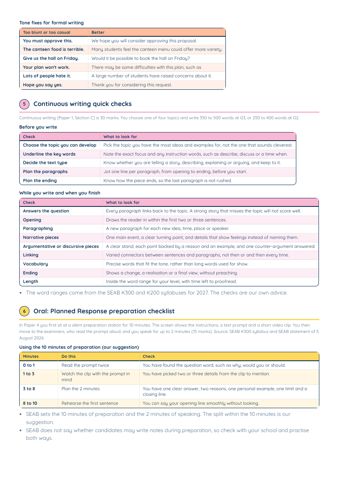
Continuous writing (Paper 1, Section C) is 30 marks. You choose one of four topics and write 350 to 500 words at G3, or 250 to 400 words at G2.
| Check | What to look for |
|---|---|
| Choose the topic you can develop | Pick the topic you have the most ideas and examples for, not the one that sounds cleverest. |
| Underline the key words | Note the exact focus and any instruction words, such as describe, discuss or a time when. |
| Decide the text type | Know whether you are telling a story, describing, explaining or arguing, and keep to it. |
| Plan the paragraphs | Jot one line per paragraph, from opening to ending, before you start. |
| Plan the ending | Know how the piece ends, so the last paragraph is not rushed. |
| Check | What to look for |
|---|---|
| Answers the question | Every paragraph links back to the topic. A strong story that misses the topic will not score well. |
| Opening | Draws the reader in within the first two or three sentences. |
| Paragraphing | A new paragraph for each new idea, time, place or speaker. |
| Narrative pieces | One main event, a clear turning point, and details that show feelings instead of naming them. |
| Argumentative or discursive pieces | A clear stand, each point backed by a reason and an example, and one counter-argument answered. |
| Linking | Varied connectors between sentences and paragraphs, not then or and then every time. |
| Vocabulary | Precise words that fit the tone, rather than long words used for show. |
| Ending | Shows a change, a realisation or a final view, without preaching. |
| Length | Inside the word range for your level, with time left to proofread. |
- The word ranges come from the SEAB K300 and K200 syllabuses for 2027. The checks are our own advice.
Oral: Planned Response preparation checklist
In Paper 4 you first sit at a silent preparation station for 10 minutes. The screen shows the instructions, a text prompt and a short video clip. You then move to the examiners, who read the prompt aloud, and you speak for up to 2 minutes (15 marks). Source: SEAB K300 syllabus and SEAB statement of 5 August 2026.
| Minutes | Do this | Check |
|---|---|---|
| 0 to 1 | Read the prompt twice | You have found the question word, such as why, would you or should. |
| 1 to 3 | Watch the clip with the prompt in mind | You have picked two or three details from the clip to mention. |
| 3 to 8 | Plan the 2 minutes | You have one clear answer, two reasons, one personal example, one limit and a closing line. |
| 8 to 10 | Rehearse the first sentence | You can say your opening line smoothly without looking. |
- SEAB sets the 10 minutes of preparation and the 2 minutes of speaking. The split within the 10 minutes is our suggestion.
- SEAB does not say whether candidates may write notes during preparation, so check with your school and practise both ways.
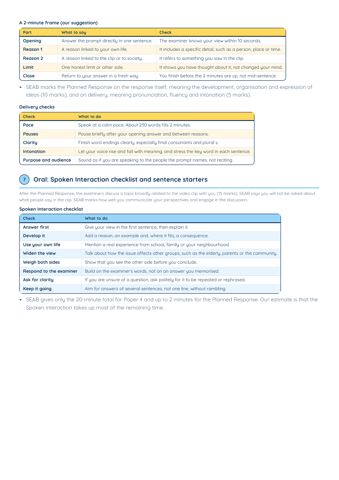
| Part | What to say | Check |
|---|---|---|
| Opening | Answer the prompt directly in one sentence. | The examiner knows your view within 10 seconds. |
| Reason 1 | A reason linked to your own life. | It includes a specific detail, such as a person, place or time. |
| Reason 2 | A reason linked to the clip or to society. | It refers to something you saw in the clip. |
| Limit | One honest limit or other side. | It shows you have thought about it, not changed your mind. |
| Close | Return to your answer in a fresh way. | You finish before the 2 minutes are up, not mid-sentence. |
- SEAB marks the Planned Response on the response itself, meaning the development, organisation and expression of ideas (10 marks), and on delivery, meaning pronunciation, fluency and intonation (5 marks).
| Check | What to do |
|---|---|
| Pace | Speak at a calm pace. About 250 words fills 2 minutes. |
| Pauses | Pause briefly after your opening answer and between reasons. |
| Clarity | Finish word endings clearly, especially final consonants and plural s. |
| Intonation | Let your voice rise and fall with meaning, and stress the key word in each sentence. |
| Purpose and audience | Sound as if you are speaking to the people the prompt names, not reciting. |
Oral: Spoken Interaction checklist and sentence starters
After the Planned Response, the examiners discuss a topic broadly related to the video clip with you (15 marks). SEAB says you will not be asked about what people say in the clip. SEAB marks how well you communicate your perspectives and engage in the discussion.
| Check | What to do |
|---|---|
| Answer first | Give your view in the first sentence, then explain it. |
| Develop it | Add a reason, an example and, where it fits, a consequence. |
| Use your own life | Mention a real experience from school, family or your neighbourhood. |
| Widen the view | Talk about how the issue affects other groups, such as the elderly, parents or the community. |
| Weigh both sides | Show that you see the other side before you conclude. |
| Respond to the examiner | Build on the examiner's words, not on an answer you memorised. |
| Ask for clarity | If you are unsure of a question, ask politely for it to be repeated or rephrased. |
| Keep it going | Aim for answers of several sentences, not one line, without rambling. |
- SEAB gives only the 20-minute total for Paper 4 and up to 2 minutes for the Planned Response. Our estimate is that the Spoken Interaction takes up most of the remaining time.
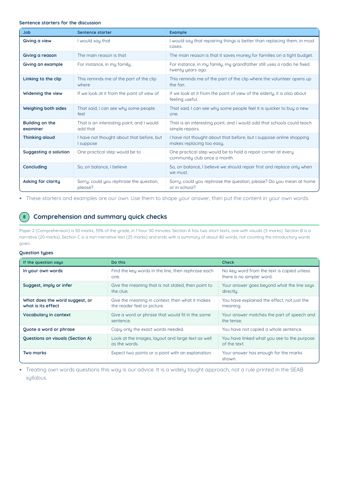
| Job | Sentence starter | Example |
|---|---|---|
| Giving a view | I would say that | I would say that repairing things is better than replacing them, in most cases. |
| Giving a reason | The main reason is that | The main reason is that it saves money for families on a tight budget. |
| Giving an example | For instance, in my family, | For instance, in my family, my grandfather still uses a radio he fixed twenty years ago. |
| Linking to the clip | This reminds me of the part of the clip where | This reminds me of the part of the clip where the volunteer opens up the fan. |
| Widening the view | If we look at it from the point of view of | If we look at it from the point of view of the elderly, it is also about feeling useful. |
| Weighing both sides | That said, I can see why some people feel | That said, I can see why some people feel it is quicker to buy a new one. |
| Building on the examiner | That is an interesting point, and I would add that | That is an interesting point, and I would add that schools could teach simple repairs. |
| Thinking aloud | I have not thought about that before, but I suppose | I have not thought about that before, but I suppose online shopping makes replacing too easy. |
| Suggesting a solution | One practical step would be to | One practical step would be to hold a repair corner at every community club once a month. |
| Concluding | So, on balance, I believe | So, on balance, I believe we should repair first and replace only when we must. |
| Asking for clarity | Sorry, could you rephrase the question, please? | Sorry, could you rephrase the question, please? Do you mean at home or in school? |
- These starters and examples are our own. Use them to shape your answer, then put the content in your own words.
Comprehension and summary quick checks
Paper 2 (Comprehension) is 50 marks, 35% of the grade, in 1 hour 50 minutes. Section A has two short texts, one with visuals (5 marks). Section B is a narrative (20 marks). Section C is a non-narrative text (25 marks) and ends with a summary of about 80 words, not counting the introductory words given.
| If the question says | Do this | Check |
|---|---|---|
| In your own words | Find the key words in the line, then rephrase each one. | No key word from the text is copied unless there is no simpler word. |
| Suggest, imply or infer | Give the meaning that is not stated, then point to the clue. | Your answer goes beyond what the line says directly. |
| What does the word suggest, or what is its effect | Give the meaning in context, then what it makes the reader feel or picture. | You have explained the effect, not just the meaning. |
| Vocabulary in context | Give a word or phrase that would fit in the same sentence. | Your answer matches the part of speech and the tense. |
| Quote a word or phrase | Copy only the exact words needed. | You have not copied a whole sentence. |
| Questions on visuals (Section A) | Look at the images, layout and large text as well as the words. | You have linked what you see to the purpose of the text. |
| Two marks | Expect two points or a point with an explanation. | Your answer has enough for the marks shown. |
- Treating own words questions this way is our advice. It is a widely taught approach, not a rule printed in the SEAB syllabus.
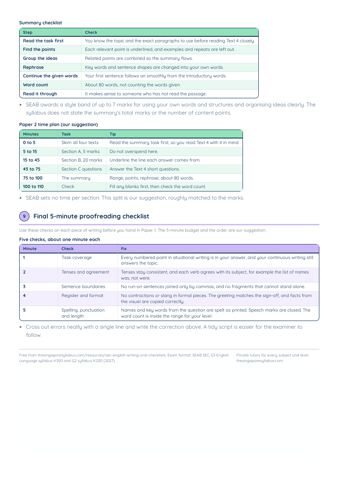
| Step | Check |
|---|---|
| Read the task first | You know the topic and the exact paragraphs to use before reading Text 4 closely. |
| Find the points | Each relevant point is underlined, and examples and repeats are left out. |
| Group the ideas | Related points are combined so the summary flows. |
| Rephrase | Key words and sentence shapes are changed into your own words. |
| Continue the given words | Your first sentence follows on smoothly from the introductory words. |
| Word count | About 80 words, not counting the words given. |
| Read it through | It makes sense to someone who has not read the passage. |
- SEAB awards a style band of up to 7 marks for using your own words and structures and organising ideas clearly. The syllabus does not state the summary's total marks or the number of content points.
| Minutes | Task | Tip |
|---|---|---|
| 0 to 5 | Skim all four texts | Read the summary task first, so you read Text 4 with it in mind. |
| 5 to 15 | Section A, 5 marks | Do not overspend here. |
| 15 to 45 | Section B, 20 marks | Underline the line each answer comes from. |
| 45 to 75 | Section C questions | Answer the Text 4 short questions. |
| 75 to 100 | The summary | Range, points, rephrase, about 80 words. |
| 100 to 110 | Check | Fill any blanks first, then check the word count. |
- SEAB sets no time per section. This split is our suggestion, roughly matched to the marks.
Final 5-minute proofreading checklist
Use these checks on each piece of writing before you hand in Paper 1. The 5-minute budget and the order are our suggestion.
| Minute | Check | Fix |
|---|---|---|
| 1 | Task coverage | Every numbered point in situational writing is in your answer, and your continuous writing still answers the topic. |
| 2 | Tenses and agreement | Tenses stay consistent, and each verb agrees with its subject, for example the list of names was, not were. |
| 3 | Sentence boundaries | No run-on sentences joined only by commas, and no fragments that cannot stand alone. |
| 4 | Register and format | No contractions or slang in formal pieces. The greeting matches the sign-off, and facts from the visual are copied correctly. |
| 5 | Spelling, punctuation and length | Names and key words from the question are spelt as printed. Speech marks are closed. The word count is inside the range for your level. |
- Cross out errors neatly with a single line and write the correction above. A tidy script is easier for the examiner to follow.
Download the free PDFPDF · 7 pages · A4 portrait · free, no sign-up
Real school papersNow practise with real O-Level school papers178 primary papers in Maths and Science and 112 secondary papers in E-Math, A-Math, Physics, Chemistry and Biology, set by Singapore schools. Most come with answers.See all 290 papers
Inside the PDF
7 A4 pages, ready to print. Tap a page to open the PDF there.
Questions students ask
How many words is SEC English situational writing?
The SEAB syllabuses for 2027 ask for 250 to 350 words at G3 (K300) and 180 to 250 words at G2 (K200). It is worth 30 marks: 10 for Task Fulfilment and 20 for Language. SEAB does not publish a penalty for going outside the range.
Which formats can come out for situational writing?
SEAB gives an email, a letter, a report and a speech as examples, and the task is based on a situation that includes a visual text. Proposals and articles are formats many schools also practise, so this booklet includes checklists for them too.
Can I write notes during the 10 minutes of oral preparation?
SEAB does not say. During preparation the screen shows the instructions, a text prompt and a video clip, and you then give a Planned Response of up to 2 minutes. Check with your school and practise planning both with and without notes.
How many marks is the SEC English summary worth?
The K300 syllabus does not state the total. It says the summary is about 80 words, not counting the introductory words, and gives a style band of up to 7 marks for using your own words and organising ideas clearly. The rest of the credit comes from the points you find.
Keep revising
- SEC English study guideSEC English exam format and tips
- O-Level E-Math Formula SheetO-Level and SEC (G3) · free PDF
- O-Level A-Math Formula SheetO-Level and SEC (G3) · free PDF
- O-Level Chemistry Periodic TableO-Level and SEC (G3) · free PDF
- O-Level Physics Formula SheetO-Level and SEC (G3) · free PDF
- O-Level Chemistry Qualitative Analysis NotesO-Level and SEC (G3) · free PDF
- SEC Social Studies Answer GuideSEC (G3 and G2) · free PDF
- Free exam calculatorsPSLE Score, L1R5 and UAS
- All free resourcesPSLE, O-Level and A-Level
Source
- SEAB, SEC G3 English Language syllabus K300 (2027), Scheme of Assessment and Band Descriptors
- SEAB, SEC G2 English Language syllabus K200 (2027)
- SEAB, O-Level English oral exam statement (5 August 2026)
The checklists, phrases, sentence starters and time plans are our own. The exam format details come from the SEAB syllabuses, and if they differ, the SEAB document is right. Tell us and we will fix it.
Want an English tutor?
Tell us the level and we send a shortlist of tutors on WhatsApp within 16 hours. You choose the tutor. About English tuition