Free resource · O-Level and SEC (G3)
O-Level Chemistry Periodic Table (6092): Free PDF
The O-Level Chemistry paper prints a periodic table with the proton number, symbol, name and relative atomic mass of every element, rounded to whole numbers except chlorine at 35.5. Under the table it gives the molar volume of a gas, 24 dm³ at room temperature and pressure, and the Avogadro constant, 6.02 × 10²³ mol⁻¹.
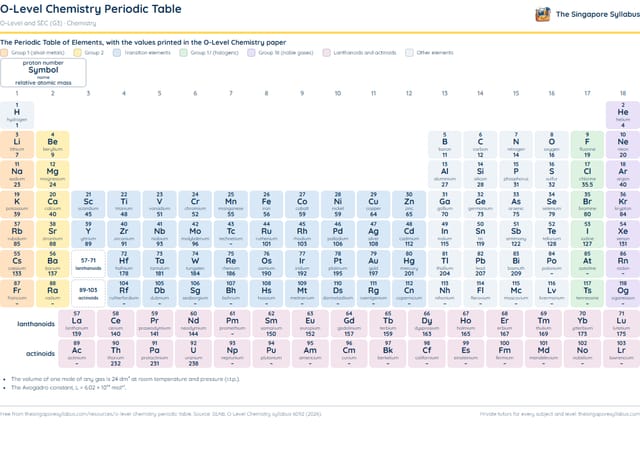
- Group 1 (alkali metals)
- Group 2
- Transition elements
- Group 17 (halogens)
- Group 18 (noble gases)
- Lanthanoids and actinoids
- Other elements
Swipe sideways to see all 18 groups.
- The volume of one mole of any gas is 24 dm³ at room temperature and pressure (r.t.p.).
- The Avogadro constant, L = 6.02 × 10²³ mol⁻¹.
All elements A to Z, with relative atomic mass
| Element | Symbol | Proton number | Relative atomic mass |
|---|---|---|---|
| actinium | Ac | 89 | – |
| aluminium | Al | 13 | 27 |
| americium | Am | 95 | – |
| antimony | Sb | 51 | 122 |
| argon | Ar | 18 | 40 |
| arsenic | As | 33 | 75 |
| astatine | At | 85 | – |
| barium | Ba | 56 | 137 |
| berkelium | Bk | 97 | – |
| beryllium | Be | 4 | 9 |
| bismuth | Bi | 83 | 209 |
| bohrium | Bh | 107 | – |
| boron | B | 5 | 11 |
| bromine | Br | 35 | 80 |
| cadmium | Cd | 48 | 112 |
| caesium | Cs | 55 | 133 |
| calcium | Ca | 20 | 40 |
| californium | Cf | 98 | – |
| carbon | C | 6 | 12 |
| cerium | Ce | 58 | 140 |
| chlorine | Cl | 17 | 35.5 |
| chromium | Cr | 24 | 52 |
| cobalt | Co | 27 | 59 |
| copernicium | Cn | 112 | – |
| copper | Cu | 29 | 64 |
| curium | Cm | 96 | – |
| darmstadtium | Ds | 110 | – |
| dubnium | Db | 105 | – |
| dysprosium | Dy | 66 | 163 |
| einsteinium | Es | 99 | – |
| erbium | Er | 68 | 167 |
| europium | Eu | 63 | 152 |
| fermium | Fm | 100 | – |
| flerovium | Fl | 114 | – |
| fluorine | F | 9 | 19 |
| francium | Fr | 87 | – |
| gadolinium | Gd | 64 | 157 |
| gallium | Ga | 31 | 70 |
| germanium | Ge | 32 | 73 |
| gold | Au | 79 | 197 |
| hafnium | Hf | 72 | 178 |
| hassium | Hs | 108 | – |
| helium | He | 2 | 4 |
| holmium | Ho | 67 | 165 |
| hydrogen | H | 1 | 1 |
| indium | In | 49 | 115 |
| iodine | I | 53 | 127 |
| iridium | Ir | 77 | 192 |
| iron | Fe | 26 | 56 |
| krypton | Kr | 36 | 84 |
| lanthanum | La | 57 | 139 |
| lawrencium | Lr | 103 | – |
| lead | Pb | 82 | 207 |
| lithium | Li | 3 | 7 |
| livermorium | Lv | 116 | – |
| lutetium | Lu | 71 | 175 |
| magnesium | Mg | 12 | 24 |
| manganese | Mn | 25 | 55 |
| meitnerium | Mt | 109 | – |
| mendelevium | Md | 101 | – |
| mercury | Hg | 80 | 201 |
| molybdenum | Mo | 42 | 96 |
| moscovium | Mc | 115 | – |
| neodymium | Nd | 60 | 144 |
| neon | Ne | 10 | 20 |
| neptunium | Np | 93 | – |
| nickel | Ni | 28 | 59 |
| nihonium | Nh | 113 | – |
| niobium | Nb | 41 | 93 |
| nitrogen | N | 7 | 14 |
| nobelium | No | 102 | – |
| oganesson | Og | 118 | – |
| osmium | Os | 76 | 190 |
| oxygen | O | 8 | 16 |
| palladium | Pd | 46 | 106 |
| phosphorus | P | 15 | 31 |
| platinum | Pt | 78 | 195 |
| plutonium | Pu | 94 | – |
| polonium | Po | 84 | – |
| potassium | K | 19 | 39 |
| praseodymium | Pr | 59 | 141 |
| promethium | Pm | 61 | – |
| protactinium | Pa | 91 | 231 |
| radium | Ra | 88 | – |
| radon | Rn | 86 | – |
| rhenium | Re | 75 | 186 |
| rhodium | Rh | 45 | 103 |
| roentgenium | Rg | 111 | – |
| rubidium | Rb | 37 | 85 |
| ruthenium | Ru | 44 | 101 |
| rutherfordium | Rf | 104 | – |
| samarium | Sm | 62 | 150 |
| scandium | Sc | 21 | 45 |
| seaborgium | Sg | 106 | – |
| selenium | Se | 34 | 79 |
| silicon | Si | 14 | 28 |
| silver | Ag | 47 | 108 |
| sodium | Na | 11 | 23 |
| strontium | Sr | 38 | 88 |
| sulfur | S | 16 | 32 |
| tantalum | Ta | 73 | 181 |
| technetium | Tc | 43 | – |
| tellurium | Te | 52 | 128 |
| tennessine | Ts | 117 | – |
| terbium | Tb | 65 | 159 |
| thallium | Tl | 81 | 204 |
| thorium | Th | 90 | 232 |
| thulium | Tm | 69 | 169 |
| tin | Sn | 50 | 119 |
| titanium | Ti | 22 | 48 |
| tungsten | W | 74 | 184 |
| uranium | U | 92 | 238 |
| vanadium | V | 23 | 51 |
| xenon | Xe | 54 | 131 |
| ytterbium | Yb | 70 | 173 |
| yttrium | Y | 39 | 89 |
| zinc | Zn | 30 | 65 |
| zirconium | Zr | 40 | 91 |
Questions students ask
What relative atomic mass should I use for chlorine?
Use 35.5. It is the only element on the O-Level table given to one decimal place. Every other relative atomic mass is a whole number, so copper is 64 and magnesium is 24.
Is the periodic table given in every O-Level Chemistry paper?
Yes. The 6092 syllabus states that a copy of the Periodic Table of Elements is printed as part of the papers, so you do not need to memorise relative atomic masses.
What is the molar volume of a gas at r.t.p.?
24 dm³ per mole at room temperature and pressure. It is printed under the periodic table, so moles of gas = volume in dm³ ÷ 24.
Keep revising
- O-Level Chemistry study guideA guide for every syllabus topic
- PSLE Math FormulasPSLE (Primary 6) · free PDF
- O-Level E-Math Formula SheetO-Level and SEC (G3) · free PDF
- O-Level A-Math Formula SheetO-Level and SEC (G3) · free PDF
- O-Level Physics Formula SheetO-Level and SEC (G3) · free PDF
- O-Level Chemistry Qualitative Analysis NotesO-Level and SEC (G3) · free PDF
- H2 Chemistry Data BookletA-Level H2 (9476) · free PDF
- MF27 List of Formulae (H2 Math)A-Level H1, H2 and H3 Mathematics · free PDF
- H2 Physics Data and Formulae ListA-Level H2 (9478) · free PDF
- Free exam calculatorsPSLE Score, L1R5 and UAS
Source
The exam paper itself is what counts on the day. If anything here differs from the SEAB document, the SEAB document is right. Tell us and we will fix it.
Want a Chemistry tutor?
Tell us the level and we send a shortlist of tutors on WhatsApp within 16 hours. You choose the tutor. About Chemistry tuition