Free resource · O-Level and SEC (G3)

O-Level A-Math Formula Sheet (4049): Free PDF

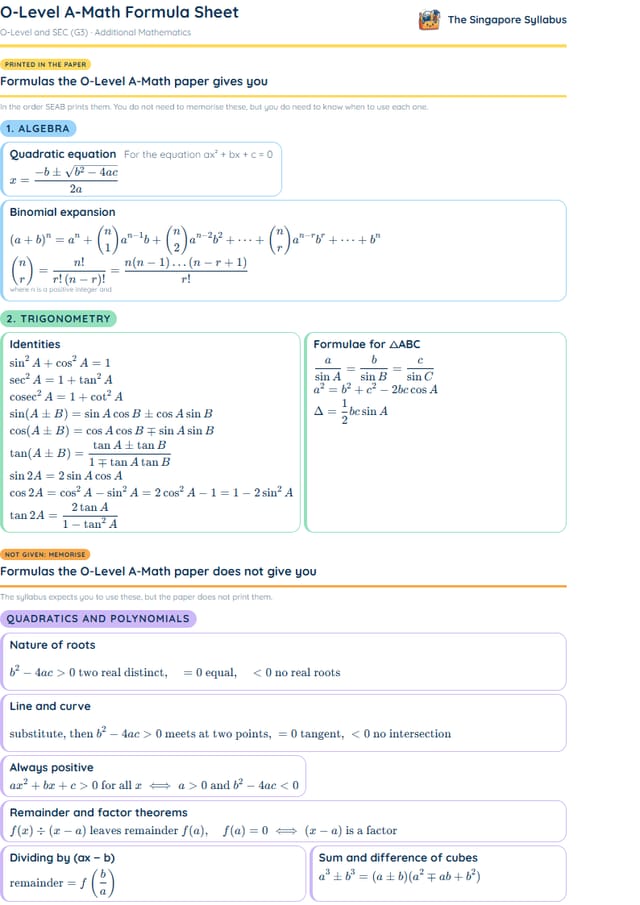
The O-Level A-Math paper prints the quadratic formula, the binomial expansion, the trigonometric identities including the addition and double angle formulae, and the sine rule, cosine rule and area of a triangle. It does not print any calculus results, laws of logarithms or circle equations, so those must be memorised.
PDF · 4 pages · A4 portrait · free, no sign-up

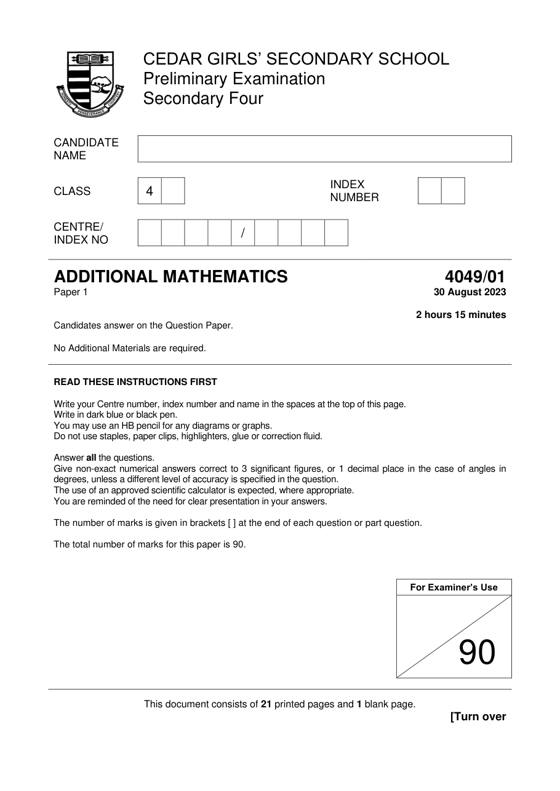
First page of the O-Level A-Math Formula Sheet PDF
  • PDF
  • 4 pages
  • A4 portrait

Printed in the paper

Formulas the O-Level A-Math paper gives you

In the order SEAB prints them. You do not need to memorise these, but you do need to know when to use each one.

1. Algebra

Quadratic equationFor the equation ax² + bx + c = 0
x=−b±b2−4ac2ax=\dfrac{-b\pm\sqrt{b^{2}-4ac}}{2a}
Binomial expansion
(a+b)n=an+(n1)an−1b+(n2)an−2b2+⋯+(nr)an−rbr+⋯+bn\displaystyle (a+b)^{n}=a^{n}+\binom{n}{1}a^{n-1}b+\binom{n}{2}a^{n-2}b^{2}+\dots+\binom{n}{r}a^{n-r}b^{r}+\dots+b^{n}
(nr)=n!r! (n−r)!=n(n−1)…(n−r+1)r!\binom{n}{r}=\dfrac{n!}{r!\,(n-r)!}=\dfrac{n(n-1)\dots(n-r+1)}{r!}where n is a positive integer and

2. Trigonometry

Identities
sin⁡2A+cos⁡2A=1\sin^{2}A+\cos^{2}A=1
sec⁡2A=1+tan⁡2A\sec^{2}A=1+\tan^{2}A
cosec⁡2A=1+cot⁡2A\operatorname{cosec}^{2}A=1+\cot^{2}A
sin⁡(A±B)=sin⁡Acos⁡B±cos⁡Asin⁡B\sin(A\pm B)=\sin A\cos B\pm\cos A\sin B
cos⁡(A±B)=cos⁡Acos⁡B∓sin⁡Asin⁡B\cos(A\pm B)=\cos A\cos B\mp\sin A\sin B
tan⁡(A±B)=tan⁡A±tan⁡B1∓tan⁡Atan⁡B\tan(A\pm B)=\dfrac{\tan A\pm\tan B}{1\mp\tan A\tan B}
sin⁡2A=2sin⁡Acos⁡A\sin 2A=2\sin A\cos A
cos⁡2A=cos⁡2A−sin⁡2A=2cos⁡2A−1=1−2sin⁡2A\cos 2A=\cos^{2}A-\sin^{2}A=2\cos^{2}A-1=1-2\sin^{2}A
tan⁡2A=2tan⁡A1−tan⁡2A\tan 2A=\dfrac{2\tan A}{1-\tan^{2}A}
Formulae for △ABC
asin⁡A=bsin⁡B=csin⁡C\dfrac{a}{\sin A}=\dfrac{b}{\sin B}=\dfrac{c}{\sin C}
a2=b2+c2−2bccos⁡Aa^{2}=b^{2}+c^{2}-2bc\cos A
Δ=12bcsin⁡A\Delta=\dfrac{1}{2}bc\sin A

Not given: memorise

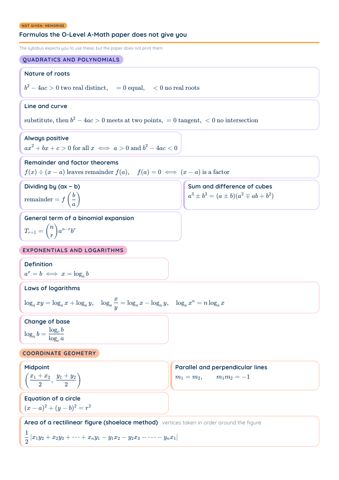
Formulas the O-Level A-Math paper does not give you

The syllabus expects you to use these, but the paper does not print them.

Quadratics and polynomials

Nature of roots
b2−4ac>0 \displaystyle b^{2}-4ac>0\ two real distinct,=0 \displaystyle ,\quad =0\ equal,<0 \displaystyle ,\quad <0\ no real roots
Line and curve
substitute, then b2−4ac>0 \displaystyle b^{2}-4ac>0\ meets at two points, =0 \displaystyle ,\ =0\ tangent, <0 \displaystyle ,\ <0\ no intersection
Always positive
ax2+bx+c>0 for all x  ⟺  a>0 and b2−4ac<0ax^{2}+bx+c>0\ \text{for all }x\iff a>0\ \text{and}\ b^{2}-4ac<0
Remainder and factor theorems
f(x)÷(x−a) \displaystyle f(x)\div(x-a)\ leaves remainder f(a),f(a)=0  ⟺  (x−a) \displaystyle \ f(a),\quad f(a)=0\iff (x-a)\ is a factor
Dividing by (ax − b)
remainder=f(ba)\text{remainder}=f\left(\dfrac{b}{a}\right)
Sum and difference of cubes
a3±b3=(a±b)(a2∓ab+b2)a^{3}\pm b^{3}=(a\pm b)(a^{2}\mp ab+b^{2})
General term of a binomial expansion
Tr+1=(nr)an−rbrT_{r+1}=\binom{n}{r}a^{n-r}b^{r}

Exponentials and logarithms

Definition
ax=b  ⟺  x=log⁡aba^{x}=b\iff x=\log_{a}b
Laws of logarithms
log⁡axy=log⁡ax+log⁡ay,\displaystyle \log_{a}xy=\log_{a}x+\log_{a}y, log⁡axy=log⁡ax−log⁡ay,\displaystyle \log_{a}\dfrac{x}{y}=\log_{a}x-\log_{a}y, log⁡axn=nlog⁡ax\displaystyle \log_{a}x^{n}=n\log_{a}x
Change of base
log⁡ab=log⁡cblog⁡ca\log_{a}b=\dfrac{\log_{c}b}{\log_{c}a}

Coordinate geometry

Midpoint
(x1+x22, y1+y22)\left(\dfrac{x_{1}+x_{2}}{2},\ \dfrac{y_{1}+y_{2}}{2}\right)
Parallel and perpendicular lines
m1=m2,\displaystyle m_{1}=m_{2}, m1m2=−1\displaystyle m_{1}m_{2}=-1
Equation of a circle
(x−a)2+(y−b)2=r2(x-a)^{2}+(y-b)^{2}=r^{2}
Area of a rectilinear figure (shoelace method)vertices taken in order around the figure
12∣x1y2+x2y3+⋯+xny1−y1x2−y2x3−⋯−ynx1∣\displaystyle \dfrac{1}{2}\left|x_{1}y_{2}+x_{2}y_{3}+\dots+x_{n}y_{1}-y_{1}x_{2}-y_{2}x_{3}-\dots-y_{n}x_{1}\right|
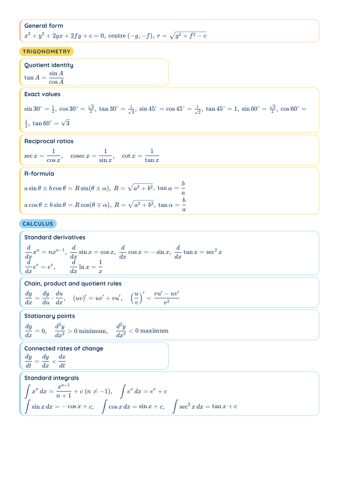
General form
x2+y2+2gx+2fy+c=0, centre (−g,−f), r=g2+f2−cx^{2}+y^{2}+2gx+2fy+c=0,\ \text{centre }(-g,-f),\ r=\sqrt{g^{2}+f^{2}-c}

Trigonometry

Quotient identity
tan⁡A=sin⁡Acos⁡A\tan A=\dfrac{\sin A}{\cos A}
Exact values
sin⁡30∘=12, cos⁡30∘=32, tan⁡30∘=13, sin⁡45∘=cos⁡45∘=12, tan⁡45∘=1, sin⁡60∘=32, cos⁡60∘=12, tan⁡60∘=3\displaystyle \sin 30^{\circ}=\tfrac{1}{2},\ \cos 30^{\circ}=\tfrac{\sqrt{3}}{2},\ \tan 30^{\circ}=\tfrac{1}{\sqrt{3}},\ \sin 45^{\circ}=\cos 45^{\circ}=\tfrac{1}{\sqrt{2}},\ \tan 45^{\circ}=1,\ \sin 60^{\circ}=\tfrac{\sqrt{3}}{2},\ \cos 60^{\circ}=\tfrac{1}{2},\ \tan 60^{\circ}=\sqrt{3}
Reciprocal ratios
sec⁡x=1cos⁡x,\displaystyle \sec x=\dfrac{1}{\cos x}, cosec⁡x=1sin⁡x,\displaystyle \operatorname{cosec}x=\dfrac{1}{\sin x}, cot⁡x=1tan⁡x\displaystyle \cot x=\dfrac{1}{\tan x}
R-formula
asin⁡θ±bcos⁡θ=Rsin⁡(θ±α), R=a2+b2, tan⁡α=ba\displaystyle a\sin\theta\pm b\cos\theta=R\sin(\theta\pm\alpha),\ R=\sqrt{a^{2}+b^{2}},\ \tan\alpha=\dfrac{b}{a}
acos⁡θ±bsin⁡θ=Rcos⁡(θ∓α), R=a2+b2, tan⁡α=ba\displaystyle a\cos\theta\pm b\sin\theta=R\cos(\theta\mp\alpha),\ R=\sqrt{a^{2}+b^{2}},\ \tan\alpha=\dfrac{b}{a}

Calculus

Standard derivatives
ddxxn=nxn−1, ddxsin⁡x=cos⁡x, ddxcos⁡x=−sin⁡x, ddxtan⁡x=sec⁡2x\displaystyle \dfrac{d}{dx}x^{n}=nx^{n-1},\ \dfrac{d}{dx}\sin x=\cos x,\ \dfrac{d}{dx}\cos x=-\sin x,\ \dfrac{d}{dx}\tan x=\sec^{2}x
ddxex=ex,\displaystyle \dfrac{d}{dx}e^{x}=e^{x}, ddxln⁡x=1x\displaystyle \dfrac{d}{dx}\ln x=\dfrac{1}{x}
Chain, product and quotient rules
dydx=dydu⋅dudx,\displaystyle \dfrac{dy}{dx}=\dfrac{dy}{du}\cdot\dfrac{du}{dx}, (uv)′=uv′+vu′,\displaystyle (uv)'=uv'+vu', (uv)′=vu′−uv′v2\displaystyle \left(\dfrac{u}{v}\right)'=\dfrac{vu'-uv'}{v^{2}}
Stationary points
dydx=0,\displaystyle \dfrac{dy}{dx}=0, d2ydx2>0 minimum,\displaystyle \dfrac{d^{2}y}{dx^{2}}>0\ \text{minimum}, d2ydx2<0 maximum\displaystyle \dfrac{d^{2}y}{dx^{2}}<0\ \text{maximum}
Connected rates of change
dydt=dydx×dxdt\dfrac{dy}{dt}=\dfrac{dy}{dx}\times\dfrac{dx}{dt}
Standard integrals
∫xn dx=xn+1n+1+c (n≠−1),\displaystyle \int x^{n}\,dx=\dfrac{x^{n+1}}{n+1}+c\ (n\neq-1), ∫ex dx=ex+c\displaystyle \int e^{x}\,dx=e^{x}+c
∫sin⁡x dx=−cos⁡x+c,\displaystyle \int \sin x\,dx=-\cos x+c, ∫cos⁡x dx=sin⁡x+c,\displaystyle \int\cos x\,dx=\sin x+c, ∫sec⁡2x dx=tan⁡x+c\displaystyle \int\sec^{2}x\,dx=\tan x+c
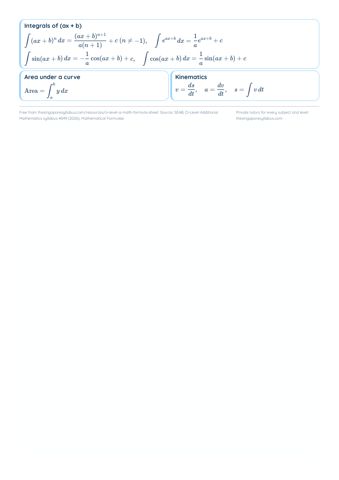
Integrals of (ax + b)
∫(ax+b)n dx=(ax+b)n+1a(n+1)+c (n≠−1),\displaystyle \int (ax+b)^{n}\,dx=\dfrac{(ax+b)^{n+1}}{a(n+1)}+c\ (n\neq-1), ∫eax+b dx=1aeax+b+c\displaystyle \int e^{ax+b}\,dx=\dfrac{1}{a}e^{ax+b}+c
∫sin⁡(ax+b) dx=−1acos⁡(ax+b)+c,\displaystyle \int\sin(ax+b)\,dx=-\dfrac{1}{a}\cos(ax+b)+c, ∫cos⁡(ax+b) dx=1asin⁡(ax+b)+c\displaystyle \int\cos(ax+b)\,dx=\dfrac{1}{a}\sin(ax+b)+c
Area under a curve
Area=∫aby dx\text{Area}=\int_{a}^{b}y\,dx
Kinematics
v=dsdt,\displaystyle v=\dfrac{ds}{dt}, a=dvdt,\displaystyle a=\dfrac{dv}{dt}, s=∫v dt\displaystyle s=\int v\,dt

Inside the PDF

4 A4 pages, ready to print. Tap a page to open the PDF there.

Download the free PDFPDF · 4 pages · A4 portrait · free, no sign-up
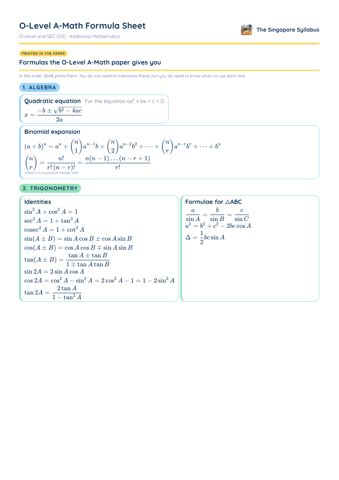
  1. O-Level A-Math Formula Sheet PDF, page 1 of 4: Algebra, TrigonometryPage 1
  2. O-Level A-Math Formula Sheet PDF, page 2 of 4: Quadratics and polynomials, Exponentials and logarithms, Coordinate geometryPage 2
  3. O-Level A-Math Formula Sheet PDF, page 3 of 4: CalculusPage 3
  4. O-Level A-Math Formula Sheet PDF, page 4 of 4: Calculus (continued)Page 4
Real school papersNow practise with real O-Level school papers252 primary papers in Maths and Science and 119 secondary papers in E-Math, A-Math, Physics, Chemistry and Biology, set by Singapore schools. Most come with answers.See all 371 papers

Questions students ask

Are differentiation and integration formulas given in O-Level A-Math?

No. The A-Math list of formulae covers algebra and trigonometry only. The derivatives and integrals of xⁿ, sin x, cos x, tan x, eˣ and ln x, and the chain, product and quotient rules, all have to be memorised.

Is the A-Math formula list the same for the 2027 SEC (G3) paper?

Yes. The SEC G3 Additional Mathematics syllabus K341 for 2027 prints the same list of formulae as the final O-Level syllabus 4049.

Do I need to memorise the double angle formulae?

No. sin 2A, cos 2A in all three forms, and tan 2A are printed in the paper, together with the addition formulae. What you must know is when to use them, for example rewriting cos 2A as 1 − 2sin²A to form a quadratic in sin A.