Free resource · SEC (G3), Sec 3 and 4
Chinese Oral Checklist 2027 (SEC 华文口试): Free PDF
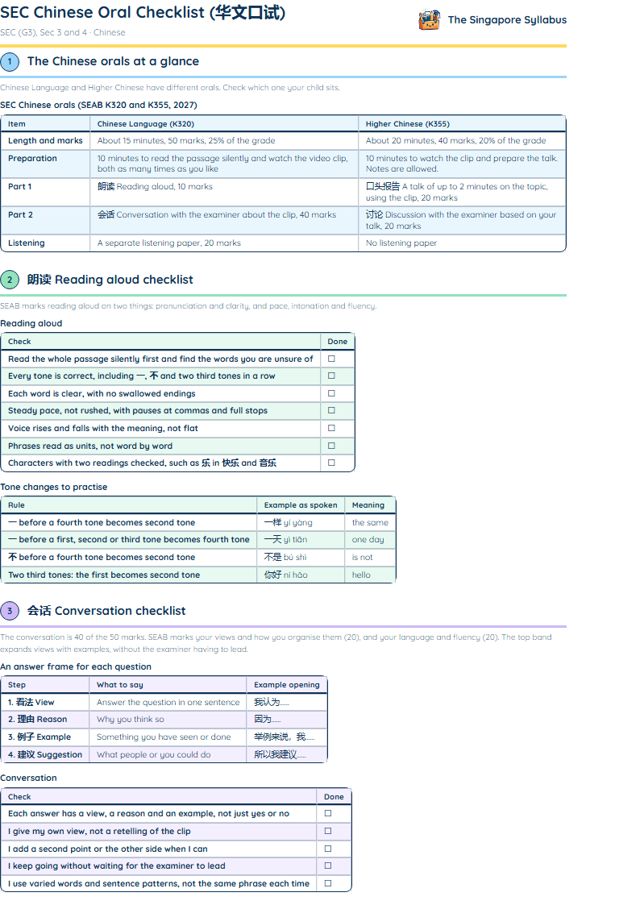
The 2027 SEC Chinese Language oral (K320) is about 15 minutes and 50 marks: reading aloud for 10 marks and a conversation about a video clip for 40, after 10 minutes of preparation. Higher Chinese (K355) has a talk of up to 2 minutes and a discussion, 20 marks each. This checklist covers what SEAB marks in each part, the tone changes to practise, an answer frame and phrases with Hanyu Pinyin.

- 2 pages
- A4 portrait
The Chinese orals at a glance
Chinese Language and Higher Chinese have different orals. Check which one your child sits.
| Item | Chinese Language (K320) | Higher Chinese (K355) |
|---|---|---|
| Length and marks | About 15 minutes, 50 marks, 25% of the grade | About 20 minutes, 40 marks, 20% of the grade |
| Preparation | 10 minutes to read the passage silently and watch the video clip, both as many times as you like | 10 minutes to watch the clip and prepare the talk. Notes are allowed. |
| Part 1 | 朗读 Reading aloud, 10 marks | 口头报告 A talk of up to 2 minutes on the topic, using the clip, 20 marks |
| Part 2 | 会话 Conversation with the examiner about the clip, 40 marks | 讨论 Discussion with the examiner based on your talk, 20 marks |
| Listening | A separate listening paper, 20 marks | No listening paper |
朗读 Reading aloud checklist
SEAB marks reading aloud on two things: pronunciation and clarity, and pace, intonation and fluency.
| Check | Done |
|---|---|
| Read the whole passage silently first and find the words you are unsure of | ☐ |
| Every tone is correct, including 一, 不 and two third tones in a row | ☐ |
| Each word is clear, with no swallowed endings | ☐ |
| Steady pace, not rushed, with pauses at commas and full stops | ☐ |
| Voice rises and falls with the meaning, not flat | ☐ |
| Phrases read as units, not word by word | ☐ |
| Characters with two readings checked, such as 乐 in 快乐 and 音乐 | ☐ |
| Rule | Example as spoken | Meaning |
|---|---|---|
| 一 before a fourth tone becomes second tone | 一样 yí yàng | the same |
| 一 before a first, second or third tone becomes fourth tone | 一天 yì tiān | one day |
| 不 before a fourth tone becomes second tone | 不是 bú shì | is not |
| Two third tones: the first becomes second tone | 你好 ní hǎo | hello |
会话 Conversation checklist
The conversation is 40 of the 50 marks. SEAB marks your views and how you organise them (20), and your language and fluency (20). The top band expands views with examples, without the examiner having to lead.
| Step | What to say | Example opening |
|---|---|---|
| 1. 看法 View | Answer the question in one sentence | 我认为…… |
| 2. 理由 Reason | Why you think so | 因为…… |
| 3. 例子 Example | Something you have seen or done | 举例来说,我…… |
| 4. 建议 Suggestion | What people or you could do | 所以我建议…… |
| Check | Done |
|---|---|
| Each answer has a view, a reason and an example, not just yes or no | ☐ |
| I give my own view, not a retelling of the clip | ☐ |
| I add a second point or the other side when I can | ☐ |
| I keep going without waiting for the examiner to lead | ☐ |
| I use varied words and sentence patterns, not the same phrase each time | ☐ |
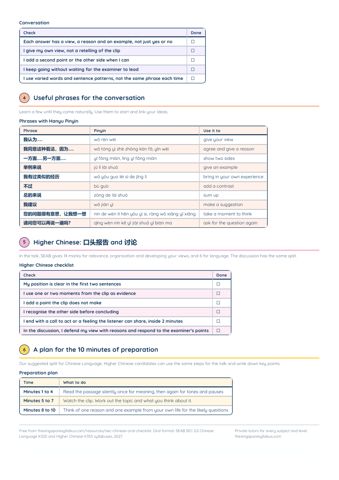
Useful phrases for the conversation
Learn a few until they come naturally. Use them to start and link your ideas.
| Phrase | Pinyin | Use it to |
|---|---|---|
| 我认为…… | wǒ rèn wéi | give your view |
| 我同意这种看法,因为…… | wǒ tóng yì zhè zhǒng kàn fǎ, yīn wèi | agree and give a reason |
| 一方面……另一方面…… | yī fāng miàn, lìng yī fāng miàn | show two sides |
| 举例来说 | jǔ lì lái shuō | give an example |
| 我有过类似的经历 | wǒ yǒu guo lèi sì de jīng lì | bring in your own experience |
| 不过 | bù guò | add a contrast |
| 总的来说 | zǒng de lái shuō | sum up |
| 我建议 | wǒ jiàn yì | make a suggestion |
| 您的问题很有意思,让我想一想 | nín de wèn tí hěn yǒu yì si, ràng wǒ xiǎng yī xiǎng | take a moment to think |
| 请问您可以再说一遍吗? | qǐng wèn nín kě yǐ zài shuō yī biàn ma | ask for the question again |
Higher Chinese: 口头报告 and 讨论
In the talk, SEAB gives 14 marks for relevance, organisation and developing your views, and 6 for language. The discussion has the same split.
| Check | Done |
|---|---|
| My position is clear in the first two sentences | ☐ |
| I use one or two moments from the clip as evidence | ☐ |
| I add a point the clip does not make | ☐ |
| I recognise the other side before concluding | ☐ |
| I end with a call to act or a feeling the listener can share, inside 2 minutes | ☐ |
| In the discussion, I defend my view with reasons and respond to the examiner's points | ☐ |
A plan for the 10 minutes of preparation
Our suggested split for Chinese Language. Higher Chinese candidates can use the same steps for the talk and write down key points.
| Time | What to do |
|---|---|
| Minutes 1 to 4 | Read the passage silently once for meaning, then again for tones and pauses |
| Minutes 5 to 7 | Watch the clip. Work out the topic and what you think about it. |
| Minutes 8 to 10 | Think of one reason and one example from your own life for the likely questions |
Inside the PDF
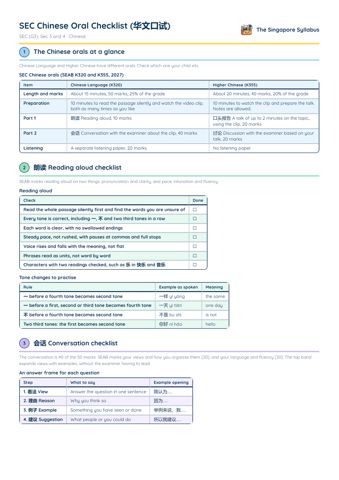
2 A4 pages, ready to print. Tap a page to open the PDF there.
Download the free PDFPDF · 2 pages · A4 portrait · free, no sign-up
Questions students ask
How many marks is the SEC Chinese oral?
For G3 Chinese Language (K320) the oral is 50 marks, 25% of the grade: reading aloud 10 marks and conversation 40 marks. For Higher Chinese (K355) it is 40 marks, 20% of the grade: a talk of 20 marks and a discussion of 20.
How long is the preparation time?
10 minutes for both. In Chinese Language you read the passage silently and watch the video clip, both as many times as you like. In Higher Chinese you watch the clip and prepare your talk, and you may write down key points.
Can I take notes for the Chinese Language oral?
The K320 syllabus does not say. Only the Higher Chinese syllabus K355 says candidates may write down key points. Ask your school how your exam centre runs it, and practise both ways.
What do examiners look for in the conversation?
SEAB marks your views and how you organise them out of 20, and your language and fluency out of 20. Answers that give a view, a reason and an example without needing the examiner to lead reach the top band.
Keep revising
- SEC Chinese oral guideFormat and model answers
- O-Level and SEC Chinese study guideThe whole Chinese paper
- O-Level E-Math Formula SheetO-Level and SEC (G3) · free PDF
- O-Level A-Math Formula SheetO-Level and SEC (G3) · free PDF
- O-Level Chemistry Periodic TableO-Level and SEC (G3) · free PDF
- Free exam calculatorsPSLE Score, L1R5 and UAS
- All free resourcesPSLE, O-Level and A-Level
More for this stage: O-Level Physics Formula Sheet, O-Level Chemistry Qualitative Analysis Notes, SEC English Writing and Oral Checklists, SEC Social Studies Answer Guide, SEC English Oral and Essay Topics.
Source
- SEAB, SEC G3 Chinese Language syllabus K320 (2027)
- SEAB, SEC G3 Higher Chinese Language syllabus K355 (2027)
- SEAB, G3 syllabuses for school candidates (2027)
The checklists, answer frame and phrases are our own. The oral details come from the SEAB syllabuses, and if they differ, the SEAB document is right. Tell us and we will fix it.