Free resource · O-Level and SEC (G3)
O-Level Physics Formula Sheet (6091): Free PDF
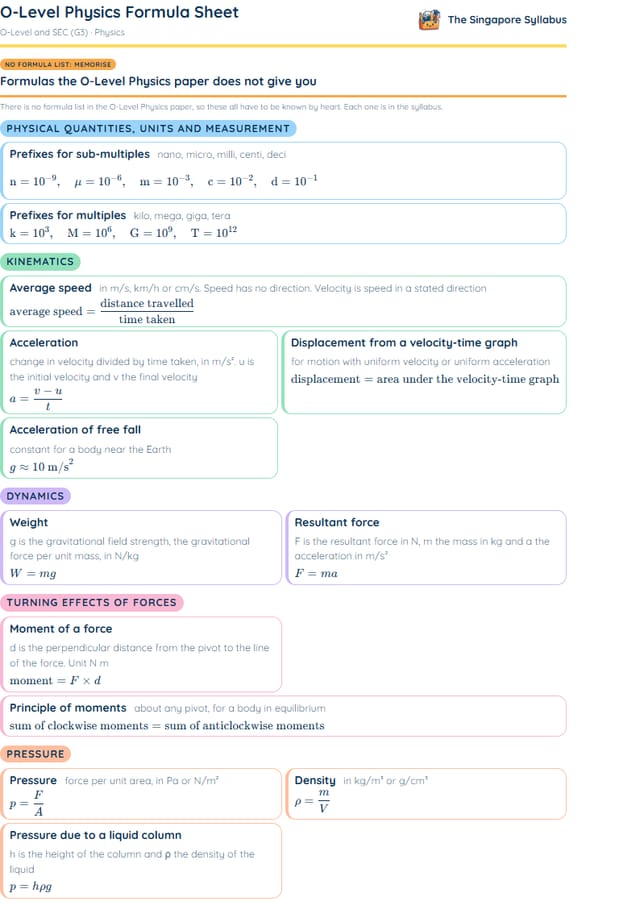
The O-Level Physics paper does not print a formula list, so every equation has to be memorised. The main ones are W = mg, F = ma, p = F/A, ρ = m/V, Ek = ½mv², Ep = mgh, E = mcΔθ, v = fλ, Q = It, R = V/I, P = VI and the transformer equation Vp/Vs = Np/Ns. The 2027 SEC (G3) Physics syllabus K323 asks for the same equations.
No formula list: memorise
Formulas the O-Level Physics paper does not give you
There is no formula list in the O-Level Physics paper, so these all have to be known by heart. Each one is in the syllabus.
Physical quantities, units and measurement
- Prefixes for sub-multiplesnano, micro, milli, centi, deci
- Prefixes for multipleskilo, mega, giga, tera
Kinematics
- Average speedin m/s, km/h or cm/s. Speed has no direction. Velocity is speed in a stated direction
- Accelerationchange in velocity divided by time taken, in m/s². u is the initial velocity and v the final velocity
- Displacement from a velocity-time graphfor motion with uniform velocity or uniform acceleration
- Acceleration of free fallconstant for a body near the Earth
Dynamics
- Weightg is the gravitational field strength, the gravitational force per unit mass, in N/kg
- Resultant forceF is the resultant force in N, m the mass in kg and a the acceleration in m/s²
Turning effects of forces
- Moment of a forced is the perpendicular distance from the pivot to the line of the force. Unit N m
- Principle of momentsabout any pivot, for a body in equilibrium
Pressure
- Pressureforce per unit area, in Pa or N/m²
- Densityin kg/m³ or g/cm³
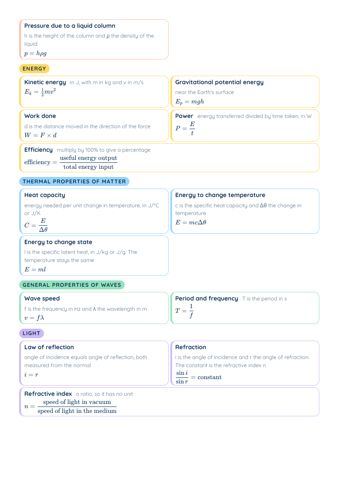
- Pressure due to a liquid columnh is the height of the column and ρ the density of the liquid
Energy
- Kinetic energyin J, with m in kg and v in m/s
- Gravitational potential energynear the Earth's surface
- Work doned is the distance moved in the direction of the force
- Powerenergy transferred divided by time taken, in W
- Efficiencymultiply by 100% to give a percentage
Thermal properties of matter
- Heat capacityenergy needed per unit change in temperature, in J/°C or J/K
- Energy to change temperaturec is the specific heat capacity and Δθ the change in temperature
- Energy to change statel is the specific latent heat, in J/kg or J/g. The temperature stays the same
General properties of waves
- Wave speedf is the frequency in Hz and λ the wavelength in m
- Period and frequencyT is the period in s
Light
- Law of reflectionangle of incidence equals angle of reflection, both measured from the normal
- Refractioni is the angle of incidence and r the angle of refraction. The constant is the refractive index n
- Refractive indexa ratio, so it has no unit
Current of electricity
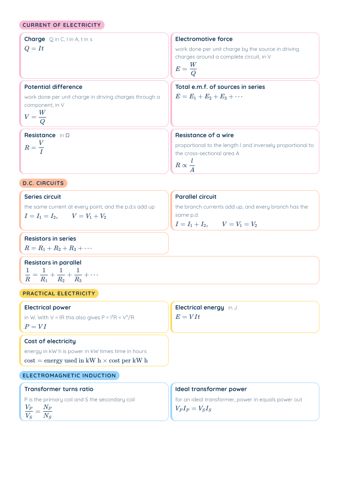
- ChargeQ in C, I in A, t in s
- Electromotive forcework done per unit charge by the source in driving charges around a complete circuit, in V
- Potential differencework done per unit charge in driving charges through a component, in V
- Total e.m.f. of sources in series
- Resistancein Ω
- Resistance of a wireproportional to the length l and inversely proportional to the cross-sectional area A
D.C. circuits
- Series circuitthe same current at every point, and the p.d.s add up
- Parallel circuitthe branch currents add up, and every branch has the same p.d.
- Resistors in series
- Resistors in parallel
Practical electricity
- Electrical powerin W. With V = IR this also gives P = I²R = V²/R
- Electrical energyin J
- Cost of electricityenergy in kW h is power in kW times time in hours
Electromagnetic induction
- Transformer turns ratioP is the primary coil and S the secondary coil
- Ideal transformer powerfor an ideal transformer, power in equals power out
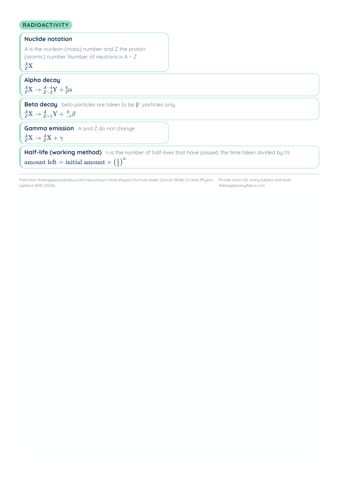
Radioactivity
- Nuclide notationA is the nucleon (mass) number and Z the proton (atomic) number. Number of neutrons is A − Z
- Alpha decay
- Beta decaybeta particles are taken to be β⁻ particles only
- Gamma emissionA and Z do not change
- Half-life (working method)n is the number of half-lives that have passed, the time taken divided by t½
Questions students ask
Is a formula sheet given in O-Level Physics?
No. The 6091 syllabus asks you to recall and apply each equation and does not include a list of formulae for the paper. You need to know every equation on this sheet by heart. An approved calculator may be used in all papers.
What value of g should I use?
The syllabus states that the acceleration of free fall for a body near the Earth is constant and approximately 10 m/s². The same g is the gravitational field strength, so it can also be written as 10 N/kg.
Is this list the same for the 2027 SEC (G3) Physics paper?
Yes. The learning outcomes in the SEC G3 Physics syllabus K323 for 2027 ask for the same equations as the O-Level syllabus 6091, so this sheet works for both.
Do I need to memorise E = mc² or a lens formula?
No. The syllabus says recall of the energy-mass equivalence is not required. For lenses it asks for ray diagrams and the characteristics of images, not a lens formula. For the resistance of a wire you only need the proportionality R ∝ l/A.
Keep revising
- O-Level Physics study guideA guide for every syllabus topic
- O-Level E-Math Formula SheetO-Level and SEC (G3) · free PDF
- O-Level A-Math Formula SheetO-Level and SEC (G3) · free PDF
- O-Level Chemistry Periodic TableO-Level and SEC (G3) · free PDF
- O-Level Chemistry Qualitative Analysis NotesO-Level and SEC (G3) · free PDF
- Free exam calculatorsPSLE Score, L1R5 and UAS
- All free resourcesPSLE, O-Level and A-Level
Source
The exam paper itself is what counts on the day. If anything here differs from the SEAB document, the SEAB document is right. Tell us and we will fix it.
Want a Physics tutor?
Tell us the level and we send a shortlist of tutors on WhatsApp within 16 hours. You choose the tutor. About Physics tuition