Free resource · SEC (G3 and G2)
SEC Social Studies Answer Guide 2027: Free PDF
SEC Social Studies is Paper 1 of every Combined Humanities subject from 2027: one 1 h 45 min paper worth 50 marks, with a 35-mark source-based case study and two structured-response questions worth 15. This guide gives sentence-starter frames for each common source question, PEEL frames for both structured-response questions, a pre-submission checklist and the common mistakes with a fix for each.
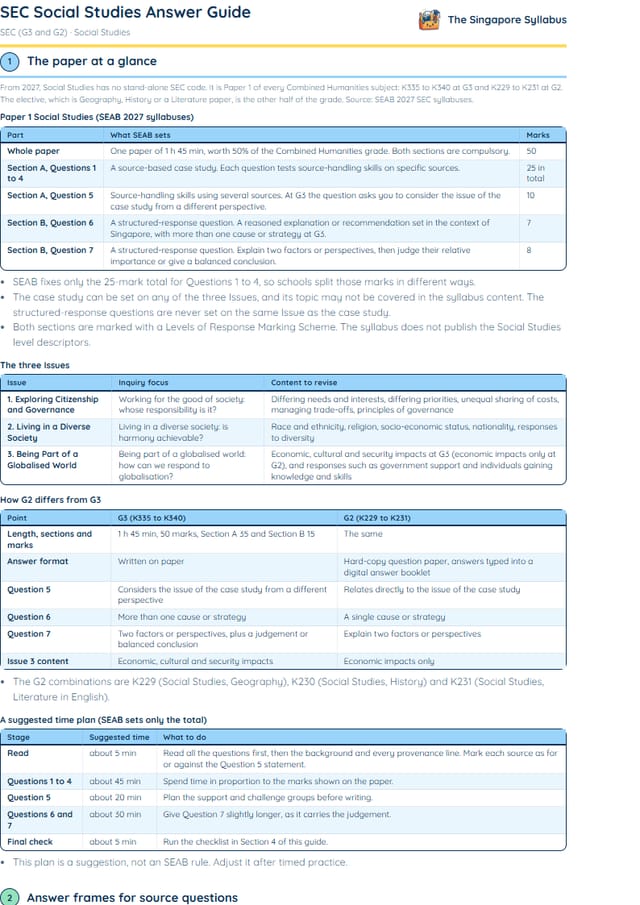
The paper at a glance
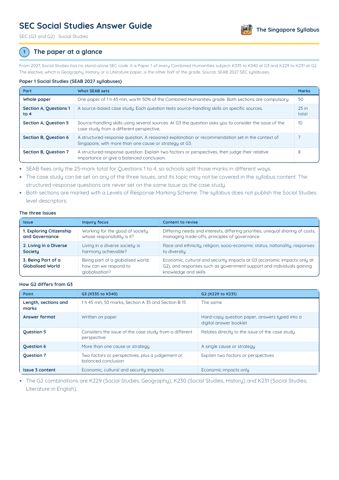
From 2027, Social Studies has no stand-alone SEC code. It is Paper 1 of every Combined Humanities subject: K335 to K340 at G3 and K229 to K231 at G2. The elective, which is Geography, History or a Literature paper, is the other half of the grade. Source: SEAB 2027 SEC syllabuses.
| Part | What SEAB sets | Marks |
|---|---|---|
| Whole paper | One paper of 1 h 45 min, worth 50% of the Combined Humanities grade. Both sections are compulsory. | 50 |
| Section A, Questions 1 to 4 | A source-based case study. Each question tests source-handling skills on specific sources. | 25 in total |
| Section A, Question 5 | Source-handling skills using several sources. At G3 the question asks you to consider the issue of the case study from a different perspective. | 10 |
| Section B, Question 6 | A structured-response question. A reasoned explanation or recommendation set in the context of Singapore, with more than one cause or strategy at G3. | 7 |
| Section B, Question 7 | A structured-response question. Explain two factors or perspectives, then judge their relative importance or give a balanced conclusion. | 8 |
- SEAB fixes only the 25-mark total for Questions 1 to 4, so schools split those marks in different ways.
- The case study can be set on any of the three Issues, and its topic may not be covered in the syllabus content. The structured-response questions are never set on the same Issue as the case study.
- Both sections are marked with a Levels of Response Marking Scheme. The syllabus does not publish the Social Studies level descriptors.
| Issue | Inquiry focus | Content to revise |
|---|---|---|
| 1. Exploring Citizenship and Governance | Working for the good of society: whose responsibility is it? | Differing needs and interests, differing priorities, unequal sharing of costs, managing trade-offs, principles of governance |
| 2. Living in a Diverse Society | Living in a diverse society: is harmony achievable? | Race and ethnicity, religion, socio-economic status, nationality, responses to diversity |
| 3. Being Part of a Globalised World | Being part of a globalised world: how can we respond to globalisation? | Economic, cultural and security impacts at G3 (economic impacts only at G2), and responses such as government support and individuals gaining knowledge and skills |
| Point | G3 (K335 to K340) | G2 (K229 to K231) |
|---|---|---|
| Length, sections and marks | 1 h 45 min, 50 marks, Section A 35 and Section B 15 | The same |
| Answer format | Written on paper | Hard-copy question paper, answers typed into a digital answer booklet |
| Question 5 | Considers the issue of the case study from a different perspective | Relates directly to the issue of the case study |
| Question 6 | More than one cause or strategy | A single cause or strategy |
| Question 7 | Two factors or perspectives, plus a judgement or balanced conclusion | Explain two factors or perspectives |
| Issue 3 content | Economic, cultural and security impacts | Economic impacts only |
- The G2 combinations are K229 (Social Studies, Geography), K230 (Social Studies, History) and K231 (Social Studies, Literature in English).
| Stage | Suggested time | What to do |
|---|---|---|
| Read | about 5 min | Read all the questions first, then the background and every provenance line. Mark each source as for or against the Question 5 statement. |
| Questions 1 to 4 | about 45 min | Spend time in proportion to the marks shown on the paper. |
| Question 5 | about 20 min | Plan the support and challenge groups before writing. |
| Questions 6 and 7 | about 30 min | Give Question 7 slightly longer, as it carries the judgement. |
| Final check | about 5 min | Run the checklist in Section 4 of this guide. |
- This plan is a suggestion, not an SEAB rule. Adjust it after timed practice.
Answer frames for source questions
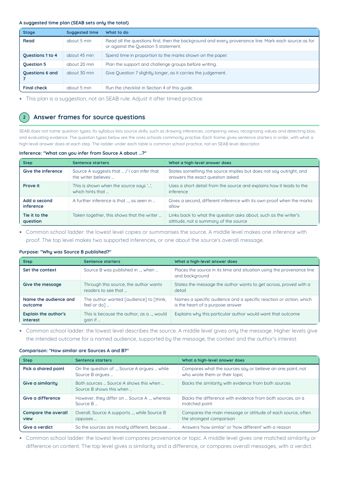
SEAB does not name question types. Its syllabus lists source skills, such as drawing inferences, comparing views, recognising values and detecting bias, and evaluating evidence. The question types below are the ones schools commonly practise. Each frame gives sentence starters in order, with what a high-level answer does at each step. The ladder under each table is common school practice, not an SEAB level descriptor.
| Step | Sentence starters | What a high-level answer does |
|---|---|---|
| Give the inference | Source A suggests that ... / I can infer that the writer believes ... | States something the source implies but does not say outright, and answers the exact question asked |
| Prove it | This is shown when the source says '...', which hints that ... | Uses a short detail from the source and explains how it leads to the inference |
| Add a second inference | A further inference is that ..., as seen in ... | Gives a second, different inference with its own proof when the marks allow |
| Tie it to the question | Taken together, this shows that the writer ... | Links back to what the question asks about, such as the writer's attitude, not a summary of the source |
- Common school ladder: the lowest level copies or summarises the source. A middle level makes one inference with proof. The top level makes two supported inferences, or one about the source's overall message.
| Step | Sentence starters | What a high-level answer does |
|---|---|---|
| Set the context | Source B was published in ..., when ... | Places the source in its time and situation using the provenance line and background |
| Give the message | Through this source, the author wants readers to see that ... | States the message the author wants to get across, proved with a detail |
| Name the audience and outcome | The author wanted [audience] to [think, feel or do] ... | Names a specific audience and a specific reaction or action, which is the heart of a purpose answer |
| Explain the author's interest | This is because the author, as a ..., would gain if ... | Explains why this particular author would want that outcome |
- Common school ladder: the lowest level describes the source. A middle level gives only the message. Higher levels give the intended outcome for a named audience, supported by the message, the context and the author's interest.
| Step | Sentence starters | What a high-level answer does |
|---|---|---|
| Pick a shared point | On the question of ..., Source A argues ... while Source B argues ... | Compares what the sources say or believe on one point, not who wrote them or their topic |
| Give a similarity | Both sources ... Source A shows this when ... Source B shows this when ... | Backs the similarity with evidence from both sources |
| Give a difference | However, they differ on ... Source A ..., whereas Source B ... | Backs the difference with evidence from both sources, on a matched point |
| Compare the overall view | Overall, Source A supports ..., while Source B opposes ... | Compares the main message or attitude of each source, often the strongest comparison |
| Give a verdict | So the sources are mostly different, because ... | Answers 'how similar' or 'how different' with a reason |
- Common school ladder: the lowest level compares provenance or topic. A middle level gives one matched similarity or difference on content. The top level gives a similarity and a difference, or compares overall messages, with a verdict.
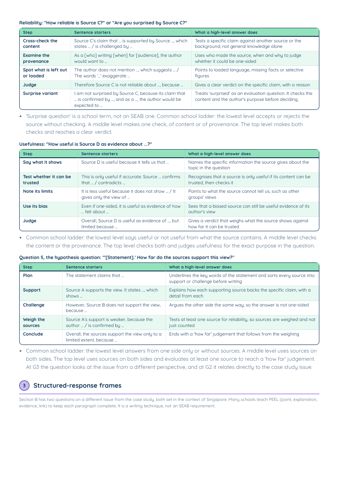
| Step | Sentence starters | What a high-level answer does |
|---|---|---|
| Cross-check the content | Source C's claim that ... is supported by Source ..., which states ... / is challenged by ... | Tests a specific claim against another source or the background, not general knowledge alone |
| Examine the provenance | As a [who] writing [when] for [audience], the author would want to ... | Uses who made the source, when and why to judge whether it could be one-sided |
| Spot what is left out or loaded | The author does not mention ..., which suggests ... / The words '...' exaggerate ... | Points to loaded language, missing facts or selective figures |
| Judge | Therefore Source C is not reliable about ..., because ... | Gives a clear verdict on the specific claim, with a reason |
| Surprise variant | I am not surprised by Source C, because its claim that ... is confirmed by ..., and as a ..., the author would be expected to ... | Treats 'surprised' as an evaluation question. It checks the content and the author's purpose before deciding. |
- 'Surprise question' is a school term, not an SEAB one. Common school ladder: the lowest level accepts or rejects the source without checking. A middle level makes one check, of content or of provenance. The top level makes both checks and reaches a clear verdict.
| Step | Sentence starters | What a high-level answer does |
|---|---|---|
| Say what it shows | Source D is useful because it tells us that ... | Names the specific information the source gives about the topic in the question |
| Test whether it can be trusted | This is only useful if accurate. Source ... confirms that ... / contradicts ... | Recognises that a source is only useful if its content can be trusted, then checks it |
| Note its limits | It is less useful because it does not show ... / It gives only the view of ... | Points to what the source cannot tell us, such as other groups' views |
| Use its bias | Even if one-sided, it is useful as evidence of how ... felt about ... | Sees that a biased source can still be useful evidence of its author's view |
| Judge | Overall, Source D is useful as evidence of ..., but limited because ... | Gives a verdict that weighs what the source shows against how far it can be trusted |
- Common school ladder: the lowest level says useful or not useful from what the source contains. A middle level checks the content or the provenance. The top level checks both and judges usefulness for the exact purpose in the question.
| Step | Sentence starters | What a high-level answer does |
|---|---|---|
| Plan | The statement claims that ... | Underlines the key words of the statement and sorts every source into support or challenge before writing |
| Support | Source A supports the view. It states ..., which shows ... | Explains how each supporting source backs the specific claim, with a detail from each |
| Challenge | However, Source B does not support the view, because ... | Argues the other side the same way, so the answer is not one-sided |
| Weigh the sources | Source A's support is weaker, because the author ... / is confirmed by ... | Tests at least one source for reliability, so sources are weighed and not just counted |
| Conclude | Overall, the sources support the view only to a limited extent, because ... | Ends with a 'how far' judgement that follows from the weighing |
- Common school ladder: the lowest level answers from one side only or without sources. A middle level uses sources on both sides. The top level uses sources on both sides and evaluates at least one source to reach a 'how far' judgement. At G3 the question looks at the issue from a different perspective, and at G2 it relates directly to the case study issue.
Structured-response frames
Section B has two questions on a different Issue from the case study, both set in the context of Singapore. Many schools teach PEEL (point, explanation, evidence, link) to keep each paragraph complete. It is a writing technique, not an SEAB requirement.
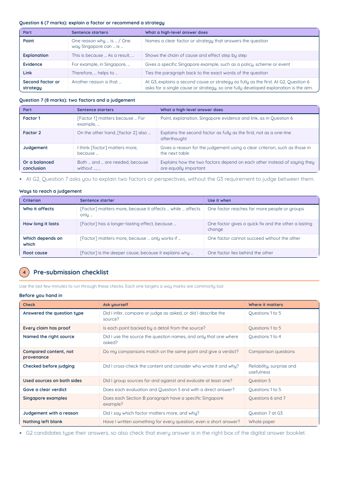
| Part | Sentence starters | What a high-level answer does |
|---|---|---|
| Point | One reason why ... is ... / One way Singapore can ... is ... | Names a clear factor or strategy that answers the question |
| Explanation | This is because ... As a result, ... | Shows the chain of cause and effect step by step |
| Evidence | For example, in Singapore, ... | Gives a specific Singapore example, such as a policy, scheme or event |
| Link | Therefore, ... helps to ... | Ties the paragraph back to the exact words of the question |
| Second factor or strategy | Another reason is that ... | At G3, explains a second cause or strategy as fully as the first. At G2, Question 6 asks for a single cause or strategy, so one fully developed explanation is the aim. |
| Part | Sentence starters | What a high-level answer does |
|---|---|---|
| Factor 1 | [Factor 1] matters because ... For example, ... | Point, explanation, Singapore evidence and link, as in Question 6 |
| Factor 2 | On the other hand, [factor 2] also ... | Explains the second factor as fully as the first, not as a one-line afterthought |
| Judgement | I think [factor] matters more, because ... | Gives a reason for the judgement using a clear criterion, such as those in the next table |
| Or a balanced conclusion | Both ... and ... are needed, because without ..., ... | Explains how the two factors depend on each other instead of saying they are equally important |
- At G2, Question 7 asks you to explain two factors or perspectives, without the G3 requirement to judge between them.
| Criterion | Sentence starter | Use it when |
|---|---|---|
| Who it affects | [Factor] matters more, because it affects ... while ... affects only ... | One factor reaches far more people or groups |
| How long it lasts | [Factor] has a longer-lasting effect, because ... | One factor gives a quick fix and the other a lasting change |
| Which depends on which | [Factor] matters more, because ... only works if ... | One factor cannot succeed without the other |
| Root cause | [Factor] is the deeper cause, because it explains why ... | One factor lies behind the other |
Pre-submission checklist
Use the last few minutes to run through these checks. Each one targets a way marks are commonly lost.
| Check | Ask yourself | Where it matters |
|---|---|---|
| Answered the question type | Did I infer, compare or judge as asked, or did I describe the source? | Questions 1 to 5 |
| Every claim has proof | Is each point backed by a detail from the source? | Questions 1 to 5 |
| Named the right source | Did I use the source the question names, and only that one where asked? | Questions 1 to 4 |
| Compared content, not provenance | Do my comparisons match on the same point and give a verdict? | Comparison questions |
| Checked before judging | Did I cross-check the content and consider who wrote it and why? | Reliability, surprise and usefulness |
| Used sources on both sides | Did I group sources for and against and evaluate at least one? | Question 5 |
| Gave a clear verdict | Does each evaluation and Question 5 end with a direct answer? | Questions 1 to 5 |
| Singapore examples | Does each Section B paragraph have a specific Singapore example? | Questions 6 and 7 |
| Judgement with a reason | Did I say which factor matters more, and why? | Question 7 at G3 |
| Nothing left blank | Have I written something for every question, even a short answer? | Whole paper |
- G2 candidates type their answers, so also check that every answer is in the right box of the digital answer booklet.
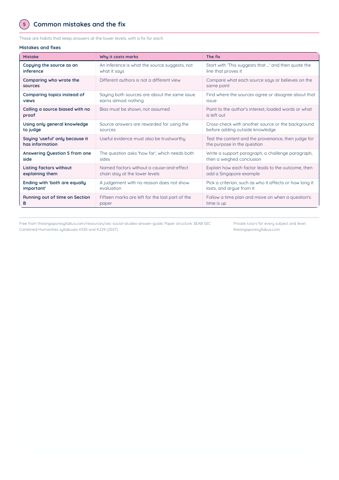
Common mistakes and the fix
These are habits that keep answers at the lower levels, with a fix for each.
| Mistake | Why it costs marks | The fix |
|---|---|---|
| Copying the source as an inference | An inference is what the source suggests, not what it says | Start with 'This suggests that ...' and then quote the line that proves it |
| Comparing who wrote the sources | Different authors is not a different view | Compare what each source says or believes on the same point |
| Comparing topics instead of views | Saying both sources are about the same issue earns almost nothing | Find where the sources agree or disagree about that issue |
| Calling a source biased with no proof | Bias must be shown, not assumed | Point to the author's interest, loaded words or what is left out |
| Using only general knowledge to judge | Source answers are rewarded for using the sources | Cross-check with another source or the background before adding outside knowledge |
| Saying 'useful' only because it has information | Useful evidence must also be trustworthy | Test the content and the provenance, then judge for the purpose in the question |
| Answering Question 5 from one side | The question asks 'how far', which needs both sides | Write a support paragraph, a challenge paragraph, then a weighed conclusion |
| Listing factors without explaining them | Named factors without a cause-and-effect chain stay at the lower levels | Explain how each factor leads to the outcome, then add a Singapore example |
| Ending with 'both are equally important' | A judgement with no reason does not show evaluation | Pick a criterion, such as who it affects or how long it lasts, and argue from it |
| Running out of time on Section B | Fifteen marks are left for the last part of the paper | Follow a time plan and move on when a question's time is up |
Download the free PDFPDF · 5 pages · A4 portrait · free, no sign-up
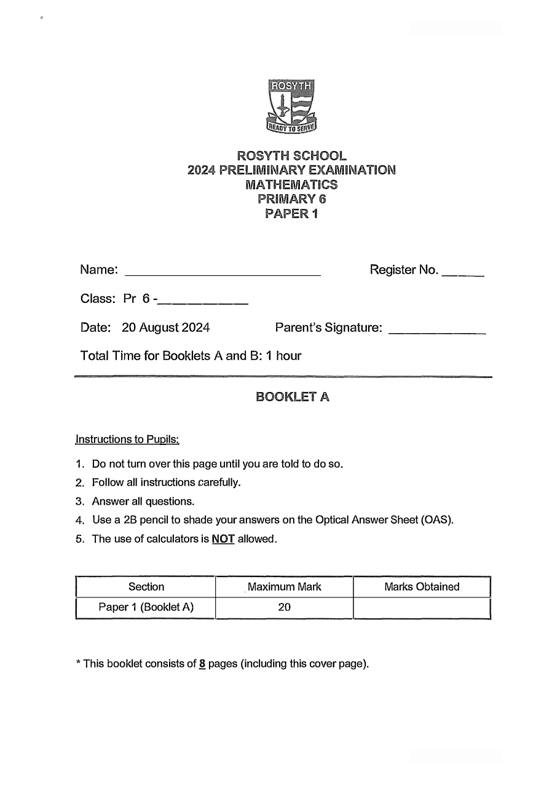
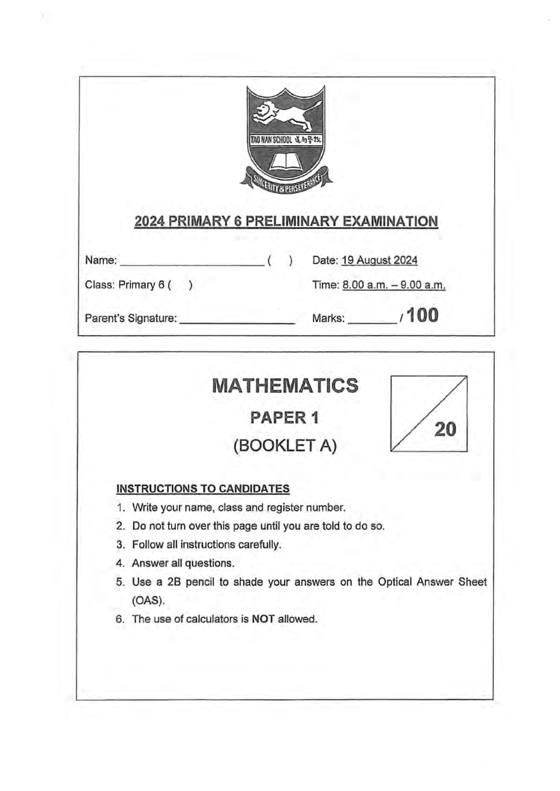
Real school papersNow practise with real O-Level school papers178 primary papers in Maths and Science and 112 secondary papers in E-Math, A-Math, Physics, Chemistry and Biology, set by Singapore schools. Most come with answers.See all 290 papers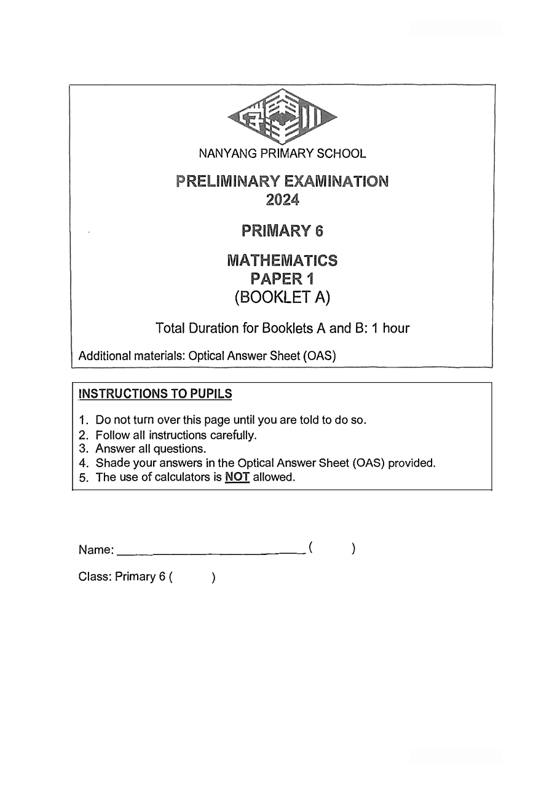
Inside the PDF
5 A4 pages, ready to print. Tap a page to open the PDF there.
Questions students ask
Does SEAB publish the level descriptors for Social Studies?
No. The 2027 syllabuses say both sections are marked with a Levels of Response Marking Scheme, but they do not publish the Social Studies descriptors. The ladders in this guide describe common school practice, not SEAB wording.
Are inference, purpose and reliability official question types?
No. SEAB lists skills such as drawing inferences, comparing views, detecting bias and evaluating evidence. Inference, purpose, comparison, reliability, usefulness and the hypothesis question are the names schools use when they practise those skills.
How many marks is the Social Studies case study worth?
Section A is worth 35 of the 50 marks. Questions 1 to 4 share 25 marks, which schools split in different ways, and Question 5 is worth 10 and uses several sources.
Is the guide the same for G2 Social Studies?
Mostly. G2 has the same length, sections and marks, but answers are typed into a digital answer booklet, Question 6 asks for a single cause or strategy, Question 7 asks you to explain two factors without a judgement, and Issue 3 covers economic impacts only.
Keep revising
- SEC Social Studies SBQ and SRQ guideHow the paper works, with model answers
- O-Level E-Math Formula SheetO-Level and SEC (G3) · free PDF
- O-Level A-Math Formula SheetO-Level and SEC (G3) · free PDF
- O-Level Chemistry Periodic TableO-Level and SEC (G3) · free PDF
- O-Level Physics Formula SheetO-Level and SEC (G3) · free PDF
- O-Level Chemistry Qualitative Analysis NotesO-Level and SEC (G3) · free PDF
- SEC English Writing and Oral ChecklistsSEC (G3 and G2) · free PDF
- Free exam calculatorsPSLE Score, L1R5 and UAS
- All free resourcesPSLE, O-Level and A-Level
Source
- SEAB, SEC G3 Humanities (Social Studies, Geography) syllabus K335 (2027)
- SEAB, SEC G3 Humanities (Social Studies, History) syllabus K336 (2027)
- SEAB, SEC G2 Humanities (Social Studies, Geography) syllabus K229 (2027)
- SEAB, 2027 SEC G3 syllabuses for school candidates
- SEAB, 2027 SEC G2 syllabuses for school candidates
The answer frames, level ladders and examples are our own and describe common school practice. The paper structure comes from the SEAB syllabuses, and if it differs, the SEAB document is right. Tell us and we will fix it.
Want a Social Studies tutor?
Tell us the level and we send a shortlist of tutors on WhatsApp within 16 hours. You choose the tutor. About Geography tuition