Free resource · SEC (G3 and G2)
O-Level and SEC English Oral and Essay Topics: Free PDF
SEAB publishes no list of O-Level or SEC oral topics. The oral is a Planned Response of up to 2 minutes to a video clip and prompt, then a Spoken Interaction with the examiners, 15 marks each, after 10 minutes of preparation. The O-Level in 2026 and the SEC from 2027 use the same format. This free booklet, also a printable PDF, has 12 original oral sets by theme, model answers, a PEEL structure and 50 essay topics.


- 9 pages
- A4 portrait
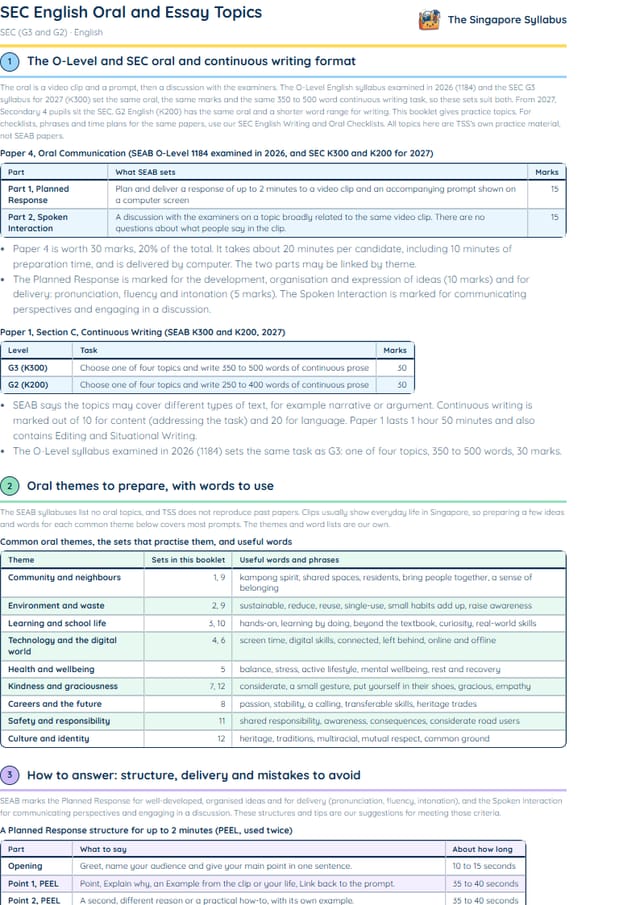
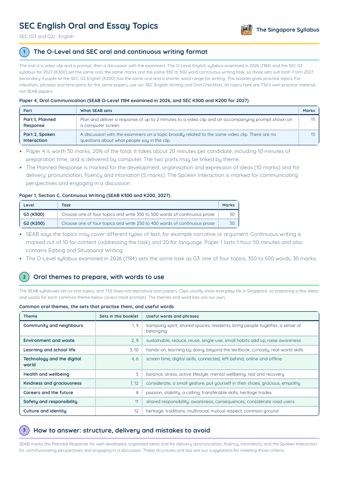
The O-Level and SEC oral and continuous writing format
The oral is a video clip and a prompt, then a discussion with the examiners. The O-Level English syllabus examined in 2026 (1184) and the SEC G3 syllabus for 2027 (K300) set the same oral, the same marks and the same 350 to 500 word continuous writing task, so these sets suit both. From 2027, Secondary 4 pupils sit the SEC. G2 English (K200) has the same oral and a shorter word range for writing. This booklet gives practice topics. For checklists, phrases and time plans for the same papers, use our SEC English Writing and Oral Checklists. All topics here are TSS's own practice material, not SEAB papers.
| Part | What SEAB sets | Marks |
|---|---|---|
| Part 1, Planned Response | Plan and deliver a response of up to 2 minutes to a video clip and an accompanying prompt shown on a computer screen | 15 |
| Part 2, Spoken Interaction | A discussion with the examiners on a topic broadly related to the same video clip. There are no questions about what people say in the clip. | 15 |
- Paper 4 is worth 30 marks, 20% of the total. It takes about 20 minutes per candidate, including 10 minutes of preparation time, and is delivered by computer. The two parts may be linked by theme.
- The Planned Response is marked for the development, organisation and expression of ideas (10 marks) and for delivery: pronunciation, fluency and intonation (5 marks). The Spoken Interaction is marked for communicating perspectives and engaging in a discussion.
| Level | Task | Marks |
|---|---|---|
| G3 (K300) | Choose one of four topics and write 350 to 500 words of continuous prose | 30 |
| G2 (K200) | Choose one of four topics and write 250 to 400 words of continuous prose | 30 |
- SEAB says the topics may cover different types of text, for example narrative or argument. Continuous writing is marked out of 10 for content (addressing the task) and 20 for language. Paper 1 lasts 1 hour 50 minutes and also contains Editing and Situational Writing.
- The O-Level syllabus examined in 2026 (1184) sets the same task as G3: one of four topics, 350 to 500 words, 30 marks.
Oral themes to prepare, with words to use
The SEAB syllabuses list no oral topics, and TSS does not reproduce past papers. Clips usually show everyday life in Singapore, so preparing a few ideas and words for each common theme below covers most prompts. The themes and word lists are our own.
| Theme | Sets in this booklet | Useful words and phrases |
|---|---|---|
| Community and neighbours | 1, 9 | kampong spirit, shared spaces, residents, bring people together, a sense of belonging |
| Environment and waste | 2, 9 | sustainable, reduce, reuse, single-use, small habits add up, raise awareness |
| Learning and school life | 3, 10 | hands-on, learning by doing, beyond the textbook, curiosity, real-world skills |
| Technology and the digital world | 4, 6 | screen time, digital skills, connected, left behind, online and offline |
| Health and wellbeing | 5 | balance, stress, active lifestyle, mental wellbeing, rest and recovery |
| Kindness and graciousness | 7, 12 | considerate, a small gesture, put yourself in their shoes, gracious, empathy |
| Careers and the future | 8 | passion, stability, a calling, transferable skills, heritage trades |
| Safety and responsibility | 11 | shared responsibility, awareness, consequences, considerate road users |
| Culture and identity | 12 | heritage, traditions, multiracial, mutual respect, common ground |
How to answer: structure, delivery and mistakes to avoid
SEAB marks the Planned Response for well-developed, organised ideas and for delivery (pronunciation, fluency, intonation), and the Spoken Interaction for communicating perspectives and engaging in a discussion. These structures and tips are our suggestions for meeting those criteria.
| Part | What to say | About how long |
|---|---|---|
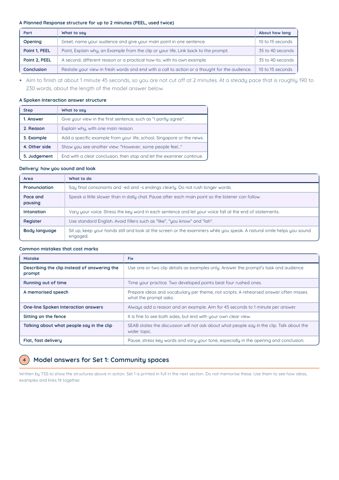
| Opening | Greet, name your audience and give your main point in one sentence. | 10 to 15 seconds |
| Point 1, PEEL | Point, Explain why, an Example from the clip or your life, Link back to the prompt. | 35 to 40 seconds |
| Point 2, PEEL | A second, different reason or a practical how-to, with its own example. | 35 to 40 seconds |
| Conclusion | Restate your view in fresh words and end with a call to action or a thought for the audience. | 10 to 15 seconds |
- Aim to finish at about 1 minute 45 seconds, so you are not cut off at 2 minutes. At a steady pace that is roughly 190 to 230 words, about the length of the model answer below.
| Step | What to say |
|---|---|
| 1. Answer | Give your view in the first sentence, such as "I partly agree". |
| 2. Reason | Explain why, with one main reason. |
| 3. Example | Add a specific example from your life, school, Singapore or the news. |
| 4. Other side | Show you see another view: "However, some people feel..." |
| 5. Judgement | End with a clear conclusion, then stop and let the examiner continue. |
| Area | What to do |
|---|---|
| Pronunciation | Say final consonants and -ed and -s endings clearly. Do not rush longer words. |
| Pace and pausing | Speak a little slower than in daily chat. Pause after each main point so the listener can follow. |
| Intonation | Vary your voice. Stress the key word in each sentence and let your voice fall at the end of statements. |
| Register | Use standard English. Avoid fillers such as "like", "you know" and "lah". |
| Body language | Sit up, keep your hands still and look at the screen or the examiners while you speak. A natural smile helps you sound engaged. |
| Mistake | Fix |
|---|---|
| Describing the clip instead of answering the prompt | Use one or two clip details as examples only. Answer the prompt's task and audience. |
| Running out of time | Time your practice. Two developed points beat four rushed ones. |
| A memorised speech | Prepare ideas and vocabulary per theme, not scripts. A rehearsed answer often misses what the prompt asks. |
| One-line Spoken Interaction answers | Always add a reason and an example. Aim for 45 seconds to 1 minute per answer. |
| Sitting on the fence | It is fine to see both sides, but end with your own clear view. |
| Talking about what people say in the clip | SEAB states the discussion will not ask about what people say in the clip. Talk about the wider topic. |
| Flat, fast delivery | Pause, stress key words and vary your tone, especially in the opening and conclusion. |
Model answers for Set 1: Community spaces
Written by TSS to show the structures above in action. Set 1 is printed in full in the next section. Do not memorise these. Use them to see how ideas, examples and links fit together.
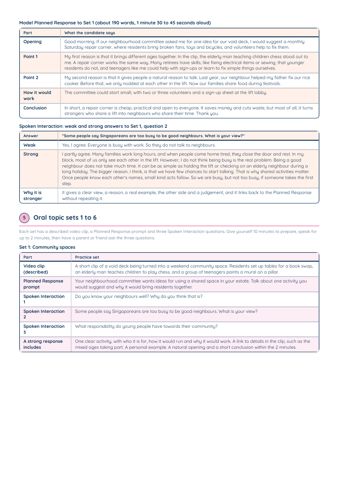
| Part | What the candidate says |
|---|---|
| Opening | Good morning. If our neighbourhood committee asked me for one idea for our void deck, I would suggest a monthly Saturday repair corner, where residents bring broken fans, toys and bicycles, and volunteers help to fix them. |
| Point 1 | My first reason is that it brings different ages together. In the clip, the elderly man teaching children chess stood out to me. A repair corner works the same way. Many retirees have skills, like fixing electrical items or sewing, that younger residents do not, and teenagers like me could help with sign-ups or learn to fix simple things ourselves. |
| Point 2 | My second reason is that it gives people a natural reason to talk. Last year, our neighbour helped my father fix our rice cooker. Before that, we only nodded at each other in the lift. Now our families share food during festivals. |
| How it would work | The committee could start small, with two or three volunteers and a sign-up sheet at the lift lobby. |
| Conclusion | In short, a repair corner is cheap, practical and open to everyone. It saves money and cuts waste, but most of all, it turns strangers who share a lift into neighbours who share their time. Thank you. |
| Answer | "Some people say Singaporeans are too busy to be good neighbours. What is your view?" |
|---|---|
| Weak | Yes, I agree. Everyone is busy with work. So they do not talk to neighbours. |
| Strong | I partly agree. Many families work long hours, and when people come home tired, they close the door and rest. In my block, most of us only see each other in the lift. However, I do not think being busy is the real problem. Being a good neighbour does not take much time. It can be as simple as holding the lift or checking on an elderly neighbour during a long holiday. The bigger reason, I think, is that we have few chances to start talking. That is why shared activities matter. Once people know each other's names, small kind acts follow. So we are busy, but not too busy, if someone takes the first step. |
| Why it is stronger | It gives a clear view, a reason, a real example, the other side and a judgement, and it links back to the Planned Response without repeating it. |
Oral topic sets 1 to 6
Each set has a described video clip, a Planned Response prompt and three Spoken Interaction questions. Give yourself 10 minutes to prepare, speak for up to 2 minutes, then have a parent or friend ask the three questions.
| Part | Practice set |
|---|---|
| Video clip (described) | A short clip of a void deck being turned into a weekend community space. Residents set up tables for a book swap, an elderly man teaches children to play chess, and a group of teenagers paints a mural on a pillar. |
| Planned Response prompt | Your neighbourhood committee wants ideas for using a shared space in your estate. Talk about one activity you would suggest and why it would bring residents together. |
| Spoken Interaction 1 | Do you know your neighbours well? Why do you think that is? |
| Spoken Interaction 2 | Some people say Singaporeans are too busy to be good neighbours. What is your view? |
| Spoken Interaction 3 | What responsibility do young people have towards their community? |
| A strong response includes | One clear activity, with who it is for, how it would run and why it would work. A link to details in the clip, such as the mixed ages taking part. A personal example. A natural opening and a short conclusion within the 2 minutes. |
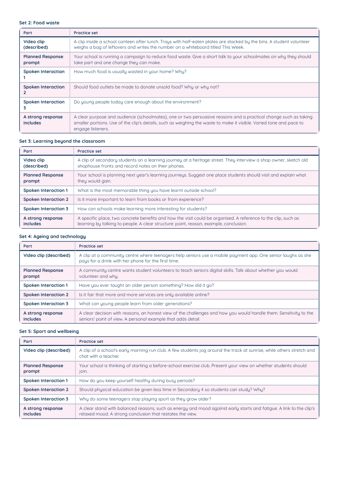
| Part | Practice set |
|---|---|
| Video clip (described) | A clip inside a school canteen after lunch. Trays with half-eaten plates are stacked by the bins. A student volunteer weighs a bag of leftovers and writes the number on a whiteboard titled This Week. |
| Planned Response prompt | Your school is running a campaign to reduce food waste. Give a short talk to your schoolmates on why they should take part and one change they can make. |
| Spoken Interaction 1 | How much food is usually wasted in your home? Why? |
| Spoken Interaction 2 | Should food outlets be made to donate unsold food? Why or why not? |
| Spoken Interaction 3 | Do young people today care enough about the environment? |
| A strong response includes | A clear purpose and audience (schoolmates), one or two persuasive reasons and a practical change such as taking smaller portions. Use of the clip's details, such as weighing the waste to make it visible. Varied tone and pace to engage listeners. |
| Part | Practice set |
|---|---|
| Video clip (described) | A clip of secondary students on a learning journey at a heritage street. They interview a shop owner, sketch old shophouse fronts and record notes on their phones. |
| Planned Response prompt | Your school is planning next year's learning journeys. Suggest one place students should visit and explain what they would gain. |
| Spoken Interaction 1 | What is the most memorable thing you have learnt outside school? |
| Spoken Interaction 2 | Is it more important to learn from books or from experience? |
| Spoken Interaction 3 | How can schools make learning more interesting for students? |
| A strong response includes | A specific place, two concrete benefits and how the visit could be organised. A reference to the clip, such as learning by talking to people. A clear structure: point, reason, example, conclusion. |
| Part | Practice set |
|---|---|
| Video clip (described) | A clip at a community centre where teenagers help seniors use a mobile payment app. One senior laughs as she pays for a drink with her phone for the first time. |
| Planned Response prompt | A community centre wants student volunteers to teach seniors digital skills. Talk about whether you would volunteer and why. |
| Spoken Interaction 1 | Have you ever taught an older person something? How did it go? |
| Spoken Interaction 2 | Is it fair that more and more services are only available online? |
| Spoken Interaction 3 | What can young people learn from older generations? |
| A strong response includes | A clear decision with reasons, an honest view of the challenges and how you would handle them. Sensitivity to the seniors' point of view. A personal example that adds detail. |
| Part | Practice set |
|---|---|
| Video clip (described) | A clip of a school's early morning run club. A few students jog around the track at sunrise, while others stretch and chat with a teacher. |
| Planned Response prompt | Your school is thinking of starting a before-school exercise club. Present your view on whether students should join. |
| Spoken Interaction 1 | How do you keep yourself healthy during busy periods? |
| Spoken Interaction 2 | Should physical education be given less time in Secondary 4 so students can study? Why? |
| Spoken Interaction 3 | Why do some teenagers stop playing sport as they grow older? |
| A strong response includes | A clear stand with balanced reasons, such as energy and mood against early starts and fatigue. A link to the clip's relaxed mood. A strong conclusion that restates the view. |
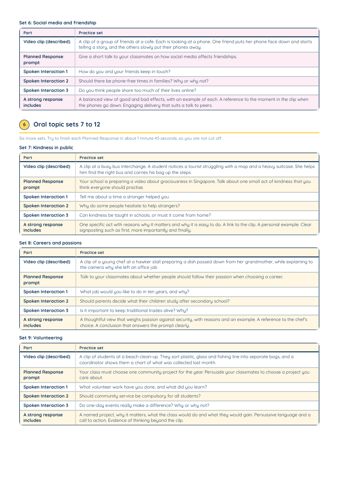
| Part | Practice set |
|---|---|
| Video clip (described) | A clip of a group of friends at a cafe. Each is looking at a phone. One friend puts her phone face down and starts telling a story, and the others slowly put their phones away. |
| Planned Response prompt | Give a short talk to your classmates on how social media affects friendships. |
| Spoken Interaction 1 | How do you and your friends keep in touch? |
| Spoken Interaction 2 | Should there be phone-free times in families? Why or why not? |
| Spoken Interaction 3 | Do you think people share too much of their lives online? |
| A strong response includes | A balanced view of good and bad effects, with an example of each. A reference to the moment in the clip when the phones go down. Engaging delivery that suits a talk to peers. |
Oral topic sets 7 to 12
Six more sets. Try to finish each Planned Response in about 1 minute 45 seconds, so you are not cut off.
| Part | Practice set |
|---|---|
| Video clip (described) | A clip at a busy bus interchange. A student notices a tourist struggling with a map and a heavy suitcase. She helps him find the right bus and carries his bag up the steps. |
| Planned Response prompt | Your school is preparing a video about graciousness in Singapore. Talk about one small act of kindness that you think everyone should practise. |
| Spoken Interaction 1 | Tell me about a time a stranger helped you. |
| Spoken Interaction 2 | Why do some people hesitate to help strangers? |
| Spoken Interaction 3 | Can kindness be taught in schools, or must it come from home? |
| A strong response includes | One specific act with reasons why it matters and why it is easy to do. A link to the clip. A personal example. Clear signposting such as first, more importantly and finally. |
| Part | Practice set |
|---|---|
| Video clip (described) | A clip of a young chef at a hawker stall preparing a dish passed down from her grandmother, while explaining to the camera why she left an office job. |
| Planned Response prompt | Talk to your classmates about whether people should follow their passion when choosing a career. |
| Spoken Interaction 1 | What job would you like to do in ten years, and why? |
| Spoken Interaction 2 | Should parents decide what their children study after secondary school? |
| Spoken Interaction 3 | Is it important to keep traditional trades alive? Why? |
| A strong response includes | A thoughtful view that weighs passion against security, with reasons and an example. A reference to the chef's choice. A conclusion that answers the prompt clearly. |
| Part | Practice set |
|---|---|
| Video clip (described) | A clip of students at a beach clean-up. They sort plastic, glass and fishing line into separate bags, and a coordinator shows them a chart of what was collected last month. |
| Planned Response prompt | Your class must choose one community project for the year. Persuade your classmates to choose a project you care about. |
| Spoken Interaction 1 | What volunteer work have you done, and what did you learn? |
| Spoken Interaction 2 | Should community service be compulsory for all students? |
| Spoken Interaction 3 | Do one-day events really make a difference? Why or why not? |
| A strong response includes | A named project, why it matters, what the class would do and what they would gain. Persuasive language and a call to action. Evidence of thinking beyond the clip. |
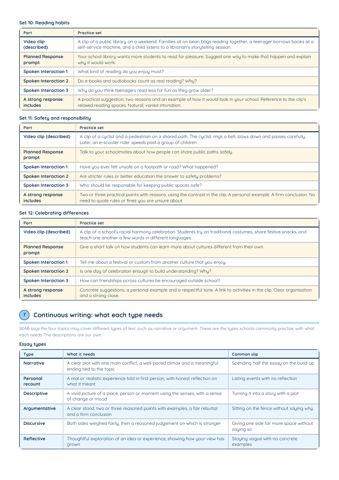
| Part | Practice set |
|---|---|
| Video clip (described) | A clip of a public library on a weekend. Families sit on bean bags reading together, a teenager borrows books at a self-service machine, and a child listens to a librarian's storytelling session. |
| Planned Response prompt | Your school library wants more students to read for pleasure. Suggest one way to make that happen and explain why it would work. |
| Spoken Interaction 1 | What kind of reading do you enjoy most? |
| Spoken Interaction 2 | Do e-books and audiobooks count as real reading? Why? |
| Spoken Interaction 3 | Why do you think teenagers read less for fun as they grow older? |
| A strong response includes | A practical suggestion, two reasons and an example of how it would look in your school. Reference to the clip's relaxed reading spaces. Natural, varied intonation. |
| Part | Practice set |
|---|---|
| Video clip (described) | A clip of a cyclist and a pedestrian on a shared path. The cyclist rings a bell, slows down and passes carefully. Later, an e-scooter rider speeds past a group of children. |
| Planned Response prompt | Talk to your schoolmates about how people can share public paths safely. |
| Spoken Interaction 1 | Have you ever felt unsafe on a footpath or road? What happened? |
| Spoken Interaction 2 | Are stricter rules or better education the answer to safety problems? |
| Spoken Interaction 3 | Who should be responsible for keeping public spaces safe? |
| A strong response includes | Two or three practical points with reasons, using the contrast in the clip. A personal example. A firm conclusion. No need to quote rules or fines you are unsure about. |
| Part | Practice set |
|---|---|
| Video clip (described) | A clip of a school's racial harmony celebration. Students try on traditional costumes, share festive snacks, and teach one another a few words in different languages. |
| Planned Response prompt | Give a short talk on how students can learn more about cultures different from their own. |
| Spoken Interaction 1 | Tell me about a festival or custom from another culture that you enjoy. |
| Spoken Interaction 2 | Is one day of celebration enough to build understanding? Why? |
| Spoken Interaction 3 | How can friendships across cultures be encouraged outside school? |
| A strong response includes | Concrete suggestions, a personal example and a respectful tone. A link to activities in the clip. Clear organisation and a strong close. |
Continuous writing: what each type needs
SEAB says the four topics may cover different types of text, such as narrative or argument. These are the types schools commonly practise, with what each needs. The descriptions are our own.
| Type | What it needs | Common slip |
|---|---|---|
| Narrative | A clear plot with one main conflict, a well-paced climax and a meaningful ending tied to the topic | Spending half the essay on the build-up |
| Personal recount | A real or realistic experience told in first person, with honest reflection on what it meant | Listing events with no reflection |
| Descriptive | A vivid picture of a place, person or moment using the senses, with a sense of change or mood | Turning it into a story with a plot |
| Argumentative | A clear stand, two or three reasoned points with examples, a fair rebuttal and a firm conclusion | Sitting on the fence without saying why |
| Discursive | Both sides weighed fairly, then a reasoned judgement on which is stronger | Giving one side far more space without saying so |
| Reflective | Thoughtful exploration of an idea or experience, showing how your view has grown | Staying vague with no concrete examples |
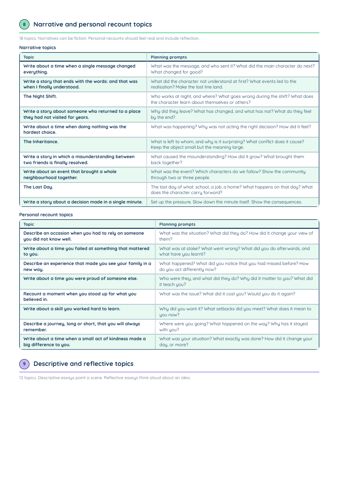
Narrative and personal recount topics
18 topics. Narratives can be fiction. Personal recounts should feel real and include reflection.
| Topic | Planning prompts |
|---|---|
| Write about a time when a single message changed everything. | What was the message, and who sent it? What did the main character do next? What changed for good? |
| Write a story that ends with the words: and that was when I finally understood. | What did the character not understand at first? What events led to the realisation? Make the last line land. |
| The Night Shift. | Who works at night, and where? What goes wrong during the shift? What does the character learn about themselves or others? |
| Write a story about someone who returned to a place they had not visited for years. | Why did they leave? What has changed, and what has not? What do they feel by the end? |
| Write about a time when doing nothing was the hardest choice. | What was happening? Why was not acting the right decision? How did it feel? |
| The Inheritance. | What is left to whom, and why is it surprising? What conflict does it cause? Keep the object small but the meaning large. |
| Write a story in which a misunderstanding between two friends is finally resolved. | What caused the misunderstanding? How did it grow? What brought them back together? |
| Write about an event that brought a whole neighbourhood together. | What was the event? Which characters do we follow? Show the community through two or three people. |
| The Last Day. | The last day of what: school, a job, a home? What happens on that day? What does the character carry forward? |
| Write a story about a decision made in a single minute. | Set up the pressure. Slow down the minute itself. Show the consequences. |
| Topic | Planning prompts |
|---|---|
| Describe an occasion when you had to rely on someone you did not know well. | What was the situation? What did they do? How did it change your view of them? |
| Write about a time you failed at something that mattered to you. | What was at stake? What went wrong? What did you do afterwards, and what have you learnt? |
| Describe an experience that made you see your family in a new way. | What happened? What did you notice that you had missed before? How do you act differently now? |
| Write about a time you were proud of someone else. | Who were they, and what did they do? Why did it matter to you? What did it teach you? |
| Recount a moment when you stood up for what you believed in. | What was the issue? What did it cost you? Would you do it again? |
| Write about a skill you worked hard to learn. | Why did you want it? What setbacks did you meet? What does it mean to you now? |
| Describe a journey, long or short, that you will always remember. | Where were you going? What happened on the way? Why has it stayed with you? |
| Write about a time when a small act of kindness made a big difference to you. | What was your situation? What exactly was done? How did it change your day, or more? |
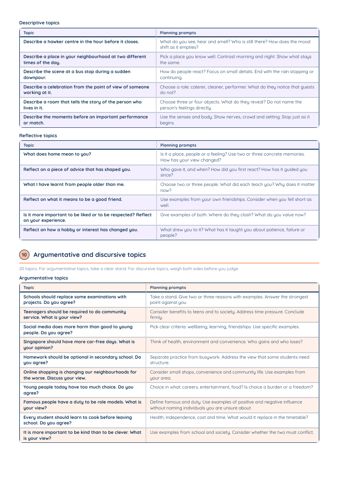
Descriptive and reflective topics
12 topics. Descriptive essays paint a scene. Reflective essays think aloud about an idea.
| Topic | Planning prompts |
|---|---|
| Describe a hawker centre in the hour before it closes. | What do you see, hear and smell? Who is still there? How does the mood shift as it empties? |
| Describe a place in your neighbourhood at two different times of the day. | Pick a place you know well. Contrast morning and night. Show what stays the same. |
| Describe the scene at a bus stop during a sudden downpour. | How do people react? Focus on small details. End with the rain stopping or continuing. |
| Describe a celebration from the point of view of someone working at it. | Choose a role: caterer, cleaner, performer. What do they notice that guests do not? |
| Describe a room that tells the story of the person who lives in it. | Choose three or four objects. What do they reveal? Do not name the person's feelings directly. |
| Describe the moments before an important performance or match. | Use the senses and body. Show nerves, crowd and setting. Stop just as it begins. |
| Topic | Planning prompts |
|---|---|
| What does home mean to you? | Is it a place, people or a feeling? Use two or three concrete memories. How has your view changed? |
| Reflect on a piece of advice that has shaped you. | Who gave it, and when? How did you first react? How has it guided you since? |
| What I have learnt from people older than me. | Choose two or three people. What did each teach you? Why does it matter now? |
| Reflect on what it means to be a good friend. | Use examples from your own friendships. Consider when you fell short as well. |
| Is it more important to be liked or to be respected? Reflect on your experience. | Give examples of both. Where do they clash? What do you value now? |
| Reflect on how a hobby or interest has changed you. | What drew you to it? What has it taught you about patience, failure or people? |
Argumentative and discursive topics
20 topics. For argumentative topics, take a clear stand. For discursive topics, weigh both sides before you judge.
| Topic | Planning prompts |
|---|---|
| Schools should replace some examinations with projects. Do you agree? | Take a stand. Give two or three reasons with examples. Answer the strongest point against you. |
| Teenagers should be required to do community service. What is your view? | Consider benefits to teens and to society. Address time pressure. Conclude firmly. |
| Social media does more harm than good to young people. Do you agree? | Pick clear criteria: wellbeing, learning, friendships. Use specific examples. |
| Singapore should have more car-free days. What is your opinion? | Think of health, environment and convenience. Who gains and who loses? |
| Homework should be optional in secondary school. Do you agree? | Separate practice from busywork. Address the view that some students need structure. |
| Online shopping is changing our neighbourhoods for the worse. Discuss your view. | Consider small shops, convenience and community life. Use examples from your area. |
| Young people today have too much choice. Do you agree? | Choice in what: careers, entertainment, food? Is choice a burden or a freedom? |
| Famous people have a duty to be role models. What is your view? | Define famous and duty. Use examples of positive and negative influence without naming individuals you are unsure about. |
| Every student should learn to cook before leaving school. Do you agree? | Health, independence, cost and time. What would it replace in the timetable? |
| It is more important to be kind than to be clever. What is your view? | Use examples from school and society. Consider whether the two must conflict. |
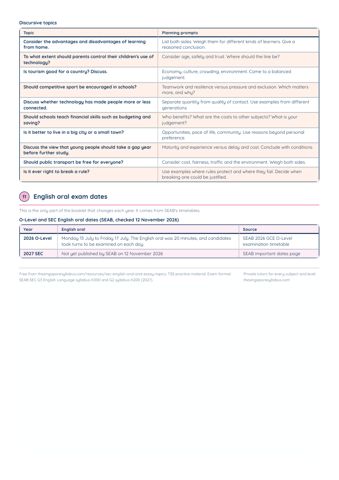
| Topic | Planning prompts |
|---|---|
| Consider the advantages and disadvantages of learning from home. | List both sides. Weigh them for different kinds of learners. Give a reasoned conclusion. |
| To what extent should parents control their children's use of technology? | Consider age, safety and trust. Where should the line be? |
| Is tourism good for a country? Discuss. | Economy, culture, crowding, environment. Come to a balanced judgement. |
| Should competitive sport be encouraged in schools? | Teamwork and resilience versus pressure and exclusion. Which matters more, and why? |
| Discuss whether technology has made people more or less connected. | Separate quantity from quality of contact. Use examples from different generations. |
| Should schools teach financial skills such as budgeting and saving? | Who benefits? What are the costs to other subjects? What is your judgement? |
| Is it better to live in a big city or a small town? | Opportunities, pace of life, community. Use reasons beyond personal preference. |
| Discuss the view that young people should take a gap year before further study. | Maturity and experience versus delay and cost. Conclude with conditions. |
| Should public transport be free for everyone? | Consider cost, fairness, traffic and the environment. Weigh both sides. |
| Is it ever right to break a rule? | Use examples where rules protect and where they fail. Decide when breaking one could be justified. |
English oral exam dates
This is the only part of the booklet that changes each year. It comes from SEAB's timetables.
| Year | English oral | Source |
|---|---|---|
| 2026 O-Level | Monday 13 July to Friday 17 July. The English oral was 20 minutes, and candidates took turns to be examined on each day. | SEAB 2026 GCE O-Level examination timetable |
| 2027 SEC | Not yet published by SEAB on 12 November 2026 | SEAB important dates page |
Questions students ask
What are the O-Level and SEC English oral topics?
The SEAB syllabuses do not list oral topics, and TSS does not reproduce past papers. Each candidate responds to a video clip and prompt, so practise across common themes such as community, the environment, technology, health, careers and kindness, as the 12 sets here do.
How long is the SEC English Planned Response?
Up to 2 minutes, in response to a video clip and a prompt shown on a computer screen. The whole oral takes about 20 minutes per candidate, including 10 minutes of preparation time.
Will I be asked about what people say in the video clip?
No. SEAB states that in the Spoken Interaction candidates will not be asked any questions about what people say in the video clip. The discussion is on a topic broadly related to the clip.
How is the SEC English oral marked?
Paper 4 is worth 30 marks, 20% of the total. The Planned Response has 15 marks: 10 for developing, organising and expressing ideas and 5 for delivery. The Spoken Interaction has 15 marks for communicating perspectives and engaging in a discussion.
How many words is SEC English continuous writing?
350 to 500 words at G3 (K300) and 250 to 400 words at G2 (K200). Candidates choose one of four topics, and the task is worth 30 marks: 10 for content and 20 for language.
Is the G2 English oral the same as G3?
The format is the same: a Planned Response of up to 2 minutes and a Spoken Interaction, 15 marks each, delivered by computer. The band descriptors differ slightly between the K300 and K200 syllabuses.
Are these past O-Level oral or essay questions?
No. Every oral set and essay topic here is TSS's own practice material. SEAB papers are not reproduced.
Is the 2026 O-Level English oral the same as the SEC oral?
Yes. The O-Level syllabus examined in 2026 (1184) and the SEC G3 syllabus for 2027 (K300) set the same Paper 4: a Planned Response and a Spoken Interaction, 15 marks each, about 20 minutes with 10 minutes of preparation, delivered by computer.
How should I structure an oral answer?
For the Planned Response, give an opening, two points built with PEEL (point, explain, example, link) and a short conclusion, finishing at about 1 minute 45 seconds. In the Spoken Interaction, answer, give a reason and an example, show the other side, then give your judgement.
When is the English oral exam?
SEAB sets the dates each year. In 2026 the O-Level English orals ran from 13 to 17 July. SEAB had not published the 2027 SEC dates on 12 November 2026.
Keep revising
- SEC English oral exam guideHow the computer-based oral runs
- SEC English continuous writing guideEssay types, planning and how it is marked
- Sec English tuitionOral and essay practice with a tutor
- O-Level E-Math Formula SheetO-Level and SEC (G3) · free PDF
- O-Level A-Math Formula SheetO-Level and SEC (G3) · free PDF
- O-Level Chemistry Periodic TableO-Level and SEC (G3) · free PDF
- Free exam calculatorsPSLE Score, L1R5 and UAS
- All free resourcesPSLE, O-Level and A-Level
More for this stage: O-Level Physics Formula Sheet, O-Level Chemistry Qualitative Analysis Notes, SEC English Writing and Oral Checklists, SEC Social Studies Answer Guide.
Source
- SEAB, SEC G3 English Language syllabus K300 (2027), Scheme of Assessment and Band Descriptors
- SEAB, SEC G2 English Language syllabus K200 (2027)
- SEAB, 2027 SEC G3 syllabuses for school candidates
- SEAB, GCE O-Level English Language syllabus 1184 (examined in 2026)
- SEAB, 2026 GCE O-Level examination timetable (PDF)
The oral sets, video clip descriptions and essay topics are our own practice material. The exam format details come from the SEAB syllabuses, and if they differ, the SEAB document is right. Tell us and we will fix it.