Free resource · A-Level H2 (9478)
H2 Physics Data and Formulae List (9478): Free PDF
The H2 Physics papers print 13 constants, from the speed of light to g = 9.81 m s⁻², and a list of formulae covering kinematics, gases, simple harmonic motion, capacitors, magnetic flux density, the particle in a box and radioactive decay. Many results you must recall are not printed, including F = ma, kinetic energy, v = fλ, Coulomb's law, V = IR, P = VI and E = hf.
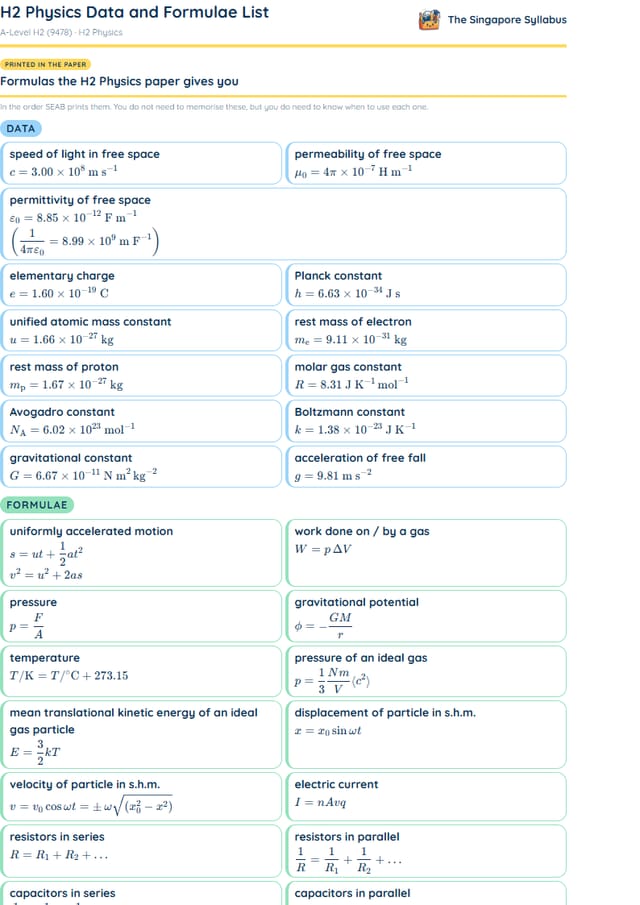
Printed in the paper
Formulas the H2 Physics paper gives you
In the order SEAB prints them. You do not need to memorise these, but you do need to know when to use each one.
Data
- speed of light in free space
- permeability of free space
- permittivity of free space
- elementary charge
- Planck constant
- unified atomic mass constant
- rest mass of electron
- rest mass of proton
- molar gas constant
- Avogadro constant
- Boltzmann constant
- gravitational constant
- acceleration of free fall
Formulae
- uniformly accelerated motion
- work done on / by a gas
- pressure
- gravitational potential
- temperature
- pressure of an ideal gas
- mean translational kinetic energy of an ideal gas particle
- displacement of particle in s.h.m.
- velocity of particle in s.h.m.
- electric current
- resistors in series
- resistors in parallel
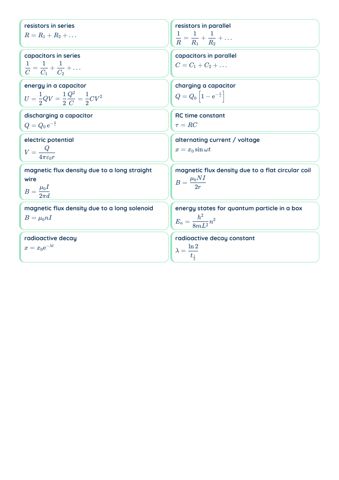
- capacitors in series
- capacitors in parallel
- energy in a capacitor
- charging a capacitor
- discharging a capacitor
- RC time constant
- electric potential
- alternating current / voltage
- magnetic flux density due to a long straight wire
- magnetic flux density due to a flat circular coil
- magnetic flux density due to a long solenoid
- energy states for quantum particle in a box
- radioactive decay
- radioactive decay constant
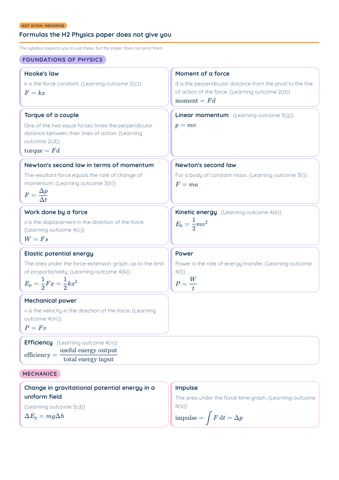
Not given: memorise
Formulas the H2 Physics paper does not give you
The syllabus expects you to use these, but the paper does not print them.
Foundations of physics
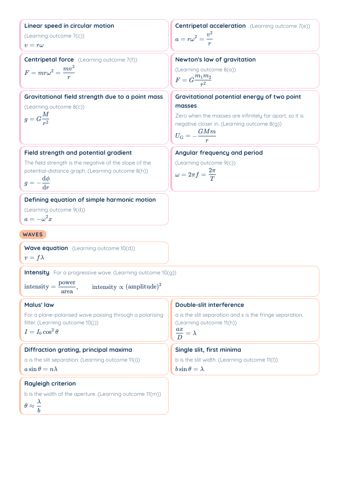
- Hooke's lawk is the force constant. (Learning outcome 2(c))
- Moment of a forced is the perpendicular distance from the pivot to the line of action of the force. (Learning outcome 2(d))
- Torque of a coupleOne of the two equal forces times the perpendicular distance between their lines of action. (Learning outcome 2(d))
- Linear momentum(Learning outcome 3(g))
- Newton's second law in terms of momentumThe resultant force equals the rate of change of momentum. (Learning outcome 3(h))
- Newton's second lawFor a body of constant mass. (Learning outcome 3(i))
- Work done by a forces is the displacement in the direction of the force. (Learning outcome 4(c))
- Kinetic energy(Learning outcome 4(e))
- Elastic potential energyThe area under the force-extension graph, up to the limit of proportionality. (Learning outcome 4(k))
- PowerPower is the rate of energy transfer. (Learning outcome 4(l))
- Mechanical powerv is the velocity in the direction of the force. (Learning outcome 4(m))
- Efficiency(Learning outcome 4(n))
Mechanics
- Change in gravitational potential energy in a uniform field(Learning outcome 5(d))
- ImpulseThe area under the force-time graph. (Learning outcome 6(a))
- Linear speed in circular motion(Learning outcome 7(c))
- Centripetal acceleration(Learning outcome 7(e))
- Centripetal force(Learning outcome 7(f))
- Newton's law of gravitation(Learning outcome 8(a))
- Gravitational field strength due to a point mass(Learning outcome 8(c))
- Gravitational potential energy of two point massesZero when the masses are infinitely far apart, so it is negative closer in. (Learning outcome 8(g))
- Field strength and potential gradientThe field strength is the negative of the slope of the potential-distance graph. (Learning outcome 8(h))
- Angular frequency and period(Learning outcome 9(c))
- Defining equation of simple harmonic motion(Learning outcome 9(d))
Waves
- Wave equation(Learning outcome 10(d))
- IntensityFor a progressive wave. (Learning outcome 10(g))
- Malus' lawFor a plane-polarised wave passing through a polarising filter. (Learning outcome 10(j))
- Double-slit interferencea is the slit separation and x is the fringe separation. (Learning outcome 11(h))
- Diffraction grating, principal maximaa is the slit separation. (Learning outcome 11(i))
- Single slit, first minimab is the slit width. (Learning outcome 11(l))
- Rayleigh criterionb is the width of the aperture. (Learning outcome 11(m))
Thermal physics
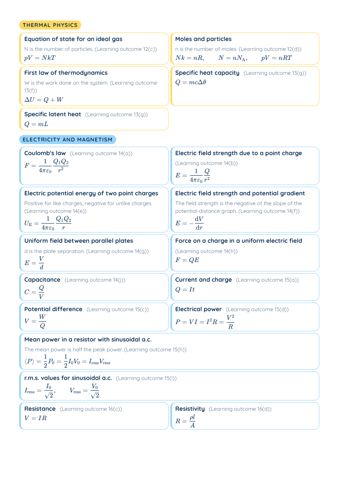
- Equation of state for an ideal gasN is the number of particles. (Learning outcome 12(c))
- Moles and particlesn is the number of moles. (Learning outcome 12(d))
- First law of thermodynamicsW is the work done on the system. (Learning outcome 13(f))
- Specific heat capacity(Learning outcome 13(g))
- Specific latent heat(Learning outcome 13(g))
Electricity and magnetism
- Coulomb's law(Learning outcome 14(a))
- Electric field strength due to a point charge(Learning outcome 14(b))
- Electric potential energy of two point chargesPositive for like charges, negative for unlike charges. (Learning outcome 14(e))
- Electric field strength and potential gradientThe field strength is the negative of the slope of the potential-distance graph. (Learning outcome 14(f))
- Uniform field between parallel platesd is the plate separation. (Learning outcome 14(g))
- Force on a charge in a uniform electric field(Learning outcome 14(h))
- Capacitance(Learning outcome 14(j))
- Current and charge(Learning outcome 15(a))
- Potential difference(Learning outcome 15(c))
- Electrical power(Learning outcome 15(d))
- Mean power in a resistor with sinusoidal a.c.The mean power is half the peak power. (Learning outcome 15(h))
- r.m.s. values for sinusoidal a.c.(Learning outcome 15(i))
- Resistance(Learning outcome 16(c))
- Resistivity(Learning outcome 16(d))
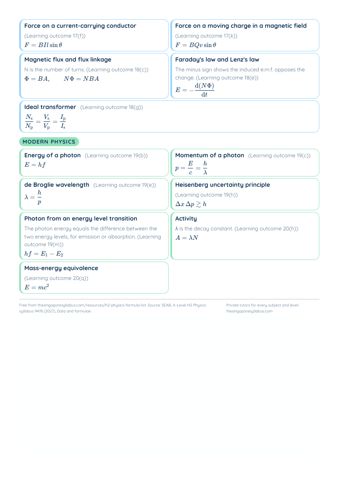
- Force on a current-carrying conductor(Learning outcome 17(f))
- Force on a moving charge in a magnetic field(Learning outcome 17(k))
- Magnetic flux and flux linkageN is the number of turns. (Learning outcome 18(c))
- Faraday's law and Lenz's lawThe minus sign shows the induced e.m.f. opposes the change. (Learning outcome 18(e))
- Ideal transformer(Learning outcome 18(g))
Modern physics
- Energy of a photon(Learning outcome 19(b))
- Momentum of a photon(Learning outcome 19(c))
- de Broglie wavelength(Learning outcome 19(e))
- Heisenberg uncertainty principle(Learning outcome 19(h))
- Photon from an energy level transitionThe photon energy equals the difference between the two energy levels, for emission or absorption. (Learning outcome 19(m))
- Activityλ is the decay constant. (Learning outcome 20(h))
- Mass-energy equivalence(Learning outcome 20(q))
Inside the PDF
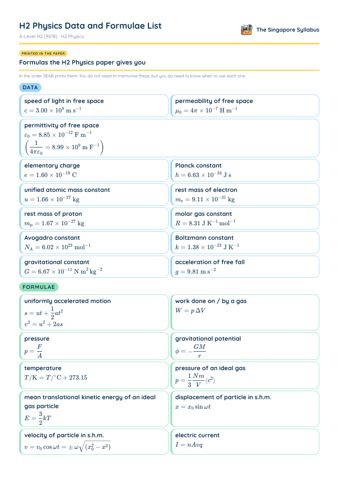
6 A4 pages, ready to print. Tap a page to open the PDF there.
Questions students ask
Which H2 Physics papers include the data and formulae list?
The syllabus says the Data and Formulae pages appear as pages 2 and 3 in Papers 1, 2 and 3.
Is F = ma given in the H2 Physics formula list?
No. The list prints the equations for uniformly accelerated motion but not Newton's second law. Learning outcome 3(i) expects you to recall F = ma for a body of constant mass, and kinetic energy, ½mv², is not printed either.
Are the wave and interference equations given?
No. The list has no wave formulae at all. You must recall v = fλ, the double-slit equation ax/D = λ, the grating equation a sin θ = nλ, the single-slit minimum b sin θ = λ and the Rayleigh criterion θ ≈ λ/b.
Is the H1 Physics data and formulae list the same as H2?
No. The H1 Physics syllabus 8867 (2027) prints a much shorter list of 8 constants and the formulae for uniformly accelerated motion, electric current and resistors in series and in parallel.
Keep revising
- H2 Physics study guideA guide for every syllabus topic
- H2 Chemistry Data BookletA-Level H2 (9476) · free PDF
- MF27 List of Formulae (H2 Math)A-Level H1, H2 and H3 Mathematics · free PDF
- Free exam calculatorsPSLE Score, L1R5 and UAS
- All free resourcesPSLE, O-Level and A-Level
Source
- SEAB, A-Level H2 Physics syllabus 9478 (2027), Data and formulae
- SEAB, A-Level H1 Physics syllabus 8867 (2027), Data and formulae
The exam paper itself is what counts on the day. If anything here differs from the SEAB document, the SEAB document is right. Tell us and we will fix it.
Want a H2 Physics tutor?
Tell us the level and we send a shortlist of tutors on WhatsApp within 16 hours. You choose the tutor. About H2 Physics tuition