Primary 5 Maths Workbook sample questions with answers
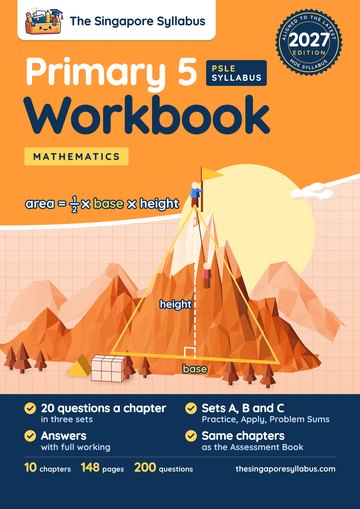
These 10 questions come from the free sample of the TSS Primary 5 Maths Workbook Assessment Book, written for Primary 5 in Singapore. Try each one first, then open the answer to see the working.
Numbers to 10 Million and Order of Operations
Write nine million, forty thousand and sixteen in numerals.
Show the answer and working
Answer: 9 040 016
- Nine million is 9 000 000.
- Forty thousand is 40 000 and sixteen is 16, with no hundreds.
- 9 000 000 + 40 000 + 16 = 9 040 016
In 5 280 713, what is the value of the digit 8?
Show the answer and working
Answer: 80 000
- Read the places from the right: 3 ones, 1 ten, 7 hundreds, 0 thousands, 8 ten thousands.
- The digit 8 is in the ten thousands place, so its value is 80 000.
Round 6 482 951 to the nearest hundred thousand.
Show the answer and working
Answer: 6 500 000
- 6 482 951 is between 6 400 000 and 6 500 000.
- The ten thousands digit is 8, so round up to 6 500 000.
Write 8 000 000 + 50 000 + 600 + 4 as a number.
Show the answer and working
Answer: 8 050 604
- 8 000 000 + 50 000 + 600 + 4 = 8 050 604
Work out 36 − 12 ÷ 4.
Show the answer and working
Answer: 33
- Divide first: 12 ÷ 4 = 3
- 36 − 3 = 33
Work out. (a) 48 ÷ 6 + 5 × 4 (b) 90 ÷ (4 + 5) × 3
Show the answer and working
Answer: (a) 28 (b) 30
- (a) 48 ÷ 6 = 8 and 5 × 4 = 20, so 8 + 20 = 28.
- (b) Brackets first: 4 + 5 = 9. Then 90 ÷ 9 = 10, and 10 × 3 = 30.
Add 15 and 9. Then multiply the answer by 4. (a) Write this as one number sentence using brackets. (b) Work out the number sentence.
Show the answer and working
Answer: (a) (15 + 9) × 4 (b) 96
- (a) The brackets show the addition happens first.
- (b) 15 + 9 = 24, and 24 × 4 = 96
Find the value of each. (a) 3500 × 200 (b) 4 800 000 ÷ 60
Show the answer and working
Answer: (a) 700 000 (b) 80 000
- (a) 3500 × 200 = 3500 × 2 × 100 = 7000 × 100 = 700 000
- (b) 4 800 000 ÷ 60 = 480 000 ÷ 6 = 80 000
A number is 5 600 000 when rounded to the nearest hundred thousand. (a) What is the smallest whole number it can be? (b) What is the greatest whole number it can be?
Show the answer and working
Answer: (a) 5 550 000 (b) 5 649 999
- Numbers from 5 550 000 to 5 649 999 round to 5 600 000.
- (a) The smallest is 5 550 000.
- (b) The greatest is 5 649 999.
Farah saved $35 each week for 24 weeks. She then paid $260 for a school trip and put the rest of her money equally into 4 jars. (a) How much did Farah save in 24 weeks? (b) How much money was in each jar?
Show the answer and working
Answer: (a) $840 (b) $145
- (a) 35 × 24 = 840
- (b) 840 − 260 = 580, and 580 ÷ 4 = 145
The full Primary 5 Maths Workbook book
The book has 10 chapters, 200 questions and 148 A4 pages. Each chapter has notes, practice and answers with the working, and the book ends with a practice examination and its mark scheme. It is a PDF you print at home, S$15.
Buy this bookDownload the free sample (PDF)
Want a tutor to go through these with your child? See Primary 5 Maths tuition.
More for this level
- Primary 5 Maths tuitionA home tutor to go through the book with your child
- Primary 5 Maths Assessment BookNotes, practice and a full exam on the same chapters
- Free P5 and P6 Maths test papersReal school papers to sit after the chapters
- PSLE Math formulas, freeThe formulas to know, on one sheet
- PSLE Mathematics topic guidesOne free page per topic, with a worked example
- Free Primary 5 Maths worksheetsA sample-sized pack to print
- All the Maths assessment booksEvery level from Primary 1 to Secondary 4, and the Workbooks
- How to choose a Maths assessment bookWhat to check before you buy any book
- Best PSLE Maths assessment booksOur book beside the other books parents ask about
These questions are our own practice material, not issued by MOE or any school. If you find a mistake, tell us and we will fix it.