Primary 6 English sample questions with answers
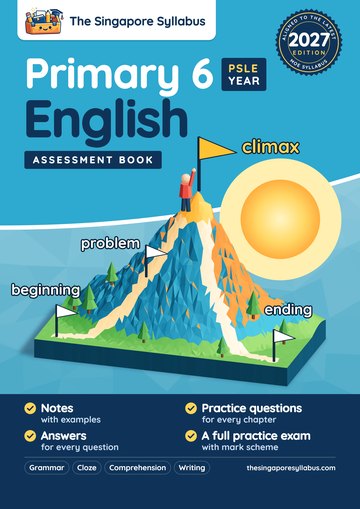
These 10 questions come from the free sample of the TSS Primary 6 English Assessment Book, written for Primary 6 in Singapore. Try each one first, then open the answer to see the working.
Grammar
Wei Ling's new school bag is very similar ______ the one she lost. (A) to (B) with (C) from (D) as
Show the answer and working
Answer: (A) to
- Similar is always followed by to, a fixed preposition pattern.
The boy ______ bicycle was left at the void deck came back for it after dinner. (A) whose (B) who (C) whom (D) which
Show the answer and working
Answer: (A) whose
- The blank shows the bicycle belongs to the boy, so we need the possessive relative pronoun whose.
Only ______ of the forty pupils in Priyanka's class forgot their consent forms, so Madam Siti was pleased. (A) a little (B) much (C) a few (D) little
Show the answer and working
Answer: (C) a few
- Pupils can be counted, so we need a few, not a little or much, which go with things we cannot count.
Madam Siti is the teacher to ______ we handed our project proposal. (A) who (B) which (C) whom (D) whose
Show the answer and working
Answer: (C) whom
- After a preposition such as to, we use the object form whom, not the subject form who.
Mr Koh, as well as his two sons, ______ at the community centre every Saturday morning. (A) volunteer (B) volunteers (C) are volunteering (D) have volunteered
Show the answer and working
Answer: (B) volunteers
- As well as his two sons is extra information, so the true subject is Mr Koh, which is singular.
- Every Saturday morning is a habit, so the simple present singular form is volunteers.
The number of pupils who cycle to school ______ grown steadily over the past three years. (A) have (B) are (C) is (D) has
Show the answer and working
Answer: (D) has
- The number of is treated as singular, so the verb is has.
All the luggage ______ already been loaded onto the coach when Darren realised his water bottle was missing. (A) had (B) have (C) has (D) were
Show the answer and working
Answer: (A) had
- Luggage is an uncountable noun and is always singular.
- Two past actions happened, and the loading came before Darren noticed, so it takes the past perfect had.
(Challenge) ______ Darren known about the road closure, he would have taken a different route to school. (A) If (B) Should (C) Were (D) Had
Show the answer and working
Answer: (D) Had
- This is an inverted conditional with no if, used for an unreal past situation.
- Had plus the subject plus the past participle replaces If ... had known.
Farhan seldom forgets to water the plants on the balcony, ______? (A) does he (B) doesn't he (C) is he (D) isn't he
Show the answer and working
Answer: (A) does he
- Seldom makes the statement negative in meaning, so the tag must be positive.
- There is no helper verb, so we use does for one person, giving does he.
Everyone but Darren and Farhan ______ already handed in the consent form. (A) have (B) has (C) are (D) were
Show the answer and working
Answer: (B) has
- Everyone is singular, and but Darren and Farhan is an exception phrase that does not change the subject.
- So the verb stays singular: has.
The full Primary 6 English book
The book has 11 chapters, 470 questions and 389 A4 pages. Each chapter has notes, practice and answers with the working, and the book ends with a practice examination and its mark scheme. It is a PDF you print at home, S$15.
Buy this bookDownload the free sample (PDF)
Want a tutor to go through these with your child? See Primary 6 English tuition.
More for this level
These questions are our own practice material, not issued by MOE or any school. If you find a mistake, tell us and we will fix it.