Best Secondary 1 and 2 Science assessment books
Use one topical book for Lower Secondary Science with worked answers your child can check, and add practice papers nearer the weighted assessments and year-end exam. Four printed books are compared below with the TSS PDFs. Schools differ in which topics they teach in Sec 1 and which in Sec 2, so check the chapter list against your child's school.
 Reviewed by Theon Teo, Founder · Updated
Books and prices last checked November 2026.
How do the main Lower Secondary Science books compare?
Lower Secondary Science builds the scientific method, matter, energy, systems and interactions that Secondary 3 Pure or Combined Science builds on. A topical book should follow the topics in the order your child's school teaches them.
Every title from another publisher on this page was opened on its publisher's or seller's own page on 29 November 2026, where we read the title, the price and what the page says the book contains. Most publishers do not print a question count, so we say so where that is the case. Many other good books exist. Leaving one out is not a judgement on it. We have no link with these publishers, and prices can change.
| Book | Type | Contents, as the seller states | Price on 29 Nov 2026 | Pick it when |
|---|---|---|---|---|
| [S1B/G3 Science Fast Forward Topical Tests](https://www.eph.com.sg/product/s1b-science-fast-forward-topical-tests/) (Educational Publishing House) | Topical tests, Sec 1 (G3) | Topical tests and a thematic test (no count stated) | S$12.90 | You want short tests after each topic, with mark schemes |
| [Secondary 1B Lower Secondary Science G3&G2 Assessment](https://popular.com.sg/products/secondary-1b-lower-secondary-science-g3-g2-assessment) (publisher not stated, sold by Popular) | Chapter questions and specimen papers, Sec 1 (G3 and G2) | Chapter questions and specimen papers (no count stated) | S$12.55 | Your child takes G2 Science, or wants vocabulary help in each chapter |
| [Lower Secondary Science Practice Paper Volume A](https://www.casco.com.sg/secondary-school/s-science-assessment-books/lower-secondary-science-practice-paper-volume-a) (Casco Publications) | Practice papers, Lower Secondary | MCQ, short-answer and free-response questions (no count stated) | S$13.80 | You want mixed practice papers. The page says it follows the 2013 syllabus, so check topics against school |
| [Secondary 2 Science (G3) Examination Practice](https://popular.com.sg/pages/recommended-assessement-books-secondary-1) (publisher not stated, sold by Popular) | Practice papers, Sec 2 (G3) | Five practice papers with solutions | S$19.00 | Before the Sec 2 year-end exam, for timed practice |
| [Secondary 1 Science Assessment Book](/shop/sec-1-science-assessment-book-pdf) (The Singapore Syllabus) | Notes, topical practice and a practice exam, Sec 1 | 224 questions in 327 pages, with notes and worked answers | S$15 | You want notes, practice and worked answers for every chapter as a PDF |
| [Secondary 2 Science Assessment Book](/shop/sec-2-science-assessment-book-pdf) (The Singapore Syllabus) | Notes, topical practice and a practice exam, Sec 2 | 249 questions in 383 pages, with notes and worked answers | S$15 | As above, for Sec 2 |
How should Secondary 1 and 2 Science practice be paced?
- Term by term: one chapter at a time, soon after the school teaches it, not working ahead.
- Before each weighted assessment: redo wrong questions from the chapters it covers, then try a practice paper under time.
- End of Secondary 2: a full practice exam is useful before starting Secondary 3 Pure or Combined Science.
What is in the TSS Secondary 1 and 2 Science books?
The Secondary 1 Science Assessment Book has 224 questions in 327 pages across 8 chapters: Chapter 1: The Scientific Endeavour, Chapter 2: Exploring Matter by its Physical Properties, Chapter 3: Exploring Matter by its Chemical Composition, Chapter 4: Separation Techniques, Chapter 5: Ray Model of Light, Chapter 6: Model of Cells: the Basic Unit of Life, Chapter 7: The Particulate Nature of Matter, Chapter 8: Model of Matter: Atoms and Molecules.
The Secondary 2 Science Assessment Book has 249 questions in 383 pages across 8 chapters: Chapter 1: Forces and Energy, Chapter 2: Transfer of Heat Energy and Its Effects, Chapter 3: Chemical Changes, Chapter 4: Interactions within Ecosystems, Chapter 5: Electrical Systems, Chapter 6: Human Digestive System, Chapter 7: Transport Systems in Living Things, Chapter 8: Human Sexual Reproductive System.
Each ends with an End-of-Year Practice Examination (Sec 1: Booklet A: 30 questions, 30 marks, Booklet B: 11 questions, 70 marks. Sec 2: Paper 1: 30 questions, 30 marks, Paper 2: 11 questions, 70 marks). S$15 each, or S$25 as a set of two. If your child's school teaches a topic in the other year, it will be in the other book.
Which TSS books cover Secondary 1 and 2?
Each TSS book is a printable PDF with notes, practice questions and worked answers for every chapter, and a practice exam at the end. S$15 each, and any books mix and match: 5 for S$49, 10 for S$82 (2 for S$25, 3 for S$34). See all of them on the Secondary Science assessment books page.
| Book | Pages | Questions | Chapters | Try it first | Tutor |
|---|---|---|---|---|---|
| Secondary 1 Science Assessment Book | 327 | 224 | 8 | Sample questions Free sample (PDF) | Secondary 1 Science tuition |
| Secondary 2 Science Assessment Book | 383 | 249 | 8 | Sample questions Free sample (PDF) | Secondary 2 Science tuition |
Look inside the Secondary 1 Science book
Real pages and questions from the Secondary 1 Science Assessment Book, taken from its free sample. Try a question, then open the answer.
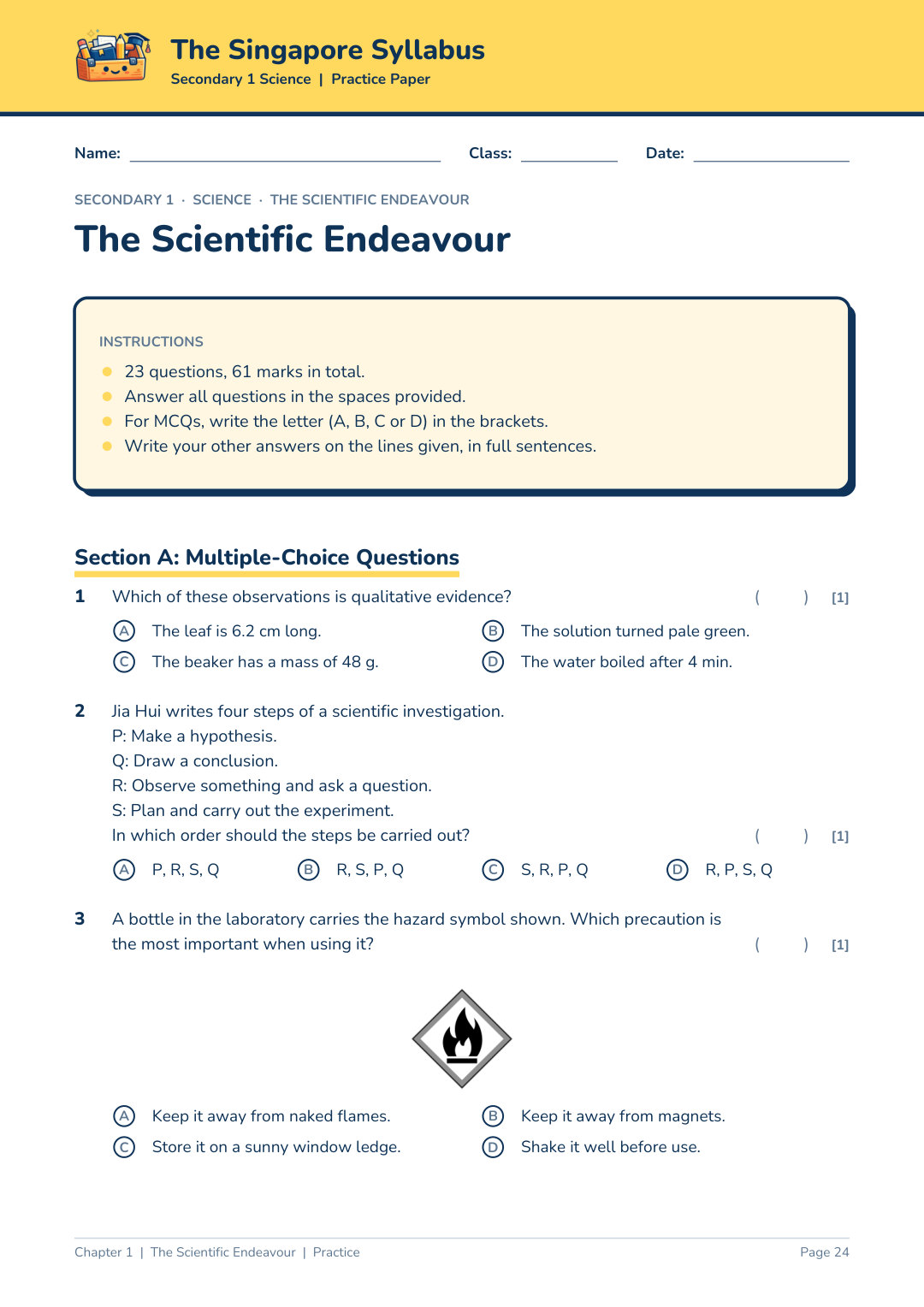 A practice page from Chapter 1 of the Secondary 1 Science book
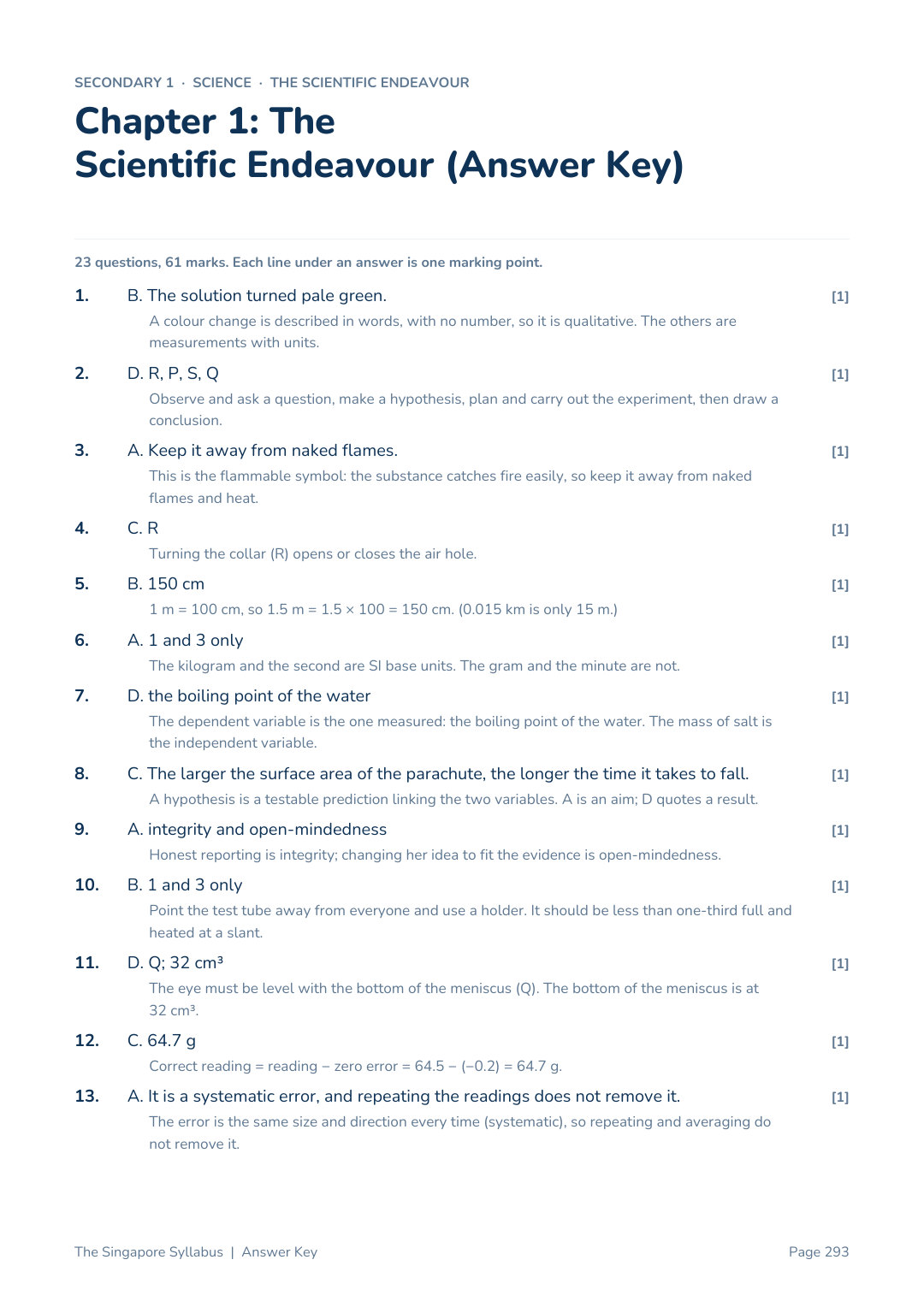 An answers page from Chapter 1 of the Secondary 1 Science book
The Scientific Endeavour
Which of these observations is qualitative evidence? (A) The leaf is 6.2 cm long. (B) The solution turned pale green. (C) The beaker has a mass of 48 g. (D) The water boiled after 4 min.
Show the answer and working
Answer: (B) The solution turned pale green.
- Quantitative evidence is a number with a unit. (A), (C) and (D) are all measurements with units.
- (B) describes a colour change in words, with no number, so it is qualitative.
The Scientific Endeavour
Jia Hui writes four steps of a scientific investigation. P: Make a hypothesis. Q: Draw a conclusion. R: Observe something and ask a question. S: Plan and carry out the experiment. In which order should the steps be carried out? (A) P, R, S, Q (B) R, S, P, Q (C) S, R, P, Q (D) R, P, S, Q
Show the answer and working
Answer: (D) R, P, S, Q
- A scientific investigation starts by observing something and asking a question (R), then making a hypothesis (P), then planning and carrying out the experiment (S), and ends with a conclusion (Q).
How the TSS PDF books work
- Instant download. The PDF opens on your order page as soon as your payment goes through, and we email you the link. Each file can be downloaded up to 10 times.
- Answers included. The answers are in the same PDF as the questions, with working or marking points, so your child can check their own work.
- Secure payment. You pay on a Stripe page by card or PayNow. We never see or store your card details.
- Refunds. If a file will not open or a page is missing, WhatsApp us within 14 days and we will send a replacement or refund you. A PDF is yours the moment you pay, so we cannot refund a downloaded file for a change of mind.
- Printing. Print what you need at home, for the children in your own family. Please do not share the files outside it.
The full rules are in the shop terms.
Questions parents ask
What is the best Secondary 1 or 2 Science assessment book?
A topical book that follows your school's teaching order, with worked answers, plus practice papers nearer exams. EPH's S1B/G3 Science Fast Forward Topical Tests (S$12.90) and Secondary 2 Science (G3) Examination Practice (S$19.00 at Popular) are printed options. The TSS Sec 1 and 2 books are PDFs with notes in every chapter. Prices as checked on 29 Nov 2026.
Is Sec 1 and Sec 2 Science the same in every school?
No. The syllabus covers both years, and schools choose which topics come in Sec 1 and which in Sec 2, so check the chapter list against your child's school before buying one year's book.
What comes after Secondary 1 and 2 Science?
From Secondary 3, students take either Pure Science subjects (Physics, Chemistry or Biology, each sat separately) or Combined Science (two of the three, examined together).
More guides to Secondary Science assessment books
- Best O-Level Physics assessment booksPure Physics topical practice, past papers and revision guides for Sec 3 and 4
- Best O-Level Chemistry assessment booksPure Chemistry topical practice and revision guides for Sec 3 and 4
- Best O-Level Biology assessment booksPure Biology topical practice and revision guides for Sec 3 and 4
- Best Combined Science assessment booksBuying by component: Physics, Chemistry and Biology for Combined Science
- All TSS Secondary Science assessment booksSec 1 and 2 Science, Sec 3 and 4 Physics, Chemistry, Biology and Combined Science
- Free O-Level Combined Science papersReal school papers, most with answers
Books from other publishers are named for information. We are not linked to them. The TSS books are our own practice material, not issued by MOE or any school. If you find a mistake on this page, tell us and we will fix it.