Secondary 1 Science sample questions with answers
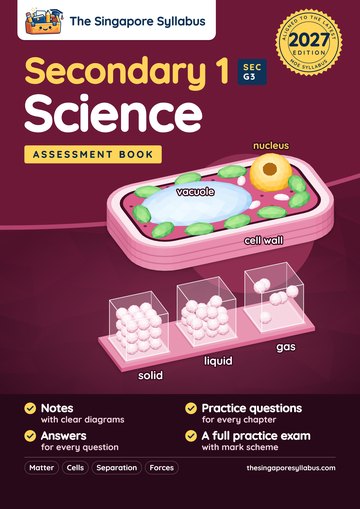
These 8 questions come from the free sample of the TSS Secondary 1 Science Assessment Book, written for Secondary 1 in Singapore. Try each one first, then open the answer to see the working.
The Scientific Endeavour
Which of these observations is qualitative evidence? (A) The leaf is 6.2 cm long. (B) The solution turned pale green. (C) The beaker has a mass of 48 g. (D) The water boiled after 4 min.
Show the answer and working
Answer: (B) The solution turned pale green.
- Quantitative evidence is a number with a unit. (A), (C) and (D) are all measurements with units.
- (B) describes a colour change in words, with no number, so it is qualitative.
Jia Hui writes four steps of a scientific investigation. P: Make a hypothesis. Q: Draw a conclusion. R: Observe something and ask a question. S: Plan and carry out the experiment. In which order should the steps be carried out? (A) P, R, S, Q (B) R, S, P, Q (C) S, R, P, Q (D) R, P, S, Q
Show the answer and working
Answer: (D) R, P, S, Q
- A scientific investigation starts by observing something and asking a question (R), then making a hypothesis (P), then planning and carrying out the experiment (S), and ends with a conclusion (Q).
Which of these lengths is equal to 1.5 m? (A) 15 mm (B) 150 cm (C) 1500 cm (D) 0.015 km
Show the answer and working
Answer: (B) 150 cm
- 1.5 m = 150 cm (multiply by 100).
- Check the others: 15 mm = 0.015 m, 1500 cm = 15 m, and 0.015 km = 15 m, so none of these equal 1.5 m.
Which of these are SI base units? 1 kilogram, 2 gram, 3 second, 4 minute. (A) 1 and 3 only (B) 2 and 3 only (C) 2 and 4 only (D) 1, 3 and 4 only
Show the answer and working
Answer: (A) 1 and 3 only
- The SI base unit of mass is the kilogram, not the gram.
- The SI base unit of time is the second, not the minute.
- So only statements 1 and 3 are SI base units.
Mei Ling investigates how the mass of salt added to 200 cm³ of water affects the boiling point of the water. What is the dependent variable? (A) the mass of salt added (B) the volume of water (C) the type of beaker used (D) the boiling point of the water
Show the answer and working
Answer: (D) the boiling point of the water
- The dependent variable is what is measured as a result of the change.
- Mei Ling changes the mass of salt (the independent variable) and measures the boiling point of the water, which is the dependent variable.
Ravi investigates how the surface area of a paper parachute affects the time it takes to fall to the ground. Which statement is a hypothesis? (A) To find out how the surface area of a parachute affects the time it takes to fall. (B) Paper parachutes are fun to make and test. (C) The larger the surface area of the parachute, the longer the time it takes to fall. (D) The parachute with the largest surface area took 3.2 s to fall.
Show the answer and working
Answer: (C) The larger the surface area of the parachute, the longer the time it takes to fall.
- A hypothesis is a testable prediction, made before the test, that links the independent and dependent variables.
- (A) is an aim, not a prediction, (B) is not testable, and (D) states an actual result rather than a prediction.
- Only (C) predicts how surface area affects falling time.
An electronic balance reads −0.2 g when nothing is on its pan. With a beaker on the pan, it reads 64.5 g. What is the actual mass of the beaker? (A) 64.3 g (B) 64.5 g (C) 64.7 g (D) 66.5 g
Show the answer and working
Answer: (C) 64.7 g
- The balance has a zero error of −0.2 g, so every reading it gives is 0.2 g too low.
- Actual mass = 64.5 − (−0.2) = 64.7 g.
A thermometer always reads 1 °C higher than the true temperature. Which statement about this error is correct? (A) It is a systematic error, and repeating the readings does not remove it. (B) It is a random error, and repeating the readings removes it. (C) It is a systematic error, and taking an average removes it. (D) It is a random error, caused by a slow reaction time.
Show the answer and working
Answer: (A) It is a systematic error, and repeating the readings does not remove it.
- An error that is always in the same direction by the same amount is a systematic error, not a random one.
- Repeating the reading and averaging would not remove it, because every reading would still be 1 °C too high.
The full Secondary 1 Science book
The book has 8 chapters, 224 questions and 327 A4 pages. Each chapter has notes, practice and answers with the working, and the book ends with a practice examination and its mark scheme. It is a PDF you print at home, S$15.
Buy this bookDownload the free sample (PDF)
Want a tutor to go through these with your child? See Secondary 1 Science tuition.
More for this level
These questions are our own practice material, not issued by MOE or any school. If you find a mistake, tell us and we will fix it.