Free notes · Primary 5 and 6
PSLE Maths notes
Free PSLE Maths notes on one page, for the PSLE Mathematics exam (0008), following MOE's 2021 primary Mathematics syllabus. Full notes for 12 of the 14 syllabus chapters, each with the key idea, the facts and formulas to know, a worked exam question, the common mistakes and exam tips. The other chapters have a checklist of what the syllabus asks for, so the page maps the whole syllabus.
Free to read, print or save as a PDF, with no sign-up. The print layout keeps every chapter and drops the menus. After each chapter, practise on the PSLE Maths school papers.
- 14 chapters
- Free to print
How to use these notes
- Pick one chapter. Read the key idea and the must-know points.
- Close the page and write down what you remember, then check and mark what you missed.
- Try the worked exam question before reading its steps, and read the common mistakes.
- Do questions on that chapter from a school paper and mark them. Redo the wrong ones a few days later.
Syllabus edition
The PSLE Mathematics exam (0008) assesses MOE's 2021 Primary Mathematics syllabus, which applies to Primary 6 from 2026. The chapter list below is the syllabus's Primary 5 and Primary 6 Standard topics, which build on Primary 1 to 4. Sources: SEAB, PSLE Mathematics 0008 (examined from 2026), MOE, 2021 Primary Mathematics syllabus.
Exam format
| Paper | What it is | Time | Marks |
|---|---|---|---|
| Paper 1, Booklet A | 18 multiple-choice questions: 10 worth 1 mark, 8 worth 2 marks. No calculator. | 1 h 10 min for both booklets | 26 |
| Paper 1, Booklet B | 12 short-answer questions, 2 marks each. No calculator. | 24 | |
| Paper 2 | 5 short-answer questions (2 marks each) and 10 structured or long-answer questions (3, 4 or 5 marks each). Calculator allowed. | 1 h 20 min | 50 |
- Both papers are on the same day with a break between them. 45 questions and 100 marks in all.
- In a one-part short-answer question, a wrong answer can still earn 1 mark for a correct method. In long-answer questions, the working must be shown.
The whole syllabus, chapter by chapter
All 14 chapters of the syllabus in order. 12 have full notes on this page. The rest have a checklist of what the syllabus asks you to do.
| Chapter | What it covers | On this page |
|---|---|---|
| 1. Whole Numbers (P5) | Numbers up to 10 million and the four operations. | Checklist |
| 2. Fractions (P5 and P6) | Fractions and division, and the four operations on fractions. | Full notes |
| 3. Decimals (P5) | Operations on decimals and converting measurements. | Full notes |
| 4. Percentage (P5 and P6) | Percentage of a whole, discount, GST, interest, and percentage change. | Full notes |
| 5. Rate (P5) | Rate as an amount per unit. | Full notes |
| 6. Ratio (P6) | Ratios, equivalent ratios and ratio problems. | Full notes |
| 7. Algebra (P6) | Letters for unknowns, simple expressions and equations. | Full notes |
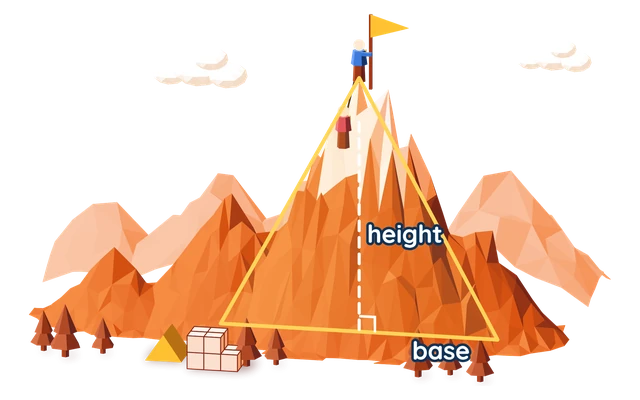
| 8. Area of Triangle (P5) | Base and height, area of a triangle and composite figures. | Checklist |
| 9. Volume of Cube and Cuboid (P5 and P6) | Unit cubes, volume of cubes and cuboids, and liquid in tanks. | Full notes |
| 10. Angles and Geometric Figures (P5 and P6) | Angle facts, triangles and special quadrilaterals. | Full notes |
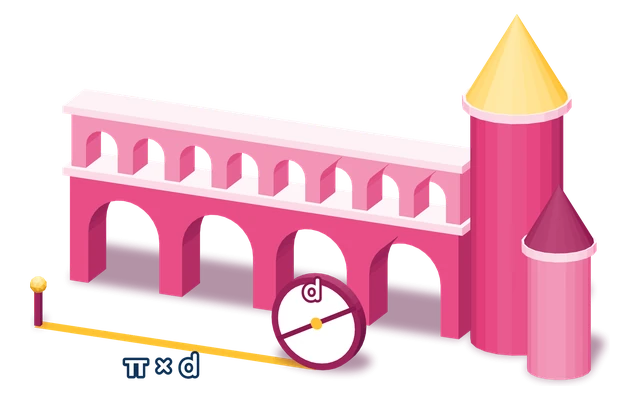
| 11. Area and Circumference of Circle (P6) | Circles, semicircles, quarter circles and composite figures. | Full notes |
| 12. Average of a Set of Data (P6) | Average, total and number of data. | Full notes |
| 13. Tables, Line Graphs and Pie Charts (P4) | Reading and interpreting data. | Full notes |
| 14. Problem solving with models | Bar models as a problem-solving heuristic across topics. | Full notes |
PSLE Maths at a glance
| Chapter | The one thing to remember |
|---|---|
| Fractions | Multiply: a/b × c/d = (a × c)/(b × d), cancelling common factors first. |
| Decimals | × 10, 100, 1000 moves digits 1, 2, 3 places left. ÷ moves them right. |
| Percentage | Percentage of a quantity: 15% of $80 = 15/100 × 80 = $12. |
| Rate | Rate = total amount ÷ number of units. |
| Ratio | A : B = 2 : 3 means A is 2/5 of the total and 2/3 of B. |
| Algebra | 3 × n is written 3n, and n ÷ 4 is written n/4. |
| Volume of Cubes and Cuboids | Volume of cuboid = length × breadth × height = base area × height. |
| Angles and Geometric Figures | Straight line 180°, at a point 360°, vertically opposite angles equal. |
| Area and Circumference of Circles | Diameter = 2 × radius. |
| Average | Average = total ÷ number of items. |
| Pie Charts and Data Analysis | Whole circle = whole data = 100% = 360°. |
| Model Drawing for Word Problems | Every unit in a model must stand for the same amount. |
Notes 1 of 12
Fractions
Key idea. A fraction is a part of a whole, and it also means division: 3/4 = 3 ÷ 4. To multiply fractions, multiply the numerators and the denominators. To divide, multiply by the reciprocal of the divisor. In word problems, draw a bar of equal units, ask 'a fraction of what?' at each step, find the value of 1 unit, then multiply.
Must know
- Multiply: a/b × c/d = (a × c)/(b × d), cancelling common factors first.
- Divide: multiply by the reciprocal of the divisor, so 6 ÷ 2/3 = 6 × 3/2 = 9.
- Fraction of a remainder: find what is left first, then take the fraction of that.
- Finding the whole: if 3/5 of it is 48, then 1/5 is 16 and the whole is 80.
What the syllabus asks you to do
- Divide a whole number by a whole number with the quotient as a fraction, such as 3 ÷ 4 = 3/4 (P5)
- Express fractions as decimals (P5)
- Add and subtract mixed numbers (P5), building on adding and subtracting fractions with different denominators (P4)
- Multiply a proper or improper fraction by a whole number, a proper fraction by a proper or improper fraction, and two improper fractions (P5)
- Multiply a mixed number by a whole number (P5)
- Divide a proper fraction by a whole number, and a whole number or proper fraction by a proper fraction, without a calculator (P6)
- Use a fraction as part of a set (P4) to find a fraction of a quantity
The four fraction operations and finding the whole, with one example each
| Task | Method | Example |
|---|---|---|
| Add or subtract | Rename with a common denominator | 3/4 + 1/6 = 9/12 + 2/12 = 11/12 |
| Multiply | Multiply numerators and denominators, cancel first | 2/3 × 3/5 = 6/15 = 2/5 |
| Divide | Multiply by the reciprocal of the divisor | 6 ÷ 2/3 = 6 × 3/2 = 9 |
| Fraction of a quantity | 'Of' means multiply | 2/5 of 30 = 12 |
| Whole from a part | Find 1 unit, then multiply up | 3/5 of it is 48, so 1/5 is 16 and the whole is 80 |
One bar labelled Flour, cut into 5 equal units. The first 2 units are shaded and labelled bread. The next 1 unit is shaded differently and labelled cookies. The last 2 units are unshaded and labelled 840 g. A note says 1 unit is 420 g, so the whole bar is 2100 g.
Worked exam question
Mrs Tan had some flour. She used 2/5 of it to bake bread and 1/3 of the remainder to bake cookies. She had 840 g of flour left. How much flour did she have at first?
- Draw a bar for all the flour and cut it into 5 equal units, because the first fraction is in fifths.
- Bread uses 2/5, which is 2 units, so the remainder is 5 − 2 = 3 units.
- Cookies use 1/3 of the remainder, which is 1/3 × 3 units = 1 unit.
- Flour left = 3 − 1 = 2 units, and this is 840 g.
- 1 unit = 840 ÷ 2 = 420 g.
- Flour at first = 5 units = 5 × 420 = 2100 g.
- Check: bread uses 2/5 × 2100 = 840 g, leaving 1260 g. Cookies use 1/3 × 1260 = 420 g, leaving 840 g, which matches the question.
Answer: She had 2100 g (2.1 kg) of flour at first.
Common mistakes
- Taking 1/3 of all the flour when the question says 1/3 of the remainder.Find the remainder first and label it on the bar, then take the fraction of that remainder.
- Writing 1/2 + 1/3 = 2/5 by adding the tops and the bottoms.Rename with a common denominator first: 3/6 + 2/6 = 5/6.
- Working out 1 1/2 × 1 1/2 as 1 1/4 by multiplying the wholes and the parts separately.Change mixed numbers into improper fractions first: 3/2 × 3/2 = 9/4 = 2 1/4.
- Flipping the first fraction in 3/5 ÷ 3/10, or flipping both.Flip only the divisor, the fraction after the ÷ sign: 3/5 × 10/3 = 2.
- Treating 1/4 of Ali's money and 1/4 of his remainder as the same amount.Draw both on the same bar, cut into equal units, before comparing.
- Leaving 12/16 or 9/4 when the simplest form or a mixed number is asked for.Reread the question last, then simplify to 3/4 or write 2 1/4.
Exam tips
- In every multi-step fraction problem, write 'of what?' next to each fraction and label the remainder on your model before you take the next fraction.
- Choose the number of units so that every fraction gives a whole number of units, for example 12 units when you need thirds and then quarters of the remainder.
- Check reasonableness: dividing by a proper fraction should give a bigger answer, and multiplying by one should give a smaller answer.
Notes 2 of 12
Decimals
Key idea. Decimals are fractions with denominators of 10, 100 and 1000, written with a decimal point. To multiply or divide by 10, 100 or 1000, move the digits 1, 2 or 3 places. To round, look at the next digit and round up if it is 5 or more. To convert a bigger unit into a smaller one, such as kg into g, multiply.
Must know
- × 10, 100, 1000 moves digits 1, 2, 3 places left. ÷ moves them right.
- Round up when the next digit is 5 or more, otherwise keep the digit.
- 1 km = 1000 m, 1 kg = 1000 g, 1 ℓ = 1000 ml, 1 m = 100 cm.
- Bigger unit to smaller unit: multiply. Smaller unit to bigger unit: divide.
What the syllabus asks you to do
- Read place values up to 3 decimal places, and compare and order decimals (P4)
- Round decimals to the nearest whole number, 1 decimal place or 2 decimal places (P4)
- Multiply and divide decimals (up to 2 decimal places) by a 1-digit whole number (P4)
- Express decimals as fractions (P4) and fractions as decimals (P5)
- Multiply and divide decimals (up to 3 decimal places) by 10, 100, 1000 and their multiples without a calculator (P5)
- Convert a measurement between a smaller and a larger unit in decimal form: km and m, m and cm, kg and g, litres and ml (P5)
Place value of each digit in 3.465
| Digit | Place | Value |
|---|---|---|
| 3 | Ones | 3 |
| 4 | Tenths | 0.4 (4/10) |
| 6 | Hundredths | 0.06 (6/100) |
| 5 | Thousandths | 0.005 (5/1000) |
Worked exam question
A bottle holds 1.25 ℓ of juice and costs $3.85. Mrs Lim buys 6 bottles and pays with a $50 note. She pours all the juice equally into 30 cups. (a) How much change does she receive? (b) How many millilitres of juice are in each cup?
- Cost of 6 bottles = 6 × $3.85. Work out 385 × 6 = 2310, then place the point to give $23.10.
- Change = $50 − $23.10 = $26.90.
- Total juice = 6 × 1.25 ℓ = 7.5 ℓ (125 × 6 = 750, with 2 decimal places gives 7.50).
- Convert to millilitres by multiplying by 1000, because litres are the bigger unit: 7.5 × 1000 = 7500 ml.
- Juice in each cup = 7500 ÷ 30 = 250 ml.
- Check: 250 × 30 = 7500 ml = 7.5 ℓ, and $23.10 + $26.90 = $50.
Answer: (a) $26.90 (b) 250 ml in each cup.
Common mistakes
- Writing 0.07 × 1000 as 7 or 700 instead of 70.Move one place for each zero in 10, 100 or 1000, then estimate to check the size.
- Writing 3 km 40 m as 3.4 km.Write the metres as thousandths: 40 m = 0.040 km, so 3 km 40 m = 3.04 km.
- Dividing by 1000 to change 1.2 kg into grams.Bigger unit to smaller unit means multiply, so 1.2 kg = 1200 g. Smaller to bigger means divide.
- Saying 0.125 is bigger than 0.2.Line up the decimal points and compare tenths first: 1 tenth is less than 2 tenths.
- Rounding halfway through a calculation, then rounding again at the end.Keep full values until the last step, then round once to the accuracy asked for.
- Writing $4.5 instead of $4.50.Write money in dollars and cents to 2 decimal places.
Exam tips
- Estimate every decimal calculation with rounded numbers first, then compare your exact answer with the estimate to catch a misplaced decimal point.
- Convert all measures into one unit at the start of a problem, and write the unit beside every line of working.
- When a question mixes money and measures, answer each part with its own unit, such as $26.90 and 250 ml, and give money to 2 decimal places.
Notes 3 of 12
Percentage
Key idea. A percentage is a fraction out of 100, so 35% = 35/100. To find a percentage of an amount, multiply. To find the whole from a part, find 1% or 10% first, then scale up to 100%. Percentage change is the change divided by the original value, times 100%. Always decide what 100% stands for before calculating.
Must know
- Percentage of a quantity: 15% of $80 = 15/100 × 80 = $12.
- After a 20% discount you pay 80% of the usual price.
- Percentage change = change ÷ original value × 100%.
- With 9% GST, the total is 109% of the price before GST.
What the syllabus asks you to do
- Express a part of a whole as a percentage, using the % notation (P5)
- Find a percentage part of a whole (P5)
- Find discount, GST and annual interest (P5)
- Find the whole given a part and the percentage (P6)
- Find percentage increase and percentage decrease (P6)
What 100% stands for in each type of percentage question
| Situation | 100% is | Example |
|---|---|---|
| Discount | The usual price | 20% off $45: pay 80% of $45 = $36 |
| GST (rate given) | The price before GST | 9% GST on $200: pay 109% of $200 = $218 |
| Annual interest | The amount saved | 2% per year on $5000: $100 interest |
| Percentage change | The original value | 40 to 50: 10/40 × 100% = 25% increase |
| Finding the whole | The unknown total | 30% is 84, so 10% is 28 and 100% is 280 |
One bar labelled Usual price, split into two parts. The first part, 17 units long and shaded, is labelled $1020 paid, 85%. The second part, 3 units long and shaded differently, is labelled discount, 15%. A note says 17 units = $1020, so 1 unit (5%) = $60 and the whole bar is $1200.
Worked exam question
A shop sells a television at a 15% discount. Ms Wong pays $1020 for it after the discount. (a) What was the usual price of the television? (b) How much did she save?
- The usual price is the whole, so usual price = 100%.
- Ms Wong pays the part left after the discount: 100% − 15% = 85% of the usual price, so 85% = $1020.
- 1% = $1020 ÷ 85 = $12.
- Usual price = 100% = 100 × $12 = $1200.
- Amount saved = $1200 − $1020 = $180, which is also 15% × $1200 = $180.
- Check: 85% of $1200 = 0.85 × 1200 = $1020, which matches the question.
Answer: (a) $1200 (b) $180
Common mistakes
- Finding the rise from 40 to 50 as 10/50 = 20%.Divide the change by the original value: 10/40 × 100% = 25%.
- Setting the sale price equal to the discount, such as $36 = 20%.Write 100% minus the discount first. After 20% off, the price paid is 80%.
- Assuming a 10% increase then a 10% decrease returns to the start.Work each step separately: $100 rises to $110, then falls by $11 to $99.
- Writing 45 cm out of 2 m as 45/2.Change to the same unit first: 45 cm out of 200 cm is 22.5%.
- Adding GST to the usual price before taking off the discount.Take off the discount first, then add GST on the discounted price.
- Giving 0.25 when a percentage is asked for.Multiply by 100% and write 25%.
Exam tips
- Begin each problem by writing '100% = ?' so you know which quantity is the whole before you calculate.
- When finding the whole, step through easy percentages such as 1%, 5% or 10% before scaling up to 100%.
- In multi-step money problems, set out each stage on its own line (usual price, discount, sale price, GST, total) so that each percentage is taken of the right amount.
Notes 4 of 12
Rate
Key idea. A rate is the amount of one quantity for each unit of another quantity, such as 12 litres per minute. Rate = total amount ÷ number of units. Total amount = rate × number of units. Number of units = total amount ÷ rate. Write every rate with both of its units, such as ℓ/min or $ per hour, so you can see which quantity is per which.
Must know
- Rate = total amount ÷ number of units.
- Total amount = rate × number of units.
- Number of units = total amount ÷ rate.
- Read 'per' as 'for each': 12 ℓ per min means 12 litres every minute.
What the syllabus asks you to do
- Understand rate as the amount of a quantity per unit of another quantity (P5)
- Find the rate given the total amount and the number of units (P5)
- Find the total amount given the rate and the number of units (P5)
- Find the number of units given the rate and the total amount (P5)
The three rate relationships, using a tap that fills 12 litres per minute
| To find | Formula | Example |
|---|---|---|
| Rate | Total amount ÷ number of units | 300 ℓ in 25 min gives 12 ℓ/min |
| Total amount | Rate × number of units | 12 ℓ/min for 25 min gives 300 ℓ |
| Number of units | Total amount ÷ rate | 300 ℓ at 12 ℓ/min takes 25 min |
A line graph of volume of water in litres against time in minutes. Tap A's line is straight, starting at 0 and rising to 300 litres at 25 minutes, passing 120 litres at 10 minutes. Tap B's dashed line is straight and less steep, rising from 0 to 200 litres at 25 minutes. The steeper line shows the higher rate.
Worked exam question
An empty tank holds 300 litres. Tap A fills it at 12 litres per minute. (a) How long does Tap A alone take to fill the tank? (b) Instead, Tap A runs alone for 10 minutes, and then Tap B, which fills at 8 litres per minute, is also turned on. How many more minutes are needed to fill the tank?
- (a) Number of units = total amount ÷ rate = 300 ÷ 12 = 25 minutes.
- (b) In the first 10 minutes Tap A puts in 12 × 10 = 120 litres.
- Water still needed = 300 − 120 = 180 litres.
- With both taps on, the rates add: 12 + 8 = 20 litres every minute.
- Time needed = 180 ÷ 20 = 9 minutes.
- Check: Tap A runs 10 + 9 = 19 minutes and gives 12 × 19 = 228 litres. Tap B runs 9 minutes and gives 8 × 9 = 72 litres. 228 + 72 = 300 litres.
Answer: (a) 25 minutes (b) 9 more minutes
Common mistakes
- Working out 120 ÷ 90 for a tap that fills 90 litres in 120 minutes.Put the quantity before 'per' first: 90 ÷ 120 = 0.75 ℓ/min.
- Calculating 12 × 1.5 = 18 litres for a 12 ℓ/min tap running for 1 1/2 hours.Change 1 1/2 h into 90 min first: 12 × 90 = 1080 litres.
- Using only Tap A's rate after Tap B is turned on.From the moment both taps run, add the rates: 12 + 8 = 20 ℓ/min.
- Charging $40 per hour for all 5 hours when the rate drops to $25 after 2 hours.Split the job into parts and use rate × number of units for each part.
- Writing 30 as the answer instead of 30 pages per minute.Write both units with every rate.
- Writing a money rate as $1.5 per kg.Write money rates to 2 decimal places: $1.50 per kg.
Exam tips
- Write each rate with both units, such as 12 ℓ/min, and check that the units in your multiplication or division match them.
- Change times into the unit of the rate before calculating, for example 1 1/2 h into 90 min for a rate in litres per minute.
- When a rate changes or a second tap is turned on, split the time into parts and use rate × number of units for each part.
Notes 5 of 12
Ratio
Key idea. A ratio compares quantities of the same kind using equal units, such as boys : girls = 2 : 3. Simplify by dividing every term by a common factor. To solve a problem, find the value of 1 unit from the total, a part or the difference. In before-and-after problems, find what stays the same and make it the same number of units in both ratios.
Must know
- A : B = 2 : 3 means A is 2/5 of the total and 2/3 of B.
- Only one quantity changes: the other quantity stays the same.
- One person gives to another: the total stays the same.
- Both get or lose the same amount: the difference stays the same.
What the syllabus asks you to do
- Read and write ratios a : b and a : b : c, where a, b and c are whole numbers (P6)
- Find equivalent ratios and the missing term in a pair of equivalent ratios (P6)
- Express a ratio in its simplest form (P6)
- Find the ratio of two or three given quantities (P6)
- Divide a quantity in a given ratio (P6)
- Use the relationship between fraction and ratio (P6)
What stays the same in before-and-after ratio problems
| What happens | What stays the same | What to do |
|---|---|---|
| Only one person's amount changes | The other person's amount | Make that person's units equal in both ratios |
| One person gives some to the other | The total | Make the totals the same number of units |
| Both receive or lose the same amount | The difference | Make the differences the same number of units |
Three bars drawn to the same unit size. John before is 20 units, with 9 units shaded as kept and 11 units shaded differently as 77 given away. John after is 9 units. Kumar is 12 units and does not change. A note says 11 units = 77, so 1 unit = 7 marbles and John had 140 at first.
Worked exam question
The ratio of the number of John's marbles to Kumar's marbles was 5 : 3. After John gave away 77 marbles, the ratio became 3 : 4. How many marbles did John have at first?
- Only John's marbles changed, so Kumar's number of marbles stayed the same.
- Kumar has 3 units before and 4 units after. Make these equal using the lowest common multiple of 3 and 4, which is 12.
- Before: 5 : 3 = 20 : 12 (multiply both terms by 4). After: 3 : 4 = 9 : 12 (multiply both terms by 3).
- John went from 20 units to 9 units, so he gave away 20 − 9 = 11 units = 77 marbles.
- 1 unit = 77 ÷ 11 = 7 marbles.
- John at first = 20 units = 20 × 7 = 140 marbles.
- Check: Kumar has 12 × 7 = 84. Before, 140 : 84 = 5 : 3. After, 63 : 84 = 3 : 4 (divide both by 21).
Answer: John had 140 marbles at first.
Common mistakes
- Comparing Kumar's 3 units before with his 4 units after directly.Make the unchanged quantity the same number of units first: both become 12 units.
- Thinking 2 : 3 stays the same after adding 1 to each term.Adding the same amount keeps the difference, not the ratio. 2 : 3 becomes 3 : 4.
- Writing boys to girls when the question asks for girls to boys.Copy the words of the question above the ratio before writing any numbers.
- Writing 45 min : 2 h as 45 : 2.Change to one unit first: 45 : 120 = 3 : 8.
- Saying A is 3/5 of the total when A : B = 3 : 5.Add the terms for the total: A is 3/8 of the total and 3/5 of B.
- Sharing $360 in the ratio 4 : 5 by working out $360 ÷ 4 or $360 ÷ 5.Add the terms first: 4 + 5 = 9 units, so 1 unit is $40.
Exam tips
- For every before-and-after problem, write the two ratios one above the other and label which quantity, total or difference stays the same before you start.
- Use the lowest common multiple when making units equal, so the numbers stay small.
- Always substitute your final values back into both the before and after ratios. It takes a few seconds and catches most unit errors.
Notes 6 of 12
Algebra
Key idea. Algebra at PSLE level uses a letter, such as n, to stand for an unknown number. You write expressions like 3n + 5, simplify them by collecting like terms, evaluate them by substituting a value, and solve simple equations such as 3n + 5 = 26 by doing the same operation to both sides, giving n = 7.
Must know
- 3 × n is written 3n, and n ÷ 4 is written n/4.
- Collect like terms: 4k + 7 − k + 3 = 3k + 10.
- Substitute with a × sign: if m = 6, 4m = 4 × 6 = 24.
- Solve by doing the same to both sides: 3x + 5 = 26 gives 3x = 21, x = 7.
What the syllabus asks you to do
- Use a letter to represent an unknown number (P6)
- Read and write simple algebraic expressions such as a + 3, a − 3, 3a and a/3 (P6)
- Simplify simple linear expressions, excluding brackets (P6)
- Evaluate simple linear expressions by substitution (P6)
- Solve simple linear equations involving whole number coefficients only (P6)
Turning words into algebraic expressions
| Words | Expression |
|---|---|
| 5 more than n | n + 5 |
| 4 less than n | n − 4 |
| Twice n | 2n |
| 4 less than twice n | 2n − 4 |
| k sweets shared equally among 3 friends | k/3 sweets each |
| Cost of 6 pens at y cents each | 6y cents |
| A plate costs $3 more than a cup costing $m | $(m + 3) |
Three bars with equal units labelled w. Jia Hui has 1 unit. Her father has 4 units. Her brother has 1 unit and an extra piece labelled 5. A note says 6 units plus 5 make 59, so 6w = 54 and w = 9.
Worked exam question
Jia Hui is w years old. Her father is 4 times as old as she is. Her brother is 5 years older than she is. (a) Express the sum of their three ages in terms of w. (b) The sum of their ages is 59 years. Find Jia Hui's age and her father's age.
- Jia Hui is w years old, her father is 4w years old and her brother is w + 5 years old.
- Sum of ages = w + 4w + w + 5 = 6w + 5 years, by collecting the w terms (1 + 4 + 1 = 6).
- Form the equation 6w + 5 = 59.
- Subtract 5 from both sides: 6w = 54.
- Divide both sides by 6: w = 9, so Jia Hui is 9 years old.
- Her father is 4 × 9 = 36 years old, and her brother is 9 + 5 = 14 years old.
- Check: 9 + 36 + 14 = 59.
Answer: (a) (6w + 5) years (b) Jia Hui is 9 years old and her father is 36 years old.
Common mistakes
- Writing '4 less than n' as 4 − n.Test with a number: 4 less than 10 is 6, so the expression is n − 4.
- Saying 3n = 35 when n = 5.Put in the × sign when substituting: 3 × 5 = 15.
- Simplifying 2k + 5 to 7k.Collect letter terms and numbers separately. 2k + 5 is already in its simplest form.
- Writing n + 3n = 3n.Count the hidden 1: n + 3n = 4n.
- Subtracting 5 from only the left side of 3x + 5 = 26.Do the same to both sides: 3x + 5 − 5 = 26 − 5, so 3x = 21.
- Leaving x = 7 unchecked.Substitute back: 3 × 7 + 5 = 26, so the answer is right.
Exam tips
- Underline phrases such as 'more than', 'less than' and 'times' and translate them one at a time, paying attention to the order of subtraction.
- Line up the equals signs when solving an equation and write what you did to both sides, so each step can be checked.
- Answer the question that is asked. In the worked example, finding w alone is not enough if the question also asks for the father's age.
Notes 7 of 12
Volume of Cubes and Cuboids
Key idea. The volume of a cuboid is length × breadth × height, and the volume of a cube is edge × edge × edge, in cubic units such as cm³. For liquids, 1 ℓ = 1000 cm³. In water tank problems, the volume of water is the base area × the height of the water, and any change in volume equals the base area × the change in height.
Must know
- Volume of cuboid = length × breadth × height = base area × height.
- Volume of cube = edge × edge × edge.
- 1 ℓ = 1000 cm³ and 1 ml = 1 cm³.
- Change in water volume = base area × change in water height.
What the syllabus asks you to do
- Build solids with unit cubes and measure volume in cubic units, cm³ and m³, excluding conversion between cm³ and m³ (P5)
- Find the volume of a cube or cuboid (P5)
- Find the volume of liquid in a rectangular tank, using the relationship between litres (or ml) and cm³ (P5)
- Find one dimension of a cuboid given its volume and the other dimensions, or its height given its volume and base area (P6)
- Find the length of one edge of a cube given its volume (P6)
- Find the area of a face of a cuboid given its volume and one dimension (P6)
Volume and capacity conversions
| Unit | Equals |
|---|---|
| 1 ℓ | 1000 ml = 1000 cm³ |
| 1 ml | 1 cm³ |
| 37 500 cm³ | 37.5 ℓ |
| 2.5 ℓ | 2500 cm³ |
| 60 000 cm³ | 60 ℓ |
Height of water
3/5 × 50 cm = 30 cm
Volume of water
60 × 40 × 30 = 72 000 cm³ = 72 ℓ
Pour out 18 ℓ
72 000 − 18 000 = 54 000 cm³ left
Base area of tank
60 × 40 = 2400 cm²
New height of water
54 000 ÷ 2400 = 22.5 cm
Worked exam question
A rectangular tank measures 60 cm by 40 cm by 50 cm (height). It is 3/5 filled with water. Then 18 ℓ of water is poured out. (a) How many litres of water were in the tank at first? (b) What is the height of the water after 18 ℓ is poured out?
- Height of water at first = 3/5 × 50 = 30 cm.
- Volume of water at first = 60 × 40 × 30 = 72 000 cm³.
- Convert using 1 ℓ = 1000 cm³: 72 000 cm³ = 72 ℓ.
- Water poured out = 18 ℓ = 18 000 cm³.
- Water left = 72 000 − 18 000 = 54 000 cm³.
- Base area of the tank = 60 × 40 = 2400 cm².
- New height = 54 000 ÷ 2400 = 22.5 cm.
- Check: the drop in height is 18 000 ÷ 2400 = 7.5 cm, and 30 − 7.5 = 22.5 cm.
Answer: (a) 72 ℓ (b) 22.5 cm
Common mistakes
- Subtracting 18 ℓ from 72 000 cm³ directly.Change litres into cm³ with 1 ℓ = 1000 cm³ before calculating.
- Using the tank's 50 cm height when the water is only 30 cm deep.Sketch the tank and mark the water level before multiplying.
- Dividing the water's volume by length × height to find the water height.Divide by the base area, which is length × breadth.
- Finding the edge of a 27 cm³ cube as 27 ÷ 3 = 9 cm.Find the number that, multiplied by itself three times, gives 27: 3 cm.
- Treating a 3 cm rise in water level as the volume of a stone.Multiply the rise by the base area, and only when the object is fully under water.
- Writing a volume as 240 cm².Volume always takes cubic units such as cm³ or m³.
Exam tips
- Sketch the tank, mark the water level, and label the base area before you calculate. Most tank questions then become one multiplication or division.
- Convert litres into cm³ at the start of the question and write units on every line.
- Learn the cubes of 1 to 10 so you can find a cube's edge from its volume without trial and error.
Notes 8 of 12
Angles and Geometric Figures
Key idea. PSLE geometry asks you to find unknown angles using a few facts: angles on a straight line add up to 180°, angles at a point add up to 360°, vertically opposite angles are equal, and the angles in a triangle add up to 180°. Add the properties of isosceles triangles, parallelograms, rhombuses and trapeziums, and work one step at a time with a reason.
Must know
- Straight line 180°, at a point 360°, vertically opposite angles equal.
- Angles in a triangle add up to 180°, and an equilateral triangle has three 60° angles.
- Isosceles triangle: the angles opposite the equal sides are equal.
- Angles between a pair of parallel sides, along the same side, add up to 180°.
What the syllabus asks you to do
- Use angles on a straight line, angles at a point and vertically opposite angles to find unknown angles (P5)
- Use the properties of isosceles, equilateral and right-angled triangles and the angle sum of a triangle (P5)
- Use the properties of the rectangle and square (P4) and of the parallelogram, rhombus and trapezium (P5)
- Find unknown angles in triangles and special quadrilaterals without additional construction of lines (P5)
- Find unknown angles, without additional construction of lines, in composite figures involving squares, rectangles, triangles, parallelograms, rhombuses and trapeziums (P6)
Angle facts with a short example of each
| Fact | Rule | Example |
|---|---|---|
| Angles on a straight line | Add up to 180° | 115° and 65° |
| Angles at a point | Add up to 360° | 125°, 98° and 137° |
| Vertically opposite angles | Are equal | Two crossing lines give two pairs of equal angles |
| Angles in a triangle | Add up to 180° | 110°, 35° and 35° |
| Isosceles triangle | Base angles are equal | Top angle 40° gives base angles of 70° |
| Right-angled triangle | Other two angles add up to 90° | 90°, 30° and 60° |
Worked exam question
ABCD is a parallelogram with AB parallel to DC and ∠DAB = 70°. E is a point on DC such that AD = DE. Find (a) ∠DEA (b) ∠EAB (c) ∠AEC.
- ∠ADC = 180° − 70° = 110°, because angles between the parallel sides AB and DC along AD add up to 180°.
- Triangle ADE is isosceles with AD = DE, so its base angles ∠DAE and ∠DEA are equal.
- ∠DEA = (180° − 110°) ÷ 2 = 70° ÷ 2 = 35°, using the angle sum of a triangle.
- ∠DAE = 35° too, so ∠EAB = ∠DAB − ∠DAE = 70° − 35° = 35°.
- D, E and C lie on a straight line, so ∠AEC = 180° − ∠DEA = 180° − 35° = 145°.
- Check: in triangle ADE, 110° + 35° + 35° = 180°.
Answer: (a) ∠DEA = 35° (b) ∠EAB = 35° (c) ∠AEC = 145°
Common mistakes
- Taking a triangle as isosceles because two sides look equal.Use only equal sides or right angles that the question states or marks.
- Putting the equal angles of an isosceles triangle between the equal sides.The equal angles face the equal sides. Mark them before calculating.
- Using 360° for angles on a straight line.Straight line: 180°. All the way round a point: 360°.
- Adding two angles diagonally opposite in a trapezium to make 180°.Pair the angles along the same non-parallel side, between the two parallel sides.
- Measuring an angle with a protractor on a figure not drawn to scale.Give a reason for every angle, such as 'angles on a straight line'.
- Treating ∠AEC as the angle at A.The vertex is the middle letter, so ∠AEC is at E.
Exam tips
- Copy the given angles onto the figure first, then write each new angle on the figure as soon as you find it, so the next step becomes visible.
- Write a short reason beside each step. It keeps your reasoning clear and lets you spot a wrong fact before it spoils the rest of the answer.
- Look for hidden isosceles triangles, such as triangles with two sides that are radii of the same circle or two sides of a rhombus.
Notes 9 of 12
Area and Circumference of Circles
Key idea. The circumference of a circle is π × diameter and its area is π × radius × radius. PSLE questions state which value of π to use, usually 3.14 or 22/7. A semicircle has half the area, and its perimeter is half the circumference plus the diameter. For composite figures, add or subtract areas and trace only the outside edge for the perimeter.
Must know
- Diameter = 2 × radius.
- Circumference = π × diameter = 2 × π × radius.
- Area = π × radius × radius, in square units.
- Use exactly the π given in the question: 3.14, 22/7 or the calculator key.
What the syllabus asks you to do
- Find the area and circumference of a circle (P6)
- Find the area and perimeter of a semicircle and a quarter circle (P6)
- Find the area and perimeter of composite figures made up of squares, rectangles, triangles, semicircles and quarter circles (P6)
- Use the area of squares and rectangles (P4) and of triangles (P5) as parts of those composite figures
Perimeter and area formulas for circles and parts of circles
| Shape | Perimeter | Area |
|---|---|---|
| Circle | π × diameter | π × radius × radius |
| Semicircle | 1/2 × π × diameter + diameter | 1/2 × π × radius × radius |
| Quarter circle | 1/4 × π × diameter + 2 × radius | 1/4 × π × radius × radius |
Worked exam question
A figure is made up of a square of side 14 cm and a semicircle. The diameter of the semicircle is one side of the square. Taking π = 22/7, find (a) the perimeter of the figure (b) the area of the figure.
- The diameter of the semicircle is 14 cm, so the radius is 7 cm.
- Curved edge = 1/2 × π × diameter = 1/2 × 22/7 × 14 = 22 cm.
- The side shared by the square and the semicircle is inside the figure, so the perimeter uses only the other 3 sides of the square: 3 × 14 = 42 cm.
- Perimeter = 42 + 22 = 64 cm.
- Area of square = 14 × 14 = 196 cm².
- Area of semicircle = 1/2 × π × radius × radius = 1/2 × 22/7 × 7 × 7 = 77 cm².
- Area of figure = 196 + 77 = 273 cm².
Answer: (a) 64 cm (b) 273 cm²
Common mistakes
- Using 14 cm in the area formula when the diameter is 14 cm.Halve the diameter first. Area = π × radius × radius, so use 7 cm.
- Including the side shared by a square and a semicircle in the perimeter.Trace only the outside edge with a finger and add the lengths you pass.
- Giving only the curved edge as the perimeter of a quarter circle.Add the two radii: a quarter of the circumference + 2 × radius.
- Using 3.14 when the question says 22/7.Underline the value of π in the question and use exactly that one.
- Writing an area as 154 cm or a circumference as 44 cm².Area takes square units such as cm². Lengths take cm or m.
- Rounding π × radius halfway through, then multiplying again.Keep exact values until the last step.
Exam tips
- Write the formula with the stated value of π before substituting, for example 'area = 22/7 × 7 × 7', so the marker can follow your method.
- Circle the word radius or diameter in the question and write down both values before you start.
- For perimeter questions, trace the outline of the figure and list each part (curved edges and straight edges) before adding.
Notes 10 of 12
Average
Key idea. The average of a set of numbers is the total divided by the number of items. Most PSLE average questions turn on the reverse: total = average × number of items. Change every average into a total, add or subtract totals to find a missing value, then divide by the correct number of items only if an average is asked for.
Must know
- Average = total ÷ number of items.
- Total = average × number of items.
- Combined average = sum of the totals ÷ total number of items.
- The average always lies between the smallest and largest values.
What the syllabus asks you to do
- Understand average as total value ÷ number of data (P6)
- Calculate the average of a set of data from its total value and number of data (P6)
- Use the relationship between average, total value and number of data to find the total value (P6)
- Use the same relationship to find a missing value or the number of data (P6)
Types of average question and the key step for each
| Question type | Key step | Example |
|---|---|---|
| Find the average | Add all values, divide by how many | 72, 85, 90, 81: 328 ÷ 4 = 82 |
| Missing value | Total from the average, minus the known values | 5 numbers average 24: 120 − 93 = 27 |
| Item added | New total minus old total | 7 × 41 − 6 × 40 = 47 |
| Item removed | Old total minus new total | 4 × 36 − 3 × 33 = 45 |
| Two groups | Add the totals, divide by all items | (1400 + 2400) ÷ 50 = 76 |
Three bars. Amy has 1 unit. Bala has 1 unit and an extra piece labelled 3 kg. Chitra has 1 unit and an extra piece labelled 6 kg. A note says 3 units and 9 kg make 114 kg, so 1 unit is 35 kg and Chitra is 41 kg.
Worked exam question
The average mass of Amy, Bala and Chitra is 38 kg. Bala is 3 kg heavier than Amy, and Chitra is 3 kg heavier than Bala. When Dev joins them, the average mass of the four children becomes 40 kg. Find (a) Dev's mass (b) Chitra's mass.
- Total mass of Amy, Bala and Chitra = 3 × 38 = 114 kg.
- Total mass of all four children = 4 × 40 = 160 kg.
- Dev's mass = 160 − 114 = 46 kg.
- Draw a model: Amy is 1 unit, Bala is 1 unit + 3 kg, Chitra is 1 unit + 3 kg + 3 kg = 1 unit + 6 kg.
- 3 units + 9 kg = 114 kg, so 3 units = 105 kg and 1 unit = 35 kg.
- Chitra = 35 + 6 = 41 kg.
- Check: Amy 35 kg, Bala 38 kg, Chitra 41 kg add up to 114 kg, and 114 + 46 = 160 = 4 × 40.
Answer: (a) Dev's mass is 46 kg (b) Chitra's mass is 41 kg
Common mistakes
- Averaging 70 and 80 to get 75 for classes of 20 and 30 pupils.Change each average into a total, add the totals, then divide by all 50 pupils.
- Adding a new pupil's mass straight onto the old average.Multiply the old average by the number of items to get the total first.
- Dividing the new total by 6 after a seventh child joins.Write the new number of items beside the new total before dividing.
- Leaving out a score of 0 when counting the items.Count every score, including 0, when you divide.
- Rounding an average, then multiplying the rounded value back into a total.Keep exact totals until the final step.
Exam tips
- Write 'total = average × number' at the top of your working and convert every average into a total before doing anything else.
- Check that your final average lies between the smallest and largest values in the set. If it does not, you have divided by the wrong number.
- For problems with differences between people, combine the average with a model, as in the worked example, so the totals and the units are both visible.
Notes 11 of 12
Pie Charts and Data Analysis
Key idea. A pie chart shows how a whole is split into parts. The whole circle is 100% of the data and 360° at the centre. A sector's fraction of the whole is its angle ÷ 360°, so a 90° sector is 1/4 or 25%. To find a sector's quantity, multiply its fraction by the total, and find a missing sector by subtracting the others from the whole.
Must know
- Whole circle = whole data = 100% = 360°.
- Fraction of the whole = sector angle ÷ 360°, so 72° is 1/5 or 20%.
- 10% of a pie chart is 36°.
- Compare two pie charts using actual quantities, not sector sizes.
What the syllabus asks you to do
- Read and interpret data from pie charts (P4, and P6 in Foundation Mathematics)
- Read and interpret data from tables and line graphs (P4)
- Complete a table from given data (P4)
- Read and interpret data from bar graphs, using different scales on an axis (P3)
Common sector angles as fractions and percentages of the whole
| Sector angle | Fraction | Percentage |
|---|---|---|
| 180° | 1/2 | 50% |
| 120° | 1/3 | 33 1/3% |
| 90° | 1/4 | 25% |
| 72° | 1/5 | 20% |
| 60° | 1/6 | 16 2/3% |
| 45° | 1/8 | 12.5% |
| 36° | 1/10 | 10% |
A pie chart with four sectors. Bus is the largest at 3/8, or 180 pupils. Car is 25%, or 120 pupils. MRT is 5/24, or 100 pupils. Walk is a 60° sector, which is 1/6, or 80 pupils. Together the sectors make 480 pupils.
Worked exam question
A pie chart shows how 480 pupils travel to school. 3/8 of them travel by bus, 25% travel by car, the sector for pupils who walk has an angle of 60°, and the rest travel by MRT. How many pupils travel by MRT?
- Bus: 3/8 of 480 = 180 pupils.
- Car: 25% of 480 = 1/4 of 480 = 120 pupils.
- Walk: 60° out of 360° is 60/360 = 1/6, and 1/6 of 480 = 80 pupils.
- MRT = 480 − 180 − 120 − 80 = 100 pupils.
- Check using fractions: 3/8 + 1/4 + 1/6 = 9/24 + 6/24 + 4/24 = 19/24, so MRT is 5/24 of the pupils, and 5/24 × 480 = 100.
Answer: 100 pupils travel by MRT.
Common mistakes
- Judging a sector as about a quarter by eye.Use only the fractions, percentages or angles given in the chart.
- Reading a 25% sector of 480 pupils as 25 pupils.Multiply by the total: 25% of 480 = 120 pupils.
- Finding a missing sector angle by subtracting the other angles from 100.Angles add up to 360°, and percentages add up to 100%.
- Saying a 40% sector in one chart is more people than a 30% sector in another.Work out the actual number for each chart before comparing.
- Reading a bar that ends between gridlines as the line below.Find what one small division stands for before reading the bar.
- Using the number of girls as the total when the chart shows all pupils.Read the title to see what the whole circle represents.
Exam tips
- Before calculating, write each sector in the same form, either all as fractions or all as percentages, and check that they add up to the whole.
- Find the missing sector first. Many questions are built around the one sector that is not labelled.
- When a question compares two pie charts, write down each total and work in actual quantities.
Notes 12 of 12
Model Drawing for Word Problems
Key idea. Model drawing shows the quantities in a word problem as bars made of equal units. Draw a bar for each quantity, label the given numbers and the unknown, and use the model to find the value of 1 unit. Then multiply to get the answer. Part-whole, comparison, before-and-after and equal fraction models cover most PSLE word problems.
Must know
- Every unit in a model must stand for the same amount.
- '4 times as many' is 4 units against 1 unit. '4 more' is an extra piece of 4.
- If A gives B an amount and they become equal, A had twice that amount more.
- Equal fractions: make the numerators the same, so 2/5 of A = 2/4 of B.
What the syllabus asks you to do
- Model drawing is not a separate content item: it is a heuristic, one of the 'general problem-solving strategies' the framework names with Pólya's 4 steps
- Use bar models as diagrams, which the framework calls 'succinct, visual representations' that 'facilitate problem solving'
- Apply the method to listed content: whole numbers, fractions, ratio and percentage word problems
- Find the value of one unit from the model, then the quantity the question asks for
- Check the reasonableness of answers in the context of the problem, as the framework asks
Which model to draw, from the clue words in the question
| Clue in the question | Model to draw | First step |
|---|---|---|
| 'altogether', 'in all', 'total' | Part-whole | Label the whole bar with the total |
| 'more than', 'less than', 'times as many' | Comparison | Line the bars up on the left and mark the difference |
| 'spent', 'gave away', 'received' | Before-and-after | Decide whether one quantity, the total or the difference stays the same |
| 'gave to the other' and 'then had the same' | Transfer | The difference at first was twice the amount given |
| '2/5 of A is equal to 1/2 of B' | Equal fractions | Make the numerators the same, then count units |
Two bars drawn to the same unit size. Ahmad's bar has 3 units: 1 unit shaded as spent and 2 units shaded as left. Ben's bar has 2 units shaded as left and a shorter extra piece labelled $50 spent. A note says 5 units plus $50 make $400, so 1 unit is $70.
Worked exam question
Ahmad and Ben had $400 altogether. After Ahmad spent 1/3 of his money and Ben spent $50, they had the same amount of money left. How much money did Ahmad have at first?
- Draw Ahmad's bar as 3 units, because he spent 1/3 of it. He spent 1 unit and has 2 units left.
- Ben has the same amount left as Ahmad, so Ben's bar is 2 units plus the $50 he spent.
- Altogether at first: 3 units + 2 units + $50 = 5 units + $50 = $400.
- 5 units = $400 − $50 = $350.
- 1 unit = $350 ÷ 5 = $70.
- Ahmad at first = 3 units = 3 × $70 = $210.
- Check: Ahmad had $210 and spent $70, leaving $140. Ben had $400 − $210 = $190 and spent $50, leaving $140. They have the same amount.
Answer: Ahmad had $210 at first.
Common mistakes
- Drawing a 3-unit bar longer than a 4-unit bar.Keep every unit the same size, so bars that look equal really are equal.
- Treating 1/3 of Ahmad's money and 1/3 of the total as the same size.Decide what each unit stands for before drawing.
- Drawing '4 times as many' as an extra piece of 4.4 times as many is 4 units against 1 unit.
- Saying the difference was 15 when one child gives 15 and they become equal.The receiver gains 15 too, so the difference at first was 2 × 15 = 30.
- Giving the value of 1 unit as the final answer.Look back at the question mark on the model before writing the answer.
- Leaving bars unlabelled in a before-and-after problem.Write a name on every bar so the before and after bars can be matched.
Exam tips
- Read the whole question once, then draw the bars sentence by sentence, labelling each one with a name and the given numbers.
- In before-and-after problems, decide what stays the same (one quantity, the total or the difference) before you draw anything.
- Finish by checking your answer against every sentence in the question, not just the last one.
Syllabus checklist for the rest
What the syllabus asks you to do in the chapters, and parts of chapters, that do not have full notes yet. Each point is the syllabus learning outcome in plain words. Tick each one you can do without looking.
Chapter 1. Whole Numbers (P5)
1 point to check
- Read and write numbers up to 10 million, multiply and divide by 10, 100, 1000 and their multiples, and use the order of operations and brackets, all without a calculator.
Chapter 8. Area of Triangle (P5)
1 point to check
- Identify the base and height of a triangle, find its area, and find the area of figures made of rectangles, squares and triangles.
If your child is struggling
- Find the exact chapter and point. The checklists and common mistakes on this page show where an answer breaks down.
- Go back to that chapter's worked question and do it again without the steps.
- Ask the school teacher which chapters the class has covered and which are tested next.
- If several chapters are weak, work on one at a time, with short timed questions, rather than rereading everything.