Secondary 3 Combined Science (Physics) sample questions with answers
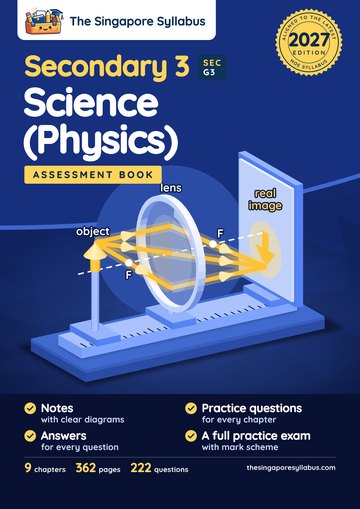
These 9 questions come from the free sample of the TSS Secondary 3 Combined Science (Physics) Assessment Book, written for Secondary 3 in Singapore. Try each one first, then open the answer to see the working.
Physical Quantities, Units and Measurement
Which of these is a base quantity? (A) force (B) temperature (C) speed (D) volume
Show the answer and working
Answer: (B) temperature
- Temperature is one of the six SI base quantities.
- Force, speed and volume are all derived quantities, worked out from the base quantities.
A grain of sand has a diameter of 450 µm. What is this diameter in metres? (A) 4.5 × 10⁻⁴ m (B) 4.5 × 10⁻⁵ m (C) 4.5 × 10⁻⁷ m (D) 4.5 × 10⁻³ m
Show the answer and working
Answer: (A) 4.5 × 10⁻⁴ m
- 450 µm = 450 × 10⁻⁶ m.
- 450 × 10⁻⁶ m = 4.5 × 10⁻⁴ m.
Which is closest to the diameter of a typical atom? (A) 10⁻⁴ m (B) 10⁻⁶ m (C) 10⁻⁸ m (D) 10⁻¹⁰ m
Show the answer and working
Answer: (D) 10⁻¹⁰ m
- A typical atom has a diameter on the order of 10⁻¹⁰ m, as given in the order-of-magnitude table for sizes.
A micrometer screw gauge reads −0.02 mm when it is fully closed. It reads 4.56 mm when it is closed on a ball bearing. What is the diameter of the ball bearing? (A) 4.58 mm (B) 4.54 mm (C) 4.56 mm (D) 4.52 mm
Show the answer and working
Answer: (A) 4.58 mm
- The zero error is −0.02 mm, so every reading from this gauge is 0.02 mm too small.
- Actual diameter = observed reading − zero error = 4.56 − (−0.02) = 4.58 mm.
A pendulum bob swings from X, through its lowest point Y, to Z and back. It takes 0.60 s to move from X to Z. What is the period of the pendulum? (A) 0.30 s (B) 1.2 s (C) 0.60 s (D) 2.4 s
Show the answer and working
Answer: (B) 1.2 s
- Moving from one extreme, X, to the other extreme, Z, is half of one complete oscillation.
- The full period is twice this time: T = 2 × 0.60 s = 1.2 s.
Which instrument is the most suitable for measuring the inside diameter of a test tube, which is about 1.5 cm? (A) vernier calipers (B) micrometer screw gauge (C) metre rule (D) measuring tape
Show the answer and working
Answer: (A) vernier calipers
- Vernier calipers have inside jaws made for measuring an internal diameter, to a precision of 0.01 cm.
- This is finer than a metre rule or measuring tape, which suits a small length such as 1.5 cm.
A stack of 250 identical cards, pressed flat, is 3.0 cm thick. What is the thickness of one card? (A) 0.012 mm (B) 0.75 mm (C) 0.12 mm (D) 1.2 mm
Show the answer and working
Answer: (C) 0.12 mm
- Thickness of one card = 3.0 cm ÷ 250 = 0.012 cm.
- 0.012 cm = 0.12 mm.
A bus travels along an expressway at 54 km/h. What is this speed in m/s? (A) 15 m/s (B) 54 m/s (C) 150 m/s (D) 194 m/s
Show the answer and working
Answer: (A) 15 m/s
- To change km/h to m/s, divide by 3.6.
- 54 ÷ 3.6 = 15 m/s.
Which length is the largest? (A) 3.0 × 10⁵ mm (B) 0.40 km (C) 2.0 × 10⁴ cm (D) 5.0 × 10⁸ µm
Show the answer and working
Answer: (D) 5.0 × 10⁸ µm
- Convert each to metres. (A) 3.0 × 10⁵ mm = 300 m. (B) 0.40 km = 400 m. (C) 2.0 × 10⁴ cm = 200 m. (D) 5.0 × 10⁸ µm = 500 m.
- The largest is (D), at 500 m.
The full Secondary 3 Combined Science (Physics) book
The book has 9 chapters, 222 questions and 362 A4 pages. Each chapter has notes, practice and answers with the working, and the book ends with a practice examination and its mark scheme. It is a PDF you print at home, S$15.
Buy this bookDownload the free sample (PDF)
Want a tutor to go through these with your child? See Combined Science tuition.
More for this level
- Combined Science tuitionA home tutor to go through the book with your child
- Secondary 3 Combined Science (Chemistry) Assessment BookThe Chemistry half of Combined Science
- Free Combined Science prelim papersReal school papers to sit after the chapters
- Physics formula sheet, freeOne page to keep beside the book
- All the Secondary Science booksScience for Sec 1 and 2, then Chemistry, Physics, Biology and Combined Science for Sec 3 and 4
These questions are our own practice material, not issued by MOE or any school. If you find a mistake, tell us and we will fix it.