Secondary 3 Chemistry sample questions with answers
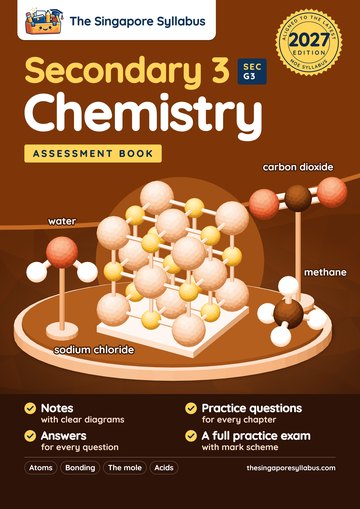
These 7 questions come from the free sample of the TSS Secondary 3 Chemistry Assessment Book, written for Secondary 3 in Singapore. Try each one first, then open the answer to see the working.
Experimental Chemistry
A pupil must add exactly 18.65 cm³ of dilute acid to a flask. Which apparatus should she use? (A) beaker (B) measuring cylinder (C) pipette (D) burette
Show the answer and working
Answer: (D) burette
- A pipette only measures one fixed volume, such as 25.0 cm³, so it cannot be used for 18.65 cm³.
- A burette can deliver any chosen volume, read to the nearest 0.05 cm³, so it is the apparatus for this job.
Name the apparatus you would use to measure (a) 2.36 g of a solid, (b) exactly 25.0 cm³ of an alkali, (c) 48 cm³ of a gas.
Show the answer and working
Answer: (a) electronic balance (b) pipette (c) gas syringe
- (a) A mass with two decimal places needs an electronic balance.
- (b) One exact, fixed volume of a liquid is measured with a pipette.
- (c) The volume of a gas is measured with a gas syringe.
Why must the conical flask NOT be rinsed with the alkali before the pipette is emptied into it?
Show the answer and working
Answer: Alkali left in the flask would add extra moles of alkali, so more acid would be needed and the titre would be too large.
- The flask only needs to hold the alkali, not measure it, so it is rinsed with distilled water only.
- If it were rinsed with alkali, extra moles of alkali would be left behind in the flask, so more acid would be needed to neutralise it, making the titre too large.
The rate of a reaction can be followed by measuring the loss in mass of the flask on an electronic balance as a gas escapes. For which reaction is this method LEAST suitable? (A) calcium carbonate and dilute hydrochloric acid (B) magnesium and dilute hydrochloric acid (C) sodium carbonate and dilute sulfuric acid (D) zinc carbonate and dilute nitric acid
Show the answer and working
Answer: (B) magnesium and dilute hydrochloric acid
- This method works when the escaping gas has a large enough mass to show a clear change on the balance.
- Magnesium with acid gives hydrogen gas, which has a very small relative molecular mass, so even a large volume of it barely changes the mass. The other three reactions all give carbon dioxide, which is much heavier.
Blue crystals of hydrated copper(II) sulfate are made by crystallisation, not by evaporating the solution to dryness. Which statements give correct reasons? 1 Strong heating removes the water of crystallisation. 2 Soluble impurities stay in the solution left after crystallisation. 3 Crystallisation also removes insoluble impurities. (A) 1 only (B) 2 only (C) 2 and 3 only (D) 1 and 2 only
Show the answer and working
Answer: (D) 1 and 2 only
- Strong heating to dryness would drive off the water of crystallisation and change the blue crystals, so statement 1 is a correct reason.
- Crystallisation also leaves soluble impurities behind in the remaining solution, so statement 2 is correct.
- Crystallisation does not remove insoluble impurities, which must be filtered out first, so statement 3 is wrong.
Which mixture of two solids can be separated by sublimation? (A) iodine and zinc oxide (B) copper(II) sulfate and sand (C) sodium chloride and sugar (D) zinc oxide and sand
Show the answer and working
Answer: (A) iodine and zinc oxide
- Sublimation only works when one solid turns straight to a gas on heating and the other does not.
- Iodine sublimes on heating, but zinc oxide does not, so this pair can be separated by sublimation. None of the other solids listed sublime.
Which mixture is best separated by fractional distillation? (A) methanol (b.p. 65 °C) and ethanol (b.p. 78 °C) (B) hexane and water (C) sand and water (D) iodine and sand
Show the answer and working
Answer: (A) methanol (b.p. 65 °C) and ethanol (b.p. 78 °C)
- Fractional distillation separates miscible liquids with close boiling points.
- Methanol and ethanol mix completely and have boiling points only 13 °C apart, so fractional distillation separates them. Hexane and water are immiscible, sand and water are separated by filtration, and iodine and sand by sublimation.
The full Secondary 3 Chemistry book
The book has 11 chapters, 295 questions and 470 A4 pages. Each chapter has notes, practice and answers with the working, and the book ends with a practice examination and its mark scheme. It is a PDF you print at home, S$15.
Buy this bookDownload the free sample (PDF)
Want a tutor to go through these with your child? See Secondary 3 Chemistry tuition.
More for this level
- Secondary 3 Chemistry tuitionA home tutor to go through the book with your child
- Secondary 4 Chemistry Assessment BookThe Secondary 4 book
- Free Chemistry prelim papersReal school papers to sit after the chapters
- O-Level periodic table, freeOne page to keep beside the book
- QA notes, freeOne page to keep beside the book
- All the Secondary Science booksScience for Sec 1 and 2, then Chemistry, Physics, Biology and Combined Science for Sec 3 and 4
These questions are our own practice material, not issued by MOE or any school. If you find a mistake, tell us and we will fix it.