Primary 6 Chinese sample questions with answers
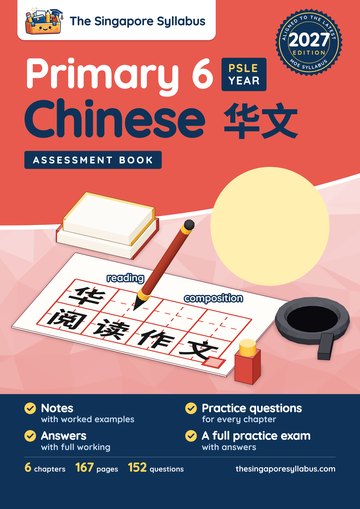
These 11 questions come from the free sample of the TSS Primary 6 Chinese Assessment Book, written for Primary 6 in Singapore. Try each one first, then open the answer to see the working.
语文应用 Vocabulary & Language Application
选出“一起”的汉语拼音。我们放学后一起去图书馆吧。(1)yī qǐ (2)yí qǐ (3)yì qǐ (4)yì qí
Show the answer and working
Answer: (3) yì qǐ
- 一 changes its tone depending on the tone of the syllable after it: yí before a 4th-tone syllable, yì before a 1st, 2nd or 3rd-tone syllable, and yī when it stands alone or ends a word.
- 起 is qǐ, a 3rd-tone syllable, so the book's answer key reads 一起 as yìqǐ.
下面哪个词语中的“长”读 zhǎng?(1)长江 (2)长处 (3)班长 (4)长久
Show the answer and working
Answer: (3) 班长
- 长 is cháng when it means length or duration, as in 长江 (Yangtze, a long river), 长处 (strong point) and 长久 (long-lasting).
- 长 is zhǎng when it means grown or a leader, as in 班长 (class monitor).
根据汉语拼音写出汉字。他做事一向很(rèn zhēn)______,很少出错。
Show the answer and working
Answer: 认真
- rèn zhēn describing how carefully and seriously someone does things, with few mistakes, is 认真 (careful, conscientious).
选出适当的字。这座古老的______梁已经有一百年的历史了。(1)桥 (2)娇 (3)骄 (4)轿
Show the answer and working
Answer: (1) 桥
- The blank plus 梁 forms 桥梁 (bridge), fitting a hundred-year-old structure.
- The book's answer key notes 桥 has the wood radical 木, matching a structure made of building material, unlike 娇, 骄 and 轿.
选出适当的词语。每个人都应该______交通规则,过马路时要看红绿灯。(1)遵守 (2)保守 (3)守护 (4)看守
Show the answer and working
Answer: (1) 遵守
- 遵守交通规则 (abide by traffic rules) is the standard collocation for following a rule.
- 保守 means conservative, 守护 means to guard over someone or something, and 看守 means to watch over a place, none of which pair naturally with 规则.
外婆常说,和邻居相处要互相体谅。选出画线词语“相处”的汉语拼音。(1)xiàng chǔ (2)xiāng chǔ (3)xiāng chù (4)xiàng chù
Show the answer and working
Answer: (2) xiāng chǔ
- 相处 (to get along with each other) reads xiāngchǔ.
- The book's answer key notes 相 means mutually and is first tone xiāng, and 处 here takes the chǔ reading used for dealing with or getting along, the same reading as in 处理 (chǔlǐ, to handle).
图书馆里的书排列得非常______,很容易找到想看的书。(1)整齐 (2)整理 (3)齐全 (4)完整
Show the answer and working
Answer: (1) 整齐
- The book's answer key notes 排列得整齐 (arranged neatly) is the correct collocation, and the other three words cannot describe how books are arranged (排列).
______大家都同意这个计划,我们就照着去做吧。(1)既然 (2)虽然 (3)即使 (4)除非
Show the answer and working
Answer: (1) 既然
- 既然……就 (since … then) fits a sentence where the second half is a decision made because the first half is already true.
- The book's answer key notes everyone's agreement is a known fact, and the next clause acts on it, matching 既然……就.
以下哪一个句子是正确的?(1)开会时,大家交流了自己的想法。(2)下课时,哥哥和我交流了座位。(3)这条马路的交流很繁忙。(4)她把礼物交流给朋友。
Show the answer and working
Answer: (1) 开会时,大家交流了自己的想法。
- 交流 means to exchange ideas, experience or culture, so it fits 想法 (ideas) in sentence (1).
- The book's answer key notes swapping seats should use 交换, a busy road should use 交通, and giving a gift should use another word, so (2), (3) and (4) use 交流 incorrectly.
以下哪一个句子是正确的?(1)他每天都及时在早上七点到校。(2)消防员及时赶到,救出了被困的老人。(3)这班地铁的车厢很及时。(4)我们打算及时在下个月去马六甲旅行。
Show the answer and working
Answer: (2) 消防员及时赶到,救出了被困的老人。
- 及时 means arriving or happening exactly when needed, as in firefighters arriving just in time to save someone.
- The book's answer key notes a daily routine should use 准时, not 及时, so (2) is the correct sentence.
看拼音写汉字:他虽然得了第一名,却一点也不(jiāo ào)______。
Show the answer and working
Answer: 骄傲
- jiāo ào describing a trait that the first-place pupil does not have, despite the achievement, is 骄傲 (proud, boastful).
The full Primary 6 Chinese book
The book has 6 chapters, 152 questions and 167 A4 pages. Each chapter has notes, practice and answers with the working, and the book ends with a practice examination and its mark scheme. It is a PDF you print at home, S$15.
Buy this bookDownload the free sample (PDF)
Want a tutor to go through these with your child? See Primary 6 Chinese tuition.
More for this level
These questions are our own practice material, not issued by MOE or any school. If you find a mistake, tell us and we will fix it.