Primary 5 Science MCQ sample questions with answers
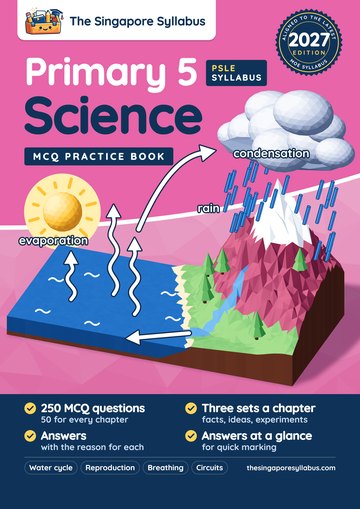
These 8 questions come from the free sample of the TSS Primary 5 Science MCQ Assessment Book, written for Primary 5 in Singapore. Try each one first, then open the answer to see the working.
Reproduction in Plants and Humans
Why do living things reproduce? (A) to grow bigger and stronger (B) to ensure the continuity of their kind (C) to get more food and water (D) to protect themselves from their enemies
Show the answer and working
Answer: (B) to ensure the continuity of their kind
- Reproduction makes new living things of the same kind.
- This means a kind of living thing keeps going from one generation to the next, instead of dying out.
Which of the following describes pollination? (A) the fusing of a male reproductive cell with an egg cell (B) the transfer of pollen grains from the anther to the stigma (C) the carrying of seeds away from the parent plant (D) the growing of a seed into a young plant
Show the answer and working
Answer: (B) the transfer of pollen grains from the anther to the stigma
- Pollination is pollen grains moving from the anther to the stigma of a flower.
- Option A describes fertilisation, C describes seed dispersal and D describes germination, which happen at other stages.
Arjun wants to make some green bean seeds germinate. Which of the following conditions must he give the seeds? A: water B: light C: air D: warmth (A) A and B only (B) A, B and C only (C) B, C and D only (D) A, C and D only
Show the answer and working
Answer: (D) A, C and D only
- Seeds need water, air and warmth to germinate.
- Many seeds germinate well in the dark, so light is not a condition for germination.
Which statement about cells is correct? (A) All living things are made up of cells. (B) Only animals are made up of cells. (C) Rocks and water are made up of cells. (D) Cells are found only in the blood of humans.
Show the answer and working
Answer: (A) All living things are made up of cells.
- Every living thing, plant or animal, is made up of one or more cells.
- Rocks and water are non-living and are not made of cells.
- In this book, as in the MOE syllabus, cells are taught at the start of the Primary 5 Reproduction topic, so this question sits in Chapter 1.
Mr Ong showed his class the flower drawn below. Which feature shows that this flower is pollinated by the wind? (A) Its anthers hang outside the flower. (B) It has large, brightly coloured petals. (C) It produces sweet nectar. (D) Its pollen grains are large and sticky.
Show the answer and working
Answer: (A) Its anthers hang outside the flower.
- A wind-pollinated flower has anthers that hang outside it, so the wind can easily blow the pollen away.
- Large bright petals, sweet nectar and large sticky pollen grains are features of flowers pollinated by insects, not wind.
Which of the following characteristics is NOT passed on from parents to their offspring? (A) the colour of the eyes (B) a scar on the knee from a fall (C) the shape of the earlobes (D) having dimples
Show the answer and working
Answer: (B) a scar on the knee from a fall
- Eye colour, earlobe shape and dimples are characteristics passed from parents to offspring through reproduction.
- A scar is an injury that happens during a person's life, it is not passed on from parents.
The diagram shows fertilisation in a human and in a flowering plant. Which statement is true of fertilisation in BOTH humans and flowering plants? (A) It takes place in the womb. (B) It takes place in the anther. (C) It needs pollen grains to land on the stigma. (D) A male reproductive cell fuses with a female reproductive cell.
Show the answer and working
Answer: (D) A male reproductive cell fuses with a female reproductive cell.
- Fertilisation always means a male reproductive cell fusing with a female reproductive cell, whether in a human or a plant.
- The womb, anther and pollen landing on the stigma are each part of only one of the two, not both.
Arjun cut open a fruit and counted 6 seeds inside it. Which of the following statements are correct? A: The ovary of the flower had at least 6 ovules. B: At least 6 egg cells were fertilised. C: The fruit developed from an ovule. D: The flower had been pollinated. (A) A and C only (B) B and D only (C) A, C and D only (D) A, B and D only
Show the answer and working
Answer: (D) A, B and D only
- Six seeds means at least 6 ovules were there and at least 6 egg cells were fertilised, and fertilisation only happens after pollination.
- The fruit itself develops from the ovary, not from an ovule, an ovule develops into a seed, so C is not correct.
The full Primary 5 Science MCQ book
The book has 5 chapters, 250 questions and 140 A4 pages. Each chapter has notes, practice and answers with the working, and the book ends with a practice examination and its mark scheme. It is a PDF you print at home, S$15.
Buy this bookDownload the free sample (PDF)
Want a tutor to go through these with your child? See Primary 5 Science tuition.
More for this level
- Primary 5 Science tuitionA home tutor to go through the book with your child
- Primary 5 Science Assessment BookNotes, practice and a full exam on the same chapters
- Free P5 and P6 Science test papersReal school papers to sit after the chapters
- PSLE Science keywords, freeThe words to use in open-ended answers
- All the Primary Science booksAn Assessment Book and an MCQ book for P3 to P6
These questions are our own practice material, not issued by MOE or any school. If you find a mistake, tell us and we will fix it.