Primary 4 Maths sample questions with answers
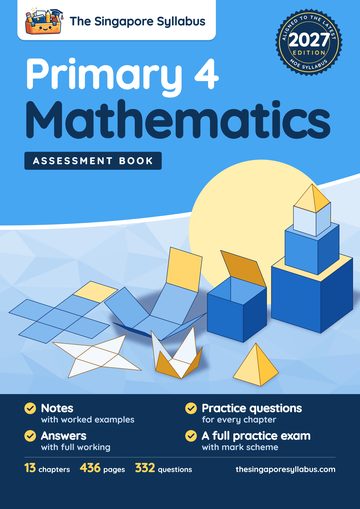
These 12 questions come from the free sample of the TSS Primary 4 Maths Assessment Book, written for Primary 4 in Singapore. Try each one first, then open the answer to see the working.
Numbers up to 100 000
The value of the digit 8 in 38 152 is ____. (A) 80 (B) 800 (C) 8000 (D) 80 000
Show the answer and working
Answer: (C) 8000
- The digit 8 is in the thousands place, so its value is 8000.
In which of the following does the digit 3 stand for 300? (A) 3159 (B) 9315 (C) 5931 (D) 1593
Show the answer and working
Answer: (B) 9315
- In 9315 the digit 3 is in the hundreds place, so it stands for 300.
Seventy-four thousand and fifty-one in numerals is ____. (A) 74 510 (B) 74 501 (C) 7451 (D) 74 051
Show the answer and working
Answer: (D) 74 051
- Seventy-four thousand is 74 000 and fifty-one is 51.
- There are no hundreds, so write 0 in the hundreds place: 74 051.
63 548 rounded to the nearest hundred is ____. (A) 63 500 (B) 63 550 (C) 63 600 (D) 64 000
Show the answer and working
Answer: (A) 63 500
- 63 548 is between 63 500 and 63 600.
- The tens digit is 4, so round down to 63 500.
58 thousands and 6 tens is the same as ____. (A) 586 (B) 5860 (C) 58 060 (D) 58 006
Show the answer and working
Answer: (C) 58 060
- 58 thousands = 58 000 and 6 tens = 60.
- 58 000 + 60 = 58 060
Which number when rounded to the nearest ten becomes 64 300? (A) 64 249 (B) 64 297 (C) 64 306 (D) 64 352
Show the answer and working
Answer: (B) 64 297
- Numbers from 64 295 to 64 304 round to 64 300.
- Only 64 297 is in that range.
Look at the number pattern below. 18, 25, 32, 39, 46, ... 18 is the 1st number. What is the 15th number? (A) 105 (B) 116 (C) 123 (D) 130
Show the answer and working
Answer: (B) 116
- Each jump is 7.
- From the 1st number to the 15th there are 14 jumps: 14 × 7 = 98
- 18 + 98 = 116
Write the missing number in the number pattern below. 16 300, 15 550, 14 800, ____, 13 300
Show the answer and working
Answer: 14 050
- Subtract 750 each time.
- 14 800 − 750 = 14 050
- Check: 14 050 − 750 = 13 300
Round 47 961 to the nearest hundred.
Show the answer and working
Answer: 48 000
- 47 961 is between 47 900 and 48 000.
- The tens digit is 6, so round up to 48 000.
Arrange these numbers from the smallest to the greatest. 26 405, 26 054, 26 540, 25 640
Show the answer and working
Answer: 25 640, 26 054, 26 405, 26 540
- 25 640 has 5 thousands and the others have 6 thousands, so it is the smallest.
- Compare the hundreds of the other three: 0 hundreds, 4 hundreds and 5 hundreds.
A number is 8300 when rounded to the nearest ten. What is the smallest possible number?
Show the answer and working
Answer: 8295
- Numbers from 8295 to 8304 round to 8300.
- 8294 would round down to 8290.
- The smallest possible number is 8295.
Round 70 459 (a) to the nearest ten, (b) to the nearest thousand.
Show the answer and working
Answer: (a) 70 460 (b) 70 000
- (a) The ones digit is 9, so round up: 70 460.
- (b) The hundreds digit is 4, so round down: 70 000.
The full Primary 4 Maths book
The book has 13 chapters, 332 questions and 436 A4 pages. Each chapter has notes, practice and answers with the working, and the book ends with a practice examination and its mark scheme. It is a PDF you print at home, S$15.
Buy this bookDownload the free sample (PDF)
Want a tutor to go through these with your child? See Primary 4 Maths tuition.
More for this level
- Primary 4 Maths tuitionA home tutor to go through the book with your child
- Free P3 and P4 Maths test papersReal school papers to sit after the chapters
- Free Primary 4 Maths worksheetsA sample-sized pack to print
- All ten Maths assessment booksEvery level from Primary 3 to Secondary 4
- How to choose a Maths assessment bookWhat to check before you buy any book
- Best PSLE Maths assessment booksOur book beside the other books parents ask about
These questions are our own practice material, not issued by MOE or any school. If you find a mistake, tell us and we will fix it.