Secondary 1 Maths sample questions with answers
These 11 questions come from the free sample of the TSS Secondary 1 Maths Assessment Book, written for Secondary 1 in Singapore. Try each one first, then open the answer to see the working.
Primes, HCF and LCM
List all the prime numbers between 30 and 50.
Show the answer and working
Answer: 31, 37, 41, 43, 47
- Test each number from 31 to 49 for factors other than 1 and itself.
- Only 31, 37, 41, 43 and 47 have exactly two factors.
Express 252 as a product of its prime factors, giving your answer in index notation.
Show the answer and working
Answer: 252 = 2^2 × 3^2 × 7
- 252 = 2 × 2 × 3 × 3 × 7
- In index notation, 252 = 2^2 × 3^2 × 7
Is 119 a prime number? Give a reason for your answer.
Show the answer and working
Answer: No. 119 = 7 × 17
- 119 = 7 × 17
- So 119 has factors other than 1 and itself (1, 7, 17 and 119).
By listing the factors, find the highest common factor (HCF) of 36 and 54.
Show the answer and working
Answer: 18
- Factors of 36: 1, 2, 3, 4, 6, 9, 12, 18, 36
- Factors of 54: 1, 2, 3, 6, 9, 18, 27, 54
- The largest factor in both lists is 18.
Find the lowest common multiple (LCM) of 8 and 14.
Show the answer and working
Answer: 56
- 8 = 2^3 and 14 = 2 × 7
- LCM = 2^3 × 7 = 56
It is given that 1512 = 2^a × 3^b × 7. Find the value of a and the value of b.
Show the answer and working
Answer: a = 3, b = 3
- 1512 = 2 × 2 × 2 × 3 × 3 × 3 × 7
- 1512 = 2^3 × 3^3 × 7, so a = 3 and b = 3
Using prime factorisation, find the value of sqrt(576). Show your working.
Show the answer and working
Answer: 24
- 576 = 2^6 × 3^2
- sqrt(576) = 2^3 × 3 = 24
Using prime factorisation, find the value of the cube root of 1728. Show your working.
Show the answer and working
Answer: 12
- 1728 = 2^6 × 3^3
- Cube root of 1728 = 2^2 × 3 = 12
Using prime factorisation, (a) express 84 and 132 as products of their prime factors, (b) find the HCF of 84 and 132, (c) find the LCM of 84 and 132.
Show the answer and working
Answer: (a) 84 = 2^2 × 3 × 7 and 132 = 2^2 × 3 × 11 (b) 12 (c) 924
- (a) 84 = 2^2 × 3 × 7 and 132 = 2^2 × 3 × 11
- (b) HCF = 2^2 × 3 = 12
- (c) LCM = 2^2 × 3 × 7 × 11 = 924
Is 91 a prime number? Explain your answer.
Show the answer and working
Answer: No. 91 = 7 × 13, so 91 is a composite number.
- 91 is odd, so 2 is not a factor.
- Digit sum 9 + 1 = 10, which is not divisible by 3, so 3 is not a factor.
- 91 does not end in 0 or 5, so 5 is not a factor.
- Try 7: 91 ÷ 7 = 13 exactly. So 91 = 7 × 13.
- 91 has factors 1, 7, 13 and 91, which is more than two factors.
Express 2016 as a product of its prime factors in index notation.
Show the answer and working
Answer: 2016 = 2^5 × 3^2 × 7
- Divide by 2 five times: 2016, 1008, 504, 252, 126, 63
- 63 = 3 × 3 × 7
- 2016 = 2^5 × 3^2 × 7
The full Secondary 1 Maths book
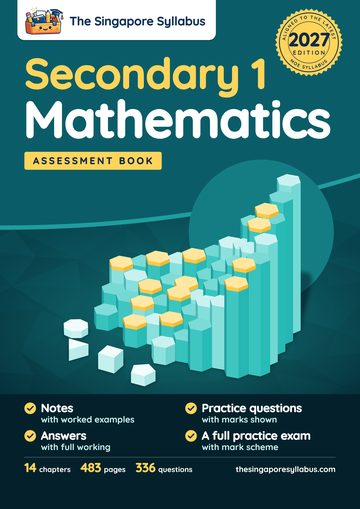
The book has 14 chapters, 336 questions and 483 A4 pages. Each chapter has notes, practice and answers with the working, and the book ends with a practice examination and its mark scheme. It is a PDF you print at home, S$15.
Buy this bookDownload the free sample (PDF)
Want a tutor to go through these with your child? See Secondary 1 Maths tuition.
More for this level
- Secondary 1 Maths tuitionA home tutor to go through the book with your child
- All ten Maths assessment booksEvery level from Primary 3 to Secondary 4
- How to choose a Maths assessment bookWhat to check before you buy any book
- Best secondary Maths assessment booksOur book beside the other books parents ask about
These questions are our own practice material, not issued by MOE or any school. If you find a mistake, tell us and we will fix it.