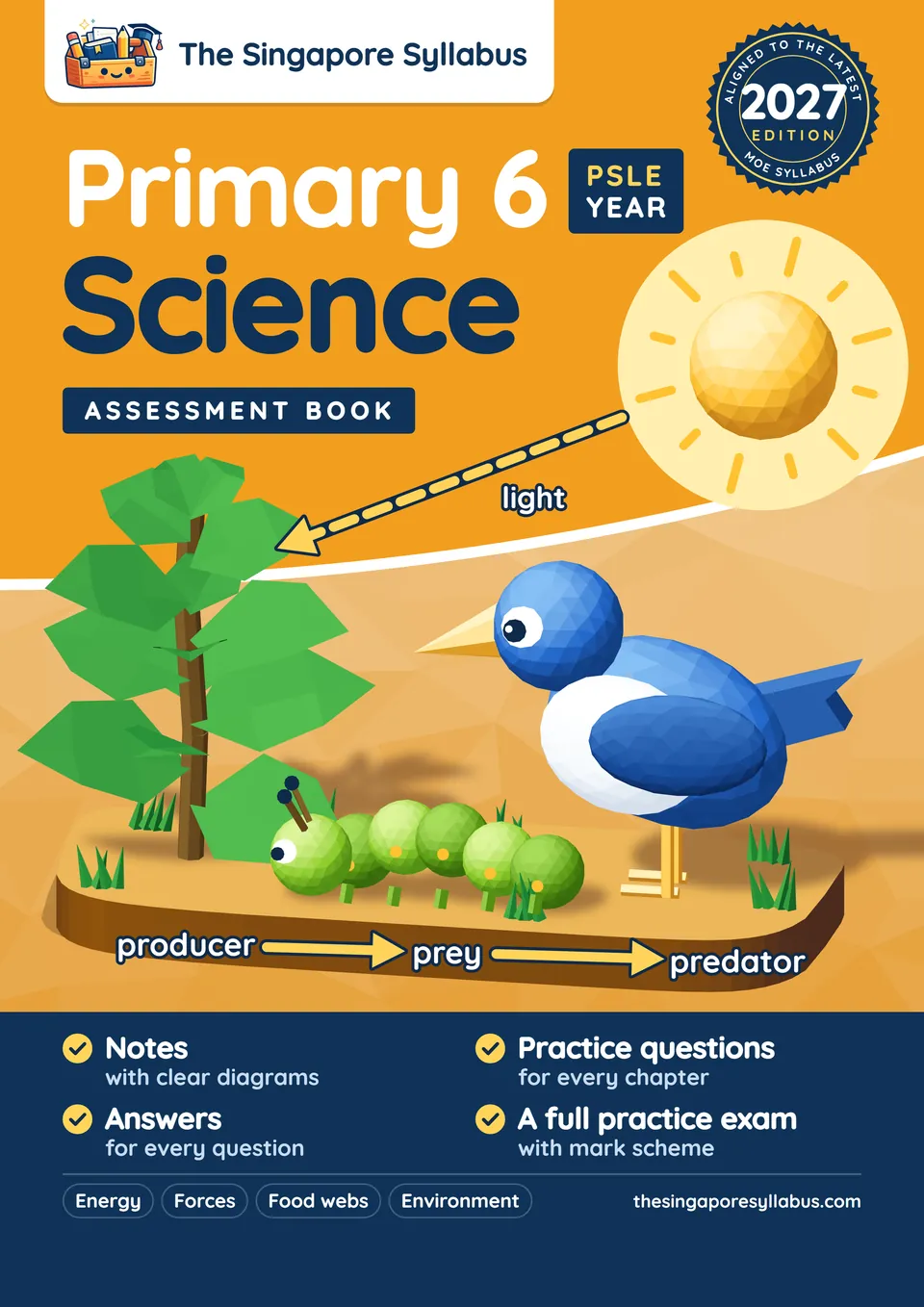
Primary 6 Science · Chapter 1Free sample
Photosynthesis and Respiration
14 ideas · 25 practice questions · 66 marks
What this chapter teaches
- 1Why living things need energyLiving things need energy from food to carry out life processes.
- 2Respiration releases energy from foodRespiration releases energy from food in all living things, day and night.
- 3The Sun: our main source of energyEnergy from the Sun passes to animals through plants.
- 4Photosynthesis: how plants make foodLight energy + water + carbon dioxide: the plant makes sugar and gives out oxygen.
- 5The leaf: where food is madeCarbon dioxide enters and oxygen leaves through the tiny openings on the leaves.
- 6Green parts and chlorophyllChlorophyll in the green parts traps light energy; parts without chlorophyll cannot make food.
- 7Photosynthesis and respiration togetherIn bright light a plant gives out more oxygen than it takes in; in the dark it only respires.
- 8How plants and animals obtain energyPlants make their own food; animals must eat to get energy.
- 9Investigating light: plants in the dark and covered leavesWithout light, a plant cannot photosynthesise to make food, so it will die.
- 10Investigating light: a water plant and oxygen bubblesThe more light the water plant receives, the more oxygen bubbles it gives out.
- 11Investigating carbon dioxide and waterWithout carbon dioxide or water, a plant cannot photosynthesise to make food.
- 12Measuring gases in a closed containerBright light: the plant adds oxygen. Dark: everything inside only respires and uses up oxygen.
- 13Experiment skills for this chapterChange one thing, keep everything else the same, measure the result, repeat it.
- 14Answering science questionsObservation + science reason with key words + link to the question.
Key Facts to Remember
- Why energy is needed
- Living things need energy to carry out life processes: growing, moving, reproducing, keeping warm.
- Respiration
- The process that releases energy from food. It takes place in all living things, day and night, all the time.
- Gases in respiration
- Oxygen is taken in; carbon dioxide is given out.
- More energy needed
- More oxygen is needed for respiration to release more energy from food (e.g. breathing faster during exercise).
- Primary source of energy
- The Sun gives out light energy and heat energy.
- Photosynthesis
- Green plants use light energy, water and carbon dioxide to make food (sugar) and give out oxygen.
- Chlorophyll
- The green substance in the green parts of a plant that traps light energy. Non-green parts cannot make food.
- The leaf
- The main part of the plant where food is made.
- Water
- Taken in by the roots and carried up the stem to the leaves.
- Tiny openings on the leaves
- Allow the exchange of gases: carbon dioxide enters, oxygen (and water vapour) leaves.
- Hot day
- Tiny openings become smaller: less water lost, but less carbon dioxide taken in, so photosynthesis is slower.
- In bright light
- A plant photosynthesises and respires; overall it takes in carbon dioxide and gives out oxygen.
- In the dark
- A plant can only respire, not photosynthesise: it takes in oxygen and gives out carbon dioxide.
- Plants and animals
- Plants make their own food; animals cannot, so they eat plants or other animals. Energy from the Sun passes to animals through plants.
- Water plant bubbles
- The nearer the lamp (more light), the more oxygen bubbles per minute. No light, no bubbles.
- Control set-up
- The same set-up without the thing being tested, to compare and confirm the result is due to that thing.
- Fair test
- Change one variable only, so that the result is due to that variable only.
- Reliable results
- Repeat at least 3 times and take the average.
The practice paper
- AMultiple-Choice Questions16 questions · 32 marks
- BOpen-Ended Questions9 questions · 34 marks
Multiple-choice and number answers are marked when you check them. For written answers, compare yours with the model answer and mark it yourself.